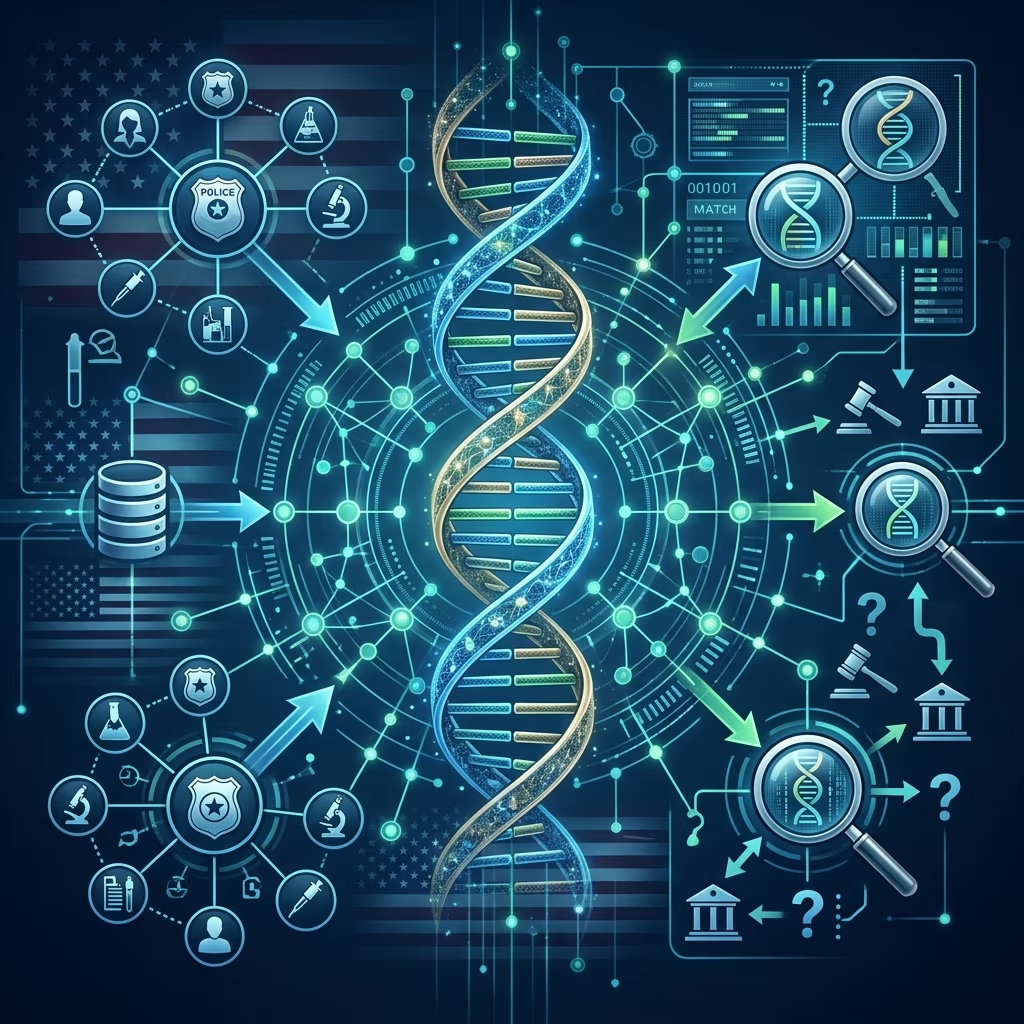
The United States maintains a comprehensive national DNA database system that has become a central tool in modern criminal investigations. This system, built around the Combined DNA Index System (CODIS) and the National DNA Index System (NDIS), allows law enforcement agencies to compare DNA profiles from crime scenes with profiles from identified individuals across the country. While it delivers major benefits for solving crimes and identifying victims, it also raises complex questions about privacy, data retention, and civil liberties.
From Forensic Innovation to Nationwide Infrastructure
DNA evidence began as a cutting-edge forensic technique used in isolated cases, but it rapidly evolved into a nationwide infrastructure. The FBI created CODIS as a software and program to support criminal justice DNA databases, enabling laboratories at local, state, and federal levels to share and search DNA profiles. Over time, this infrastructure has expanded in scale and scope.
Key milestones in the development of national DNA databases include:
- The first large-scale national DNA database in the United Kingdom in the mid-1990s, which demonstrated how routine DNA profiling could assist investigations.
- The implementation of NDIS in the United States in 1998, establishing a national-level index within CODIS for sharing DNA profiles across jurisdictions.
- Subsequent legislative changes that broadened who could be required to provide DNA, including many categories of convicted offenders, and in some states, arrestees for certain crimes.
By combining advances in genetics, information technology, forensic science, and policing, the national DNA database system has become a powerful socio-technical tool for law enforcement.
How CODIS and NDIS Are Structured
The backbone of the U.S. national DNA database system is CODIS, the FBI-supported program and software that manages DNA profile information. CODIS operates on three interconnected levels of data sharing:
- Local DNA Index Systems (LDIS) – Laboratory-level databases where DNA profiles are first generated and stored.
- State DNA Index Systems (SDIS) – State-level systems that aggregate data from local laboratories and allow sharing within the state.
- National DNA Index System (NDIS) – The national index where participating laboratories upload eligible profiles for interstate comparison.
Within CODIS, NDIS holds several specialized indexes designed for different investigative purposes.
| Index Type | Who/What is Included | Primary Use |
|---|---|---|
| Offender Index | DNA profiles of individuals convicted of qualifying crimes | Link offenders to unsolved crimes and verify identities |
| Arrestee / Detainee Index | Profiles of certain arrestees or detainees, depending on law | Identify potential suspects early in investigations |
| Forensic (Casework) Index | DNA from crime scenes where the source is unknown | Match crime scene DNA to known individuals or other cases |
| Missing Persons Index | Profiles related to missing persons cases | Help identify missing persons and human remains |
| Unidentified Human Remains Index | Profiles from unidentified bodies or remains | Support identification through family or missing persons matches |
| Relatives of Missing Persons Index | Voluntary samples from biological relatives of missing persons | Facilitate kinship comparisons for identification purposes |
These indexes work together to enable rapid, automated searching of new DNA profiles against millions of existing records, a capability that significantly enhances the detection and resolution of both serious and volume crimes.
Who Is Required to Provide DNA?
The national DNA database system relies on DNA samples collected from a range of individuals under federal and state law. The exact categories can vary by jurisdiction, but they typically include:
- Convicted offenders, especially those convicted of felonies or specified serious crimes.
- Arrestees or detainees for certain offenses, in states that authorize collection at the point of arrest.
- Individuals in federal custody or under supervision who are required by law to provide DNA samples for the Federal DNA Database Unit.
- Relatives of missing persons, when they voluntarily provide DNA to assist in identifying remains or missing individuals.
The FBI’s Federal DNA Database Unit (FDDU) receives blood or buccal (cheek) swab samples from individuals who are legally required to submit DNA. Laboratory staff then create DNA profiles and upload them to NDIS, where they are searched against forensic profiles from unsolved crime scenes across the country.
Importantly, participation for relatives of missing persons is voluntary and limited in scope: their DNA is used only for identification of the missing person or remains, and federal law explicitly restricts that use.
From Sample Collection to Database Search
Turning a physical DNA sample into a usable digital profile involves several carefully regulated steps. Federal law and FBI policy require that DNA data entering NDIS must meet strict technical and quality standards.
Technical Standards and Laboratory Requirements
To upload DNA data into NDIS, laboratories must comply with criteria set out in the DNA Identification Act and CODIS program rules.
- DNA must be generated by a laboratory accredited by an approved accrediting agency.
- Profiles must be produced using accepted PCR-based technologies, including Short Tandem Repeat (STR) analysis, Y-STR testing for male-specific markers, and mitochondrial DNA (mtDNA) for certain biological samples.
- DNA profiles must meet minimum “core loci” requirements—specific genetic markers agreed upon for consistent comparison.
- Only certain categories of DNA data are eligible, such as convicted offender, arrestee, detainee, forensic casework, missing persons, and related indexes.
Older technologies, such as restriction fragment length polymorphism (RFLP), are no longer accepted at NDIS because they do not conform to current standardization and sensitivity requirements.
The Search and Match Process
Once DNA profiles are in CODIS, the system routinely performs automated searches. When a new profile is added, it is compared across appropriate indexes to identify potential matches.
- A crime scene profile in the forensic index may be compared to offender and arrestee indexes to identify a suspect.
- Profiles from different crime scenes can be matched to each other, revealing patterns or connections between incidents.
- Missing persons and human remains indexes can be searched against relative profiles to assist identification.
When a potential match—often called a “hit”—is identified in NDIS, the FBI’s FDDU and participating laboratories confirm the match and pass information to investigators, who then decide how to use it in an investigation.
Confidentiality, Access, and Expungement
Because DNA information is sensitive, federal law imposes strict rules on who can access NDIS data and for what purposes. Under the DNA Identification Act of 1994, DNA data in CODIS and NDIS is treated as confidential.
- Access to DNA data is restricted to criminal justice agencies for legitimate law enforcement identification purposes.
- Personally identifiable information must be removed before DNA profile information can be used for population statistics, research on identification methods, or quality control.
- Participating laboratories are required to have and follow expungement procedures consistent with federal law.
Expungement allows removal of DNA data under specified conditions, such as when a qualifying conviction is overturned or a legal requirement to retain the sample no longer applies. However, policies vary by jurisdiction, and debates continue about whether retention periods and expungement safeguards are adequate.
Benefits for Criminal Justice and Public Safety
Supporters of the national DNA database system highlight its substantial contributions to solving crimes and enhancing public safety. Research and official statistics demonstrate several recurring benefits:
- Identification of suspects in cases that might otherwise remain unsolved, including serious violent crimes and long-standing cold cases.
- Linking multiple incidents to the same individual or group, which can reveal patterns of offending and help dismantle serial or organized criminal activity.
- Exoneration of the innocent when DNA evidence contradicts earlier assumptions or supports claims of wrongful conviction.
- Support in volume crime reduction, as systematic DNA searching has been described as a key scientific tool for addressing more common offenses, not just rare or high-profile cases.
- Improved identification of missing persons and remains, providing closure to families and assisting in disaster victim identification.
Datasets that reconstruct NDIS statistics over time show large growth in the number of offender, arrestee, and forensic profiles, as well as the number of investigations aided—a sign that law enforcement increasingly relies on these tools.
Privacy, Equity, and Ethical Concerns
At the same time, the expansion of DNA databases has raised significant concerns among civil liberties advocates, scholars, and members of the public. These concerns often focus on the balance between investigative benefits and individual rights.
Scope of Collection and Retention
One major issue is how broadly DNA collection laws apply and how long profiles can be retained. Some policies have permitted indefinite retention of DNA profiles from individuals who were merely suspects, or even volunteers in mass screenings, provided certain consent conditions were met. Critics argue that such broad retention may go beyond what is necessary for legitimate law enforcement aims.
Studies documenting state-level DNA collection laws and demographic data suggest that policies can differ significantly across states, including who is subject to collection and whether familial searching is allowed. These variations raise questions about consistency, fairness, and the potential for disparate impacts on particular communities.
Potential for Misuse and Function Creep
Another concern involves the risk that DNA data could be used for purposes beyond criminal identification, such as unauthorized research, surveillance, or genetic profiling. The DNA Identification Act seeks to limit such risks by restricting access and requiring removal of personally identifiable information when data is used for statistical or research purposes.
Nonetheless, critics warn that large-scale, long-term storage of genetic data could invite “function creep,” where new uses are introduced over time, potentially without robust public debate or legal safeguards.
Equity and Representation in Databases
Because DNA collection often targets individuals within criminal justice systems, populations that are more frequently arrested or convicted may be overrepresented in DNA databases. Research compiling demographic data from state-level records shows this concern is not merely theoretical: some states report racial and gender disparities in whose DNA is stored.
These disparities raise questions about whether DNA databases inadvertently amplify existing inequalities in policing and sentencing, and whether safeguards are sufficient to prevent discriminatory use of genetic information.
Comparing the U.S. System with Other Countries
The U.S. national DNA database is part of a global trend, but systems differ in scale, legal frameworks, and oversight. The United Kingdom, for example, built one of the earliest and largest national DNA databases in the world, which has been used extensively for crime investigations.
- The UK National DNA Database holds millions of individual profiles and hundreds of thousands of crime scene samples, and has been considered a model of intensive DNA use in policing.
- In the U.S., CODIS and NDIS emphasize federated sharing among local, state, and federal laboratories under a unified technical framework, but with varying state laws on collection and retention.
This comparative perspective highlights that policy choices—such as who must provide DNA, how long data is kept, and how oversight is structured—play a major role in shaping both the effectiveness and the ethical profile of national DNA databases.
Practical Considerations for Individuals and Practitioners
For individuals, attorneys, and criminal justice professionals, understanding the national DNA database system can have practical implications. The following points often matter in real cases:
- Eligibility for DNA collection: Whether an individual must provide DNA depends on federal and state law, the nature of the offense, and their status (e.g., convicted, arrested, detained).
- Use of DNA evidence: DNA matches can be powerful evidence, but they must be interpreted cautiously, considering possibilities such as lab error, contamination, or complex kinship relationships.
- Expungement rights: Knowing when and how to seek removal of a DNA profile can be important for individuals whose legal circumstances have changed.
- Consent and missing persons: Families who provide DNA to help identify missing relatives should be aware of the legal limits on how their DNA may be used.
Legal counsel familiar with both criminal procedure and forensic science can help navigate these issues, particularly in jurisdictions with evolving DNA laws and policies.
Frequently Asked Questions (FAQs)
What is CODIS in simple terms?
CODIS is the FBI-supported program and software system that allows accredited forensic laboratories to store and compare DNA profiles for criminal justice purposes. It connects local, state, and national DNA databases so that crime scene DNA can be matched against profiles of known individuals.
What is the difference between CODIS and NDIS?
CODIS refers broadly to the FBI’s DNA database program and software, which operates at local, state, and national levels. NDIS is the national-level index within CODIS that contains DNA profiles contributed by participating laboratories and enables interstate comparisons.
Who can access DNA data in NDIS?
Access to DNA data in NDIS is restricted to criminal justice agencies and is limited to law enforcement identification purposes, as required by the DNA Identification Act. When DNA profiles are used for research or population statistics, personal identifiers must be removed.
Can my DNA profile be removed from the database?
Federal law and CODIS program rules require participating laboratories to have expungement procedures. Whether and how a profile can be removed depends on the governing statutes and the circumstances—for example, if a conviction is overturned or a legal requirement for retention no longer applies. State laws may offer different mechanisms and criteria for expungement.
Are relatives of missing persons required to give DNA?
No. DNA samples from relatives of missing persons are collected on a voluntary basis and are used only to help identify missing individuals or human remains, under explicit statutory limitations.
References
- CODIS and NDIS Fact Sheet — Federal Bureau of Investigation. 2022-03-10. https://www.fbi.gov/how-we-can-help-you/dna-fingerprint-act-of-2005-expungement-policy/codis-and-ndis-fact-sheet
- Federal DNA Database Unit — Federal Bureau of Investigation. 2021-09-01. https://le.fbi.gov/science-and-lab/biometrics-and-fingerprints/federal-dna-database-unit
- Combined DNA Index System (CODIS) — Federal Bureau of Investigation / Wikipedia summary page (primary FBI program description). 2020-08-15. https://en.wikipedia.org/wiki/Combined_DNA_Index_System
- CODIS and the National DNA Index System (NDIS) statistics dataset — National-level forensic DNA datasets for the United States. 2024-12-01. https://arxiv.org/html/2511.11953
- Genetics and Forensics: Making the National DNA Database — Prainsack, B., Social Studies of Science. 2005-10-01. https://pmc.ncbi.nlm.nih.gov/articles/PMC1351151/
- The UK National DNA Database — Wellcome Connecting Science (YourGenome). 2023-05-10. https://www.yourgenome.org/theme/the-uk-national-dna-database/
- NYS DNA Databank and Combined DNA Index System (CODIS) — New York State Division of Criminal Justice Services. 2022-06-01. https://www.criminaljustice.ny.gov/forensic/dnadatabank.htm