
Agreed Divorce In Texas: Step-By-Step Guide And Forms Explained
Learn how an agreed divorce works in Texas, from filing to final decree, and what couples must do to smoothly end their marriage.
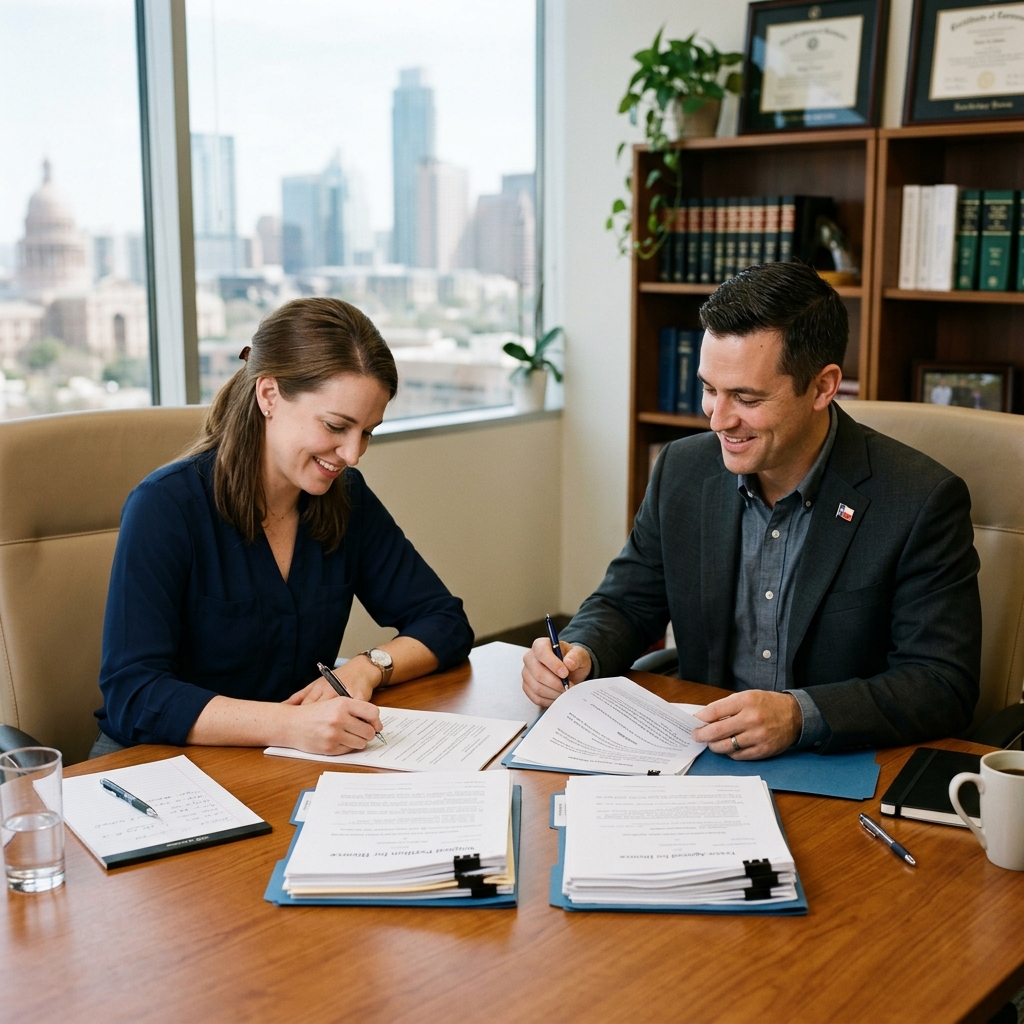
An agreed divorce in Texas, often called an uncontested divorce, is a way for spouses to legally end their marriage when they can reach agreement on all key issues. This type of divorce is usually faster, less expensive, and less stressful than a contested case, but it still must follow Texas law and court procedures.
What Is an Agreed Divorce in Texas?
In Texas, an agreed divorce is a divorce where both spouses sign off on all terms before the judge issues a Final Decree of Divorce. The court does not decide how property is divided or who has custody; instead, the judge reviews the spouses’ written agreement and, if it meets legal standards, approves it.
To qualify as an agreed or uncontested divorce, the spouses must reach consensus on topics such as:
- Division of property and debts (including real estate, vehicles, bank accounts, retirement plans)
- Child-related terms, if they have minor children (custody, visitation schedules, child support)[10]
- Spousal maintenance (sometimes called alimony, if applicable)
- Any other requested orders, such as name changes or responsibility for attorney’s fees
Even when everything is agreed, Texas courts require specific forms and minimum waiting times before the divorce can be finalized.
Residency and Legal Grounds: Are You Eligible to File?
Texas Residency Requirements
Before filing for divorce in Texas, at least one spouse must meet the state’s residency rules.
| Requirement | Minimum Time | Explanation |
|---|---|---|
| State residency | 6 months | One spouse must have lived in Texas for the six months immediately before filing. |
| County residency | 90 days | The filing spouse must have lived in the county where the case is filed for at least 90 days. |
If these requirements are not met, the court can refuse to accept the case or later determine it was filed in the wrong place.
Grounds for Divorce in Texas
Texas allows both no‑fault and fault‑based grounds for divorce. Most agreed divorces use a no‑fault ground, which does not require showing misconduct.
- No‑fault ground: Typically stated as “insupportability,” meaning the marriage cannot continue because of conflict or discord and there is no reasonable expectation of reconciliation.
- Fault grounds: May include cruelty, adultery, conviction of a felony, abandonment, or living apart for a set period. These are more likely to be used in contested cases.
Using a no‑fault ground generally makes it easier to keep the case uncontested and focused on practical solutions rather than blame.
Key Advantages of an Agreed Divorce
When spouses can cooperate, an agreed divorce offers several practical benefits:
- Reduced cost: Fewer hearings, less discovery, and shorter timelines usually mean lower attorney’s fees and fewer court costs.
- More control: The couple designs their own property division and parenting plan instead of leaving decisions to a judge.
- Privacy: Collaborative negotiation can limit conflict and keep sensitive issues out of lengthy courtroom proceedings.
- Predictability: Because terms are agreed in advance, there is less uncertainty about the outcome.
However, an agreed divorce still requires careful attention to paperwork, formal procedures, and statutory waiting periods.
Step‑by‑Step Overview of the Texas Agreed Divorce Process
While each case is unique, most agreed divorces in Texas follow a common sequence from filing to final decree.
1. Preparing the Divorce Petition
The process begins when one spouse (the petitioner) prepares and files an Original Petition for Divorce in the appropriate county court or district court.
- Identifies both spouses and states that the court has jurisdiction under Texas residency rules.
- States the grounds for divorce (usually insupportability).
- Requests relief regarding property division, child custody and support (if applicable), and any name changes or other orders.
Texas provides standardized form sets for uncontested divorces, including versions for couples with and without minor children.[10] These official forms include instructions to help self‑represented litigants complete petitions correctly.
2. Filing the Petition With the Court
Once the petition is completed, it must be filed with the clerk of the court. This officially opens the divorce case.
- The petitioner typically pays a filing fee unless they qualify for and obtain a waiver based on indigency.
- In some counties, standing orders about children and property automatically apply when a divorce is filed and must be attached to the petition.
- Filing may occur in person at the clerk’s office or electronically through the state’s e‑filing system.
After the clerk processes the petition, the case is assigned a cause number, and the petitioner receives file‑stamped copies for use later in the process.
3. Providing Notice to the Other Spouse
The other spouse (the respondent) must be formally informed that the divorce has been filed. In agreed cases, this step is often simplified using a waiver or cooperative service.
Common options include:
- Waiver of Service: The respondent signs a notarized waiver acknowledging receipt of the petition and giving up the right to formal service by a process server.
- Service and Answer: If a waiver is not used, the petition can be served by a sheriff, constable, or private process server, and the respondent may then file an Answer with the court.
Texas law provides a minimum answer period of 20 days plus the following Monday at 10 a.m. after service for the respondent to file an Answer, though in an agreed case the respondent may act sooner.
4. Drafting the Final Decree and Supporting Documents
To finalize an agreed divorce, spouses must prepare a Final Decree of Divorce that spells out all of their agreements in detail. Both spouses signing the decree is a core feature of an uncontested case.
The decree typically includes:
- Identification of the parties and confirmation of the court’s jurisdiction
- Detailed division of community property and allocation of debts
- Provisions about retirement accounts, real estate transfers, and vehicle titles, if relevant
- Orders related to child conservatorship, possession (visitation), and child support, for cases involving minor children[10]
- Any name changes or other relief granted by the court
Texas form packets for agreed divorces with and without minor children include sample decrees and instructions to help litigants avoid omissions or inconsistent terms.[10]
5. The 60‑Day Waiting Period
Texas law generally requires a minimum 60‑day waiting period between the date the petition is filed and the date a court can grant the divorce.
| Aspect | Rule |
|---|---|
| Standard waiting period | A judge normally cannot sign the Final Decree of Divorce until at least 60 days after the petition is filed. |
| Purpose | Allows time for reflection, negotiation, and resolution of issues before the marriage is legally ended. |
| Exceptions | In family violence situations, the court may waive the 60‑day period if there is a qualifying conviction or protective order related to the marriage. |
This waiting period applies even if both spouses agree on every detail from the outset.
6. Court Review and Final Hearing
When the waiting period has passed and all documents are ready, the case can be set for a brief hearing or, in some counties, proven up through affidavits.
Common features of the final step include:
- The judge reviews the Final Decree of Divorce and any required attachments to ensure they comply with Texas law.
- In a hearing, the petitioner may answer a short series of questions about residency, grounds for divorce, and whether the decree reflects the parties’ agreement.
- In some counties and in certain uncontested cases, parties may not need to appear in person if the court allows proof by affidavit.
Once the judge signs the decree and it is filed with the clerk, the divorce becomes final under Texas law, and the court’s orders take effect.
Texas Agreed Divorce Forms and Where to Find Them
To support uncontested divorces, Texas courts and legal aid organizations provide standardized form sets and instructions. These resources help self‑represented litigants navigate the process for simple cases.
Examples of official or authoritative resources include:
- Texas Law Help form packets for divorces with and without minor children, including petitions, waivers, answers, and final decrees.[10]
- Court‑specific packets such as Dallas County’s Agreed Divorce forms for cases involving children, which outline required documents and steps.
- State law library guides describing the basics of uncontested divorce, legal terminology, and relevant sections of the Texas Family Code.
Although these tools simplify the process, spouses should carefully read all instructions and may still benefit from advice from a family‑law attorney, especially if they own significant assets or have complex parenting issues.
Common Issues in Agreed Divorces
Even when couples intend to remain cooperative, several recurring problems can delay or complicate an agreed divorce in Texas.
Missing or Incorrect Information
- Not listing all community property and debts can result in disputes later or court rejection of the decree.
- Failure to comply with county‑specific standing orders or local rules may cause delays at the filing stage.
Changes of Heart During the Process
- If one spouse withdraws consent to terms before the judge signs the decree, the case may stop being uncontested and can turn into a contested divorce.
- Last‑minute disagreements about child support, visitation, or retirement accounts frequently require renegotiation or court involvement.
Underestimating Legal Complexity
- Property division involving pensions, stock options, or business interests often needs professional guidance to avoid unintended tax or financial consequences.
- Parents must ensure their agreed parenting plan meets statutory requirements so the court can approve it; informal arrangements may not be enforceable.[10]
To minimize these risks, couples should fully discuss their expectations, carefully review their paperwork, and consider consulting legal professionals for specific questions.
Tips for a Smooth Agreed Divorce in Texas
The following practical suggestions can help spouses move through the agreed divorce process more efficiently:
- Verify eligibility early: Confirm that residency requirements are met and that filing in Texas is proper before preparing forms.
- Use official forms when possible: Texas Law Help and county packets are designed to meet legal standards and reduce errors.[10]
- Plan for the 60‑day wait: Understand that the divorce cannot be finalized before this period in most cases and schedule negotiations accordingly.
- Document agreements in detail: Vague or incomplete terms in the decree can cause enforcement problems later.
- Communicate respectfully: Maintaining cooperation makes it easier to settle outstanding issues and keep the case uncontested.
Frequently Asked Questions About Texas Agreed Divorce
How long does a Texas agreed divorce usually take?
In many agreed cases, the shortest possible timeframe is a little over 60 days because state law prohibits courts from granting most divorces before that waiting period ends. Complex property issues, scheduling conflicts, or paperwork errors can extend the timeline.
Do both spouses have to go to court for an agreed divorce?
Often, only the filing spouse appears in court for a brief prove‑up hearing, especially when the other spouse has signed the decree and either a waiver or an answer. Some counties allow uncontested divorces to be finalized with affidavits instead of an in‑person hearing, but local rules differ.
Can we do an agreed divorce if we have children?
Yes. Spouses with minor children may use agreed divorce procedures, but the court must review and approve detailed orders regarding conservatorship, possession schedules, and child support to ensure that they comply with Texas Family Code standards.[10] Specialized form sets are available for cases involving children.
What if one spouse lives outside Texas?
An agreed divorce can still be filed in Texas as long as the residency requirements are satisfied by at least one spouse. The out‑of‑state spouse can usually sign waivers, answers, and the final decree remotely, but notarization and proper filing must be handled carefully, and some counties require additional declarations for out‑of‑state parties.
Do we need lawyers for an agreed divorce?
Texas does not require either spouse to hire an attorney for an agreed divorce, and many simple uncontested cases are handled without legal representation.[10] Still, legal advice can be important when the couple has significant assets, complicated retirement plans, or concerns about long‑term child custody arrangements.
References
- Step-by-Step Timeline: Filing an Uncontested Divorce in Texas — Texas Advocates. 2026-01-12. https://www.texasadvocates.com/blog/2026/january/step-by-step-timeline-filing-an-uncontested-divo/
- How Long Does It Take To Get A Divorce In Texas If Both Parties Agree? — Jason Wright Law. 2023-05-01. https://jasonwrightlaw.com/faqs/how-long-does-it-take-to-get-a-divorce-in-texas-if-both-parties-agree/
- Understanding the Divorce Process in Texas — Stagg & Associates. 2022-09-15. https://www.staggandassociates.com/blogs/understanding-the-divorce-process-in-texas/
- Divorce Set 1: Uncontested, No Minor Children, No Real Property — Texas Courts. 2018-06-01. https://www.txcourts.gov/media/515764/divorceset1forms.pdf
- I need a divorce. We do not have minor children. — Texas Law Help. 2024-03-10. https://texaslawhelp.org/guide/i-need-a-divorce-we-do-not-have-minor-children
- Agreed Divorce Forms Set B — Dallas County District Clerk. 2022-07-01. https://www.dallascounty.org/Assets/uploads/docs/district-clerk/divorce/Agreed-Divorce-Set-B-Packet-assembled-July-2022.pdf
- Texas Divorce — WomensLaw.org. 2023-02-01. https://www.womenslaw.org/laws/tx/divorce
- Filing for Divorce — Texas State Law Library. 2021-11-10. https://guides.sll.texas.gov/divorce/filing-for-divorce
Similar Articles








Read full bio of medha deb


