
Understanding Prenuptial Agreements in Washington, DC
A practical guide to the rules, benefits, and limits of prenuptial agreements under District of Columbia law for future spouses and domestic partners.
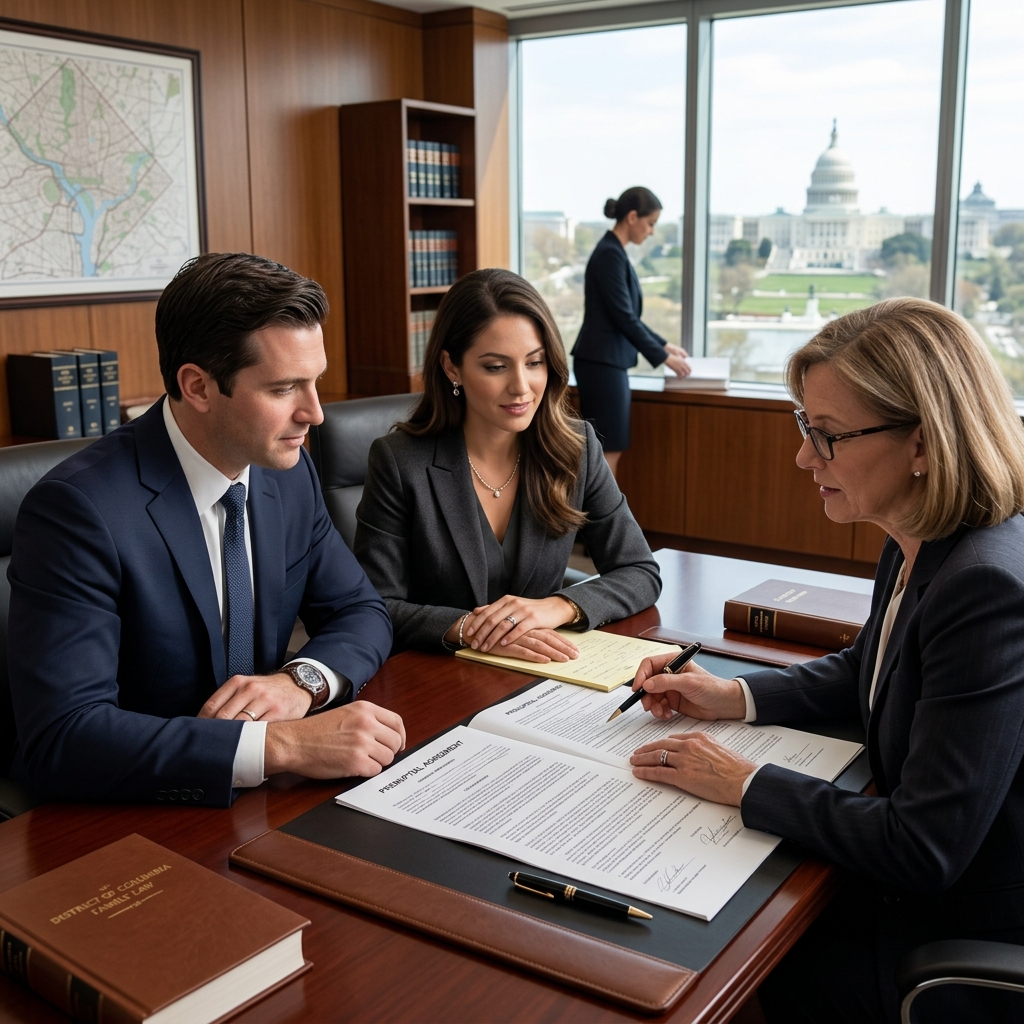
Prenuptial agreements in the District of Columbia are more than just documents for wealthy couples; they are legal tools that help future spouses or domestic partners clarify financial expectations, manage risk, and avoid disputes if the relationship ends. Under DC law, these agreements are recognized as formal contracts and are governed by specific statutory rules that affect their validity, scope, and enforceability.
This guide explains how prenuptial agreements work in Washington, DC, what the law requires, what terms you can and cannot include, and how courts decide whether to enforce them. It is intended for individuals considering a prenup before marriage or domestic partnership and for those who want to better understand the protections such contracts can offer.
What Is a Prenuptial Agreement Under DC Law?
In Washington, DC, a prenuptial agreement—also called a premarital agreement—is a contract between people who plan to marry or enter into a domestic partnership, made in contemplation of that legal relationship. It becomes effective when the marriage or domestic partnership begins.
Key characteristics include:
- Prospective parties: It is signed by individuals before they marry or register a domestic partnership.
- Contract status: It is treated as a formal contract that allocates property rights and financial obligations in the event of divorce, separation, annulment, or death.
- Future focus: The agreement primarily addresses what happens if the relationship ends, not everyday marital conduct.
DC’s premarital agreement statute is part of Title 46 of the District of Columbia Code, which sets out definitions, formal requirements, permitted contents, and rules on enforcement.
Core Legal Requirements for a Valid DC Prenuptial Agreement
Not every written agreement between spouses will be enforceable. District of Columbia law and local practice impose several baseline conditions that must be satisfied.
Formalities: Writing and Signatures
A premarital agreement in DC must be in writing and signed by both parties. Oral understandings or informal promises are not sufficient. The statute does not require separate financial consideration; the marriage or domestic partnership itself is treated as the consideration for the agreement.
Although not strictly mandated by statute, practitioners commonly recommend:
- Signing in front of a notary to strengthen evidence of authenticity and voluntariness.
- Maintaining complete copies for each party and, ideally, preserving draft versions and disclosure schedules.
Voluntary Execution
DC law requires that the agreement be executed voluntarily by both parties. If a party can show they were pressured or coerced into signing, the agreement may not be enforceable.
Factors that may affect a court’s assessment of voluntariness include:
- Whether the signing occurred well before the wedding date or at the last minute.
- Whether each party had a realistic opportunity to consult independent counsel.
- Whether any threats, undue pressure, or misrepresentation accompanied the signing.
Full and Fair Financial Disclosure
Although the exact disclosure standard is defined in case law and statute, a central principle is that each party must receive fair and reasonable disclosure of the other’s property and financial obligations, or knowingly waive additional disclosure in writing.
In practice, this means:
- Listing assets (bank accounts, investments, real estate, business interests, retirement accounts).
- Identifying liabilities (loans, credit card debts, tax liabilities, other obligations).
- Describing ongoing financial commitments such as support obligations or guarantees.
If a party lacked adequate knowledge of the other’s financial situation and did not receive fair disclosure, DC courts can refuse to enforce the agreement—particularly if the terms are significantly one-sided.
Absence of Fraud and Unconscionability
DC law and practice require that premarital agreements not be the product of fraud and not be unconscionable when signed. Unconscionability refers to terms that are so unfair or one-sided that enforcement would offend fundamental principles of justice.
When assessing unconscionability, courts may consider:
- The economic disparity between the parties at the time of signing.
- Whether one party fully understood the agreement’s impact, especially on property and support.
- The quality of legal advice and the clarity of the document.
Under DC law, unconscionability is determined by the court, not by the parties.
What Topics Can a DC Prenuptial Agreement Cover?
District of Columbia law allows premarital agreements to address a broad range of financial and property-related issues, so long as the terms do not violate public policy or statutory limits.
Property Rights and Management
Parties may agree on the rights and obligations each will have in any property of either or both, whenever acquired or located.
- Ownership and classification: Designating assets as separate or marital, and specifying how property acquired during the marriage will be treated.
- Control and management: Determining who may manage, transfer, or encumber specific assets or business interests.
- Division on dissolution: Establishing formulas or rules for dividing assets and retirement accounts in the event of divorce.
Spousal or Domestic Partner Support
DC law permits parties to modify or eliminate spousal or domestic partner support through a premarital agreement, within limits. However, a court can override those terms if they would leave a spouse eligible for public assistance at the time of separation or divorce.
Common approaches include:
- Waiving alimony entirely, subject to court review.
- Setting a formula or cap for support based on years of marriage.
- Providing tiered support that changes with the length of the relationship.
Estate Planning and Death Benefits
Premarital agreements frequently coordinate with estate planning, addressing:
- Rights in each other’s estates and expectations regarding wills or trusts.
- Beneficiary designations for life insurance or retirement accounts.
- Handling of inheritances or family trusts as separate property.
Because DC’s statute expressly acknowledges premarital agreements in the context of property and rights at death, integrating the prenup with an estate plan can reduce future disputes.
Choice of Law and Dispute Resolution
Couples may also address procedural matters, such as:
- Choice of law: Selecting which jurisdiction’s law will govern interpretation of the agreement, particularly where one spouse has ties to another state or country.
- Forum selection or arbitration: Identifying preferred venues or agreeing to arbitration for disputes related to the contract.
Topics That Cannot Be Included
Despite the broad flexibility, some subjects are off-limits or severely constrained:
- Child support and custody: Parties may not restrict a child’s right to financial support or predetermine future custody arrangements in a prenup.[10]
- Illegal or public policy–violating terms: Provisions that require unlawful acts or conflict with major public policy standards are unenforceable.
When DC Courts Refuse to Enforce a Prenuptial Agreement
Even if an agreement satisfies formal requirements, DC law provides specific grounds for a court to refuse enforcement.
Statutory Enforcement Standards
Under the DC premarital agreements statute, the agreement is not enforceable if the party opposing enforcement proves either:
- They did not execute the agreement voluntarily, or
- The agreement was unconscionable when executed and, before signing, that party did not receive fair and reasonable disclosure, did not waive disclosure, and did not have adequate knowledge of the other’s property or obligations.
If these conditions are met, the court may refuse to enforce all or part of the contract.
Effect of Public Assistance Concerns
DC law limits the ability of a prenup to eliminate support where doing so would shift the burden onto public assistance programs. If a provision modifying or eliminating spousal or domestic partner support would cause one party to be eligible for public assistance at the time of separation or divorce, a court may require support despite the agreement.
Partial Enforcement
Courts are not necessarily required to strike down an entire agreement. If specific clauses are invalid—for example, an unconscionable support waiver—a court may enforce the remaining valid provisions if they are severable and consistent with DC law.
Typical Structure and Content of a DC Prenup
While individual agreements vary, many DC prenuptial agreements share a similar organizational logic to address property, support, and contingencies clearly.
| Section | Purpose |
|---|---|
| Recitals | Describe the parties, their intent to marry or register a domestic partnership, and their understanding of the agreement’s purpose. |
| Definitions | Define key terms such as “separate property,” “marital property,” and “commingled property.” |
| Schedules of Assets and Debts | Attach detailed lists of each party’s assets and liabilities before marriage, supporting full disclosure. |
| Property During Marriage | Specify how property acquired during the marriage will be classified, managed, and divided. |
| Division on Dissolution | Set rules or formulas for dividing property and retirement accounts upon divorce or separation. |
| Spousal Support | Address whether support is waived, capped, or defined by formula, subject to public assistance limits. |
| Estate and Death Benefits | Coordinate rights at death, including life insurance and inheritance expectations. |
| Choice of Law | Identify the jurisdiction whose law will govern the agreement. |
| Miscellaneous Clauses | Include severability, amendment procedures, and integration clauses. |
Practical Steps to Create a Strong DC Prenuptial Agreement
Legal requirements are only part of the picture. How the agreement is negotiated and executed can significantly affect whether a court later upholds it.
Start the Process Early
Practitioners recommend beginning prenup discussions well in advance of the wedding or domestic partnership registration. Early drafting and negotiation help demonstrate voluntariness and reduce the risk that a party later claims they felt compelled to sign due to time pressure.
Use Independent Legal Counsel
Although DC law does not require each party to have a separate attorney, independent counsel is strongly advised. Separate lawyers can:
- Explain DC statutory requirements and case law implications.
- Identify unconscionable or risky provisions before signing.
- Help tailor the agreement to the couple’s specific financial and family circumstances.
Document Financial Disclosure Thoroughly
Attaching schedules of assets and debts to the agreement helps prove that both parties had access to detailed information. Consider including:
- Account statements and valuations as of a specific date.
- Descriptions of business interests and ownership percentages.
- Summaries of contingent liabilities, guarantees, or litigation exposures.
Maintain Fairness and Clarity
While parties may agree to unequal divisions of property or support waivers, the more extreme the imbalance, the greater the risk a court finds the agreement unconscionable. Clearly drafted, balanced provisions that both parties understand and accept are more likely to withstand judicial scrutiny.
Frequently Asked Questions About DC Prenups
Do we need consideration beyond the marriage?
No. Under DC law, a premarital agreement is enforceable without separate consideration; the contemplated marriage or domestic partnership serves as the underlying basis for the contract.
Can we decide future child support or custody in our prenup?
No. DC law and practice do not allow premarital agreements to limit a child’s right to support or predetermine custody arrangements. Those issues are decided based on the child’s best interests and applicable statutes at the time of a dispute.[10]
Is independent legal counsel required?
Independent counsel is not strictly required by statute, but it is strongly recommended. Courts consider whether each party had a meaningful opportunity to obtain advice when evaluating voluntariness and fairness.
What happens if the agreement is found unconscionable?
If a court determines the agreement was unconscionable when executed and proper disclosure was lacking, it may refuse to enforce all or part of the agreement, particularly provisions dealing with support or highly unequal property allocations.
When does a DC prenuptial agreement take effect?
The agreement becomes effective when the marriage or domestic partnership begins. If the marriage or partnership never occurs, the premarital agreement does not take effect.
References
- District of Columbia Premarital Agreements Statute (Title 46, Chapter 5) — D.C. Council / D.C. Law Library. 2023-01-01. https://code.dccouncil.gov/us/dc/council/code/titles/46/chapters/5
- District of Columbia Prenuptial Agreements – FindLaw Overview — FindLaw. 2022-05-10. https://www.findlaw.com/state/dc-law/district-of-columbia-prenuptial-agreements.html
- District of Columbia Prenuptial Agreements — District Family Law. 2021-09-15. https://www.districtfamilylaw.com/district-of-columbia-prenuptial-agreements.html
- Premarital Agreements in Washington, DC — Douglas & Boykin PLLC. 2020-03-01. https://www.douglasboykin.com/areas-of-practice/family-law/prenuptial-and-postnuptial-agreements/
- Prenuptial Agreement in D.C. — Strickler, Platnick & Hatfield, P.C. 2022-11-30. https://www.modernfamilylawfirm.com/family-law/district-of-columbia-dc/prenuptial-agreements-in-dc/
- Washington, DC Prenuptial Agreements — Good Law DC. 2021-07-20. https://www.goodlawdc.com/dc-prenuptial-agreement/prenuptial-agreements-premarital-agreements-washington-dc/
- Enforcing and Challenging Prenuptial Agreements in Washington, DC — Ramin G. Asgard Law / RG Law. 2023-04-05. https://rglaw.net/enforcing-and-challenging-prenuptial-agreements-in-washington-dc-disclosure-fairness-and-litigation-risks/
Similar Articles








Read full bio of medha deb


