
Understanding Ohio Divorce Forms and Procedure
A practical, step‑by‑step guide to Ohio divorce requirements, forms, timelines, and court process for spouses ending a marriage.
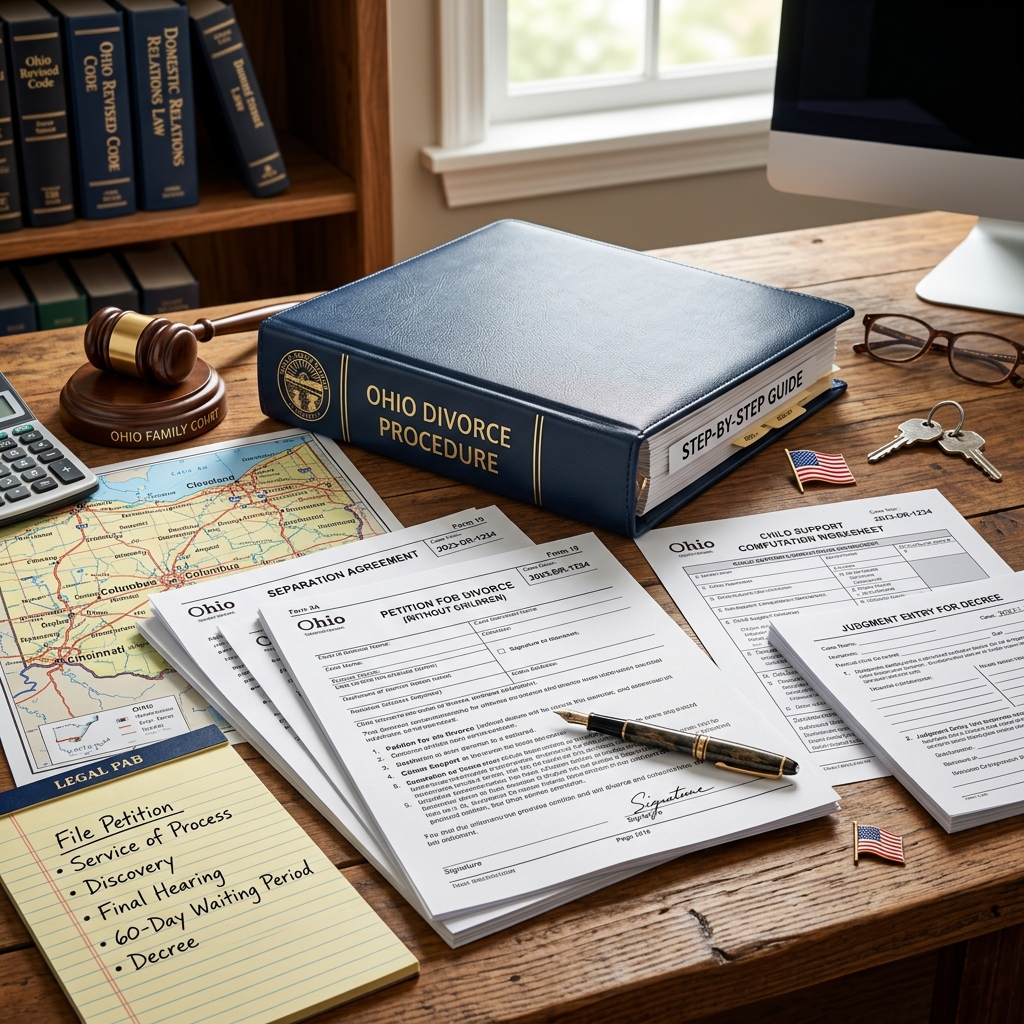
Ending a marriage in Ohio involves specific legal steps, standardized court forms, and important deadlines that spouses must follow to obtain a valid divorce or dissolution. This guide explains the residency rules, types of marital termination available, required paperwork, and the typical path a case follows through the courts, with a focus on how forms are used at each stage.
Ohio Residency and Basic Eligibility Requirements
Before you can file for divorce or dissolution in Ohio, you must meet certain eligibility requirements under state law. Courts will not accept your case unless these conditions are satisfied, so it is critical to confirm them first.
State and County Residency Rules
- Six‑month state residency: At least one spouse must have lived in Ohio for a minimum of six months immediately before filing for divorce or dissolution.
- County residency: You typically must file in a county where one spouse has resided for at least 90 days before filing.
- Out‑of‑state spouse: You may file in Ohio even if your spouse lives in another state, as long as the Ohio residency rules are met.
In addition, if either spouse is pregnant, the court generally will not finalize the divorce until after the child is born, because parenting and support orders must address the child who will soon be part of the family unit.
No Legal Separation Requirement
Ohio law does not require spouses to obtain a formal legal separation before seeking a divorce or dissolution. You may file directly for divorce or dissolution once residency and other requirements are met.
Divorce vs. Dissolution: Choosing the Right Path
Ohio offers more than one way to legally end a marriage. The two primary routes are divorce and dissolution of marriage, and understanding the differences helps you decide which path fits your situation.
| Feature | Divorce | Dissolution of Marriage |
|---|---|---|
| Agreement level | May be contested; spouses can disagree on key issues. | Requires full agreement on all terms before filing. |
| Who starts the case | One spouse files a complaint for divorce. | Both spouses jointly file a petition for dissolution. |
| Typical timeframe | Uncontested: about 4–6 months; contested: about 12–18 months or more. | Often finished in 30–90 days after filing, subject to court schedule. |
| Use of fault grounds | Can be based on fault or no‑fault grounds. | Generally no‑fault; focuses on mutual agreement. |
| Court involvement | May involve hearings, discovery, mediation, and trial. | Usually one brief hearing to approve the joint agreement. |
Fault and No‑Fault Divorce in Ohio
Ohio permits both fault‑based and no‑fault divorces. In a no‑fault case, spouses rely on grounds such as incompatibility or living separate and apart for at least a year. In a fault‑based case, the filing spouse alleges specific misbehavior by the other spouse.
Common fault grounds in Ohio include:
- Adultery
- Extreme cruelty
- Gross neglect of duty
- Habitual drunkenness
- Fraudulent inducement to marry
- Imprisonment
- Willful absence for more than one year
While fault grounds may influence issues such as property division or spousal support in some cases, many modern divorces proceed on a no‑fault basis to reduce conflict.
Standard Ohio Divorce Forms: With and Without Children
Ohio uses standardized domestic relations forms to streamline divorce filings across the state. The Supreme Court of Ohio publishes series of forms for divorces with children and without children, and local courts may add their own county‑specific requirements.
Core Forms for Divorce With Children
When minor children are involved, the court must address parenting time, child support, and decision‑making authority. Standard forms help judges collect consistent information from parents.
The plaintiff (the spouse filing for divorce) will typically need to submit forms such as:
- Complaint for Divorce With Children – starts the case and states the grounds and requested relief.
- Parenting Proceeding Affidavit – provides information about the children, prior custody cases, and current living arrangements.
- Affidavit of Basic Information, Income and Expenses – outlines household income, recurring expenses, and employment details.
- Affidavit of Property and Debt – lists real estate, vehicles, bank accounts, retirement assets, and outstanding liabilities.
- Health Insurance Affidavit – explains each spouse’s health coverage and options for the children.
- Request for Service – tells the clerk how to formally deliver the complaint to the other spouse.
- Parenting Plan – sets out the proposed schedule, decision‑making rules, and responsibilities for each parent.
To finalize a case involving children, the court will need a Judgment Entry – Decree of Divorce With Children. In some courts, the parties or their attorneys prepare this document for the judge to review and sign.
Forms in Divorce Without Children
For divorces where there are no minor children, Ohio still requires affidavits about finances and property, as well as a complaint and judgment entry. The exact form numbers differ but the overall purpose is similar: to ensure the court has clear information about each spouse’s income, assets, debts, and requested orders.
Timeline: How Long Does a Divorce Take in Ohio?
Ohio divorces do not all follow the same schedule. The timeframe depends on whether the case is contested, the court’s workload, and whether children are involved. State guidance and legal practice provide approximate ranges.
Typical Timeframes by Case Type
- Dissolution of marriage: Often finalized in about 30–90 days after filing, because all issues are already resolved by agreement.
- Uncontested divorce: Frequently takes around 4–6 months from filing to final decree.
- Contested divorce: Commonly lasts 12–18 months, and complex cases with children or substantial assets can extend to two years or more.
Ohio legal resources note that divorces without children may be resolved in roughly 4–12 months, while those with children often sit at the longer end of the spectrum due to custody and support issues.
Key Factors That Affect Timing
Several elements can speed up or slow down an Ohio divorce:
- Whether the spouses agree on property division, spousal support, and parenting.
- The need for discovery, such as exchanging financial records or obtaining appraisals.
- Use of mediation or other alternative dispute resolution methods.
- The court’s hearing calendar and the availability of judges.
- Whether temporary orders are requested for support or parenting while the case is pending.
Step‑by‑Step Overview of the Ohio Divorce Process
Although each case is unique, most Ohio divorces follow a predictable sequence from filing through final judgment. Below is a high‑level walkthrough of the major procedural steps.
1. Filing the Complaint and Initial Forms
The process begins when one spouse files a Complaint for Divorce in the Court of Common Pleas, typically in the domestic relations division. The complaint includes basic facts about the marriage, grounds for divorce, and initial requests about property, support, and children.
At the same time, the plaintiff usually files the relevant affidavits and requests, such as:
- Affidavit of income, expenses, property, and debt.
- Health insurance affidavit.
- Request for temporary orders, if immediate support or parenting rulings are needed.
The clerk of court collects a filing fee and reviews the paperwork for completeness before the case is docketed.
2. Service of Process and Response Deadlines
After filing, the plaintiff must ensure the other spouse (the defendant) is officially notified of the case through service of process. Service may occur by certified mail, personal delivery, or other methods allowed under the Ohio Rules of Civil Procedure, and arrangements are typically made through the clerk’s office.
Once served, the defendant has 28 days to file an Answer to the complaint and, if desired, a counterclaim raising their own requests.
- If no Answer is filed: the court may schedule an uncontested divorce hearing. The plaintiff must prepare a proposed decree resolving all issues and provide a copy to the other spouse in advance.
- If an Answer is filed: the court will set a scheduling conference, where deadlines for exchanging documents and future hearings are established.
3. Discovery and Information Gathering
In contested cases, a period of discovery allows both sides to obtain detailed information before settlement or trial. Discovery may include written questions, document requests, depositions, and financial disclosures.
During this phase, it is helpful for spouses to gather and organize:
- Tax returns and pay stubs.
- Bank statements and retirement account summaries.
- Mortgage documents and loan agreements.
- Receipts or appraisals for major assets.
- Evidence relevant to fault allegations if pursued.
4. Temporary Orders and Parenting Requirements
When children or financial support are at stake, the court may issue temporary orders to govern the family’s arrangements while the divorce is pending. These orders can address temporary child support, spousal support, parenting time schedules, and possession of the marital home.
In some Ohio counties, parents involved in a divorce with minor children must attend a mandatory parenting education class. This requirement is typically set out in local rules and notices issued by the domestic relations court.
5. Settlement Conferences, Mediation, and Hearings
As the case moves forward, courts often encourage spouses to resolve disputes through negotiation or mediation instead of trial. Many Ohio divorces are settled at or before a pre‑trial hearing or settlement conference, where the judge or magistrate reviews the outstanding issues.
At these conferences, spouses and their attorneys may discuss:
- Division of marital property under equitable distribution principles.
- Responsibility for debts and ongoing expenses.
- Parenting schedules and legal decision‑making responsibilities for children.
- Child support and spousal support amounts.
Some courts also refer parties to mediation, where a neutral professional helps them reach a mutually acceptable agreement.
6. Trial or Final Hearing and Judgment Entry
If all issues are resolved, the court will hold a relatively brief final hearing to confirm the agreement is lawful and voluntary. The judge then signs a Judgment Entry – Decree of Divorce, which officially ends the marriage once filed with the clerk.
When disagreements remain, the case proceeds to a more extensive trial. At trial, each side presents evidence and testimony, and the judge issues final orders regarding property, support, and parenting. The signed judgment entry becomes part of the public record.
Practical Tips for Working With Ohio Divorce Forms
Completing and filing divorce forms correctly is essential for a smooth case. Mistakes can delay proceedings or result in incomplete orders. The following practical tips can help spouses manage the paperwork more effectively.
- Use official statewide forms where available – The Supreme Court of Ohio provides standard domestic relations forms in interactive PDF format, which are widely accepted across counties.
- Check local court rules – Individual counties may require supplemental forms or specific formatting. Review your domestic relations court’s website or clerk’s instructions.
- Fill out affidavits completely and honestly – Inaccurate information about income, property, or debts can harm your case and may lead to sanctions.
- Keep copies of everything – Maintain a file of all forms you submit and receive, including stamped copies showing the court’s filing date.
- Consider legal advice – While some spouses navigate the forms on their own, consulting with a family law attorney or legal aid organization can help avoid costly errors.
SEO‑Friendly FAQs About Ohio Divorce Forms and Process
FAQ 1: Can I file for divorce in Ohio if my spouse lives in another state?
Yes. You may file for divorce or dissolution in Ohio as long as you meet the state residency requirement (at least six months living in Ohio) and any applicable county residency rules. Your spouse’s residence in another state does not prevent the Ohio court from hearing the case.
FAQ 2: Do I have to be legally separated before I can get divorced?
No. Ohio law does not require spouses to obtain a formal legal separation prior to filing for divorce or dissolution. You can file directly once the residency and other eligibility requirements are satisfied.
FAQ 3: Where can I find official Ohio divorce forms?
Standardized divorce forms, including those for cases with children, are available from the Supreme Court of Ohio in interactive PDF format. Many domestic relations courts also provide links to these forms and any county‑specific documents on their websites.
FAQ 4: How long will my Ohio divorce take?
The duration depends on the type of case and level of conflict. A dissolution is often completed in 30–90 days, an uncontested divorce commonly takes about 4–6 months, and a contested divorce may last 12–18 months or longer, especially when children or complex assets are involved.
FAQ 5: What happens if my spouse does not respond to the divorce complaint?
If the defendant does not file an Answer within 28 days after being served, the court may treat the case as uncontested. The court will usually schedule an uncontested divorce hearing, and the filing spouse must prepare a proposed decree and comply with notice requirements before that hearing.
References
- Law Facts: Divorce, Dissolution & Separation — Ohio State Bar Association. 2022-03-01. https://www.ohiobar.org/public-resources/commonly-asked-law-questions-results/law-facts/law-facts-divorce-dissolution–separation/
- Ohio Divorce Timeline — Ohio Legal Help. 2023-06-15. https://www.ohiolegalhelp.org/detail/divorce-process
- Domestic Relations and Juvenile Standardized Forms: Divorce With Children — Supreme Court of Ohio. 2021-09-01. https://www.supremecourt.ohio.gov/courts/services-to-courts/children-families/dom-rel-juvenile-forms/divorce-with-children/
- General Procedure Overview — Butler County Domestic Relations Court. 2020-10-01. https://drcourt.bcohio.gov/general_procedural.php
- Divorce / Dissolution of Marriage / Annulment / Legal Separation — Franklin County Court of Common Pleas, Domestic Relations Division. 2021-05-01. https://drj.fccourts.org/Court-Services/Domestic-Court/Divorce-Dissolution-of-Marriage-Annulment-Legal-Separation
- Ohio Divorce FAQ — Laubacher & Co. 2023-02-10. https://www.laubacherlaw.com/divorce/divorce-faq/
- The Ohio Divorce Process — The Dohner Law Firm. 2019-08-01. https://www.dohnerlaw.com/family-law/the-divorce-process/
Similar Articles








Read full bio of medha deb


