
North Dakota Traffic Laws: Essential Guide For Drivers In 2025
A practical guide to North Dakota traffic rules, driver responsibilities, penalties, and safety requirements for everyday motorists.
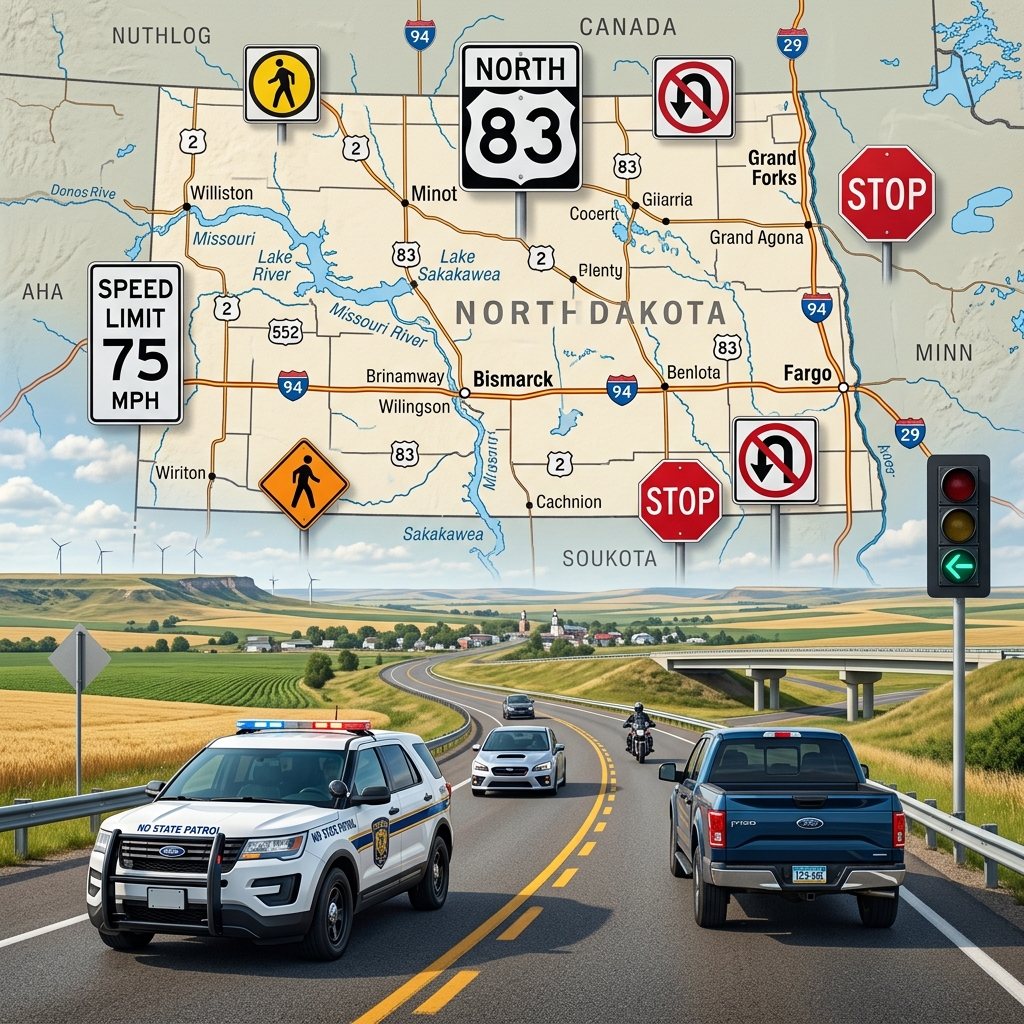
North Dakota drivers are subject to a network of traffic laws designed to keep roads safe, clarify the responsibilities of motorists, and reduce crashes and injuries. While many rules are similar to those found in other states, North Dakota has specific provisions on speed limits, distracted driving, move-over obligations, and seat belt use that every driver should understand.
This guide explains major North Dakota traffic regulations in plain language, including licensing requirements, core rules of the road, penalties for violations, and practical safety tips. It is not a substitute for legal advice, but it will help you navigate everyday driving situations more confidently.
Driver Licensing and Legal Responsibility
Before focusing on individual traffic rules, it is important to understand who is legally allowed to drive in North Dakota and what responsibilities come with holding a driver’s license.
Who Must Have a North Dakota License
Most North Dakota residents must hold a valid North Dakota operator’s license or permit to drive within the state. The license must be signed and carried whenever you operate a vehicle.
- Residents are generally required to obtain a North Dakota license instead of driving long-term on an out-of-state license.
- New residents must register vehicles and secure proper licensing within a specified time once they become residents or employed in the state.
- Operating a vehicle without the required license or permit can lead to citations, fines, and potential suspension of driving privileges.
Basic Duties of Licensed Drivers
Holding a license means agreeing to follow North Dakota traffic laws and exercise reasonable care on the roadway. Key responsibilities include:
- Obeying all posted traffic signs and signals.
- Keeping your vehicle in safe operating condition (lights, brakes, tires, etc.).
- Staying alert and avoiding distractions that impair safe driving.
- Yielding right-of-way when required and driving at safe speeds for conditions.
Failure to follow these duties can result in citations, fines, points on your driving record, and, in serious cases, license suspension or criminal charges.
Speed Limits and Safe Speed Principles
Speed regulations in North Dakota are set to balance efficient travel with safety on different types of roads. Specific speed limits are posted where necessary, but drivers also have a general duty to travel at speeds that are reasonable for current traffic, weather, and visibility conditions.
Common Speed Limit Categories
While actual posted speeds may vary by location, typical North Dakota limits include categories such as rural interstate highways, urban roadways, and county or township roads. These are intended for ideal driving conditions and may not always be safe in bad weather or heavy traffic.
| Road Type (Typical) | Purpose of Limit | Key Safety Considerations |
|---|---|---|
| Interstate highways | Allow efficient travel over long distances while minimizing severe crashes. | Higher speeds require longer stopping distance and more following space. |
| Paved two-lane county roads | Balance local access with rural safety needs, including agricultural and truck traffic. | Narrow lanes and limited shoulders may demand extra caution, especially at night. |
| Urban and residential streets | Protect pedestrians, cyclists, and local traffic in neighborhoods and business districts. | Frequent intersections and crosswalks require lower speeds and readiness to stop. |
Driving Too Fast or Too Slow
North Dakota law prohibits driving at a speed greater than is reasonable and prudent for existing conditions, even if you are below the posted limit. Likewise, you may not drive so slowly that you block normal traffic flow, except when reduced speed is necessary for safety or when required by law.
- Excessive speed can lead to citations, higher fines for very high speeds, and points on your driving record.
- Unreasonably slow driving may require you to travel in the right-hand lane or as close as practical to the right curb to avoid obstructing traffic.
- Speeding that contributes to a crash can increase penalties and potential civil liability.
Rules of the Road: Lanes, Turns, and Right-of-Way
Beyond speed limits, North Dakota drivers must follow detailed rules on lane use, turning movements, and right-of-way at intersections and crosswalks. These regulations help prevent collisions and assign clear responsibilities in common driving scenarios.
Lane Use on Multi-Lane Roads
On roadways with clearly marked lanes, vehicles must be driven as nearly as practical within a single lane and should not move from that lane until it is safe to do so.
- On multi-lane roads, use the appropriate lane for your speed and intended maneuvers.
- On three-lane two-way roads, the center lane generally should not be used as a travel lane except when overtaking or preparing for a permitted turn, and only when it is safe.
- Official devices or markings may prohibit lane changes in certain areas; drivers must obey those controls.
Turning and U-Turn Limitations
North Dakota law restricts turns that could create blind conflicts with other vehicles. For example, vehicles may not be turned to proceed in the opposite direction on curves or near the crest of hills where approaching drivers cannot see the turning vehicle within a safe distance.
When turning right or left at intersections:
- Use turn signals to indicate your intention.
- Yield to oncoming traffic and pedestrians in crosswalks, as required by law.
- Avoid cutting across lanes or turning from the wrong lane, which can lead to citations and crashes.
Right-of-Way at Intersections and Crosswalks
Right-of-way rules are central to safe intersection driving. Vehicular traffic facing a green signal may proceed, but must yield to pedestrians lawfully using the crosswalk and other traffic already in the intersection.
- Drivers must yield to pedestrians who are lawfully within adjacent crosswalks when making turns.
- Motorists may not enter an intersection, crosswalk, or railroad grade crossing unless there is sufficient space on the other side to clear the area without obstructing traffic.
- At unsignalized intersections, right-of-way typically favors the vehicle that arrives first or, in case of simultaneous arrival, the vehicle on the right, but drivers should proceed cautiously and be prepared to yield.
Parking, Standing, and Stopping Rules
Improper stopping or parking can create hazards and obstruct roadways. North Dakota traffic law restricts where and how vehicles may be stopped, stood, or parked.
General Parking Requirements
Drivers may not stop, stand, or park a vehicle in violation of restrictions indicated by official traffic-control devices.
- Do not park in areas marked with “No Parking” signs or where stopping would block traffic.
- Leave sufficient width of the roadway opposite a standing vehicle for the free passage of other vehicles, often specified as at least a certain number of feet.
- Park so that your vehicle can be clearly seen by other road users at a safe distance in both directions.
Stopping Near Crosswalks and Railroads
Drivers must avoid blocking crosswalks and railroad crossings. North Dakota law prohibits entering these areas unless there is space to completely clear them once you proceed.
- If traffic ahead is stopped, wait before the crosswalk or crossing, not inside it.
- Never drive onto railroad tracks unless you are certain you can cross fully without stopping.
Distracted Driving and Electronic Devices
Distracted driving is a growing safety concern, and North Dakota has enacted specific laws governing cellphone and text messaging use while driving.
Texting and Cellphone Restrictions
Text messaging is prohibited for all drivers in North Dakota, and violations carry a $100 fine. Young drivers face additional restrictions:
- Drivers under age 18 are prohibited from using any electronic communication devices, including cellphones, while driving.
- For 14- and 15-year-old drivers, violations carry a $20 fine and add four points to the driving record.
These rules are intended to reduce distraction-related crashes by limiting activities that take drivers’ eyes off the road, hands off the wheel, or attention away from driving.
Broad Distracted Driving Law
Effective August 1, 2017, North Dakota broadened its distracted driving law to cover any distraction that impairs a driver’s ability to operate safely.
- If a driver is distracted and commits a traffic violation, law enforcement can issue a $100 citation for distracted driving, regardless of age.
- Distractions can include interacting with passengers, using navigation devices unsafely, eating, or other activities that meaningfully interfere with safe driving.
Seat Belts, Child Restraints, and Occupant Safety
Occupant protection laws are critical to reducing injuries and fatalities in crashes. North Dakota requires proper seat belt use and child restraints for most vehicle occupants.
Seat Belt Requirements
All front and back seat occupants must be properly buckled up, regardless of age. Historically, seat belt enforcement in some states has been secondary (requiring another violation first), but North Dakota’s seat belt law has been updated to allow primary enforcement, meaning officers may stop a vehicle solely for seat belt violations.
- Failure to wear a seat belt typically results in a $20 citation.
- Proper use of lap and shoulder belts significantly reduces the risk of serious injury or death in crashes.
Child Restraint Rules
Children must be secured in appropriate safety seats or boosters according to age, weight, and height guidelines.
- Violations of child restraint laws carry at least a $25 citation and one point on the driver’s record.
- Parents and guardians are responsible for ensuring children are restrained correctly each time the vehicle moves.
Impaired Driving and Related Penalties
Driving under the influence of alcohol or drugs is a serious offense in North Dakota. Impaired driving laws carry escalating penalties based on the number of offenses and the circumstances of the violation.
Core Impaired Driving Principles
Although specific blood alcohol concentration limits and detailed penalty schedules are set out in the state code, general principles include:
- Operating a vehicle while impaired by alcohol, illegal drugs, or certain medications is prohibited.
- Penalties may include fines, license suspension, mandatory education or treatment programs, and possible incarceration for repeated or severe offenses.
- Impaired driving that results in injury or death can lead to felony charges.
Move-Over Law and Emergency Vehicles
North Dakota’s Move Over Law aims to protect law enforcement officers, first responders, roadside workers, and motorists stopped along the roadway.
Core Move-Over Requirements
When any vehicle is stopped on or near the roadway and displaying flashing, revolving, or rotating lights (including hazard lights), drivers approaching must:
- Change lanes into a lane not immediately adjacent to the stopped vehicle, if safe and possible.
- Slow down to a safe and reasonable speed if a lane change is not possible due to traffic or weather conditions.
- Exercise heightened caution around emergency vehicles, highway maintenance vehicles, and other stationary vehicles with visible hazard lights.
Penalties for Move-Over Violations
Failure to yield to emergency or highway maintenance vehicles can result in a $50 fine and two points on your driving record. Failing to yield right-of-way to stationary motor vehicles with hazard lights carries a $20 fine and no points.
Enhanced penalties may apply when a violation leads to a crash or endangers maintenance or emergency workers. In 2023, the law was expanded to include all motor vehicles displaying hazard lights, not just official or emergency vehicles.
Consequences of Traffic Violations
Traffic violations in North Dakota are typically handled through a system of fines and points, with more serious or repeated offenses leading to stronger sanctions.
Fines and Point System
Examples of penalties include:
- $100 fine for text messaging while driving.
- $20 citation for seat belt violations; $25 citation and one point for child restraint violations.
- Specific fines for speeding, careless driving, and other offenses, often scaled by the severity of the violation.
- Points added to your driving record for many moving violations, which can eventually lead to license suspension if accumulated.
Suspensions and Other Sanctions
For serious or repeated violations, North Dakota authorities may suspend or revoke a driver’s license.
- Impaired driving, fleeing law enforcement, and excessive point accumulation can trigger suspensions.
- During suspension, operating a vehicle can lead to additional penalties and potential criminal charges.
Practical Tips for Safe and Legal Driving in North Dakota
Applying the laws in everyday driving situations requires practical awareness. The following tips can help you stay both safe and compliant:
- Always scan ahead for signs and signals indicating speed changes, lane restrictions, and crosswalks.
- Drive at a speed that matches weather and traffic conditions, even when this means traveling below the posted limit.
- Maintain safe following distances, especially at higher speeds and on rural roads.
- Put your phone away or use hands-free options, and avoid any activity that takes attention away from the road.
- Keep everyone in the vehicle properly restrained, including children in appropriate safety seats.
- Watch for stopped vehicles with flashing or hazard lights and follow move-over and slow-down requirements every time.
Frequently Asked Questions About North Dakota Traffic Laws
Do I need a North Dakota license if I move from another state?
Yes. Most new residents must obtain a North Dakota operator’s license and register their vehicle shortly after becoming residents or employed in the state. Continuing to drive on an out-of-state license past the allowed period can result in citations.
Is it illegal to text while stopped at a red light?
North Dakota’s texting ban applies to drivers, not just moving vehicles. Because the law targets driver behavior that impairs safe operation, using a device while temporarily stopped in traffic can still be considered a violation and is generally discouraged.
Can I be ticketed solely for not wearing a seat belt?
Yes. North Dakota’s seat belt law now allows primary enforcement, meaning law enforcement may stop and ticket a driver solely for not wearing a seat belt or failing to ensure occupants are properly restrained.
What should I do when I see an emergency vehicle with lights on?
Slow down and, when safe, move into a lane that is not immediately adjacent to the stopped vehicle. If you cannot change lanes, reduce speed significantly and pass with caution as required by the Move Over Law.
How can traffic violations affect my driving record?
Many traffic violations add points to your driving record and may carry fines. Accumulating too many points or committing serious offenses can lead to license suspension and higher insurance costs.
References
- North Dakota Century Code, Title 39, Chapter 10 — North Dakota Legislative Assembly. 2023-01-01. https://ndlegis.gov/cencode/t39c10.pdf
- Traffic Safety Laws — North Dakota Department of Transportation. 2023-06-01. https://www.dot.nd.gov/travel-and-safety/safety/traffic-safety-laws
- Move Over Law — Vision Zero North Dakota. 2023-08-01. https://www.visionzero.nd.gov/reaching-zero/road-users/move-over-law
- North Dakota Driver’s Manual — North Dakota Department of Transportation. 2022-01-01. https://static.epermittest.com/media/filer_public/34/6c/346c9519-ed08-4f0b-9b25-ce9ebb7a5517/north-dakota-drivers-manual-2022.pdf
- Chapter Thirteen Traffic Article 1 — City of New England, North Dakota. 2018-06-01. https://ndnewengland.com/wp-content/uploads/2018/06/CHAPTER-THIRTEEN.pdf
- North Dakota’s New Fleeing and Owner Liability Law — Fargo Police Department. 2023-08-01. https://www.facebook.com/fargopolicedepartment/posts/1179254887568950
Similar Articles








Read full bio of Sneha Tete


