
Understanding Rent Control and Vacancy Decontrol
A practical guide to how rent control and vacancy decontrol shape rental prices, tenant protections, and housing markets in the United States.
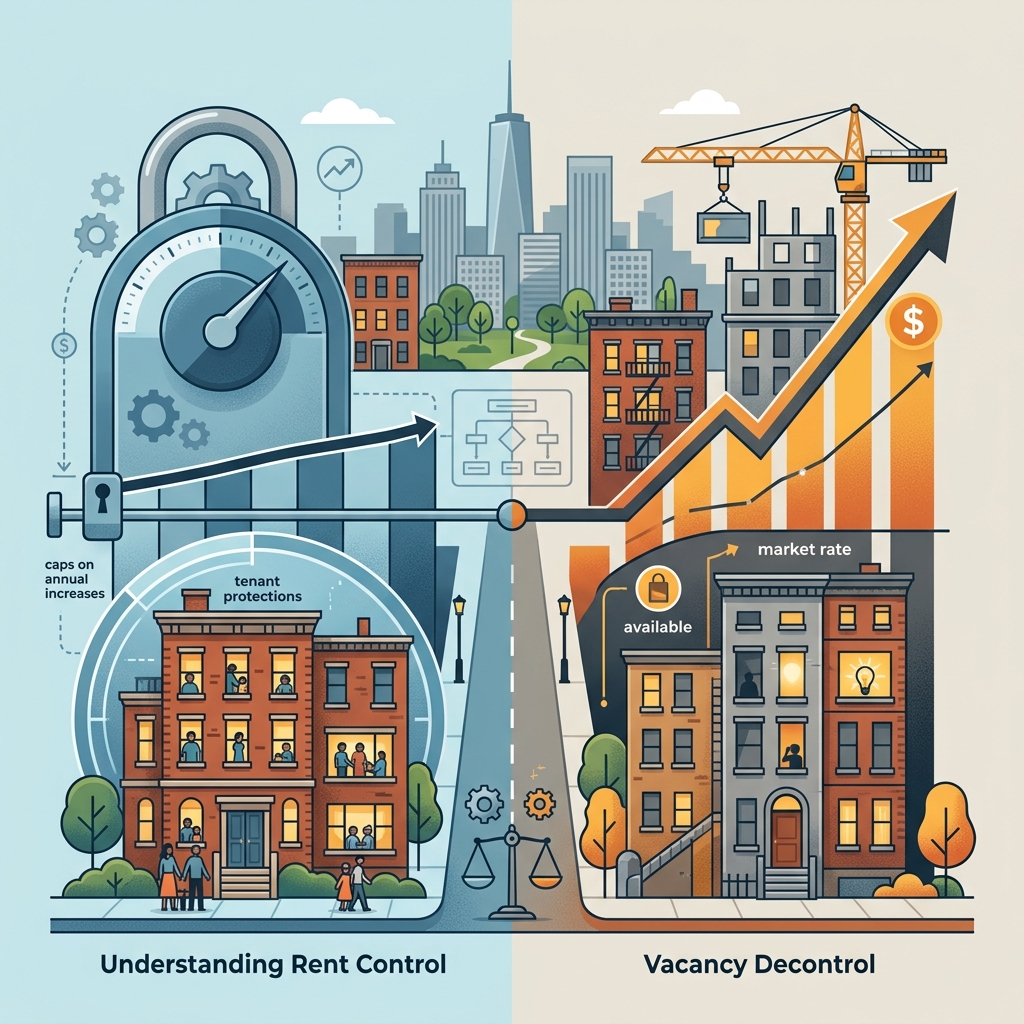
Rent control is one of the most debated tools in housing policy, used by some jurisdictions to curb rapidly rising rents and protect tenants from displacement. Vacancy decontrol is a companion concept that determines what happens to the rent of a unit when the current tenant moves out. Together, these rules shape the balance of power between landlords and tenants and influence the supply and affordability of housing in cities that adopt them.
Core Concepts: What Is Rent Control?
Rent control broadly refers to laws that restrict how much landlords may charge for rent and how quickly they can raise prices over time. These rules typically apply to certain residential properties and are enacted at the city or state level, often in response to concerns about affordability or gentrification.
Modern rent regulation in the United States is usually more moderate than the strict price freezes seen during earlier periods. Today, rent control and stabilization often focus on capping annual rent increases and limiting evictions rather than permanently freezing rents.
- Rent control (strict systems): Sometimes referred to as first-generation controls, these can freeze rents or allow only very limited increases over long periods.
- Rent stabilization (moderate systems): Caps yearly rent increases for covered units but still allows landlords to raise rents within defined limits, often based on inflation.
- Targeted scope: Most programs apply only to certain types of units, such as older multifamily buildings, and exempt newer construction or small owner-occupied properties.
In effect, rent control replaces purely market-based pricing with legally regulated ceilings or formulas, aiming to slow rent growth and improve stability for tenants.
Vacancy Control vs. Vacancy Decontrol
The way a rent-controlled unit is treated when a tenant moves out is crucial to understanding the long-term impact of rent regulation. Two key models have emerged: vacancy control and vacancy decontrol.
Vacancy Control: Rent Follows the Unit
Under vacancy control, the regulated rent level is tied to the unit itself, not to the individual tenant. This means the rent remains regulated even when tenants change.
- New tenants pay roughly the same regulated rent as the prior tenant, with only limited allowed increases.
- Landlords cannot reset rent to market levels between tenancies.
- This model offers strong long-term affordability for a particular property but can heavily constrain potential rental income for owners.
Vacancy Decontrol: Rent Follows the Tenancy
Vacancy decontrol works differently. Here, rent is regulated only while a particular tenant remains in the unit. Once that tenant moves out, the landlord may raise the rent closer to market levels for the next tenant.
- Existing tenants enjoy capped increases and some protections from displacement.
- Landlords regain greater pricing flexibility when units turn over.
- This system is now common in what some researchers call “third generation” rent regulation.
Many contemporary rent regulation schemes combine inflation-based annual limits on rent increases with vacancy decontrol when units change hands.
Legal Landscape: Where Rent Control Exists
Rent control is rare in the United States, and the legal framework varies widely by state and city. Some states explicitly authorize local rent control; others prohibit it or preempt local jurisdictions from adopting such laws.
State Authorization and Preemption
According to legislative and policy analyses, only a relatively small group of states authorize rent control or rent stabilization at the local level, and many states bar local governments from enacting such measures.
- States allowing rent control in some localities: A handful of states, including California, New York, New Jersey, Maryland, Maine, Oregon, and Minnesota, have local jurisdictions that maintain some form of rent regulation.
- States with statewide rent regulation: Oregon and California adopted statewide limits on rent increases in 2019, an important shift from purely local approaches.
- States prohibiting or preempting rent control: More than thirty states have laws blocking cities from implementing rent control or similar measures.
Distinguishing between state laws and local ordinances is important. Even where state law authorizes rent control, individual cities may choose not to adopt it.
Typical Features of Rent Control Ordinances
Local rent control or rent stabilization ordinances often cover similar ground and address three main questions:
- Where rent control is permitted (within which cities or counties).
- How maximum rent is calculated and adjusted over time (often linked to inflation indices such as the Consumer Price Index).
- Which properties are exempt, such as newer buildings or small-scale landlords.
Together, these elements determine who benefits from rent control, how much landlords can charge, and how rents evolve over time.
How Rent Control and Vacancy Decontrol Work in Practice
To understand the practical impact of rent control and vacancy decontrol, it is helpful to break down how they influence day-to-day decisions by landlords and tenants.
Setting and Adjusting Rents
In many regulated jurisdictions, rent increases are tied to inflation and may allow a small additional percentage above that benchmark. For example, some regimes permit annual increases equal to the growth in the Consumer Price Index plus a modest margin.
| Feature | Rent-Controlled Units |
|---|---|
| Annual rent increase limit | Often tied to inflation (e.g., CPI) plus a small percentage. |
| Vacancy treatment | Typically vacancy decontrol; rent reset allowed when tenant leaves. |
| New construction | Frequently exempt to encourage development. |
| Small landlords | Sometimes exempt if owning only a few units or occupying the property. |
Under vacancy decontrol, these limits apply only while a tenant occupies the unit. When the tenant leaves, the landlord may raise rent significantly, which can offset some of the income constraints imposed during the tenancy.
Eviction Protections and Tenant Stability
Many rent control systems pair price restrictions with rules that make it harder to evict tenants without cause. These “just cause” provisions may limit evictions to specific reasons such as nonpayment of rent or significant lease violations.
- Tenants benefit from increased stability and predictability of housing costs.
- Landlords face tighter rules on when and how they can reclaim units.
- The combination of capped rent increases and stronger eviction protections can significantly reduce displacement risk for covered tenants.
Policy Impacts: Pros and Cons of Rent Control
Economic research and policy analyses have highlighted both potential benefits and drawbacks of rent control and vacancy decontrol. Effects differ across cities and depend on how laws are designed and enforced.
Potential Benefits for Tenants
- Greater affordability for covered units: Tenants in regulated apartments often pay lower rents than they would in an unregulated market.
- Reduced displacement risk: Caps on rent increases and eviction protections can make it easier for tenants to remain in their homes despite local rent pressures.
- Improved housing stability: Research has found that rent control can reduce tenant mobility, allowing households to stay in neighborhoods for longer periods.
Potential Costs and Market Distortions
At the same time, evidence suggests that rent control can create trade-offs that extend beyond tenants currently benefiting from regulated units.
- Reduced supply of rental housing: Studies indicate that strict rent controls can encourage conversion of rental buildings to condominiums or other uses, shrinking the stock of rental units.
- Higher rents in uncontrolled areas: When some units are heavily regulated, landlords of unregulated units may raise rents further, redistributing the costs of regulation to other tenants.
- Misallocation of housing: Long-term tenants may remain in units that no longer fit their size or location needs because they fear losing favorable regulated rents, reducing turnover and choice in the market.
- Maintenance and investment concerns: With limited rent revenue, some landlords may defer maintenance or invest less in regulated buildings, potentially affecting housing quality.
Policy organizations have concluded that, while rent control can provide short-term relief to existing tenants, its overall costs often outweigh its benefits over the long term, especially when compared with alternative approaches such as zoning reform or community land trusts.
Third-Generation Rent Regulation and Vacancy Decontrol
Many U.S. jurisdictions now employ what researchers call “third generation” rent regulation. These frameworks attempt to moderate the most severe side effects of earlier, stricter rent control while preserving some tenant protections.
- Inflation-linked rent increases: Rents are allowed to rise with inflation, sometimes with a small additional margin to cover operating costs.
- Vacancy decontrol: Landlords may reset rent to near-market levels when tenants leave, which can reduce incentives to remove units from the rental market.
- Exemptions for newer units: Regulatory systems often exempt buildings constructed after a certain date, aiming to protect incentives for new housing development.
These features reflect attempts by policymakers to balance tenant stability and landlord viability in a way that avoids some of the more severe distortions associated with older, strictly controlled systems.
Practical Considerations for Landlords and Tenants
For individuals navigating rent-controlled markets, understanding vacancy decontrol and related rules is essential. While the specifics vary by jurisdiction, several general considerations apply.
For Tenants
- Know whether your unit is regulated and, if so, under which program (rent control vs. rent stabilization). This affects how quickly rent can rise and what protections you have.
- Understand vacancy rules: Under vacancy decontrol, favorable rent terms typically do not carry over if you move; protections are tied to your current tenancy.
- Check local “just cause” rules that may limit eviction grounds and require landlords to follow specific procedures.
- Document rent increases and compare them with local legal limits to ensure your landlord is complying with applicable laws.
For Landlords
- Verify whether your property is subject to regulation and whether any exemptions apply, particularly for newer construction or small portfolios.
- Stay current on annual allowable rent increase percentages and procedural requirements for notices and registration, where applicable.
- Factor vacancy decontrol into long-term planning by considering how turnover may allow gradual alignment with market rents.
- Be mindful of maintenance obligations to avoid claims that poor conditions are being used as a pressure tactic on regulated tenants.
Because rent control and vacancy decontrol rules differ widely across jurisdictions, both landlords and tenants should consult local law and, when necessary, legal counsel to fully understand their rights and obligations.
FAQs: Rent Control and Vacancy Decontrol
Is rent control the same as rent stabilization?
No. Rent control often refers to stricter systems that may freeze or severely limit rent increases, while rent stabilization typically allows more moderate, inflation-based increases but still caps rent growth for covered units.
Do all states allow cities to adopt rent control?
No. Many states expressly prohibit or preempt local rent control ordinances, while only a small group authorize cities to implement them. Some states, like Oregon and California, have adopted statewide rent regulation laws.
What happens to rent when a tenant moves out under vacancy decontrol?
Under vacancy decontrol, once a regulated tenant vacates a unit, the landlord may raise the rent toward market levels for the next tenant. Future increases for that new tenant may then be constrained by standard annual caps while they occupy the unit.
Does rent control increase or reduce the supply of rental housing?
Research suggests that strict rent control can reduce the supply of rental housing over time, as some landlords convert units to other uses or invest less in new construction. More moderate systems paired with vacancy decontrol may lessen, but not eliminate, these effects.
Are rent-controlled units always high quality and well maintained?
Not necessarily. While some landlords continue to invest in regulated properties, others may defer maintenance if rent caps limit revenue. Policymakers often respond by pairing rent regulation with building code enforcement and tenant protections to mitigate quality concerns.
References
- States Authorizing Rent Control — Connecticut General Assembly Office of Legislative Research. 2015-01-27. https://www.cga.ct.gov/2015/rpt/2015-R-0020.htm
- Rent Control in the United States — Various authors. Last updated 2022. https://en.wikipedia.org/wiki/Rent_control_in_the_United_States
- Rent Control Laws in the United States — Super Lawyers. 2023-07-12. https://www.superlawyers.com/resources/landlord-and-tenant/rent-control-laws-in-the-united-states/
- Rent Regulation Policy in the United States — National Multifamily Housing Council. 2024-01-01. https://www.nmhc.org/globalassets/research–insight/research-reports/rent-regulation/rent_regulation_policy_in_the_united_states_2024.pdf
- What Does Economic Evidence Tell Us About the Effects of Rent Control? — Rebecca Diamond, Brookings Institution. 2018-10-18. https://www.brookings.edu/articles/what-does-economic-evidence-tell-us-about-the-effects-of-rent-control/
- Fact Sheet: Rent Control and Stabilization — Network for Public Health Law. 2021-11-01. https://www.networkforphl.org/wp-content/uploads/2021/11/Fact-Sheet-Rent-Control-and-Stabilization.pdf
- Rent Control: Definition, How It Works, vs. Rent Stabilization — Investopedia. 2023-05-18. https://www.investopedia.com/terms/r/rent-control.asp
Similar Articles








Read full bio of medha deb


