
Understanding Mistrials in Florida Criminal Cases
A clear guide to what a mistrial means, why it happens, and how it affects your rights and future in Florida criminal court.
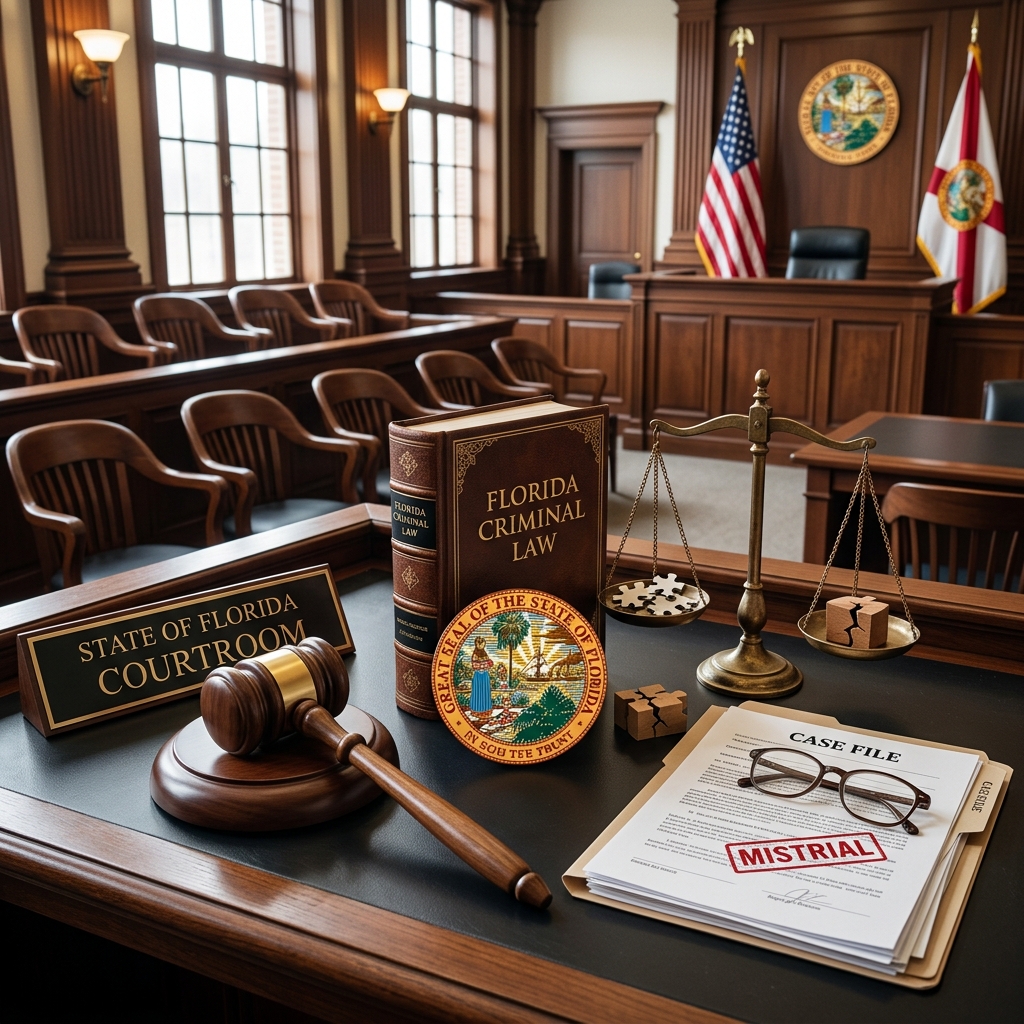
In Florida criminal courts, a mistrial occurs when a trial is stopped and declared void before the judge or jury reaches a final decision on guilt or innocence. It does not resolve the case; instead, it leaves the charges in place and may lead to a new trial or dismissal.
Because a mistrial can dramatically change the direction of a criminal case, defendants and families benefit from understanding when mistrials happen, how judges decide to declare them, and what they mean for double jeopardy and possible retrial.
What Is a Mistrial in Criminal Court?
A mistrial is a criminal trial that ends prematurely and is treated as if it never successfully finished. The key feature is that the proceedings stop before a valid verdict or final judgment is entered.
In Florida, this can happen in both jury trials and non-jury trials (bench trials). Once the judge declares a mistrial, the current trial is over, the jury is discharged, and the case effectively resets.
| Regular Trial Outcome | Mistrial Outcome |
|---|---|
| Jury or judge issues a verdict (guilty or not guilty). | No valid verdict is reached; trial is declared void. |
| Case moves to sentencing or is closed. | Case remains pending; prosecution may retry or dismiss. |
| Double jeopardy normally prevents retrial after acquittal. | Retrial is often allowed, unless barred by double jeopardy rules. |
Common Reasons Courts Declare Mistrials
Mistrials can arise from many different problems, but they generally fall into several broad categories recognized in practice and by legal guidance.
1. Hung Jury (Deadlocked Jury)
A hung jury occurs when jurors cannot unanimously agree on whether the defendant is guilty or not guilty. Florida criminal verdicts must be unanimous, so a deadlock means the jury cannot issue a lawful verdict.
Courts typically respond by:
- Giving additional, neutral instructions encouraging continued deliberations.
- Allowing more time for jurors to discuss the evidence.
- Declaring a mistrial if it becomes clear further deliberation will not break the deadlock.
When the jury ultimately cannot reach unanimity, the judge must declare a mistrial in certain proceedings requiring a unanimous verdict, such as sexually violent predator determinations under Florida law.
2. Serious Procedural Errors
Trials can also be compromised by significant legal or procedural errors. If an error causes substantial and irreparable prejudice to a party’s right to a fair trial, a mistrial may be required.
Examples include:
- Improper admission of highly prejudicial evidence that should have been excluded.
- Incorrect jury instructions that misstate the law in a way that affects the verdict.
- Errors in how the case is presented that cannot be fixed with a simple curative instruction.
North Carolina’s criminal procedure manual, which reflects common principles in U.S. practice, notes that when a legal defect or error causes “substantial and irreparable prejudice” to the defendant’s case, the judge must order a mistrial. This approach is similar to how Florida courts treat serious trial errors.
3. Juror Misconduct
Jurors must decide the case only on the evidence presented in court and the law explained by the judge. When jurors violate these rules, mistrials may be necessary to protect fairness.
Typical forms of juror misconduct include:
- Contacting parties, witnesses, or lawyers outside the courtroom.
- Conducting independent research, such as searching for information online about the case.
- Discussing the case with outsiders or on social media before deliberations are complete.
- Concealing bias or important information during jury selection.
If the misconduct seriously threatens the impartiality of the jury, the judge may end the trial and declare a mistrial.
4. Misconduct by Lawyers or Parties
A mistrial can also result from misconduct by attorneys or parties that taints the proceedings. Official guidance highlights misconduct that causes “substantial and irreparable prejudice” to either the defense or the state.
Examples include:
- Prosecutors making improper comments, such as referencing prior convictions that the jury is not supposed to hear.
- Defense attorneys introducing inadmissible evidence in a way that cannot be cured by an instruction.
- Any party deliberately violating court orders to gain an unfair advantage.
In some jurisdictions, statutes specifically allow mistrials when misconduct by jurors, defendants, or defense counsel substantially harms the state’s case. Florida courts follow similar principles when assessing whether misconduct requires ending a trial.
5. Unforeseen Events and Outside Circumstances
Occasionally, events outside anyone’s control make it impossible to continue a fair trial. Legal authorities refer to this as manifest necessity for a mistrial.
Situations can include:
- Illness or death of a juror, key trial participant, or judge that prevents continuation.
- Natural disasters or emergencies that disrupt court proceedings.
- Jury tampering or threats that compromise jurors’ ability to decide freely.
When these events occur and no reasonable alternative exists, judges may declare a mistrial to protect the integrity of the process.
How a Mistrial Is Requested and Declared
Either side in a criminal case—the prosecution or the defense—may ask the judge to declare a mistrial. In some circumstances, the judge can also act on their own initiative if they believe continuing the trial would be unfair or impossible.
Motions for Mistrial
A motion for mistrial is usually made immediately after the problem arises. Common steps include:
- The affected party formally asks the court to declare a mistrial.
- The judge hears arguments from both sides about whether the issue can be cured or is too serious.
- The judge decides to either grant or deny the motion.
Courts often try less drastic remedies first—such as striking testimony or giving corrective instructions—before resorting to a mistrial, because ending a trial wastes time and resources for all involved.
Judge’s Role and Discretion
The judge must decide whether continuing the trial would be a waste of time and expense, or would violate a party’s right to a fair and impartial trial. If the prejudice is too great and cannot be fixed, a mistrial may be the only appropriate remedy.
Legal guidance emphasizes that judges have significant discretion to decide when circumstances amount to “manifest necessity” for a mistrial, particularly in cases of hung juries or serious misconduct.
What Happens After a Mistrial in Florida?
Declaring a mistrial does not automatically end the criminal case. Instead, it resets the process and raises a new question: what comes next?
Immediate Effects on the Defendant
Once a mistrial is declared:
- The original jury is discharged and cannot continue deliberating.
- No conviction or acquittal is entered; the defendant’s legal status does not change.
If the defendant was out on bond before the trial, they typically remain out until the next court date. If they were in custody, they often remain incarcerated unless the court modifies its earlier order.
Prosecution Options After Mistrial
Following a mistrial, prosecutors generally have three main options.
- Retry the case: The most common outcome is scheduling a new trial with a different jury. In Florida, there is no specific statutory limit on the number of mistrials, though in practice more than two or three is rare.
- Dismiss the charges: Prosecutors may decide not to proceed further and move to dismiss the case entirely, especially if evidence is weak or misconduct would undermine a retrial.
- Seek a plea agreement: The parties may negotiate a plea to resolve the case without another full trial.
In some specialized proceedings, such as sexually violent predator cases, Florida law specifies that any retrial after a mistrial must occur within a defined period (for example, 90 days), unless continued for good cause.
Mistrials and Double Jeopardy in Florida
The constitutional principle of double jeopardy prevents a person from being tried more than once for the same offense after a final judgment. The interaction between mistrials and double jeopardy can be complex.
When Jeopardy Attaches
Under both the U.S. and Florida Constitutions, jeopardy attaches in a jury trial when the jury is sworn. That means the defendant is officially in jeopardy for the charges, and future prosecutions may be limited depending on how the case ends.
Defense-Requested Mistrials
When the defense asks for a mistrial and the judge grants it, courts typically allow the state to retry the case. The reasoning is that by requesting the mistrial, the defendant usually waives double jeopardy protection for that trial’s outcome.
However, there is a critical exception: if the prosecutor intentionally provokes the defense into requesting a mistrial—such as by deliberate misconduct designed to force a restart—double jeopardy may bar retrial. Florida courts have recognized this protection, holding that prosecutors cannot “goad” the defense into a mistrial just to get a second chance with a new jury.
Judge-Declared Mistrials Over Defendant’s Objection
When a judge declares a mistrial without the defendant’s consent, double jeopardy questions are more sensitive:
- If the mistrial is supported by manifest necessity—such as a genuinely hung jury or unavoidable events—retrial is generally allowed.
- If the mistrial results from judicial or prosecutorial misconduct that seriously undermines the defendant’s rights, retrial may be barred.
Courts carefully examine the reasons for the mistrial. If the state or the court caused the problem through misconduct, and the defendant did not consent, attempting to retry the case may violate double jeopardy protections.
Frequently Asked Questions About Mistrials
Can a person be tried multiple times after mistrials?
Florida does not set a specific statutory limit on the number of mistrials that can occur in a case. However, repeated mistrials are rare, and more than two or three attempts are unusual in practice. After multiple mistrials, prosecutors may reconsider whether retrial is appropriate or fair.
Does a mistrial mean the defendant is innocent?
No. A mistrial means the court did not reach a valid verdict. The defendant is neither formally found guilty nor not guilty, and the charges remain pending unless the state dismisses them.
Is a hung jury the same as an acquittal?
Not at all. A hung jury is a deadlocked jury that cannot reach a unanimous decision. In that situation, no verdict is entered, and the judge declares a mistrial. An acquittal, by contrast, is a clear not-guilty verdict that generally bars further prosecution for the same offense.
Do all mistrials involve misconduct?
No. Many mistrials, particularly those caused by hung juries or unforeseen events, do not involve wrongdoing by any party. Misconduct is one possible reason for a mistrial, but not the only one.
Should defendants want a mistrial?
The decision to seek a mistrial is highly case-specific. A mistrial can erase a deeply unfair proceeding, but it also means facing the uncertainty and stress of another trial. Defendants should consult experienced criminal defense counsel to weigh the risks, especially regarding double jeopardy and the prosecutor’s likely next steps.
Key Takeaways for Florida Defendants
- A mistrial ends a criminal trial early and leaves the case unresolved.
- Common reasons include hung juries, serious procedural errors, juror misconduct, and unavoidable outside events.
- Either side can request a mistrial, and judges have substantial discretion in deciding whether one is necessary.
- After a mistrial, prosecutors may retry the case, dismiss charges, or pursue a plea agreement.
- Double jeopardy protections may bar retrial when misconduct by the state or court provokes or necessitates the mistrial without the defendant’s consent.
Because mistrials involve complex procedural and constitutional issues, anyone facing a possible mistrial in Florida should seek guidance from a qualified criminal defense attorney familiar with state and federal law.
References
- How Do Mistrials Work? — American Bar Association (How Courts Work). 2023-01-01. https://www.americanbar.org/groups/public_education/resources/law_related_education_network/how_courts_work/mistrials/
- 243.2 – Grounds for Mistrial — UNC School of Government, NC PRO. 2022-06-01. https://ncpro.sog.unc.edu/manual/243-2
- Mistrials and Florida Law — R&F Law Group. 2021-09-15. https://www.rflawgroup.com/mistrials-and-florida-law/
- Double Jeopardy & Florida Mistrial: When Retrial Is Barred — Fighter Law. 2020-05-10. https://www.fighterlaw.com/defense-motion-for-mistrial-doesnt-equal-waiver-of-double-jeopardy-protection/
- The 2025 Florida Statutes, s.394.917 — Florida Legislature (Online Sunshine). 2025-01-01. https://www.leg.state.fl.us/Statutes/index.cfm?App_mode=Display_Statute&URL=0300-0399/0394/Sections/0394.917.html
- Mistrial by Hung Jury — Law Office of John R. Calcagni III. 2019-03-20. https://www.calcagnilaw.com/criminal-law/mistrial-by-hung-jury/
- Mistrial Limits in Criminal Cases — Avvo Legal Answers (Florida criminal practice commentary). 2018-11-05. https://www.avvo.com/legal-answers/mistrial-limits-criminal-case-1699687.html
Similar Articles








Read full bio of medha deb




