
Federal Criminal Cases Explained: Steps, Grand Jury, Sentencing
A clear, practical guide to how criminal cases move through the federal court system, from investigation and charging to trial, verdict, and sentencing.
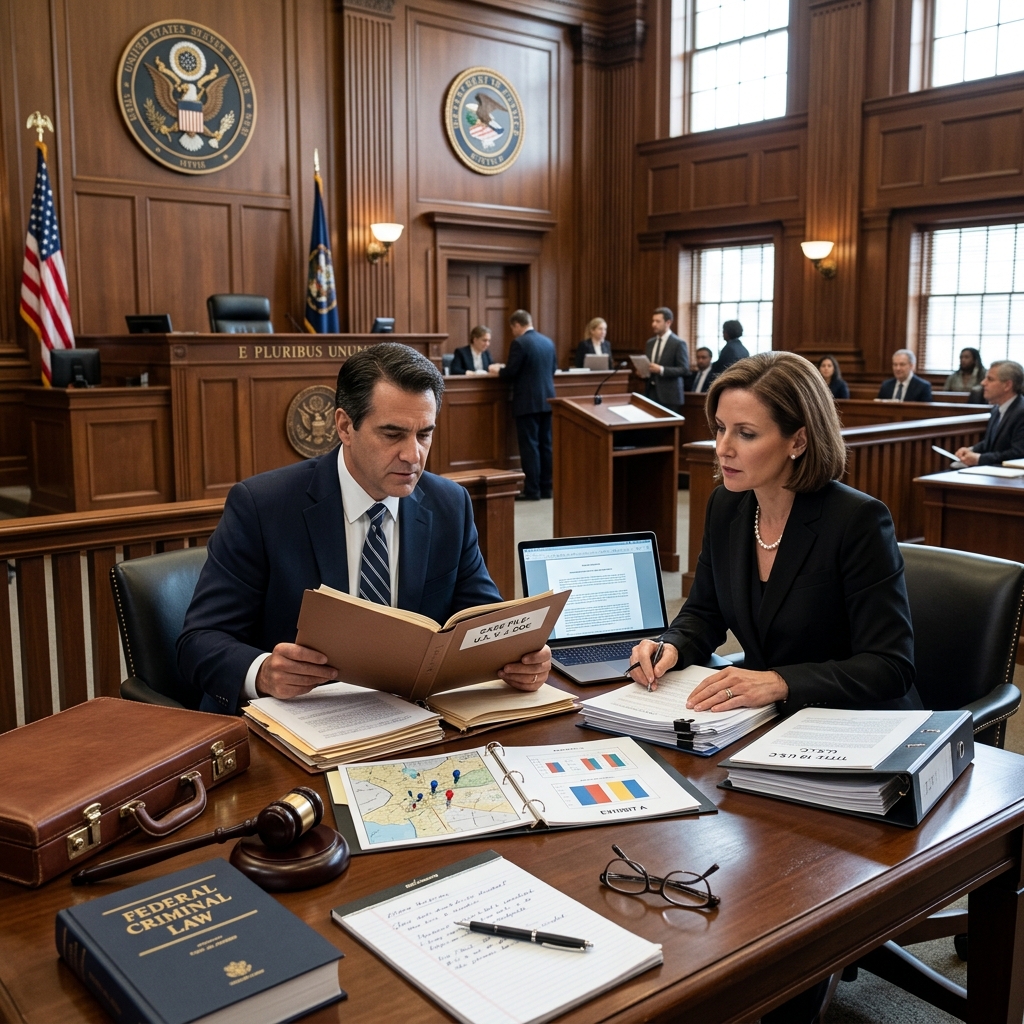
Federal criminal cases follow a structured path from investigation to sentencing, governed by the United States Constitution, federal statutes, and rules of criminal procedure.[10] This guide explains how these cases begin, the people involved, the steps of a typical case, and what makes federal criminal proceedings distinct from civil cases and from state-level prosecutions.
Federal Criminal Cases vs. Civil and State Cases
To understand federal criminal cases, it helps to distinguish them from civil cases and from state criminal cases.
- Criminal vs. civil: In a criminal case, the government accuses a person or entity of violating a criminal law and seeks punishment, such as imprisonment or fines.[10] In a civil case, private parties (or sometimes the government) seek remedies like money damages or injunctions for alleged wrongs that are not classified as crimes.
- Federal vs. state: Most criminal prosecutions in the United States occur in state courts, which handle violations of state criminal laws—such as robbery or assault under state statutes. Federal criminal cases involve offenses defined by federal law, crimes on federal property, or certain conduct that crosses state lines or falls under exclusive federal jurisdiction.
- Limited jurisdiction: Federal courts are “courts of limited jurisdiction,” meaning they can only hear cases authorized by the Constitution or federal statutes, including federal criminal prosecutions.
Key Differences from Civil Cases
Federal criminal cases differ from civil cases in at least three core ways:
- Who can bring the case: Only the federal government can initiate a federal criminal case, typically through a U.S. Attorney’s Office.[10]
- Potential consequences: Convictions may result in imprisonment, supervised release, fines payable to the government, and restitution to victims.[10]
- Burden and standard of proof: The government must prove guilt beyond a reasonable doubt, a more demanding standard than the “preponderance of the evidence” standard common in civil cases.[10]
How Federal Criminal Cases Begin
A federal criminal case does not start with a private complaint or lawsuit. It starts with the government’s decision to investigate and, if warranted, to charge a person with a federal offense.
Reporting and Investigation
Allegations of federal criminal conduct are generally reported to law enforcement agencies such as local police, the Federal Bureau of Investigation (FBI), or other federal investigative bodies.[10] These agencies gather evidence and work closely with prosecutors in deciding whether federal charges are appropriate.
- Local police: May uncover potential federal crimes, especially where conduct overlaps state and federal jurisdictions.
- Federal agencies: The FBI, Drug Enforcement Administration (DEA), and other agencies focus on specific categories of federal offenses like drug trafficking or terrorism.
- Evidence collection: Agents interview witnesses, subpoena records, and, where authorized, execute search warrants.
Charging Decisions and the U.S. Attorney
The principal federal prosecutor in most criminal cases is the U.S. Attorney, who represents the United States in court proceedings.[10] Each federal district has an office of the U.S. Attorney, which evaluates investigations and decides whether to bring charges.
- Referral from law enforcement: After an investigation, law enforcement agencies present evidence to the U.S. Attorney’s Office for review.
- Legal evaluation: Prosecutors consider whether the evidence supports a federal offense, whether the case fits federal priorities, and whether it is appropriate to proceed in federal rather than state court.
- Formal charges: In felony cases, formal charges are typically brought through an indictment returned by a grand jury.
The Grand Jury and Indictment
In many federal felony prosecutions, the charging process involves a grand jury. This is a group of citizens who review evidence presented by the government and decide whether there is probable cause to believe a crime has been committed.
Role of the Grand Jury
The grand jury does not determine guilt or innocence. Instead, it decides whether the government has sufficient evidence to require a defendant to stand trial.[10]
- Evidence review: The U.S. Attorney presents witnesses and documents to the grand jury in a confidential setting.
- Probable cause standard: The grand jury assesses whether the evidence shows probable cause that a federal crime occurred and that the accused committed it.
- Indictment: If the grand jury agrees, it issues an indictment—a formal charging document listing the alleged offenses.
| Feature | Grand Jury | Trial Jury (Petit Jury) |
|---|---|---|
| Primary function | Decides whether to charge (indict) based on probable cause | Decides guilt or innocence based on evidence at trial |
| Standard applied | Probable cause | Beyond a reasonable doubt |
| Timing | Before charges and trial | During the trial phase |
| Typical size | Up to about 23 members (varies by rule) | Generally 12 members in federal criminal trials |
From First Appearance to Trial
Once charges are filed—either by indictment or, in some cases, by information—the case begins moving through a series of steps in the federal district court, the primary trial court in the federal system.
Initial Appearance and Arraignment
After arrest or summons, the defendant appears before a federal judge for an initial hearing. This is often followed by an arraignment, where the defendant is formally informed of the charges and enters a plea.
- Notification of charges: The judge ensures that the defendant understands the accusations and the rights they possess.
- Bail and release conditions: The court may decide whether the defendant can be released pending trial and on what conditions.
- Plea: Defendants typically plead “not guilty” at this stage, reserving the right to challenge the case or negotiate later.
Pretrial Proceedings
Before trial, the parties exchange information and litigate legal issues. This stage includes discovery, pretrial motions, and potential plea negotiations.
- Discovery: Prosecutors provide the defense with evidence and information, such as witness statements and documents, so the defense can prepare.
- Pretrial motions: The defense and prosecution may ask the court to decide specific legal questions—such as whether certain evidence should be excluded.
- Plea bargaining: Many federal criminal cases resolve without trial when the defendant and government agree to a negotiated plea and proposed sentence.
The Federal Criminal Trial
If the case does not end through a plea or dismissal, it proceeds to trial in the federal district court. The trial is the formal process in which a jury hears evidence and determines whether the government has proved the defendant’s guilt beyond a reasonable doubt.
Burden and Standard of Proof
A central feature of federal criminal trials is the burden of proof. The government bears the responsibility for proving the defendant’s guilt; the defendant does not have to prove innocence.[10]
- Burden on the government: Prosecutors must present evidence sufficient to convince the jury that the defendant committed each element of the charged offense.
- Beyond a reasonable doubt: This is the highest standard in the legal system. It requires evidence so convincing that jurors are left with no reasonable doubt about the defendant’s guilt.[10]
- Defendant’s rights: Defendants may remain silent, contest the government’s evidence, and present their own witnesses and documents as part of their defense.
Typical Trial Sequence
Although exact procedures vary, a federal criminal trial usually follows a structured sequence in front of a jury:
- Jury selection: Potential jurors are questioned and selected to form a trial jury.
- Opening statements: The prosecution and defense outline the evidence they expect to present and the conclusions they believe the jury should draw.
- Government’s case: The prosecution calls witnesses and introduces exhibits to support the charges. The defense may cross-examine each witness.
- Defense case: The defense may present evidence, call witnesses, or argue that the prosecution’s case is insufficient.
- Closing arguments: Both sides summarize the evidence and discuss how the law applies.
- Jury instructions: The judge instructs the jury on the relevant law and the standard of proof.
- Deliberation and verdict: The jury deliberates privately and returns a verdict of guilty or not guilty.
Verdict, Double Jeopardy, and Appeals
Once the jury reaches a decision, the verdict has significant legal consequences. Federal law also imposes important limits on whether the government can try the defendant again.
If the Defendant Is Found Not Guilty
If the jury returns a verdict of not guilty, the defendant is acquitted and released. The government cannot appeal the acquittal or bring the same federal charges again for that offense.[10]
This rule is rooted in the Constitution’s protection against double jeopardy, which prohibits a person from being tried twice in federal court for the same offense after an acquittal.[10]
If the Defendant Is Found Guilty
A guilty verdict does not end the case. It begins a new phase focused on sentencing and possible appeals.
- Post-trial motions: The defense may ask the court to set aside the verdict or grant a new trial.
- Appeals: After sentencing, the defendant can appeal to a federal court of appeals, challenging legal rulings or the application of law made by the trial court.
Sentencing in Federal Criminal Cases
Sentencing is the process by which the court determines the punishment following a conviction or a guilty plea. In federal court, judges draw on statutory ranges and advisory guidelines to make individualized decisions.
Factors Considered at Sentencing
Federal judges typically consider several types of information in deciding an appropriate sentence.
- U.S. Sentencing Guidelines: The court may consult guidelines issued by the U.S. Sentencing Commission, which provide advisory ranges based on the nature of the offense and the defendant’s criminal history.[10]
- Trial evidence: Evidence presented at trial or described in the plea agreement helps the judge understand the seriousness of the conduct.
- Pre-sentence information: A pretrial or probation officer may prepare a report summarizing the defendant’s background, which is shared with both sides and the court.
- Input from the parties: The U.S. Attorney and defense lawyer can argue for a particular sentence and present additional information, including victim impact statements or mitigating circumstances.[10]
Types of Federal Criminal Sentences
A federal sentence may involve multiple components.
- Imprisonment: Time in a federal prison, often followed by supervised release.
- Fines: Monetary penalties paid to the government.
- Restitution: Payments ordered to compensate victims for financial loss or harm caused by the crime.[10]
- Conditions of supervision: Requirements during supervised release or probation, such as reporting to an officer or participating in treatment programs.
Frequently Asked Questions (FAQs)
1. Can a private citizen file a federal criminal case?
No. Only the federal government can initiate a federal criminal case, usually through a U.S. Attorney’s Office in coordination with law enforcement agencies.[10] Private individuals may report suspected crimes, but they do not file criminal charges themselves.
2. What is the difference between an indictment and a criminal complaint?
An indictment is a formal charging document issued by a grand jury, typically for felony offenses. A criminal complaint is a document filed by a prosecutor, often used earlier in an investigation or for certain less serious charges. In federal felony cases, an indictment is generally required to proceed to trial.
3. What does “beyond a reasonable doubt” really mean?
“Beyond a reasonable doubt” means the evidence must be so strong that a reasonable person would have no logical, remaining doubt about the defendant’s guilt. It is deliberately demanding, reflecting the serious consequences of criminal conviction and the presumption of innocence.[10]
4. Can the government appeal if the jury finds the defendant not guilty?
No. If a defendant is acquitted, the government cannot appeal the verdict or retry the defendant in federal court for the same offense, because the Constitution prohibits double jeopardy. This protection ensures finality and prevents repeated prosecutions for the same alleged crime.[10]
5. Where do federal criminal trials and appeals take place?
Federal criminal trials occur in the U.S. district courts, which are the general trial courts in the federal system. Appeals from these trials go to a U.S. court of appeals, and in rare cases may reach the Supreme Court of the United States, the final level of review.
References
- Criminal Cases — United States Courts. 2024-01-01. https://www.uscourts.gov/about-federal-courts/types-cases/criminal-cases
- Introduction to the Federal Court System — U.S. Department of Justice. 2024-01-01. https://www.justice.gov/usao/justice-101/federal-courts
- Federal Crimes — Justia Criminal Law Center. 2023-05-01. https://www.justia.com/criminal/offenses/other-crimes/federal-crimes/
- The Federal Criminal Process — Eisner Gorin LLP. 2023-03-01. https://www.thefederalcriminalattorneys.com/federal-criminal-process
- Federal Crimes — Crime Survivors Guide — Crime Survivors NOLA. 2022-06-01. https://www.crimesurvivorsnola.org/federal-crimes
Similar Articles








Read full bio of medha deb




