The Supreme Court’s 2007 decision in Brendlin v. California significantly clarified what it means to be “seized” during a police traffic stop under the Fourth Amendment to the United States Constitution. Before this case, courts disagreed about whether passengers were seized in the same way as drivers when officers stopped a vehicle. Brendlin resolved that debate by holding that every occupant of a stopped car is seized for Fourth Amendment purposes.
This article explains the background of the case, the legal issue the Court faced, the Court’s reasoning, and what the ruling means in practice for passengers, police officers, and courts applying the Fourth Amendment.
Context: The Fourth Amendment and Police Traffic Stops
The Fourth Amendment protects people from unreasonable searches and seizures by government officials. A seizure occurs when police, through physical force or a show of authority, restrain a person’s freedom of movement. Traffic stops are a routine context in which this protection applies, and the Supreme Court has long held that stopping a car is a seizure of the driver.
However, until Brendlin, the Court had not expressly held that passengers are also seized when a vehicle is stopped. Some state courts treated passengers as merely present when the driver was detained, leaving them with limited ability to challenge the legality of the stop. Brendlin confronted this gap directly.
- Key constitutional principle: Any person who is seized by a government agent may challenge the legality of that seizure.
- Practical question: Are passengers seized when officers stop a car, or only the driver?
- Legal consequence: If passengers are seized, they may seek to suppress unlawfully obtained evidence under the Fourth Amendment.
The Facts Behind Brendlin v. California
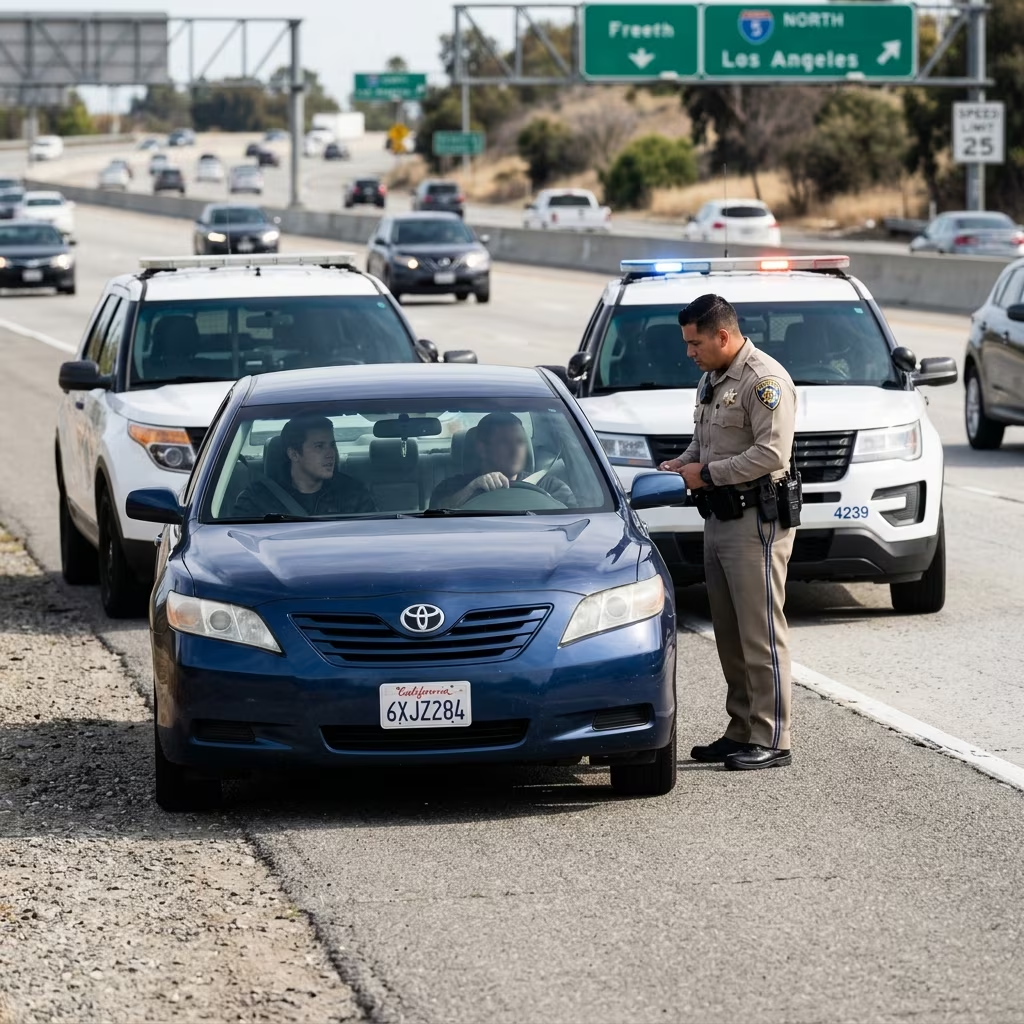
The case arose from a police traffic stop in California. Officers stopped a vehicle to check its registration status, even though they lacked adequate justification that the car was being operated unlawfully. During the stop, one officer recognized Bruce Brendlin, who was sitting in the passenger seat, as a parole violator with an outstanding warrant.
After confirming the warrant, the officer ordered Brendlin out of the car, arrested him, and searched him, the driver, and the vehicle. Officers found methamphetamine and drug paraphernalia on Brendlin and in the car.
Brendlin was charged with drug-related offenses and parole violation. He asked the trial court to suppress the drug evidence, arguing that the initial stop lacked reasonable suspicion or probable cause and therefore amounted to an unconstitutional seizure under the Fourth Amendment.
Competing Views in the California Courts
The case moved through the California courts with sharply different interpretations of whether Brendlin, as a passenger, had been seized by the traffic stop:
| Court | View of Passenger Status | Outcome on Suppression |
|---|---|---|
| Trial court | Held that Brendlin had not been seized during the stop; only the driver was detained. | Denied suppression motion; evidence admitted and conviction upheld. |
| California Court of Appeal | Concluded that a traffic stop necessarily results in a seizure of both driver and passengers. | Reversed; held the stop unlawful and evidence should be suppressed. |
| California Supreme Court | Ruled that only the driver is detained; passengers are present as a practical byproduct of the stop but not seized. | Reinstated the conviction and drug evidence; Brendlin could not challenge the stop. |
This conflict set the stage for the United States Supreme Court to resolve whether passengers can rely on the Fourth Amendment to contest the legality of a traffic stop.
The Legal Question: Are Passengers Seized During a Traffic Stop?
The Supreme Court framed the central issue in direct constitutional terms:
- Issue: Under the Fourth Amendment, is a passenger in a car that is stopped by police “seized”, thereby having the right to challenge the legality of that stop?
California argued that the driver is the sole target of a vehicle stop, and although passengers are practically stopped, they remain legally free to leave or ignore the officers. On that view, Brendlin could not claim any violation because he was not seized until he was formally ordered out of the car and arrested.
Brendlin, by contrast, argued that when officers stop a car, they exercise control over all occupants. A reasonable passenger would not feel free to exit the car or walk away without police permission, meaning a seizure occurs at the moment the car is stopped.
The Supreme Court’s Holding
In a unanimous opinion, the Supreme Court held that passengers are seized at the same time as drivers when police stop a vehicle. The Court explained that the appropriate test is whether, in the total circumstances of the stop, a reasonable person in the passenger’s position would feel free to terminate the encounter and leave.
- Holding: When an officer makes a traffic stop, all occupants of the vehicle are seized for Fourth Amendment purposes.
- Result for Brendlin: Because the stop was alleged to be unlawful, Brendlin could challenge its legality and seek suppression of the evidence discovered afterward.
The Reasonable Person Standard
The Court relied on the well-established standard from United States v. Mendenhall, which asks whether, in view of all the circumstances, a reasonable person would feel free to leave or otherwise terminate their encounter with the police. In the context of a traffic stop:
- The vehicle is stopped by police authority.
- Officers often position themselves near doors, windows, or in ways that control movement.
- Passengers are typically expected to remain in the car unless instructed otherwise.
Under these circumstances, the Court concluded that a reasonable passenger would not feel free simply to open the door and walk away. Instead, passengers would understand that officers are exercising control over the scene and over everyone in the vehicle.
The Court emphasized that the analysis is objective—it is not based on what a particular defendant believed, but on what a reasonable person would think in similar circumstances.
Why Being “Seized” Matters: The Ability to Challenge the Stop
The holding in Brendlin has important practical consequences. When passengers are considered seized by a traffic stop, they gain the same constitutional ability as drivers to challenge the stop itself.
Core Implications
- Suppression of Evidence: Any occupant may move to suppress evidence obtained after an unlawful traffic stop, on the ground that their own seizure violated the Fourth Amendment.
- Civil Liability: An unlawful stop that seizes passengers can support civil actions for constitutional violations, such as claims under 42 U.S.C. § 1983 or Bivens suits.
- Uniform Treatment: Courts must treat drivers and passengers alike in evaluating whether the police had reasonable suspicion or probable cause to initiate the stop.
Brendlin thus ensures that passengers are not second-class citizens in constitutional terms. If officers stop a car in violation of the Fourth Amendment, everyone in that car may raise that violation in court.
Law Enforcement Perspective After Brendlin
For police and other law enforcement officials, Brendlin clarifies both their authority and their constitutional limits during traffic stops.
Authority Over Passengers
Existing case law, combined with Brendlin, recognizes that officers who lawfully stop a vehicle may exercise substantial control over passengers during the stop:
- They may require passengers to remain in the vehicle while the stop is conducted.
- They may ask passengers to exit the vehicle when safety or investigation needs warrant it.
- They may control the movements of both drivers and passengers throughout the stop, consistent with officer safety and reasonable investigative procedures.
These powers do not disappear after Brendlin. Rather, Brendlin ensures that the initial decision to stop the vehicle must itself be reasonable; otherwise, both drivers and passengers may later claim a constitutional violation.
Constitutional Limits
Officers must have at least reasonable suspicion or probable cause to conduct a traffic stop; stopping a car without any lawful basis makes the seizure of every occupant unconstitutional.
- Evidence discovered from an unconstitutional stop may be excluded from criminal trials under the exclusionary rule.
- Unlawful stops may expose officers and agencies to potential civil lawsuits alleging violations of constitutional rights.
Passenger Rights and Responsibilities
From the perspective of passengers, Brendlin clarifies how the Fourth Amendment protects them during routine traffic encounters.
What Passengers Can Rely On
- Protection from Unreasonable Seizures: Passengers are seized when the car is stopped and may challenge any stop that lacks lawful justification.
- Standing to Challenge: A passenger need not be the driver to claim that a traffic stop violated the Fourth Amendment; their own seizure is enough.
- Objective Standard: Courts evaluate the situation from the perspective of a reasonable person in the passenger’s position, not based on subjective feelings.
Limits to Passenger Rights
Brendlin does not grant passengers an unrestricted ability to leave or disregard officer commands during a lawful stop. Once the vehicle is lawfully stopped:
- Passengers are subject to reasonable instructions aimed at officer safety and investigation.
- Refusing lawful commands could lead to additional legal consequences.
At the same time, Brendlin ensures that passengers may later argue that the initial stop was improper and seek to exclude evidence obtained because of it.
Relationship to Prior Supreme Court Doctrine
Brendlin fits within a broader line of Fourth Amendment cases dealing with seizures and traffic stops:
- United States v. Mendenhall: Provides the baseline reasonable person test for determining whether a seizure has occurred.
- Earlier traffic stop cases had clearly stated that drivers are seized, and had suggested—but not squarely held—that passengers were also seized.
By expressly holding that all occupants are seized when a car is stopped, Brendlin turned those suggestions into binding doctrine and resolved lingering uncertainty in lower courts.
Frequently Asked Questions (FAQs)
Does Brendlin mean passengers are always seized in a car?
Brendlin applies when police stop a vehicle through a show of authority or physical force. In that situation, every occupant is seized for Fourth Amendment purposes. Simply riding in a car that is not being stopped by police does not amount to a seizure.
Can a passenger challenge a stop even if the driver consents?
Yes. The right to challenge the legality of a stop stems from the passenger’s own seizure, not the driver’s consent or conduct. If the initial stop lacked lawful basis, a passenger may argue that it violated the Fourth Amendment.
What happens if the traffic stop is ruled unlawful?
If a court finds that a traffic stop was unconstitutional, evidence obtained as a result of that stop may be excluded from trial under the Fourth Amendment’s exclusionary rule. This applies for both drivers and passengers.
Does Brendlin change what officers can do during a lawful stop?
Brendlin does not limit officers’ established authority to control occupants during a lawful stop. Officers may still direct passengers to stay in or exit the vehicle and manage their movements for safety and investigation purposes. The ruling mainly affects the threshold question of whether the stop itself was lawful.
Why is Brendlin significant for everyday traffic encounters?
Brendlin ensures that passengers have equal constitutional footing with drivers when a vehicle is stopped. It recognizes that when police stop a car, they effectively control the movements of everyone inside, and therefore must justify that seizure under the Fourth Amendment.
References
- Facts and Case Summary – Brendlin v. California — Administrative Office of the U.S. Courts. 2007-06-25. https://www.uscourts.gov/about-federal-courts/educational-resources/educational-activities/fourth-amendment-activities/brendlin-v-california/facts-and-case-summary-brendlin-v-california
- Brendlin v. California, 551 U.S. 249 — Supreme Court of the United States via Justia. 2007-06-25. https://supreme.justia.com/cases/federal/us/551/249/
- Brendlin v. California — Oyez Project at IIT Chicago-Kent College of Law. 2007. https://www.oyez.org/cases/2006/06-8120
- Brendlin v. California — Federal Law Enforcement Training Centers (FLETC) audio summary. 2007. https://www.fletc.gov/passengers-traffic-stops-brendlin-v-california-mp3
- Brendlin v. California — Wikipedia (background summary, primary sources cited in article). Last updated various. https://en.wikipedia.org/wiki/Brendlin_v._California