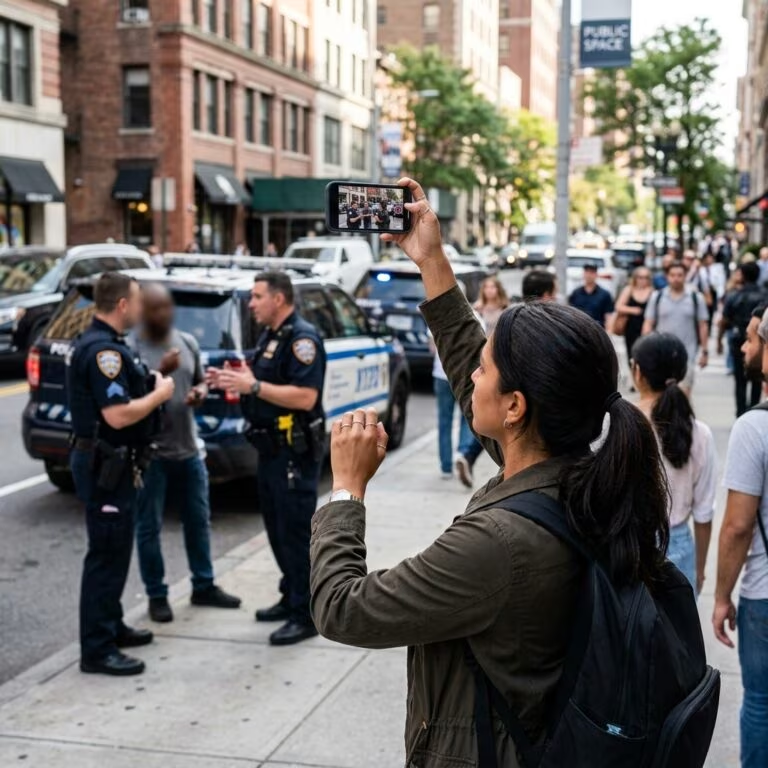
The **Fourth Amendment** to the United States Constitution is a central protection for personal privacy and freedom from government intrusion. It limits when and how officials can **search** people and property or **seize** items and individuals, and it sets strict rules for issuing **warrants**. In everyday terms, it is the part of the Constitution that answers a basic question: *When can the government legally look through your stuff or stop you and take you into custody?*
1. The Fourth Amendment in Plain Language
The official text of the Fourth Amendment appears in the Bill of Rights, ratified in 1791. In essence, it does two big things:
- Protects people against **unreasonable searches and seizures** by the government.
- Sets conditions for valid **warrants**: they must be based on **probable cause**, supported by **oath or affirmation**, and must **specifically describe** the place to be searched and the items or people to be seized.
In simple terms, this means government agents, such as police officers, usually need a solid reason and legal authorization before they can:
- Enter your home or go through your belongings.
- Stop and frisk you or detain you.
- Take your property as evidence.
The Amendment reflects the historical idea that **”each person’s home is their castle”**, protected from arbitrary government intrusion. It is also a foundation for modern privacy law and rules on surveillance, including wiretaps and access to electronic data.
2. Key Concepts: Search, Seizure, and Reasonableness
2.1 What is a “search”?
Under the Fourth Amendment, a **search** occurs when a government official intrudes into a space where a person has a **reasonable expectation of privacy**. This typically includes:
- Your home and enclosed yard.
- Private areas of your car (such as the trunk).
- Your closed bags, drawers, and lockers.
- Your personal communications and digital data, like emails or stored phone information.
Courts often use a two-part test to decide whether there is a protected expectation of privacy:
- You must actually expect privacy in the place or item.
- Society must be prepared to recognize that expectation as **reasonable**.
2.2 What is a “seizure”?
A **seizure of property** happens when the government meaningfully interferes with someone’s right to possess that property, such as taking items as evidence or participating in an eviction. A **seizure of a person** includes being arrested or even briefly detained, for example during a traffic stop.
2.3 What makes a search or seizure “unreasonable”?
The Fourth Amendment bans **unreasonable** searches and seizures but does not spell out the full meaning of “unreasonable”. Over time, courts have developed rules that generally treat a search or seizure as reasonable if:
- It is authorized by a valid warrant based on probable cause, or
- It fits within one of several limited exceptions that do not require a warrant.
Broadly, the goal is to prevent **arbitrary or unjustified intrusions** into people’s lives and property.
3. Warrants and Probable Cause: The Heart of the Protection
3.1 What is a warrant?
A **warrant** is a court order, usually issued by a judge or magistrate, that authorizes government agents to conduct a search or make an arrest. The Fourth Amendment requires warrants to meet strict conditions:
| Requirement | What it Means |
|---|---|
| Probable cause | There must be a fair probability, based on facts, that evidence of a crime or a wanted person will be found in the place to be searched or seized. |
| Oath or affirmation | Officers must swear to the truth of the information supporting the warrant, typically in an affidavit. |
| Particularity | The warrant must specifically describe the place to be searched and the people or items to be seized, preventing broad “general warrants”. |
These requirements were designed to avoid the abuses of **general warrants** and “writs of assistance” used in colonial times, which allowed wide, unchecked searches. Today, they remain central to controlling investigative power.
3.2 Probable cause vs. reasonable suspicion
Fourth Amendment law often distinguishes **probable cause** from **reasonable suspicion**:
- Probable cause is a stronger standard and is usually needed for warrants and arrests. It requires facts that would lead a reasonable person to believe a crime has been committed or that evidence is present in a specific place.
- Reasonable suspicion is a lower standard and often applies to brief stops, such as traffic stops or stop-and-frisk situations, where officers need specific, articulable facts that suggest criminal activity.
Both standards are meant to ensure that police actions are not based on mere hunches or arbitrary decisions.
4. When Police Need a Warrant—and When They Do Not
The general rule is that searches and seizures require a warrant. However, the Supreme Court has recognized several **exceptions** when warrantless actions can still be reasonable.
4.1 Common situations where a warrant is required
Police usually need a warrant to:
- Enter and search a private home, except in emergencies.
- Search closed containers, such as locked boxes or digital devices, absent consent or another exception.
- Conduct extensive surveillance or wiretaps of private communications.
4.2 Typical exceptions to the warrant requirement
Court decisions have identified several kinds of searches or seizures that can be conducted without a warrant, provided other constitutional standards are met. Examples include:
- Search incident to lawful arrest: After making a lawful arrest, officers may search the person and the immediate area to protect themselves and preserve evidence.
- Consent searches: If someone voluntarily agrees to a search, a warrant is not required, but the consent must be genuine and not coerced.
- Plain view: If officers are lawfully present and see evidence of a crime in plain view, they may seize it without a warrant.
- Exigent circumstances: In emergencies—such as hot pursuit of a fleeing suspect, immediate threats to safety, or risk of evidence destruction—officers may act without a warrant.
- Vehicle stops and checkpoints: Under certain conditions, officers can stop vehicles based on reasonable suspicion, and sometimes as part of structured checkpoints.
- Good-faith reliance on a warrant: If officers rely on a warrant they reasonably believe is valid, evidence may be admissible even if a court later finds the warrant defective.
Even in these exception categories, the **reasonableness** requirement still applies. Officers must respect constitutional limits, and courts may exclude evidence if those limits are violated.
5. Privacy in the Modern Era: Digital Data and Surveillance
Originally, the Fourth Amendment focused on physical places such as homes and tangible property like papers and personal effects. Over time, courts have recognized that **electronic communications and digital records** can raise similar privacy concerns.
5.1 Electronic communications as “papers”
Judicial decisions have emphasized that the protections against unreasonable searches and seizures apply to the contents of communications, regardless of the technology used. Private communications can be treated as akin to personal papers, meaning:
- Accessing the content of emails, text messages, or stored files often requires probable cause and a warrant.
- Broad or indefinite surveillance of communications may violate the particularity and reasonableness requirements.
5.2 Digital privacy and expectations
As people increasingly store personal information on phones, computers, and online services, courts and lawmakers continue to refine what counts as a **reasonable expectation of privacy** in those spaces. Important questions include:
- How much data officers can access from a seized device without a warrant.
- When metadata (such as call logs or IP addresses) is protected compared with full content.
- How long government agencies can keep data collected during investigations.
Many of these issues are addressed through statutes and case law, but the core constitutional principle comes from the Fourth Amendment’s focus on protecting individuals against unreasonable intrusions.
6. How the Fourth Amendment Shapes Everyday Encounters
Understanding the Fourth Amendment can help people recognize the legal framework behind common interactions with law enforcement. It does not guarantee that every encounter will proceed perfectly, but it provides standards that courts use to judge government actions.
6.1 Typical scenarios
Examples of everyday situations influenced by Fourth Amendment principles include:
- Traffic stops: Usually based on reasonable suspicion of a traffic violation or other criminal activity. Officers may ask questions and, in some circumstances, conduct limited searches.
- Home visits: Officers typically need a warrant or consent to enter a private residence, absent an emergency.
- Public encounters: Brief stops for questioning in public places may be allowed if officers can point to specific reasons for suspicion.
- School or workplace searches: These may involve different standards depending on the role of government actors and the policies in place, but Fourth Amendment principles are often part of the analysis.
6.2 Balancing security and liberty
Courts frequently describe the Fourth Amendment as a balance between two important goals:
- Allowing effective law enforcement and public safety operations.
- Preserving individual rights to privacy, property, and personal security.
The requirement of probable cause, judicial oversight through warrants, and limits on broad searches are all tools used to maintain this balance.
7. Quick FAQ: Common Questions About the Fourth Amendment
Does the Fourth Amendment apply only to federal government actions?
No. While originally directed at the federal government, the Fourth Amendment now applies to state and local officials as well, through constitutional interpretation and incorporation doctrines.
Is every search without a warrant unconstitutional?
No. Some searches without a warrant are allowed if they fall into recognized exceptions, such as consent, search incident to lawful arrest, exigent circumstances, or certain vehicle searches.
What happens if police violate the Fourth Amendment?
If a court finds that a search or seizure was unreasonable, the main remedy is often the **exclusion of evidence** obtained as a result, meaning that evidence cannot be used in criminal proceedings. The exact remedy can vary by case and jurisdiction.
Does the Fourth Amendment protect my online data?
Yes, but the level of protection can depend on the type of data and how it is stored. Courts have recognized that contents of communications and many forms of digital data are protected, often requiring a warrant based on probable cause.
Can I consent to a search and then change my mind?
In many situations, a person may withdraw consent, but timing matters. Once officers have already lawfully seized evidence based on consent, changing your mind does not retroactively invalidate the earlier search. Specific outcomes depend on the circumstances and judicial rulings.
8. Why the Fourth Amendment Still Matters Today
The Fourth Amendment remains a vital constitutional safeguard, even as technology and policing practices evolve. It continues to:
- Define the limits of government power in investigations and enforcement.
- Protect individuals against arbitrary or unjustified intrusions into their homes, personal spaces, and digital lives.
- Ensure that searches and seizures are grounded in facts and subject to judicial oversight through warrants.
By insisting on **reasonableness**, **probable cause**, and **specificity**, the Fourth Amendment helps maintain the broader constitutional promise that people in the United States can be “secure” in their persons, houses, papers, and effects. In practice, it is a key mechanism for keeping government power in check while still allowing legitimate law enforcement activities.
References
- U.S. Constitution – Fourth Amendment — Library of Congress / Constitution Annotated. 2023-01-01. https://constitution.congress.gov/constitution/amendment-4/
- Fourth Amendment Protection Against Unreasonable Search and Seizure — FindLaw. 2024-01-01. https://constitution.findlaw.com/amendment4.html
- Constitutional Amendments – Amendment 4 – “The Right to Privacy” — Ronald Reagan Presidential Library & Museum. 2023-09-01. https://www.reaganlibrary.gov/education/lesson-plans/high-school/constitutional-amendments/constitutional-amendments-amendment-4
- Fourth Amendment — Legal Information Institute, Cornell Law School. 2022-06-01. https://www.law.cornell.edu/constitution/fourth_amendment
- Fourth Amendment to the United States Constitution — U.S. Constitution (overview, secondary summary). 2021-08-01. https://en.wikipedia.org/wiki/Fourth_Amendment_to_the_United_States_Constitution
- Interpretation: The Fourth Amendment — National Constitution Center. 2022-05-01. https://constitutioncenter.org/the-constitution/amendments/amendment-iv/interpretations/121
- Fourth Amendment — Electronic Privacy Information Center (EPIC). 2023-11-01. https://epic.org/issues/privacy-laws/fourth-amendment/