The Fourth Amendment to the United States Constitution is a core protection for personal privacy, limiting when and how government officials may conduct searches or seize property. It affects everyday life in places as familiar as your home, your school, your car, and even your phone. This guide explains key concepts, highlights major Supreme Court decisions, and offers practical examples to help students and educators explore search and seizure issues.
1. The Text and Purpose of the Fourth Amendment
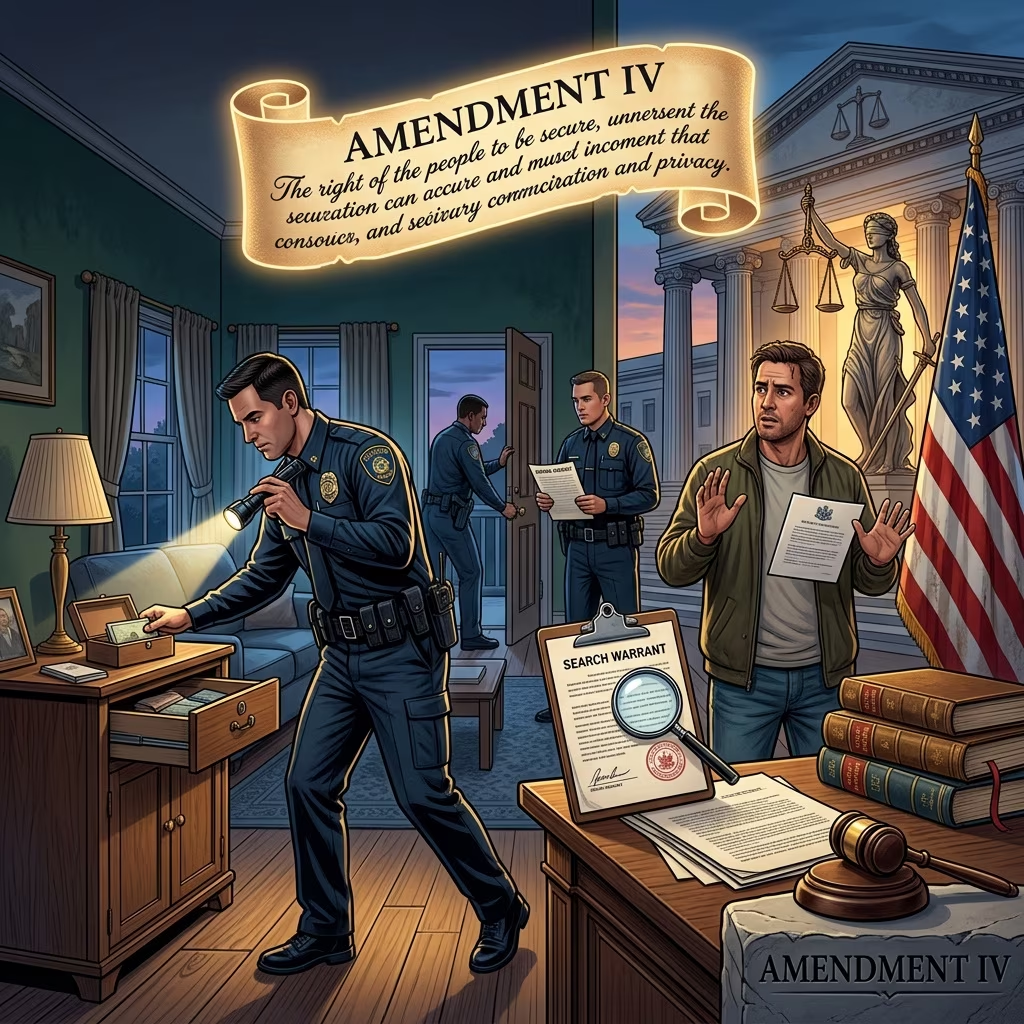
The Fourth Amendment states that people have the right to be secure in their persons, houses, papers, and effects against unreasonable searches and seizures, and that warrants may issue only on probable cause, supported by oath or affirmation, and describing the place to be searched and the persons or things to be seized. In simple terms, it balances two goals:
- Protect individual privacy and security from government intrusion.
- Allow effective law enforcement when officers have lawful justification.
This balance has been refined through centuries of court decisions, especially by the Supreme Court, which interprets what counts as a search, when a search is unreasonable, and what exceptions exist to the warrant requirement.
2. Core Concepts: Searches, Seizures, and Reasonableness
2.1 What Is a “Search”?
A search occurs when the government intrudes on an area where a person has a reasonable expectation of privacy. That expectation is shaped by social norms, technology, and legal precedent.
Common examples include:
- Entering and looking around inside a home.
- Opening a backpack, purse, or locker controlled by a student.
- Accessing data on a cell phone or laptop.
2.2 What Is a “Seizure”?
A seizure happens when government officials meaningfully interfere with a person’s freedom of movement or take possession of property. Examples include:
- Stopping someone on the street and preventing them from leaving.
- Detaining a car during a traffic stop.
- Confiscating a backpack, phone, or other personal item.
2.3 Reasonable vs. Unreasonable
The Fourth Amendment forbids unreasonable searches and seizures, not all searches and seizures. Whether a particular action is reasonable depends on factors such as:
- Government interests: public safety, crime prevention, school order.
- Individual interests: privacy, dignity, security.
- Procedural safeguards: warrants, probable cause, clear limits on scope.
Courts often weigh these competing interests. In schools, for example, the Supreme Court has applied a more flexible standard than in private homes, recognizing the special needs of the school environment.
3. Warrants, Probable Cause, and Key Exceptions
3.1 The General Rule: Warrants Required
As a general rule, police must obtain a warrant from a judge before conducting a search, especially inside a home. Warrants must be based on probable cause, meaning there is a fair probability that evidence of a crime will be found in the place to be searched.
Warrants are important because they:
- Add an independent review by a judge.
- Limit where officers can search and what they can seize.
- Provide written documentation of the legal basis for the search.
3.2 Warrantless Searches in Homes
Searches and seizures inside a home without a warrant are typically considered unreasonable. However, the Supreme Court recognizes narrow exceptions, including:
- Consent: When a person with authority voluntarily allows officers to search.
- Search incident to arrest: Limited search around a lawfully arrested individual for weapons or evidence.
- Exigent circumstances: Emergency situations where waiting for a warrant could threaten life, allow escape, or lead to destruction of evidence.
- Plain view: Items obviously related to criminal activity that officers lawfully observe without entering hidden areas.
3.3 Vehicles and Traffic Stops
Vehicles are treated differently because they are mobile and used on public roads. Courts allow more flexibility for searches of cars than for homes.
- If officers have probable cause to believe a vehicle contains evidence of a crime, they may search areas where that evidence might reasonably be found.
- Officers may conduct traffic stops when they have reasonable suspicion of a traffic violation or criminal activity.
- During a lawful stop, officers may perform a limited pat-down of the driver or passengers for safety, even without belief that they are involved in a crime, if circumstances justify it.
- In some situations involving highway checkpoints, courts have allowed stops without individualized suspicion when there are special law enforcement concerns, such as border security or sobriety checkpoints.
4. Student Rights and Searches in Public Schools
4.1 How the Standard Changes at School
Students do not lose their Fourth Amendment rights at the schoolhouse gate, but the Supreme Court has adjusted the standards to reflect the unique needs of schools. School officials are not treated the same as police officers and typically do not need warrants to search students under their authority.
Instead, courts apply a reasonableness test that asks:
- Was the search justified at its outset?
- Was the scope of the search reasonably related to the circumstances and not excessively intrusive?
In a leading case, the Court explained that searches of students must be reasonable at their inception and in their scope, taking into account the student’s age and sex and the nature of the alleged infraction.
4.2 The Two-Part Test for School Searches
For searches by school authorities, a widely cited framework considers two key questions:
| Stage | Legal Requirement | Typical Examples |
|---|---|---|
| Reasonable at inception | There must be reasonable grounds to suspect that the search will uncover evidence of a violation of law or school rules. | Teacher hears multiple students say someone is selling vape pens out of a particular backpack. |
| Reasonable in scope | The measures adopted must be related to the objectives of the search and not excessively intrusive in light of the student’s age, sex, and the nature of the suspected violation. | Checking pockets and bags for prohibited items; not escalating to highly invasive physical searches without strong justification. |
Courts have emphasized that highly invasive searches, such as body searches, require specific, reliable information pointing to serious wrongdoing and are rarely justified in the school context.
4.3 Group Searches and Random Testing
In general, the Fourth Amendment disfavors broad searches of entire groups without individualized suspicion. However, the Supreme Court has upheld some limited drug testing programs in schools under a “special needs” rationale, especially when students voluntarily participate in activities such as sports or extracurricular programs.
When designing school policies, administrators typically consider:
- Whether the testing policy is tailored to legitimate safety concerns.
- Whether students are given clear notice.
- Whether less intrusive measures could adequately protect school safety.
5. Everyday Scenarios: Home, School, Car, and Public Spaces
5.1 At Home
Because homes receive the highest level of protection, searches without warrants are usually presumed unreasonable. Key points for students to understand:
- Police generally need a warrant to enter and search a private residence, subject to exceptions such as consent or emergencies.
- Roommates or family members may sometimes grant consent to search common areas.
- The plain view exception allows officers to seize evidence they can clearly see from a lawful vantage point.
5.2 At School
In schools, student expectations of privacy are lower than at home, especially regarding lockers, desks, and participation in extracurricular activities. Policies often inform students that certain areas or items may be subject to inspection.
- Administrators may search a locker if there are reasonable grounds to suspect it contains contraband or evidence of rules violations.
- Teachers may inspect a backpack when there is credible information about forbidden items, such as drugs or weapons.
- Highly invasive searches, such as requiring removal of clothing, are rarely acceptable and demand a strong, specific basis.
5.3 In Your Car
Teen drivers and passengers are affected by Fourth Amendment rules whenever they are stopped by police. Important principles include:
- A traffic stop requires at least reasonable suspicion of a violation or crime.
- If officers develop probable cause that a car contains evidence of a crime, they may search areas where that evidence could reasonably be located.
- Officers may order drivers and passengers out of the vehicle and conduct limited pat-downs when justified by safety concerns.
5.4 In Public Spaces
In public, people generally have a lower expectation of privacy regarding what is visible or audible to others. However, the Fourth Amendment still protects against unreasonable seizures of persons.
- Brief stops (often called Terry stops) are permitted when officers observe unusual conduct that reasonably suggests criminal activity may be afoot and conduct limited questioning.
- Random checkpoints must be narrowly designed and usually involve specific, significant safety concerns such as drunk driving or border enforcement.
- Simply walking away from an officer or refusing to answer questions, absent other circumstances, does not usually justify a seizure.
6. Applying Landmark Cases to Modern Issues
Supreme Court decisions interpret the Fourth Amendment and guide how it applies to contemporary situations, including technology such as cell phones.[10] Many educational activities encourage students to analyze fact patterns and link them to key cases.
6.1 Technology and Privacy
Smartphones and laptops contain vast amounts of personal information. Courts have increasingly recognized that searches of digital devices may require special safeguards similar to those that protect homes and papers.[10] In schools, debates continue over:
- When administrators may inspect student phones.
- Whether monitoring school-issued devices is a search.
- How to craft policies that balance safety with privacy for students.
Educational exercises often ask students to compare earlier cases about paper documents or physical containers with scenarios involving text messages, social media, and cloud storage.[10]
6.2 Balancing Safety and Rights
Across settings, the central question is how to balance individual rights with collective safety. For example:
- Should schools have broad authority to search lockers without suspicion?
- When is random drug testing justified?
- How do we handle anonymous tips about weapons or threats on campus?
Activities that use hypothetical situations—such as search scenarios in buses, parking lots, or classrooms—help students apply Fourth Amendment principles to realistic problems.
7. Classroom Ideas and Discussion Questions
Teachers can encourage critical thinking about the Fourth Amendment through interactive methods. While specific lesson plans vary, common strategies include:
- Position spectrums: Students physically line up along a continuum from “strong privacy protection” to “strong security priority” and explain their views.
- Mock hearings: Students role-play as lawyers and judges, arguing whether particular searches are constitutional.
- Case jigsaws: Small groups analyze different Supreme Court cases and share how each decision shapes modern rules.
Discussion prompts might include:
- How would you define a “reasonable” search in your school?
- Do students have the same privacy rights as adults? Why or why not?
- How should the law respond to new technologies that change what can be searched?
8. Frequently Asked Questions (FAQs)
Q1: Do students have Fourth Amendment rights at school?
Yes. Students are protected against unreasonable searches and seizures at school. However, school officials usually do not need warrants, and searches are judged under a more flexible reasonableness standard that considers school safety and discipline.
Q2: Can a teacher search my backpack without asking?
A teacher or administrator typically needs reasonable grounds to suspect that your backpack contains evidence of a violation of law or school rules. The search must also be limited in scope and not overly intrusive for the situation and your age.
Q3: Do police always need a warrant to search a house?
Police usually must obtain a warrant to search a home, and warrantless home searches are presumptively unreasonable. Exceptions exist for consent, emergencies, searches incident to arrest, and items in plain view when officers are lawfully present.
Q4: What is the difference between probable cause and reasonable suspicion?
Probable cause is a higher standard requiring a fair probability that evidence of a crime will be found or that a person committed a crime. Reasonable suspicion is a lower standard allowing brief stops or limited searches when specific facts suggest possible criminal activity, such as unusual behavior or a traffic violation.
Q5: Can my school require random drug testing?
Courts have allowed some forms of random drug testing, especially for students in extracurricular activities, under a special needs doctrine that balances privacy against safety. The constitutionality of a particular policy depends on how it is structured and justified.
References
- What Does the Fourth Amendment Mean? — United States Courts. 2023-03-01. https://www.uscourts.gov/about-federal-courts/educational-resources/about-educational-outreach/activity-resources/what-does-fourth-amendment-mean
- Public Schools: Fourth Amendment — Search and Seizure — Justia (U.S. Constitution Annotated). 2020-01-15. https://law.justia.com/constitution/us/amendment-04/22-public-schools.html
- Search and Seizure in the Public Schools — EBSCO Research Starters. 2014-06-01. https://www.ebsco.com/research-starters/law/search-and-seizure-public-schools
- The Fourth Amendment — Bill of Rights Institute Homework Help Series. 2021-09-01. https://billofrightsinstitute.org/videos/the-fourth-amendment-bris-homework-help-series/
- Fourth Amendment Activities — United States Courts. 2022-05-01. https://www.uscourts.gov/about-federal-courts/educational-resources/educational-activities/fourth-amendment-activities
- Module 11: The Fourth Amendment — National Constitution Center. 2018-08-01. https://constitutioncenter.org/education/constitution-101-curriculum/11-the-fourth-amendment