Genocide is widely regarded as one of the gravest crimes in international law, often described as the “crime of crimes” because it targets entire groups for physical destruction. To understand how genocide is addressed in criminal law, it is essential to look at its formal definition, the required elements prosecutors must prove, and the way this offense fits within the broader framework of international and domestic criminal justice.
What Does the Law Mean by Genocide?
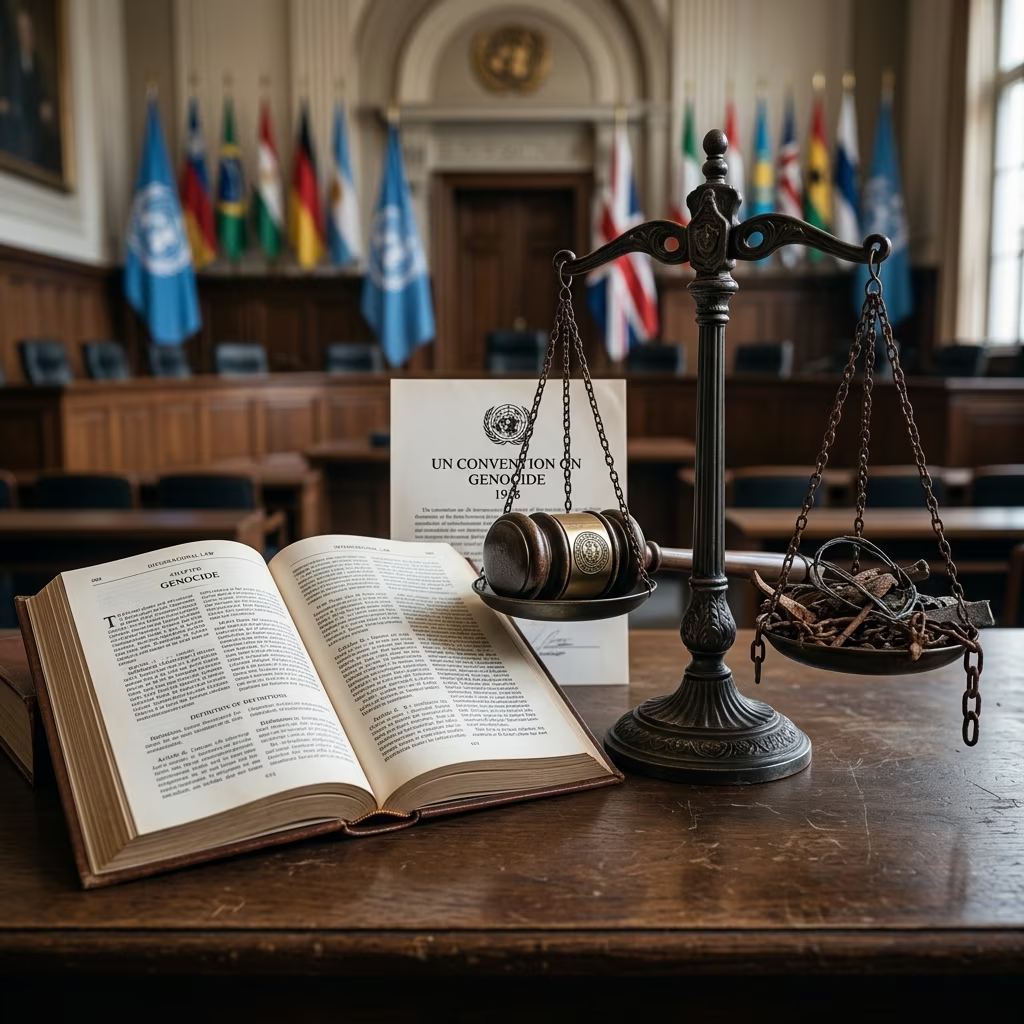
Genocide is not simply mass killing. In law, it has a very specific meaning that was codified in the Convention on the Prevention and Punishment of the Crime of Genocide (commonly called the Genocide Convention) adopted by the United Nations General Assembly in 1948.
Under Article II of the Genocide Convention, genocide consists of certain prohibited acts committed with a particular intent: the intent to destroy, in whole or in part, a national, ethnic, racial, or religious group, as such. This definition has been incorporated into many national legal systems and is applied by international courts.
| Element | Description |
|---|---|
| Protected group | National, ethnic, racial, or religious group targeted as such. |
| Mental element | Specific intent to destroy the group in whole or in part. |
| Physical acts | One or more of five enumerated acts, such as killing or causing serious harm. |
The Mental Element: Special Intent to Destroy a Group
One of the most demanding aspects of proving genocide is establishing the perpetrator’s specific intent (often called dolus specialis). The Genocide Convention and subsequent jurisprudence make clear that it is not enough that large numbers of people are killed or harmed; prosecutors must show that the perpetrators intended to destroy the group as such, at least in substantial part.
Courts and tribunals look for evidence of this destructive intent in:
- Policy documents, orders, or plans issued by political or military leaders.
- Systematic patterns of violence directed at a particular group rather than random attacks.
- Statements, speeches, or propaganda that call for elimination or annihilation of the group.
- Selection of victims based solely on their membership in the protected group, regardless of individual behavior.
The focus on the group as the target is crucial. The victims are deliberately selected because of their real or perceived membership in one of the protected groups, not because of personal actions or political opinions. Political groups, for example, are not explicitly listed in the Convention, which has led to legal and scholarly debates about the scope of protection.
The Physical Acts That Can Constitute Genocide
Alongside the mental element, the law specifies five categories of conduct which, when carried out with the requisite intent, amount to genocide. These acts are exhaustively listed in Article II of the Genocide Convention:
- Killing members of the group – direct, intentional killings targeting group members.
- Causing serious bodily or mental harm – including torture, severe physical violence, or psychological trauma.
- Deliberately inflicting conditions of life calculated to bring about physical destruction – for example, forced starvation, denial of medical care, or forced displacement into lethal environments.
- Imposing measures intended to prevent births within the group – such as forced sterilization, systematic sexual violence intended to prevent reproduction, or discriminatory measures that obstruct family formation.
- Forcibly transferring children of the group to another group – removing children from their group and placing them elsewhere with the aim of erasing their group identity.
Any of these acts can qualify as genocide if they are carried out with the intent to destroy the protected group in whole or in part. Without that specific intent, the conduct may still be criminal—potentially as war crimes or crimes against humanity—but it will not meet the legal threshold for genocide.
Related Offenses Under the Genocide Convention
The Genocide Convention does more than define genocide; it also identifies a set of related crimes that states must punish. Article III of the Convention lists the following offenses:
- Genocide itself.
- Conspiracy to commit genocide – agreement between two or more persons to commit genocide.
- Direct and public incitement to commit genocide – openly urging others to commit genocide.
- Attempt to commit genocide – taking substantial steps towards genocidal acts that are not completed.
- Complicity in genocide – assisting, aiding, or otherwise contributing to the commission of genocide.
By criminalizing these forms of participation, the Convention seeks to reach planners, propagandists, and facilitators, not only those who physically carry out genocidal acts.
Genocide, War Crimes, and Crimes Against Humanity: Key Differences
Genocide is part of a broader family of international crimes that includes war crimes and crimes against humanity. Understanding the differences is important for legal analysis and for public discussion of atrocities.
| Crime | Core Focus | Typical Context | Intent Requirement |
|---|---|---|---|
| Genocide | Destruction of a protected group (national, ethnic, racial, religious). | War or peace; context not limited to armed conflict. | Specific intent to destroy the group in whole or in part. |
| Crimes against humanity | Widespread or systematic attack on any civilian population. | May occur in war or peacetime. | Intent to carry out the attack; no need to aim at destroying a group. |
| War crimes | Serious violations of the laws and customs of war. | Must be linked to an armed conflict. | Intent to commit the prohibited act, such as targeting civilians. |
Another term frequently used in public debate is ethnic cleansing. International law does not recognize ethnic cleansing as an independent crime, though the conduct involved may amount to genocide, crimes against humanity, or war crimes, depending on the facts. United Nations reports have described ethnic cleansing as forcibly removing an ethnic or religious group from a territory, often through violent and terror-driven means.
International Legal Framework and Obligations of States
The Genocide Convention binds states that are parties to it. Article I affirms that genocide, whether committed in time of peace or war, is a crime under international law, and states undertake to prevent and punish it.
State obligations include:
- Criminalization – incorporating the Convention’s definition of genocide and related crimes into domestic law.
- Prosecution – bringing alleged perpetrators to trial in national courts or cooperating with international tribunals.
- Prevention – taking measures to deter and halt emerging genocidal campaigns, such as sanctions, diplomatic action, or security interventions consistent with international law.
- Cooperation – assisting other states and international bodies with investigations and extradition when appropriate.
In addition to the Convention, institutions such as the International Criminal Court (ICC) and ad hoc tribunals have jurisdiction over genocide and play a central role in enforcing these norms, although the specific jurisdictional rules depend on the court and the situation.
Genocide in U.S. and Domestic Criminal Law
Many countries, including the United States, have enacted domestic statutes that reflect the international definition of genocide. These laws typically:
- Adopt the Convention’s protected groups and core acts.
- Require proof of the same specific intent to destroy a group.
- Provide for significant penalties, often including life imprisonment.
- Allow prosecution of nationals and, in some cases, foreign perpetrators under certain jurisdictional bases such as territoriality or universal jurisdiction.
Domestic genocide laws operate alongside other criminal statutes, including those addressing terrorism, war crimes, and human rights abuses. Prosecutors must decide which charges best fit the evidence and the available legal tools in each jurisdiction.
Practical Challenges in Prosecuting Genocide
Despite its clear legal definition, genocide prosecutions are complex. Some of the recurring challenges include:
- Proving specific intent – establishing that leaders or perpetrators intended to destroy a group, rather than simply to achieve military or political objectives.
- Gathering evidence – collecting reliable documentation, witness testimony, and forensic proof in conflict zones.
- Political considerations – states may be reluctant to label atrocities as genocide due to diplomatic or strategic concerns.
- Jurisdiction and enforcement – securing custody of suspects and conducting fair trials, particularly when alleged perpetrators are senior officials or leaders.
These difficulties explain why international tribunals and domestic courts often charge crimes against humanity or war crimes even where some observers may see genocidal patterns. The available evidence and legal thresholds guide charging decisions.
Frequently Asked Questions About Genocide Law
Does mass killing always qualify as genocide?
No. Mass killing is a tragic and serious crime, but it is legally classified as genocide only when it is directed against a protected group with the intent to destroy that group in whole or in part. Otherwise, it may be prosecuted as crimes against humanity, war crimes, or other serious offenses.
Can genocide occur outside of war?
Yes. The Genocide Convention makes clear that genocide is illegal “whether committed in time of peace or in time of war.” Many genocides or genocidal campaigns have taken place outside formal armed conflicts or alongside internal political struggles.
Are political groups protected under the Genocide Convention?
Political groups are not explicitly listed among the protected groups in Article II, which focuses on national, ethnic, racial, and religious groups. However, if political persecution overlaps with persecution of one of these protected groups, conduct may still be charged as genocide, depending on the facts and the group targeted.
What is the difference between genocide and ethnic cleansing?
Ethnic cleansing refers to policies designed to remove a group from a territory, often through force or intimidation. International law does not treat ethnic cleansing as a separate crime, but acts involved in ethnic cleansing can amount to genocide, crimes against humanity, or war crimes if the legal elements of those offenses are met.
Who can be prosecuted for genocide?
Individuals—not groups or states themselves—are criminally liable for genocide under international law. This includes political leaders, military commanders, and other actors who plan, order, or carry out genocidal acts or who conspire, incite, attempt, or are complicit in genocide. States can be held responsible in international forums for failing to prevent or punish genocide, but that is a separate question of state responsibility rather than criminal liability.
References
- Definitions of Genocide and Related Crimes — United Nations Office on Genocide Prevention and the Responsibility to Protect. 2023-01-01. https://www.un.org/en/genocide-prevention/definition
- Convention on the Prevention and Punishment of the Crime of Genocide — United Nations, Office of the High Commissioner for Human Rights. 1948-12-09. https://www.ohchr.org/en/instruments-mechanisms/instruments/convention-prevention-and-punishment-crime-genocide
- Genocide Convention — United Nations / Historical Overview via Wikipedia references. 1948-12-09. https://history.state.gov/historicaldocuments/frus1949v02/d251
- Introduction to the Definition of Genocide — United States Holocaust Memorial Museum. 2023-05-01. https://encyclopedia.ushmm.org/content/en/article/introduction-to-the-definition-of-genocide
- Genocide | Wex Legal Dictionary — Legal Information Institute, Cornell Law School. 2022-01-15. https://www.law.cornell.edu/wex/genocide
- Genocide and International Law — The British Academy. 2020-04-20. https://www.thebritishacademy.ac.uk/blog/genocide-and-international-law/
- International Law: Understanding Justice in Times of War — United Nations Regional Information Centre. 2023-02-10. https://unric.org/en/international-law-understanding-justice-in-times-of-war/