
Understanding FCC Robocall Rules and Your Rights
A practical, up-to-date guide to FCC robocall rules, consent requirements, exemptions, and how to fight back against illegal calls and texts.
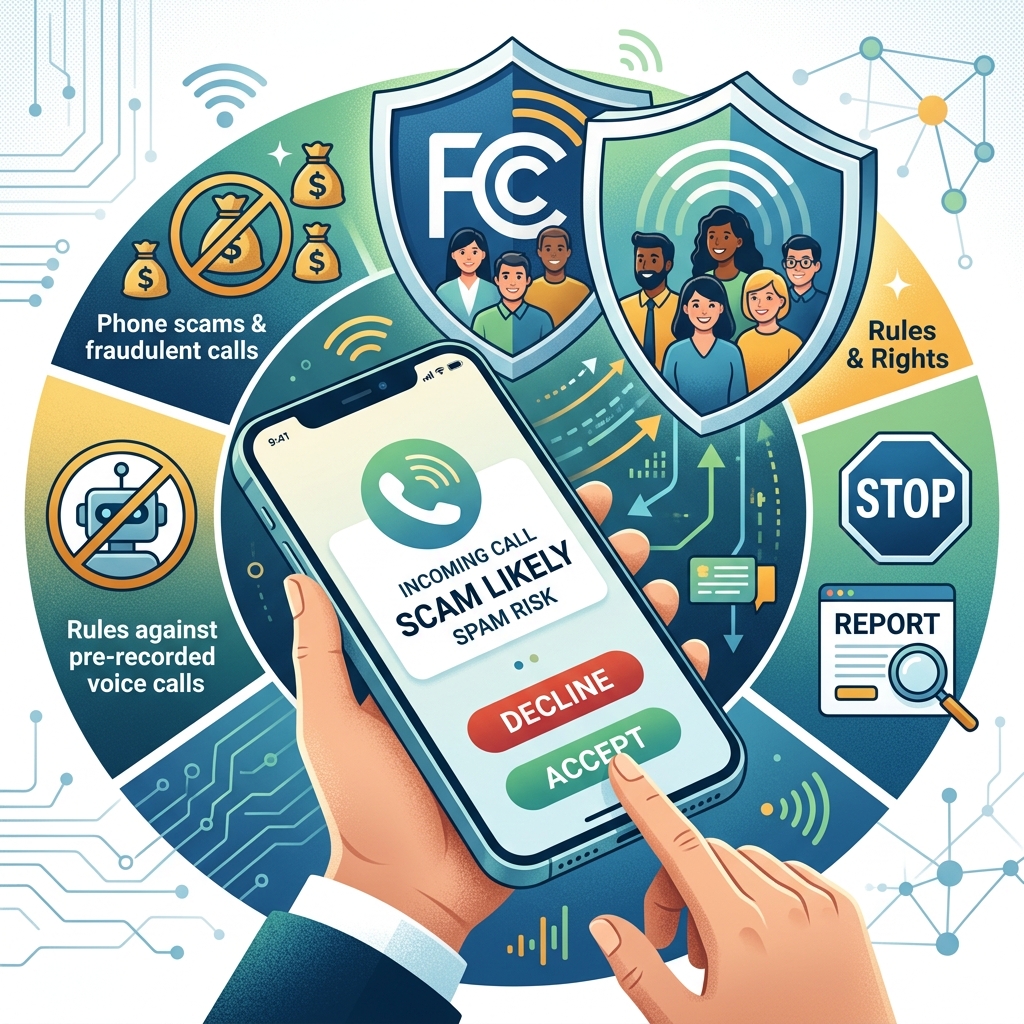
Robocalls and automated texts have become one of the most common consumer complaints in the United States, prompting the Federal Communications Commission (FCC) to adopt detailed rules that govern how, when, and why these calls may be made. This guide explains those rules in plain language, outlines your rights, and shows practical steps you can take to reduce unwanted calls and hold violators accountable.
What Counts as a Robocall?
The term robocall generally refers to any call or text message that is placed using an automatic dialing system or that delivers a prerecorded or artificial voice message. These can be telemarketing calls, informational notifications, scam calls, or even legitimate alerts from businesses or government agencies.
Under FCC and federal law, many robocalls are regulated by the Telephone Consumer Protection Act (TCPA) and related FCC regulations, which set clear limits on when companies may contact you using automated technology.
- Autodialed calls: Calls placed using equipment that can dial numbers without human intervention.
- Prerecorded/artificial voice calls: Calls where you hear a recorded message instead of a live person.
- Robotexts: Text messages sent using automated systems, often in large batches.
These rules apply to both wireless (mobile) numbers and many landline numbers, but the level of protection can differ depending on the type of call and the type of number.
Core FCC Rules: Consent Is the Starting Point
The foundation of FCC robocall regulation is the concept of prior express consent—your permission, given before the call or text occurs. In many cases, a caller must have your consent before making robocalls or robotexts to your phone.
Consent Requirements for Telemarketing Robocalls
Telemarketing robocalls—calls made to sell products or services—have the strictest rules.
- Written consent is required for telemarketing robocalls that use prerecorded or artificial voices to your home or mobile phone.
- Consent may be obtained electronically, for example through a website form or a keypress during a phone interaction, as long as it is clearly documented.
- Telemarketers cannot rely solely on an “established business relationship” to justify robocalls to your wireless number; they still need your express permission.
For telemarketing calls without prerecorded messages (live calls), additional rules apply, including limits on calling hours and respect for the National Do Not Call Registry.
Consent Rules for Non-Telemarketing and Informational Calls
Informational or non-marketing robocalls—such as appointment reminders, fraud alerts, or school closings—may be subject to slightly different rules, but consent is still critical for wireless numbers.
- Autodialed or prerecorded non-telemarketing calls to wireless numbers generally require your oral or written consent.
- Informational robocalls to landlines are more often permitted without prior consent, but can still be limited by other laws or rules.
Political, Nonprofit, and Other Special Categories
FCC rules treat some categories of robocalls differently:
- Political campaign robocalls and texts are prohibited to cell phones and other mobile devices without your prior express consent.
- Those same political robocalls may be allowed to traditional landline phones even without prior consent, though certain other rules still apply.
- Calls to sensitive lines—such as emergency numbers, hospital lines, and toll-free numbers—are subject to strict prohibitions on autodialed and prerecorded calls.
Key Exemptions: When Consent Is Not Required
Some robocalls are allowed without your prior consent because they serve pressing or socially valuable functions.
Emergency and Safety-Related Calls
Emergency calls that involve danger to life or safety are a major exception to consent requirements.
- Robocalls providing urgent information about threats to health or safety may be permitted without prior consent.
- Examples include severe weather warnings, evacuation notices, or public safety alerts from government agencies.
Certain Healthcare and Financial Alerts
Other categories may be subject to specific limits set by law or FCC rulemaking, such as healthcare or financial-related robocalls.
- For example, some healthcare-related residential robocalls (such as appointment reminders) are limited in frequency and content to reduce abuse.
- Fraud alerts or security notifications from financial institutions may be allowed under tightly defined conditions intended to protect consumers, not market services.
Your Right to Revoke Consent and Opt Out
Even when you have given consent, you retain the right to say stop. Both FCC rules and general consumer protection principles recognize your ability to revoke consent and opt out of future calls.
Opt-Out Tools During Robocalls
Telemarketing robocalls must give you an easy way to opt out immediately.
- For prerecorded telemarketing calls, FCC rules require an automated opt-out mechanism that is announced at the beginning of the message and available throughout the call.
- This opt-out tool must allow you to request no further robocalls from that caller, often by pressing a specific number.
Revoking Consent in Any Reasonable Manner
Beyond using on-call opt-out tools, you may revoke consent by other reasonable methods.
- You can withdraw consent in writing, over the phone, or using methods the caller provides, such as email or web forms.
- Consumer advocates advise keeping records of letters or communications revoking consent in case you need to prove a violation later.
The National Do Not Call Registry
The National Do Not Call Registry, administered by the Federal Trade Commission (FTC) in coordination with FCC rules, is a key tool for reducing unwanted telemarketing calls.
- You can add your number to the Registry online or by phone; once registered, most telemarketers must stop calling you within 31 days.
- Even if telemarketers are not using autodialers or prerecorded messages, the Registry generally prohibits them from calling registered numbers for sales purposes.
- If you keep receiving sales calls more than 31 days after registration, you can file a complaint with the FTC and, in some cases, the FCC.
| Type of Call | Effect of Registration |
|---|---|
| Telemarketing sales calls | Generally prohibited after your number has been on the Registry for 31 days. |
| Charitable or political calls | Often exempt, but other rules may still limit robocall use. |
| Informational or account-related calls | May still be allowed, especially when you’ve given consent. |
Technology-Based Protections: Caller ID Authentication and Blocking
Recognizing that rules alone cannot stop all illegal robocalls, the FCC has pushed telecommunications providers to adopt new technologies that help identify and filter suspicious calls.
STIR/SHAKEN Caller ID Authentication
Caller ID spoofing—displaying a fake number to trick you into answering—has been widely used by robocallers. To counter this, the FCC requires many providers to implement STIR/SHAKEN caller ID authentication in the IP portions of their networks.
- STIR/SHAKEN is a framework that verifies whether the caller ID information transmitted with a call can be trusted.
- Most major voice service providers and intermediate gateway providers must use this technology to authenticate caller ID information.
- As implementation expands, consumers and law enforcement can more easily trace illegal robocalls and reduce their effectiveness.
Robocall Mitigation Programs
The FCC also requires all voice providers, whether or not they implement STIR/SHAKEN, to adopt robocall mitigation programs aimed at preventing the origination and transmission of illegal robocalls.
- Providers must document their mitigation plans and file certifications with the FCC’s Robocall Mitigation Database.
- This creates accountability and helps the FCC identify providers that fail to control illegal traffic.
Consumer-Level Tools
On your end, you can combine regulatory protections with available tools:
- Use call-blocking features offered by your phone carrier or smartphone apps to filter suspected spam and robocalls.
- Consider enabling voicemail screening and only returning calls from known, verified numbers.
- Review caller ID and beware of local-looking numbers that may be spoofed.
How to Report Unwanted and Illegal Robocalls
Stopping illegal robocalls requires enforcement. Complaints from consumers help regulators identify patterns, investigate bad actors, and pursue penalties.
Filing Complaints with the FCC
The FCC provides an online complaint process for unwanted calls and texts.
- When reporting, you select “unwanted calls/texts” as the main issue and then choose the subtype that best describes your experience.
- If the call came from an international number in non-standard format, you can include that information in an additional details field.
- Consumers whose own numbers are being spoofed or incorrectly labeled as spam can also use the FCC complaint system.
Evidence to Keep for Possible Legal Action
In some situations, consumers may be able to seek damages under the TCPA against callers who violate robocall restrictions.
- Maintain records of calls and voicemails, including dates, times, and caller identity when available.
- Keep a written log summarizing conversations, especially if you asked the caller to stop or revoked consent.
- Retain copies of any letters or emails you sent to revoke consent.
Recent Developments and Evolving Rules
FCC robocall rules are not static. As technology and industry practices change, the Commission updates its regulations and guidance, and courts sometimes review the scope of FCC authority.
Changes to Consent Standards
Some recent legal decisions and proposals have addressed how strictly consent must be tied to specific callers or topics. For example, an appellate court has examined the validity of FCC rules that attempted to narrow what counts as prior express consent for telemarketing robocalls. While the details are technical, the overall trend highlights ongoing debate about how far the FCC can go in tightening consumer protections.
Continued Focus on AI and Novel Technologies
The FCC has also signaled that calls using artificial intelligence or synthetic voices are subject to the same rules as other prerecorded or artificial voice calls, including consent requirements and applicable prohibitions. As AI tools become more common, regulatory attention is likely to increase.
Practical Checklist: Reducing Robocalls Step by Step
Putting the rules into practice can feel overwhelming. The following checklist offers a simple sequence of actions.
- Register your number with the National Do Not Call Registry to block most sales calls.
- Review consents you have given to businesses and revoke any you no longer want, in writing or through provided channels.
- Use call-blocking tools from your provider or smartphone to filter suspected robocalls.
- Opt out during calls by using automated menus or requesting to be removed from call lists.
- Document violations with call logs and saved messages, especially for repeated unwanted calls.
- File complaints with the FCC and FTC when you receive illegal or persistent unwanted robocalls.
Frequently Asked Questions (FAQs)
Do all robocalls violate FCC rules?
No. Some robocalls are legal, especially when you have given prior express consent or when the call falls within an exemption such as an emergency alert or certain informational calls. Problems arise when callers ignore consent requirements, exceed frequency limits, or use robocalls for deceptive or abusive purposes.
Can I stop political robocalls?
Political robocalls to mobile phones generally require your prior consent, so you have stronger protections in that context. Political robocalls to landlines may be allowed even without your consent, but you can still ask campaigns to remove you from their lists and use call-blocking tools to reduce their impact.
What if my number is being spoofed?
If you discover that scammers are using your number as a fake caller ID to contact others, you can file a complaint with the FCC, choosing the option indicating that your own number is being spoofed. Call authentication technologies such as STIR/SHAKEN are intended to reduce this practice over time by making spoofing easier to detect and block.
Is adding my number to the Do Not Call Registry enough?
Registration significantly reduces legitimate telemarketing calls, but it does not stop all robocalls or illegal behavior. Bad actors may ignore the Registry, and certain types of calls, such as informational or political calls, may still be allowed. Combining registration with consent management, call-blocking tools, and complaint filing provides stronger protection.
Can I sue a company that keeps robocalling me?
In some circumstances, yes. The TCPA allows consumers to seek statutory damages for certain violations, such as repeated unauthorized autodialed or prerecorded calls. Before pursuing legal action, it is wise to consult a qualified attorney and gather detailed records of calls, consents, and any revocation communications.
References
- Stop Unwanted Robocalls and Texts — Federal Communications Commission. 2023-09-27. https://www.fcc.gov/consumers/guides/stop-unwanted-robocalls-and-texts
- Stop Illegal Robocalls and Texts (Consumer Guide PDF) — Federal Communications Commission. 2024-02-08. https://www.fcc.gov/sites/default/files/stop_unwanted_robocalls_and_texts.pdf
- Robocalls & Telemarketing — National Association of Consumer Advocates. 2022-06-01. https://www.consumeradvocates.org/for-consumers/robocalls-telemarketing/
- Combating Spoofed Robocalls with Caller ID Authentication — Federal Communications Commission. 2023-11-16. https://www.fcc.gov/call-authentication
- Unwanted Calls/Texts – Phone — Federal Communications Commission Consumer Complaints. 2022-05-10. https://consumercomplaints.fcc.gov/hc/en-us/articles/115002234203-Unwanted-Calls-Texts-Phone
- The FCC Imposes New Requirements on Non-Marketing Residential Robocalls — Brownstein Hyatt Farber Schreck. 2021-12-30. https://www.bhfs.com/insight/the-fcc-imposes-new-requirements-on-non-marketing-residential-robocalls/
Similar Articles








Read full bio of medha deb


