
Understanding Criminal Intent and a Defendant’s Mental State
Explore how a defendant’s mental state, intent levels, and legal defenses shape criminal responsibility and case outcomes.
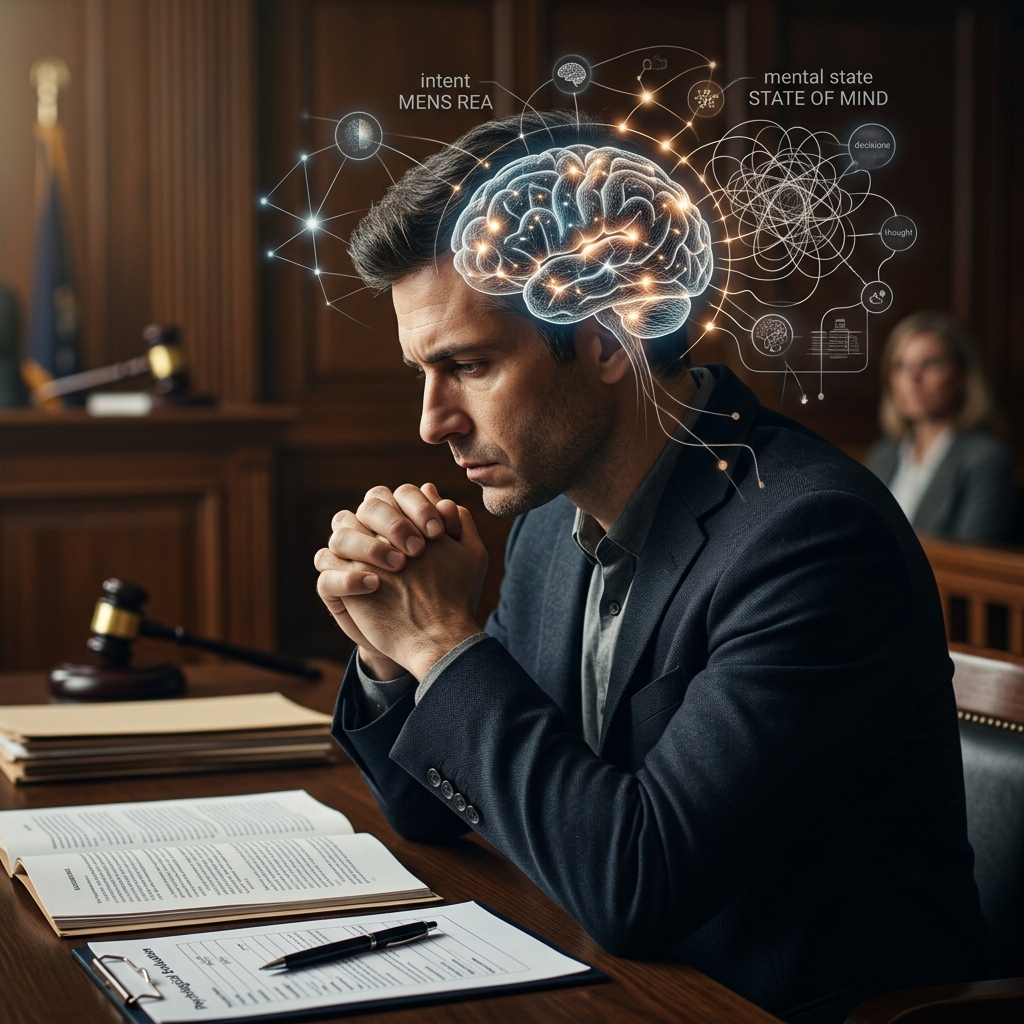
In criminal law, a defendant’s mental state at the time of the alleged offense is often just as important as what they physically did. Most crimes require proof of both a prohibited act and a culpable state of mind, known as criminal intent or mens rea (“guilty mind”).
This article explains how criminal intent works, why mental state matters, the core levels of culpability recognized in modern law, and how mental health and other factors can affect responsibility. It is designed to be a practical, plain-language guide for anyone trying to understand how courts evaluate a defendant’s mind when deciding guilt and punishment.
Why Mental State Matters in Criminal Cases
Criminal law traditionally punishes people not just for causing harm, but for doing so with a blameworthy mindset. The basic idea is that someone who intentionally engages in prohibited behavior is more morally and legally responsible than someone who causes harm accidentally.
- A guilty mind plus a guilty act usually must be proven beyond a reasonable doubt.
- Many crimes require a specific mental state; others are strict liability offenses that do not require proof of intent.
- The more blameworthy the mental state, the more severe the potential punishment tends to be.
Without a mental state requirement, people could be convicted for purely accidental harm even when they exercised reasonable care. For that reason, most modern criminal codes insist that the prosecution prove some form of mens rea for the majority of offenses.
Actus Reus and Mens Rea: The Two Pillars of Crime
To understand criminal intent, it helps to distinguish between two core elements of a crime:
| Element | Meaning | Role in a Criminal Case |
|---|---|---|
| Actus reus | The physical act or omission that violates a criminal statute. | Shows what the defendant did or failed to do. |
| Mens rea | The mental state required by law for a particular crime. | Shows the defendant’s awareness, purpose, or disregard when acting. |
In most prosecutions, the state must prove both that the defendant engaged in the prohibited conduct and that they did so with the statutorily required mental state. A mismatch between the alleged act and the required intent can defeat a charge.
Common Mental States in Modern Criminal Law
Many jurisdictions follow the approach of the Model Penal Code (MPC), which organizes criminal intent into four main levels:
- Purpose (or “purposely”)
- Knowledge (or “knowingly”)
- Recklessness (or “recklessly”)
- Negligence (or “negligently”)
These mental states are ranked from most to least culpable. The more deliberate or aware the defendant was, the more serious the offense and the potential penalty tend to be.
Purpose: Acting With a Specific Aim
A person acts purposely when they consciously desire a particular result. This is the highest level of mens rea under the MPC.
- The defendant’s goal is to bring about the prohibited outcome.
- Purpose often applies to crimes such as intentional homicide or premeditated assault.
- Purpose is similar to what older common-law doctrine called specific intent to cause a particular result.
Knowledge: Awareness of Virtual Certainty
Acting knowingly means the defendant is aware that a result is practically certain to follow from their conduct, even if they do not positively wish for that result.
- The focus is on awareness of the consequences, rather than desire.
- Knowledge can apply when someone continues risky conduct while understanding the near-certain harm it will cause.
- Under the MPC, knowledge is slightly less culpable than purpose but still blameworthy.
Recklessness: Conscious Disregard of Risk
Recklessness involves being aware of a substantial and unjustifiable risk of harm, yet choosing to ignore that risk.
- The defendant knows there is a serious danger but proceeds anyway.
- The risk must be significant enough that ignoring it represents a gross deviation from how a reasonable person would act.
- Many traffic offenses and endangerment crimes use recklessness as the relevant mental state.
Negligence: Failure to Perceive a Serious Risk
Negligence is the lowest level of mens rea in the MPC framework. It arises when the defendant should have been aware of a substantial risk but was not, and a reasonable person in the same situation would have recognized it.
- The key is what a reasonable person would perceive, not what the defendant actually knew.
- Negligence often appears in crimes such as negligent homicide or child endangerment.
- Even without intent to harm, failing to exercise reasonable care can support criminal liability in some situations.
Common-Law Intent: General vs. Specific
Before the MPC, courts commonly described intent in terms of general intent and specific intent. Many jurisdictions still use these terms alongside or instead of the MPC categories.
- General intent is the intent to perform the criminal act itself. The defendant meant to do the conduct that the law forbids.
- Specific intent refers to an intent that goes beyond merely doing the act, such as intending a further result or consequence (for example, intending to steal, not merely to take property).
Understanding whether an offense requires general or specific intent is crucial, because certain defenses are available only when the charge involves specific intent.
Strict Liability: When Intent Does Not Matter
Not all crimes require proof of a mental state. For some offenses, usually regulatory or public-welfare crimes, the legislature has removed the mens rea requirement. These are known as strict liability crimes.
- A defendant may be convicted even if they acted carefully and had no bad intentions.
- Typical examples include certain traffic violations or regulatory offenses involving health, safety, or environmental rules.
- The policy justification is often that protecting the public is more important than examining each defendant’s mental state.
Strict liability is the exception rather than the rule. Because it removes the requirement to prove a guilty mind, courts and legislatures usually limit it to specific categories of offenses.
Mental Health and the Ability to Form Criminal Intent
Mental health conditions can significantly influence whether a person is capable of forming the intent required for a crime. Serious mental disorders may impair judgment, perception, and understanding of reality, raising questions about criminal responsibility.
- Some defendants may not fully understand the nature or consequences of their actions.
- Others may be unable to distinguish right from wrong at the time of the offense.
- In appropriate cases, mental health evidence can support defenses such as insanity or diminished capacity.
Courts must balance individual fairness with public safety. They rely on psychiatric and psychological evaluations to determine whether a defendant had the capacity to form the required mens rea and whether they are competent to stand trial.
Key Defenses Related to Mental State
Several defenses in criminal law focus directly on the defendant’s mental state. These defenses do not deny that an act occurred; instead, they challenge whether the defendant was legally responsible in light of their mind at the time.
Insanity Defense
The insanity defense asserts that, due to a severe mental disease or defect, the defendant was unable to understand the nature of their actions or to distinguish right from wrong when the offense occurred.
- When successful, insanity typically negates the entire mens rea for the crime.
- A defendant found not guilty by reason of insanity is generally not punished in the usual criminal sense but may be committed to a secure treatment facility.
- Jurisdictions use different legal tests (such as the M’Naghten Rule) to evaluate insanity at the time of the offense.
Diminished Capacity
Diminished capacity is a partial defense that argues the defendant’s mental condition prevented them from forming a specific intent required for a more serious offense.
- It does not eliminate criminal liability but can reduce the level of the charge.
- For example, proving diminished capacity might result in conviction for a lesser included offense that requires only general intent.
- This defense commonly relies on expert testimony about the defendant’s mental functioning.
Intoxication and Mens Rea
Drug or alcohol intoxication can affect awareness and judgment, but its impact on criminal liability is limited. In most jurisdictions, intoxication alone is not enough to support an insanity defense.
- Voluntary intoxication may sometimes be used to challenge whether the defendant had specific intent, but this depends heavily on local law.
- Involuntary intoxication—when the defendant did not choose to ingest the substance—may provide a stronger defense in some cases.
- Courts are cautious about allowing intoxication to excuse criminal behavior, especially where public safety is at stake.
Competency to Stand Trial: A Different Mental Question
Beyond intent at the time of the offense, courts also examine whether a defendant is competent to stand trial. Competency focuses on the present ability to understand the proceedings and assist in one’s own defense, not on past intent.
- If a defendant is found incompetent, the trial is usually suspended.
- Courts often order treatment aimed at restoring competency so the case can proceed.
- Competency determinations protect the fairness and legitimacy of the criminal process.
How Intent Influences Charges and Sentences
The level of intent proven in a case can make the difference between a minor offense and a serious felony. Legislatures often create different degrees of the same crime based on the defendant’s mental state.
- Higher levels of intent (such as purpose or knowledge) typically carry longer prison terms and larger fines.
- Lower levels (such as recklessness or negligence) may be punished less severely, recognizing the difference in blameworthiness.
- In some situations, proving only negligence rather than recklessness can change felony charges into misdemeanors.
Intent also influences collateral consequences. A conviction for an intentional violent offense may lead to stricter parole conditions, professional licensing issues, or immigration consequences compared to a negligent or strict liability offense.
Practical Tips for Defendants and Families
People facing criminal accusations, or their families, often struggle to understand how mental state will be evaluated. While each case is unique, some general considerations are helpful:
- Document mental health history: Prior diagnoses, medications, and hospitalizations may be relevant to defenses based on mental state.
- Seek legal counsel early: An attorney can explain which mental state the prosecution must prove and what evidence might challenge it.
- Consider expert evaluations: Psychologists or psychiatrists can assess capacity to form intent and competency to stand trial.
- Understand limits of defenses: Insanity and diminished capacity are legally complex and may not apply to every mental health condition.
Because the rules around mens rea, mental health, and defenses vary by jurisdiction, personalized legal advice is crucial. General information cannot substitute for guidance from a qualified criminal defense lawyer.
Frequently Asked Questions About Criminal Intent
Does a person need to know that their conduct is illegal to have mens rea?
Generally, a defendant does not need to know that their conduct is against the law to be guilty of a crime. The mens rea requirement focuses on awareness of the conduct and its consequences, not on knowledge of the statute itself.
Can someone be convicted without any proof of intent?
Yes, but only for certain strict liability offenses, where the legislature has removed the need to prove a mental state. For most crimes, however, the prosecution must show some level of intent, such as purpose, knowledge, recklessness, or negligence.
How is intent proved in court?
Intent is rarely proved by direct evidence of a defendant’s thoughts. Instead, prosecutors rely on circumstantial evidence—such as actions, statements, planning behavior, and the nature of the harm—to persuade the jury about the defendant’s mental state.
Can mental illness completely excuse criminal behavior?
Severe mental illness can support an insanity defense, which may excuse criminal responsibility if legal criteria are met. However, many mental health conditions do not meet the strict standards for insanity and instead may be considered in sentencing or as part of a diminished capacity argument.
What is the difference between recklessness and negligence?
With recklessness, the defendant is aware of a substantial risk and consciously disregards it. With negligence, the defendant fails to perceive a substantial risk that a reasonable person would have noticed. Both can support criminal liability, but recklessness is generally considered more blameworthy and often punished more severely.
References
- Mens rea | Wex | US Law — Legal Information Institute (Cornell Law School). 2023-01-01. https://www.law.cornell.edu/wex/mens_rea
- The Mental State Requirement in Criminal Law Cases — Justia. 2022-05-10. https://www.justia.com/criminal/mental-state-requirement/
- 4.2 Criminal Intent | Criminal Law — Lumen Learning. 2020-08-15. https://courses.lumenlearning.com/suny-fmcc-criminallaw/chapter/4-2-criminal-intent/
- Mens Rea: The Criminal State of Mind — LawShelf Educational Media. 2019-11-01. https://www.lawshelf.com/shortvideoscontentview/mens-rea-the-criminal-state-of-mind/
- Drug and Alcohol Intoxication: Mens Rea Defenses — American Academy of Psychiatry and the Law Newsletter. 2015-03-01. https://www.aapl.org/docs/newsletter/N241_mens_rea_defenses.htm
- How Does Mental Health Impact Criminal Intent? — West Michigan Defense Team. 2024-02-20. https://www.wmdtlawyers.com/blog/how-does-mental-health-impact-criminal-intent/
- How Defendants’ Mental States Affect Their Responsibility for a Crime — Anthem EAP / LegalAssist. 2021-06-01. https://www.anthemeap.com/northside-hospital/find-legal-support/resources/criminal-law/legal-assist/how-defendants-mental-states-affect-their-responsibility-for-a-crime
Similar Articles








Read full bio of Sneha Tete




