
Understanding Criminal Investigations in the United States
Learn how criminal investigations begin, how evidence is gathered, and how cases move from suspicion to possible charges.
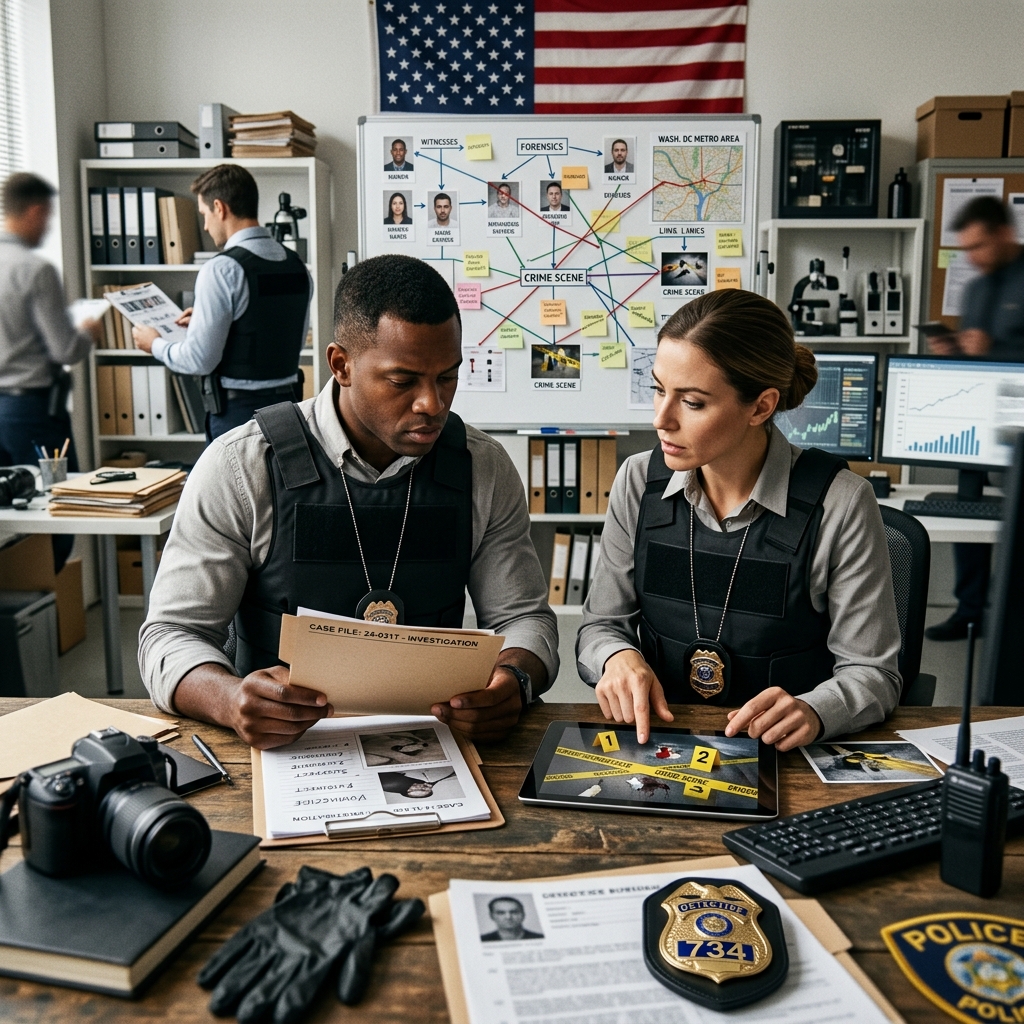
Criminal investigations form the bridge between a suspected crime and the courtroom. They are not a single event but a sequence of decisions and actions designed to answer core questions: Did a crime occur, who is responsible, and can it be proven with reliable evidence? This article explains how modern criminal investigations typically unfold in the United States, what rights and standards apply, and when legal help becomes critical.
What Is a Criminal Investigation?
A criminal investigation is the process by which law enforcement and related agencies collect, analyze, and interpret information to determine whether a crime was committed and, if so, who committed it.[10] The investigation focuses on building an objective factual record that can later support or defeat criminal charges in court.
Key goals of a criminal investigation include:
- Establishing whether a crime took place under applicable laws
- Identifying victims, witnesses, and potential suspects
- Collecting and preserving physical, digital, and testimonial evidence
- Reconstructing events in time and space as accurately as possible
- Providing prosecutors with a complete and legally admissible case file
Investigations can be handled by local police, state authorities, or federal agencies such as the FBI, IRS Criminal Investigation, Drug Enforcement Administration, or Homeland Security Investigations, depending on the nature and scope of the suspected offense.
How Criminal Investigations Are Initiated
Investigations usually begin when law enforcement learns of possible criminal conduct. Under federal and state practice, the starting point is rarely a single formal step but one of several common triggers.
Common Ways an Investigation Begins
- Victim reports – A person or business reports a theft, assault, fraud, or other harm to police or a federal agency.
- Witness tips – Bystanders, employees, or community members report what they saw or heard, including anonymous tips.
- Law enforcement observation – Officers personally witness suspicious behavior or an apparent crime in progress.
- Regulatory or financial anomalies – Agencies such as the IRS may detect irregular tax returns, unusual financial transactions, or Bank Secrecy Act violations that warrant criminal inquiry.
- Interagency referrals – Administrative or civil regulators, such as securities or environmental agencies, refer potential criminal matters to prosecutors or investigative agencies.
Not every complaint becomes a full-scale criminal case. Investigators and prosecutors screen incoming information to decide whether it potentially violates criminal law, whether evidence is realistically obtainable, and whether the matter warrants the commitment of investigative resources.
Early Response and Securing the Scene
When police respond to a reported crime, their first priority is safety and stabilization. Only after immediate dangers are controlled does systematic evidence collection begin.
Initial Priorities at a Crime Scene
- Protect life and safety – Provide medical aid, neutralize ongoing threats, and ensure safety of officers and bystanders.
- Secure and control the area – Establish perimeters, control access, and prevent unnecessary movement that could destroy evidence.
- Preliminary assessment – Note obvious signs of forced entry, disturbances, or fleeing suspects and relay information to assisting units.
Once the scene is safe, investigators shift to documentation and preservation of the physical environment as it existed immediately after the event.
Gathering and Preserving Evidence
Evidence is at the core of any criminal case. Investigators use a mix of documentation methods, scientific techniques, and legal procedures to collect it while preserving its integrity for court.
Documenting the Scene
Investigators commonly rely on three complementary forms of documentation:
- Photographs – Wide, medium, and close-up shots capture the overall scene, the position of the body or objects, and detailed views of items such as weapons or bloodstains.
- Sketches and diagrams – Scaled drawings record distances and spatial relationships, helping jurors understand how events unfolded.
- Written notes – Detailed notes capture conditions (lighting, weather, odors), item descriptions, and actions taken, forming the basis of later reports.
Types of Physical and Digital Evidence
Evidence can take many forms, and its value depends on reliability, proper handling, and legal admissibility.
- Physical evidence – Fingerprints, DNA, weapons, clothing, tool marks, and other tangible objects collected under controlled conditions.
- Biological samples – Blood, hair, bodily fluids, or tissue subjected to forensic analysis.
- Digital evidence – Data from phones, computers, cameras, or online accounts, often obtained via warrants or consent and analyzed by specialists.
- Documents and records – Contracts, emails, tax filings, bank statements, or business logs relevant to financial or fraud cases.
Chain of Custody and Integrity
To use evidence in court, investigators must show that it is authentic and unchanged. This is maintained through a documented chain of custody—a record of who collected, handled, transferred, and stored each item. Breaks in this chain can lead to challenges and possible exclusion of evidence at trial.
Interviews, Statements, and Suspect Questioning
Testimonial evidence—what people saw, heard, or experienced—is another major component of an investigation. Investigators interview many categories of individuals, each with different rights and risks.
Types of Interviews
- Witness interviews – People with direct or indirect knowledge of events describe what they observed. Their accounts can be crucial to reconstructing timelines and corroborating physical evidence.
- Victim statements – Victims explain what happened, the harm suffered, and any known information about the suspect.
- Informant or tipster contacts – Confidential sources may provide leads, but their credibility and motivations must be evaluated carefully.
Questioning Suspects and Constitutional Rights
When someone is a suspect and in custody, constitutional protections become central. Under U.S. law, custodial interrogations generally require warnings about the right to remain silent and the right to an attorney. Statements must be voluntary and not coerced to be admissible in court.
Suspects may:
- Choose to remain silent
- Request a lawyer before or during questioning
- Stop answering questions at any time
Investigators must balance the need for information with constitutional requirements and ethical questioning practices.
Legal Thresholds: Reasonable Suspicion, Probable Cause, and Beyond
Investigative steps are constrained by legal standards that protect individual rights. The level of proof needed rises as the government’s intrusion increases.
| Standard | General Meaning | Typical Uses |
|---|---|---|
| Reasonable suspicion | Specific, articulable facts suggesting criminal activity may be occurring. | Brief investigative stops, limited pat-downs in some circumstances. |
| Probable cause | Facts and circumstances that would lead a reasonable person to believe a crime was committed and the person or place is linked to it. | Arrest warrants, search warrants, some warrantless arrests. |
| Proof beyond a reasonable doubt | The highest standard in law, leaving jurors firmly convinced of guilt. | Required for conviction at trial. |
These standards help courts evaluate whether investigators were justified in stopping individuals, searching property, or making arrests.
Searches, Warrants, and Seizures
Many investigative techniques involve searching people, homes, vehicles, or digital accounts to find evidence. In the federal system and in most states, the U.S. Constitution’s Fourth Amendment governs when and how such searches may occur.
Search Warrants
As a general rule, police must obtain a search warrant from a neutral judge before searching private areas such as residences or electronic devices. To secure a warrant, investigators submit a sworn affidavit explaining:
- The nature of the suspected crime
- The place to be searched and items to be seized
- Facts supporting probable cause that evidence will be found there
Judges review the affidavit and, if convinced, issue a warrant specifying the scope of the search.
Arrests and Arrest Warrants
An arrest deprives a person of liberty, so it also requires probable cause. Arrests may occur:
- With an arrest warrant issued by a judge based on probable cause
- Without a warrant, if officers have probable cause, such as when they directly witness a serious crime
After arrest, federal rules and most state systems require that the person be brought promptly before a court for an initial hearing.
Analyzing Evidence and Identifying Suspects
Once initial evidence has been secured, investigators move into a more analytical phase. This stage involves testing hypotheses about what happened and comparing them against all available information.
Forensic and Analytical Work
- Laboratory testing – DNA analysis, fingerprint comparison, ballistics, toxicology, and trace evidence examination help connect or exclude individuals and objects.
- Digital forensics – Specialists recover and analyze data from seized devices, networks, and cloud accounts.
- Pattern and linkage analysis – Investigators study times, locations, and methods to link related crimes and identify possible offenders.
Developing and Narrowing Suspects
Investigators may start with a broad pool of potential suspects and then narrow it based on:
- Alibis and verified timelines
- Physical or digital evidence tying individuals to the scene or victims
- Witness identifications or descriptions, weighed for reliability
- Background information such as known motives, prior disputes, or similar past conduct
Modern investigative practice emphasizes avoiding tunnel vision, meaning that investigators are encouraged to consider alternative explanations and actively look for evidence that might disprove their working theories.
Referral to Prosecutors and Charging Decisions
When investigators believe they have assembled sufficient evidence, the case is typically referred to a prosecutor for review. At the federal level, United States Attorneys decide whether to bring formal charges, often after working closely with investigative agencies.
Prosecutor Review
Prosecutors evaluate whether:
- The evidence is legally obtained and admissible
- The facts satisfy the elements of specific criminal statutes
- The case is strong enough to meet the burden of proof at trial
- There are alternatives, such as civil enforcement or no action
If the prosecutor decides to proceed in federal court, charges may be filed through a complaint, information, or indictment, commonly after presentation to a grand jury.
Role of the Investigative Agencies
Different agencies bring specialized tools to criminal investigations. In the federal system, agencies such as the FBI, IRS Criminal Investigation, DEA, and Homeland Security Investigations have distinct mandates but often collaborate on complex cases.
- FBI – Handles a wide range of federal crimes, including terrorism, public corruption, organized crime, cybercrime, and major violent crimes.
- IRS Criminal Investigation – Focuses on violations of the Internal Revenue Code, the Bank Secrecy Act, and money laundering statutes.
- DEA – Investigates offenses involving controlled substances, including trafficking and illegal distribution networks.
- Homeland Security Investigations – Addresses immigration-related crimes, smuggling, trade violations, and certain cyber offenses.
Local and state police perform the bulk of day‑to‑day criminal investigations nationwide, often with support from state crime labs and specialized units.
When You May Need a Criminal Defense Lawyer
Because investigative actions can directly affect a person’s liberty and long-term record, seeking legal advice early in the process can be critical. Indicators that you should consult a criminal defense attorney include:
- You are contacted by police or federal agents who want to “ask some questions” about a crime.
- Officers execute a search warrant at your home, office, or on your devices.
- You receive a subpoena to testify or produce records in a criminal matter.
- You are arrested, booked, or informed that you are a suspect.
A defense lawyer can explain your rights, communicate with investigators on your behalf, and help you avoid statements or actions that could be misinterpreted later in court.
Frequently Asked Questions About Criminal Investigations
How long can a criminal investigation last?
There is no fixed length for an investigation. Minor property crimes may be resolved quickly, while complex financial or organized crime investigations can continue for months or years. Time limits are often governed by statutes of limitations, which set deadlines by which prosecutors must bring charges, not by how long police may investigate.
Do police have to tell me that I am under investigation?
Law enforcement is generally not required to inform someone that they are the subject of an investigation unless they are being arrested or questioned in custody. In many cases, investigators avoid alerting potential suspects to prevent destruction of evidence or flight.
Can I refuse to speak with investigators?
In the United States, individuals typically have the right to decline voluntary interviews and, if in custody, to invoke the right to remain silent and request an attorney. There are exceptions, such as basic identification requirements in certain situations, but you are not required to discuss the facts of a suspected crime without counsel.
What happens to evidence after the case ends?
After a case concludes, agencies may retain evidence for a defined period, especially in serious or violent offenses. Rules vary by jurisdiction and type of case. In some circumstances, individuals can petition for the return of seized property that is no longer needed as evidence.
Are all investigations handled the same way?
No. While the general framework—responding, collecting evidence, analyzing, and referring to prosecutors—is similar, specific procedures differ based on the type of crime, the agency involved, jurisdictional rules, and available resources. Homicide, cybercrime, tax fraud, and drug trafficking investigations each require specialized methods, tools, and expertise.
References
- How Criminal Investigations Are Initiated — Internal Revenue Service, Criminal Investigation Division. 2024-03-08. https://www.irs.gov/compliance/criminal-investigation/how-criminal-investigations-are-initiated
- The Criminal Investigation Process: An In-Depth Overview — American Public University System. 2023-05-11. https://www.amu.apus.edu/area-of-study/criminal-justice/resources/the-criminal-investigation-process/
- Criminal Investigations — Texas State University, Geographic Investigation Initiative. 2022-09-01. https://www.txst.edu/gii/research/criminal-investigations.html
- A Brief Description of the Federal Criminal Justice Process — Federal Bureau of Investigation. 2015-01-15. https://www.fbi.gov/how-we-can-help-you/victim-services/a-brief-description-of-the-federal-criminal-justice-process
- Investigation — United States Department of Justice, U.S. Attorneys. 2015-04-01. https://www.justice.gov/usao/justice-101/investigation
- Introduction to Criminal Investigation: Processes, Practices and Thinking — University of Minnesota Libraries Publishing. 2017-08-01. https://open.umn.edu/opentextbooks/textbooks/introduction-to-criminal-investigation-processes-practices-and-thinking
- The Criminal Investigation Process Volume III — U.S. Department of Justice, National Institute of Justice. 1983-01-01. https://www.ojp.gov/pdffiles1/Digitization/148118NCJRS.pdf
Similar Articles








Read full bio of Sneha Tete




