
Retrieving Seized Property After an Arrest
Understand how to reclaim money, vehicles, and personal items seized by police after an arrest, and the legal steps required when property is held as evidence or forfeited.
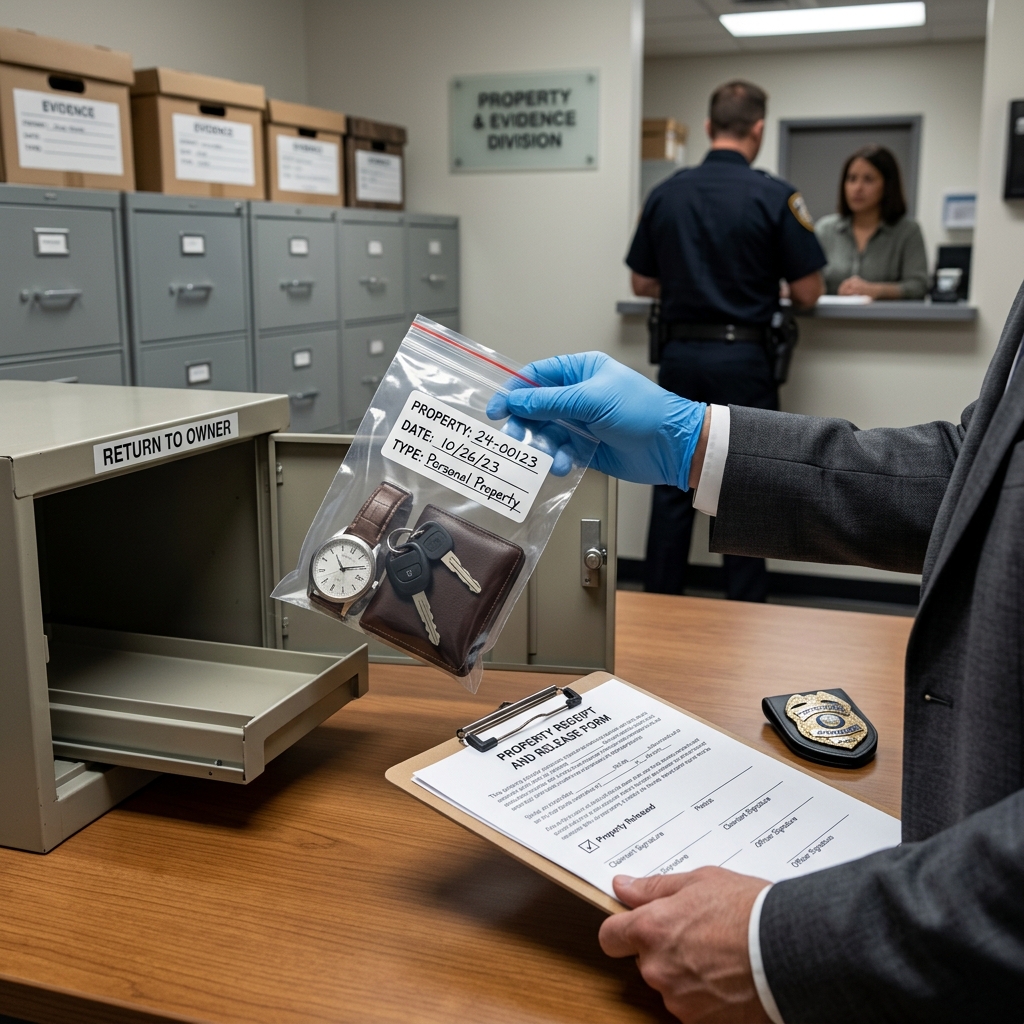
When police arrest someone, they often take control of that person’s belongings: cash, phones, jewelry, vehicles, and other personal items. What happens to this property, and how you can get it back, depends on why it was seized and how the law treats it. This guide explains the main categories of seized property, outlines typical procedures for reclaiming items, and highlights situations where you may need a court order or face permanent loss of your belongings.
Why Police Seize Property During or After an Arrest
Law enforcement agencies generally seize property for a small number of legally recognized reasons. Understanding the label placed on your belongings is critical, because it determines your rights and the process for recovery.
Common Legal Reasons for Seizing Property
- Safekeeping – Items taken only to protect them while you are in custody, such as a wallet, phone, or keys, so they are not lost or stolen.
- Evidence – Property believed to be connected to a crime, such as a weapon, drugs, or documents relevant to the charges.
- Contraband – Items that are illegal to possess at all, including controlled substances or unlawfully possessed firearms.
- Forfeiture – Property law enforcement believes is connected to criminal activity and seeks to permanently take through civil or criminal forfeiture proceedings.
Police should document what they take and issue some form of receipt or voucher listing the items and identifying the agency or unit that seized them. This documentation is often your primary proof that the property exists and is in government custody.
Types of Seized Property and Your Rights
The rules for getting items back vary by category. Identifying whether your property is labeled as evidence, safekeeping, contraband, or forfeiture is the first step toward recovery.
Property Held for Safekeeping
Safekeeping occurs when officers temporarily hold belongings simply because you are being detained and cannot hold onto them yourself.
- Often includes clothing, wallets, phones, and small valuables not linked to a crime.
- Items are usually stored in a property room associated with the jail or police station.
- The agency should provide a voucher or inventory receipt, though paperwork may sometimes follow later.
Once you are released and no charges require the property as evidence, safekeeping items are normally returned when you present valid identification and the voucher or property receipt.
Property Held as Evidence
Evidence property is more complicated. Prosecutors and police may retain these items until the criminal case is fully resolved.
- Evidence can include physical objects, digital devices, documents, or vehicles tied to allegations.
- Even property with significant personal value (family heirlooms, business records) may be held as evidence for an extended period.
- In some jurisdictions, items may not be released until the prosecutor confirms they are no longer needed and issues a written release to the property clerk.
After the case ends—whether through dismissal, acquittal, or plea agreement—evidence that is not contraband may typically be returned to its owner, often upon a formal request or a court order if the agency refuses.
Contraband and Illegal Items
Contraband refers to items that are illegal to possess under any circumstances. Law enforcement does not return contraband, regardless of the outcome of the case.
- Illegal drugs, unregistered or prohibited weapons, counterfeit currency, or stolen goods are common examples.
- Such items are generally destroyed, retained for law enforcement use in limited cases, or otherwise disposed of according to statute.
If an item itself violates the law, you should not expect it to be returned even if you are never formally charged or later acquitted.
Property Seized for Forfeiture
Forfeiture is a separate legal process in which the government attempts to permanently take property due to its alleged connection to criminal activity.
- Often involves high-value items such as cash, vehicles, or real estate thought to be proceeds or instruments of crime.
- Can occur through civil asset forfeiture (against the property) or criminal forfeiture (tied to a conviction).
- Owners generally receive written notice explaining deadlines and procedures to contest the forfeiture.
Failure to respond to forfeiture notices within the stated timeframe can result in automatic loss of the property, even if the related criminal case is weak or unresolved.
Key Documents: Vouchers, Receipts, and Release Forms
Paperwork plays an essential role in reclaiming seized property. Without it, proving ownership and locating items can be difficult.
Property Voucher or Receipt
Most jurisdictions require officers to provide a receipt specifying the amount of money and type of property taken, along with the seizing agency’s contact information.
- Contents – List of items, date of seizure, arrest number or incident number, and storage location.
- Purpose – Acts as proof that law enforcement has your property and allows you or a representative to claim it later.
- If you did not receive one – You may need to contact the precinct or property officer after release to obtain a voucher.
Prosecutor Release or Court Order
For property seized as evidence, you may need additional documents before the property division can release items.
- In some areas, the district attorney’s office must sign a release stating evidence is no longer needed.
- If prosecutors or police refuse to release property, your attorney can seek a court order for return of property.
Court orders are especially important when law enforcement insists that items remain evidence or when disputes arise over who owns the property.
Typical Steps to Get Your Property Back
Although specific procedures vary by state and police department, common patterns exist. The table below compares general approaches for safekeeping and evidence property.
| Property Type | Usual Requirements | When You Can Claim | Potential Obstacles |
|---|---|---|---|
| Safekeeping | Voucher/receipt and government-issued ID. | After release from custody, once property is no longer needed. | Lost voucher, failing to retrieve within agency’s deadline. |
| Evidence | Voucher, prosecutor release or court order, ID. | After case resolution or when prosecutor agrees it is no longer needed. | Case delays, refusal to release, need to file a motion with the court. |
| Forfeiture | Formal written claim, legal filings, possible hearing. | Within strict deadlines stated in forfeiture notice. | Missing deadlines, complex legal arguments, proving innocent ownership. |
Standard Retrieval Process for Safekeeping Items
For property held solely for safekeeping, the process is usually straightforward:
- Confirm where property is stored (booking facility, precinct, or central property room).
- Bring your voucher or receipt and valid photo identification.
- If you are still incarcerated, send a notarized authorization letter so a trusted person can pick up your items, following the agency’s requirements.
Agencies may impose time limits—sometimes a set number of days—after which unclaimed property may be considered abandoned.
Seeking Return of Evidence Property
When property is held as evidence, a more formal approach is often necessary:
- Ask your defense attorney to request a release from the prosecutor once items are no longer needed.
- If informal requests fail, your attorney can file a motion or petition for return of seized property, asking the trial court to order law enforcement to release it.
- Courts may weigh factors such as whether the property is still needed for trial, whether restoration would harm the investigation, and who legally owns the item.
Legal motions must generally be served on both the prosecutor and any relevant agency, followed by a hearing where the judge decides whether the property should be returned.
Asset Forfeiture and Innocent Owner Claims
Civil asset forfeiture laws allow government agencies to start separate proceedings aimed at permanently taking property. These rules vary widely but usually include formal notice and strict deadlines.
Notice and Deadlines
Owners typically receive a written notice indicating that the property is subject to forfeiture and explaining how to contest that action.
- Notices often specify a limited period (for example, 30 days) to file a claim or objection.
- Failure to respond within the deadline can result in automatic forfeiture.
Innocent Owner Protections
Many jurisdictions permit an “innocent owner” to contest forfeiture if they can show they did not know about or participate in the alleged criminal activity.
- Owners may be required to submit a written request to the seizing agency, providing evidence of lawful ownership and lack of involvement.
- The agency typically must respond in writing and either grant or deny the claim within a set timeframe.
If the claim is denied or ignored, owners can then challenge the forfeiture in court. Because forfeiture law is complex, legal representation is strongly recommended.
Time Limits and Long-Term Seizures
Laws sometimes limit how long property can be held without formal action, such as filing charges or initiating forfeiture proceedings. Some courts have interpreted constitutional protections, like the Fourth Amendment, to restrict unreasonably long property seizures.
- Agencies may be required to return property within a certain period if they do not start forfeiture or retain it as evidence.
- If property is held for an extended time without explanation, a motion for return of property may be used to challenge the ongoing seizure.
Specific time limits are governed by state law and vary considerably, so checking local statutes or court rules is important.
Practical Tips for Protecting Your Property Rights
Individuals dealing with seized property can take several practical steps to improve their chances of recovering items:
- Keep all paperwork – Store vouchers, receipts, and forfeiture notices safely and make copies for your attorney.
- Act quickly – Do not ignore deadlines listed in forfeiture notices or property policies; delay can mean permanent loss.
- Use written requests – Communicate with agencies and prosecutors in writing when possible, keeping copies of correspondence.
- Verify status regularly – Follow up with property clerks or legal bureaus to confirm whether items are still held, released, or subject to forfeiture.
- Seek legal advice – An experienced criminal defense or civil rights attorney can navigate motions, hearings, and forfeiture challenges.
FAQs: Getting Property Back After an Arrest
Can I get my property back before my criminal case ends?
Sometimes. Safekeeping items are often returned promptly once you are released, and evidence may be released early if prosecutors determine it is no longer needed. However, if the property is central to the case (for example, a weapon or key documents), law enforcement may retain it until trial or a plea agreement is reached.
What if the police refuse to return my belongings?
If informal requests fail and you believe the agency has no legal basis to keep the property, your attorney can file a motion or petition for return of property. A judge will then decide whether continued seizure is justified.
Do I need a lawyer to get my property back?
For simple safekeeping cases, you may be able to retrieve items by presenting identification and your voucher. For evidence, forfeiture, or disputed ownership, legal representation is highly advisable, because the process often involves formal motions, strict deadlines, and contested hearings.
What happens if I never claim my property?
If you do not reclaim property by the deadlines set by law or agency policy, it may be treated as abandoned. Agencies may dispose of unclaimed items, retain them for official use, or destroy them, depending on local rules.
Can someone else pick up my property for me?
Many police departments permit a designated third party to retrieve property if they present proper identification and an authorization letter, which may need to be notarized. Check with the specific agency for its requirements.
References
- How to Get Your Property Back from the Police After You’re Released from Custody — Bamieh & De Smeth, PLC. 2017-09-06. https://www.bamiehdesmeth.com/blog/get-property-back-police-youre-released-custody/
- When the NYPD Keeps Your Property: Frequently Asked Questions About Civil Forfeiture — The Bronx Defenders. 2014-05-01. https://www.bronxdefenders.org/when-the-nypd-keeps-your-property-frequently-asked-questions-about-civil-forfeiture/
- After an Arrest, Do You Get Your Property Back? — Nobles & Yanez. 2013-10-21. https://noblesyanezlaw.com/after-an-arrest-do-you-get-your-property-back/
- Get My Property After Arrest — Atlanta Police Department. 2022-01-10. https://www.atlantapd.org/i-want-to/get-my-property-after-arrest
- How Do I Get Back Property Confiscated in a Criminal Case? — Arnold & Smith, PLLC. 2019-04-15. https://www.arnoldsmithlaw.com/how-do-i-get-back-property-confiscated-in-a-criminal-case.html
- Getting Property Back After an Arrest — Reentry Net / Bronx Defenders. 2011-07-01. https://www.reentry.net/ny/help/item.2915-Getting_Property_Back_After_an_Arrest
- Property Seized by Law Enforcement — Utah Courts. 2021-11-01. https://www.utcourts.gov/en/self-help/case-categories/criminal-justice/property-seized.html
- Disposition of Seized Personal Property — Office of the Attorney General, Florida. 1995-03-08. https://www.myfloridalegal.com/ag-opinions/disposition-of-seized-personal-property
- California Search and Seizure: Motion for Return of Seized Property — San Diego Law Library. 2020-02-01. https://sdlawlibrary.libguides.com/search/seizure
Similar Articles








Read full bio of medha deb




