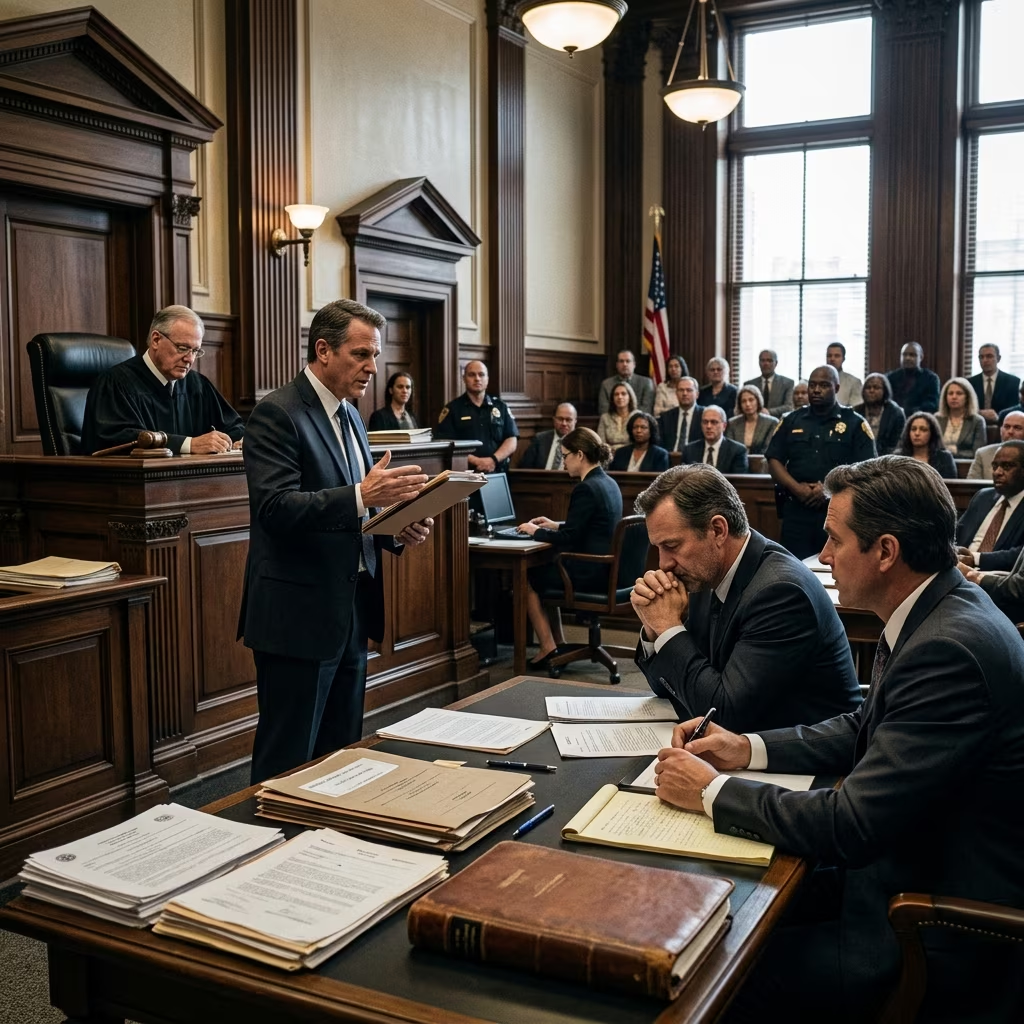
A criminal charge is the formal starting point of a criminal case: it is the government’s official accusation that a specific person has violated a criminal law. Although being charged is serious, it is not the same as being found guilty, and the law provides important protections to anyone facing charges.
What Does “Criminal Charge” Mean?
In legal terms, a criminal charge is a formal allegation made by a governmental authority, usually a prosecutor or law enforcement agency, that someone has committed a crime. The accusation is recorded in an official document and triggers the criminal justice process, from first court appearances to potential trial and sentencing.
Some core elements of a criminal charge include:
- Governmental accusation – charges are brought by the state or federal government, not by private individuals.
- Reference to a specific law – each charge corresponds to a statute that defines the alleged offense and possible penalties.
- Identification of the accused – the charging document names at least one defendant who is alleged to have committed the offense.
- Alleged conduct – the document outlines the factual basis for the accusation, such as acts, omissions, or circumstances.
Before a person can be convicted, the government must prove each criminal charge beyond a reasonable doubt, a demanding legal standard designed to protect the innocent.
How Criminal Charges Are Formally Filed
A criminal charge does not exist in the abstract; it appears in a written legal instrument often called a charging document. Depending on the jurisdiction and seriousness of the offense, different forms may be used.
Common Charging Documents
- Complaint – a sworn statement, often by law enforcement or a complaining witness, setting out the alleged facts and the offense.
- Information – a formal accusation filed by a prosecutor, generally used in place of an indictment for some offenses.
- Indictment – a formal charge approved by a grand jury after reviewing evidence presented by the prosecutor, commonly used in serious federal and state felony cases.
- Citation or ticket – used for minor offenses and infractions, especially traffic violations; still a charging document but usually for lower-level conduct.
In federal criminal cases, the U.S. Attorney’s Office typically presents evidence to a grand jury, which then decides whether to issue an indictment requiring the defendant to stand trial.
Who Decides to Bring Charges?
Only government authorities can initiate criminal charges. The decision usually follows an investigation and review of evidence.
- Law enforcement investigation – police or other agencies collect reports, statements, physical evidence, and other information.
- Prosecutorial review – a prosecutor evaluates whether the evidence supports specific charges and whether proceeding is in the public interest.
- Victim involvement – victims can report crimes and, in some jurisdictions, seek charges through applications to judicial officers, but final charging authority rests with the state.
Formal charges are typically announced in court at the defendant’s first appearance or arraignment, where the accused is advised of the exact offenses alleged.
Types of Criminal Charges and Offenses
Criminal charges vary widely in seriousness, potential penalties, and social impact. Legal systems classify offenses to distinguish minor infractions from serious crimes.
Felonies, Misdemeanors, and Infractions
| Category | Typical Penalties | Examples (general) |
|---|---|---|
| Felony | Often more than one year in prison, substantial fines, possible long-term supervision, and in some jurisdictions, life imprisonment or even capital punishment. | Robbery, serious assaults, homicide, major financial crimes. |
| Misdemeanor | Fines, probation, community service, or local jail sentences typically up to one year. | Petty theft, disorderly conduct, some impaired driving offenses. |
| Infraction / violation | Usually fines or civil penalties; generally no jail time, though procedures vary by jurisdiction. | Traffic tickets, minor regulatory offenses. |
Major Categories of Criminal Acts
Legal systems also group offenses based on the kind of harm involved. One widely used framework identifies several broad categories:
- Crimes against persons – offenses that directly harm or threaten people, such as assault or homicide.
- Crimes against property – offenses focused on property, including theft, burglary, and vandalism.
- Inchoate crimes – incomplete or preparatory offenses like attempt and conspiracy, where the law intervenes before full harm occurs.
- Statutory crimes – conduct criminalized by specific statutes, often involving public safety or regulation (such as certain traffic or drug offenses).
- Financial or white-collar crimes – fraud, embezzlement, and other offenses involving deception in business or financial settings.
Each criminal charge will be tied to one or more of these categories, shaping the potential penalties and how the case proceeds.
From Charge to Case: Basic Steps in a Criminal Prosecution
Although details vary among jurisdictions, many criminal cases follow a recognizable sequence once a charge is filed.
Typical Progression of a Criminal Case
- Offense – conduct occurs that may violate a criminal law.
- Investigation – law enforcement gathers information, interviews witnesses, and reviews records. This may continue even after charges are filed.
- Arrest or summons – if probable cause is found, officers may arrest the suspect or serve a summons directing them to appear in court.
- Charging document issued – a complaint, information, indictment, citation, or similar instrument formally alleges the offense.
- First appearance / arraignment – the accused is informed of the charges, advised of core rights, and may address bail or other conditions of release.
- Pretrial proceedings – may include motions, plea negotiations, and hearings on probable cause (especially for felonies).
- Trial – if no plea is entered that resolves the case, a judge or jury hears evidence and determines whether the government has proved the charge beyond a reasonable doubt.
- Verdict and sentencing – if the defendant is found not guilty, they are released and cannot be retried for the same federal offense due to protections against double jeopardy. If found guilty, the judge imposes a sentence following applicable guidelines.
Charge vs. Conviction
It is important to distinguish between being charged with a crime and being convicted of one.
| Aspect | Charged | Convicted |
|---|---|---|
| Legal meaning | Formal accusation of criminal activity. | Official finding of guilt after plea or trial. |
| Status of the accused | Presumed innocent; government must still meet its burden of proof. | Legally determined to have committed the offense charged. |
| Stage of case | Beginning or middle of proceedings; case is still pending. | Outcome stage; sentencing and potential appeals follow. |
| Main consequences | Court dates, possible bail or conditions of release, stress and disruption, but no criminal penalty yet. | Criminal record, punishment (prison, fines, probation), and longer-term effects on employment, housing, and civil rights. |
Rights of Defendants Facing Criminal Charges
Even when charges are serious, defendants retain crucial legal protections. These rights are grounded in constitutional principles and court rules designed to ensure fairness.
Key Protections in Criminal Cases
- Presumption of innocence – the law treats every accused person as innocent unless and until the government proves guilt beyond a reasonable doubt.
- Right to remain silent – defendants are not required to testify or answer incriminating questions, and their silence cannot be used as proof of guilt.
- Right to counsel – in many criminal cases, especially where incarceration is possible, defendants have the right to a lawyer. If they cannot afford one, a public defender or court-appointed attorney is often available.
- Right to a public trial – trials are typically open to the public, reinforcing transparency and accountability.
- Right to confront witnesses – defendants may cross-examine prosecution witnesses and challenge evidence.
- Protection against double jeopardy – once acquitted in federal court, a defendant cannot be tried again for the same federal offense.
Understanding these rights early can significantly influence how a defendant responds to a criminal charge and works with legal counsel.
Practical Considerations When You Are Charged
Facing a criminal charge can be overwhelming. While every situation is unique, certain practical steps are widely recommended to protect legal interests and personal wellbeing.
Immediate Steps After Learning of a Charge
- Read all documents carefully – examine any complaint, citation, or summons so you understand exactly what is alleged and which court is involved.
- Note all deadlines and court dates – failing to appear, even on a minor charge, can lead to additional consequences such as warrants or new offenses.
- Consult a qualified attorney – legal advice is essential to evaluate options, potential defenses, and the impact of any plea or trial outcome.
- Avoid discussing the case publicly – statements made to others or on social media can sometimes be used as evidence.
- Follow all release conditions – if bail or other conditions are imposed, compliance helps avoid further legal problems.
Long-Term Impact of Criminal Charges
Even when charges do not result in conviction, they can affect many aspects of life. A criminal record, especially after a conviction, may influence employment, housing, licensing, and social relationships. Some jurisdictions provide mechanisms—such as expungement or record sealing—to reduce the impact of past charges under certain conditions, but these processes are often complex.
FAQs About Criminal Charges
Are all offenses considered crimes?
Not necessarily. Legal systems often distinguish crimes from infractions or regulatory violations. Infractions may be punishable only by fines or civil penalties and may follow different procedures, even though they still appear in charging documents like citations.
Can a private person “file criminal charges”?
Individuals can report alleged crimes and, in some jurisdictions, submit applications for charges to certain judicial officers, but only the government—through prosecutors or authorized officials—ultimately issues criminal charges.
Can charges be changed or dismissed?
Yes. Prosecutors may amend charges as new evidence emerges or dismiss them entirely when the evidence is insufficient or legal issues arise. Judges also have authority to dismiss charges in specific circumstances, such as lack of probable cause or procedural defects.
What happens if the government does not prove the charge?
If the prosecution fails to prove every element of the offense beyond a reasonable doubt, the defendant is entitled to a not-guilty verdict, and the case is dismissed. In federal court, the government cannot appeal an acquittal or retry the defendant for the same offense due to double jeopardy protections.
Does being charged mean I will go to prison?
No. Many criminal charges, especially misdemeanors and infractions, carry penalties other than incarceration, and some cases are resolved with dismissals or non-custodial sentences. The ultimate outcome depends on the nature of the charge, the evidence, applicable law, and the decisions made by the parties and the court.
References
- Criminal charge — Wikimedia Foundation. 2024-04-25. https://en.wikipedia.org/wiki/Criminal_charge
- Charge (criminal law definition) — Legal Information Institute, Cornell Law School. 2023-06-01. https://www.law.cornell.edu/wex/charge
- The Difference Between a Criminal Charge and Conviction — Andrew Karpf Criminal Law. 2023-09-15. https://www.andrewkarpfcriminallaw.com/the-difference-between-a-criminal-charge-and-conviction/
- Types of Criminal Offenses Under the Law — Justia. 2022-08-10. https://www.justia.com/criminal/offenses/
- Criminal Cases — North Carolina Judicial Branch. 2023-05-12. https://www.nccourts.gov/help-topics/criminal-law/criminal-cases
- Criminal Cases — United States Courts. 2024-01-05. https://www.uscourts.gov/about-federal-courts/types-cases/criminal-cases
- Criminal Cases — Maryland Courts. 2022-11-30. http://www.mdcourts.gov/legalhelp/criminalcases