
Trust Deed vs. Mortgage: How Home Loans Are Secured
Understand how trust deeds and mortgages secure home loans, affect foreclosure, and shape your rights as a property owner.
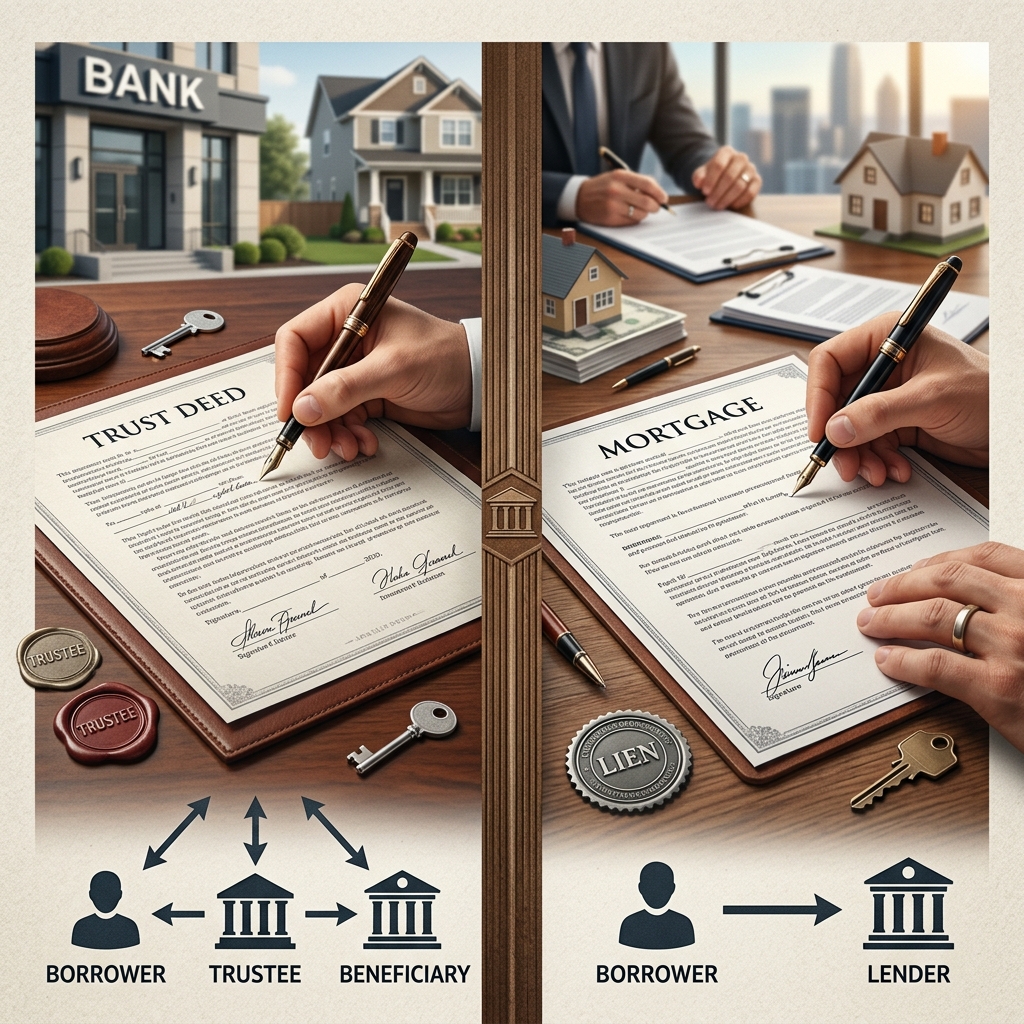
When you finance a home, you sign more than just a stack of papers at closing. Among the most important are the legal documents that secure your loan against the property—usually either a mortgage or a deed of trust. Understanding how these two instruments work can help you anticipate what happens if you default, how foreclosure is handled, and what your rights are as an owner-borrower.
Big Picture: Why Lenders Use Security Instruments
In most residential real estate transactions, the lender needs a way to ensure it can recover the money it lends if the borrower fails to pay. The law accomplishes this through a security instrument that creates a lien on the property, giving the lender rights to sell or take possession of the real estate if the debt is not repaid.
- Mortgage: A two-party agreement between borrower and lender that uses the property as collateral.
- Deed of trust: A three-party agreement involving a borrower, a lender, and a neutral trustee who holds legal title until the loan is paid.
Both documents secure the same thing—the lender’s interest in the property—but they use slightly different legal structures and foreclosure procedures, often depending on the laws of the state where the property is located.
Core Structural Differences: Parties and Roles
The easiest way to distinguish a mortgage from a deed of trust is to look at who signs the agreement and what their roles are.
| Feature | Mortgage | Deed of Trust |
|---|---|---|
| Number of parties | Two: borrower and lender | Three: borrower (trustor), lender (beneficiary), trustee |
| Who holds legal title during repayment | Typically the borrower; lender has a lien interest | Neutral third-party trustee holds legal title; borrower has equitable title |
| Common foreclosure method | Judicial foreclosure through court proceedings | Nonjudicial (power-of-sale) foreclosure, if allowed by state law |
| Speed and cost of foreclosure | Generally slower and more expensive due to court process | Generally faster and less costly when nonjudicial options exist |
What Is a Mortgage in Legal Terms?
A mortgage is a legal contract in which real estate is pledged as collateral for a loan. The borrower (often called the mortgagor) gives the lender (the mortgagee) an interest in the property as security for the promise to repay.
If the borrower defaults—by missing payments or violating other loan terms—the mortgage gives the lender the right to seek a judicial foreclosure, meaning the lender must go to court and follow a statutory procedure before the property can be sold.
- The borrower retains ownership and typically remains on title during the life of the loan.
- The mortgage is recorded in the public land records, giving notice of the lender’s lien.
- Once the loan is paid, the lender releases the mortgage, clearing the lien from the property’s title.
What Is a Deed of Trust?
A deed of trust is also a security instrument used to protect the lender’s interest in the property, but it adds a third party called the trustee.
- Trustor: The borrower who conveys legal title to the trustee as security for the loan.
- Beneficiary: The lender who benefits from the security interest and can demand foreclosure if the borrower defaults.
- Trustee: A neutral third party (often a title company or trustee company) that holds legal title and has a power of sale if the borrower fails to perform.
During repayment, the trustee holds legal or “bare” title, while the borrower retains equitable title—practical ownership, the right to live in the home, and the duty to maintain it. Once the loan is satisfied, the trustee reconveys legal title to the borrower, extinguishing the lender’s security interest.
Title, Ownership, and What Borrowers Really “Own”
People often ask whether signing a deed of trust means they no longer own their home. In practice, both mortgages and deeds of trust are mechanisms for securing a loan; they do not prevent you from living in or using your property as long as you meet your obligations.
- Under a mortgage, you are on title and the lender holds a lien. You are both legal and equitable owner, subject to the lien.
- Under a deed of trust, the trustee holds legal title, but you retain equitable ownership and full use of the property.
In both cases, the lender’s interest is limited to securing repayment. Once the debt is paid in full, the mortgage or deed of trust is released, and your title is no longer encumbered by that specific lien.
Foreclosure: Court-Based vs. Power-of-Sale
The foreclosure process is one of the most important differences between mortgages and deeds of trust because it affects how quickly and through what procedure a property may be sold if the borrower defaults.
Judicial Foreclosure Under a Mortgage
With a mortgage, foreclosure usually must proceed through the courts. The lender files a lawsuit, serves the borrower, and pursues a judgment authorizing sale of the property. This process is typically:
- Slower: Court schedules, procedural requirements, and possible borrower defenses extend timelines.
- More expensive: Legal fees and court costs add to the overall expense of foreclosure.
- More formal: Borrowers have defined opportunities to raise legal objections or negotiate resolutions.
Nonjudicial Foreclosure Under a Deed of Trust
Many deeds of trust contain a power-of-sale clause, allowing the trustee to sell the property without going through a full court process, subject to state law requirements. This is known as nonjudicial foreclosure.
- Trigger: The lender informs the trustee that the borrower is in default.
- Procedure: The trustee follows statutory steps such as notices of default, publication requirements, and a public auction.
- Outcome: The property is sold, and proceeds are applied to the debt. Any surplus after costs and loan balance may go to the borrower, depending on state law.
Because nonjudicial foreclosure avoids full litigation, it is often faster and less costly, which is one reason lenders in certain states prefer deeds of trust.
Where Each Instrument Is Typically Used
Whether a mortgage or a deed of trust is used for a given property often depends on state statutes and customary practice. Some states favor mortgages as the standard security instrument, while others rely heavily on deeds of trust with power-of-sale provisions.
Legal practice tools and state comparison charts indicate that jurisdictions differ in their preferred instrument, and in some cases, both may be used under specific circumstances. For borrowers, this means the type of document they sign is largely dictated by local law and lender preference, rather than personal choice.
How These Documents Relate to the Note and Deed
It is important to distinguish the security instrument (mortgage or deed of trust) from other key documents signed at closing:
- Promissory note: Your written promise to repay the loan, including principal, interest rate, and payment terms. It does not itself create a lien on the property.
- Deed (to the property): Transfers ownership of the property to you. It is unrelated to the loan obligation, although it is recorded in land records.
- Mortgage or deed of trust: Grants the lender rights against the property as collateral for the note.
The note and the security instrument work together: the note creates the debt, and the mortgage or deed of trust secures that debt with the real estate.
Practical Implications for Homeowners
From a homeowner’s perspective, the day-to-day experience of owning a home with a mortgage or a deed of trust is similar: you make payments, maintain insurance, pay property taxes, and comply with loan covenants. However, several practical implications follow from the choice of instrument:
- Foreclosure risk and timing: In a deed-of-trust state, nonjudicial foreclosure can proceed more quickly after default, potentially giving borrowers less time to react.
- Legal remedies: Judicial foreclosure under a mortgage may offer more structured opportunities to challenge the process or seek modification, though this depends heavily on local law and individual circumstances.
- Closing paperwork: In a deed-of-trust transaction, you may see references to a trustee and power-of-sale language, whereas mortgage documents will focus on your direct relationship with the lender.
Key Points Borrowers Should Review Before Signing
Regardless of which instrument is used, borrowers should read and understand several aspects of their loan documents:
- Default definition: How missed payments, insurance lapses, or other breaches are treated.
- Acceleration clause: When the lender can demand full repayment if you default.
- Foreclosure process: Whether the foreclosure is judicial or nonjudicial, and what notice requirements apply.
- Right to reinstate or cure: Whether you can bring the loan current and stop foreclosure and on what terms.
- Release of lien: How and when the mortgage or deed of trust will be formally released once the loan is paid.
Frequently Asked Questions (FAQs)
Does a deed of trust mean I don’t own my home?
No. While the trustee holds legal title under the deed of trust, you retain equitable title and full use of the property. You are treated as the owner for practical purposes, as long as you comply with loan terms.
Is one safer for borrowers: a mortgage or a deed of trust?
Safety depends more on state law protections and your financial situation than on the instrument itself. Mortgages usually require judicial foreclosure, which can provide more formal opportunities for court review, while deeds of trust often allow faster nonjudicial foreclosure. Both systems include borrower protections set by statute, and you should consult a local attorney to understand rights under your state’s law.
Can I choose between a mortgage and a deed of trust?
Usually not. The type of instrument is largely determined by the state where the property is located and by lender practice. Many lenders follow the prevailing standard in each jurisdiction.
What happens to the deed of trust or mortgage when I pay off my loan?
When the loan is paid in full, the lender or trustee records a release or reconveyance document in the land records, which removes the lien from the property’s title.
Is a deed of trust the same as the deed to my house?
No. The deed to your house transfers ownership and shows who holds title. A deed of trust is a security instrument that creates a lien on that ownership to secure the loan. They serve different legal functions, even though they are both recorded in public land records.
References
- What’s the Difference Between a Mortgage and Deed of Trust? — Nolo. 2023-06-01. https://www.nolo.com/legal-encyclopedia/whats-the-difference-between-mortgage-deed-trust.html
- What is the difference between a deed of trust and a mortgage? — Underwood Law. 2022-04-15. https://underwood.law/blog/what-is-the-difference-between-a-deed-of-trust-and-a-mortgage
- Know the difference: Deed of trust vs. mortgage — JPMorgan Chase Bank. 2021-09-10. https://www.chase.com/personal/mortgage/education/managing-your-mortgage/deed-of-trust-vs-mortgage
- Deed vs Deed of Trust — First Savings Mortgage Corporation. 2020-11-02. https://www.firstsavingsmortgage.com/mortgage-blog/deed-vs-deed-of-trust/
- The Differences between the Deed, the Note, and the Deed of Trust — NFM Lending. 2017-07-11. https://nfmlending.com/financing-your-home/education/blog/the-differences-between-the-deed-the-note-and-the-deed-of-trust/
- Deed of Trust vs Mortgage: Key Differences — SoFi. 2023-02-20. https://www.sofi.com/learn/content/deed-of-trust-vs-mortgage/
- What is deed of trust? — Rocket Mortgage. 2023-04-05. https://www.rocketmortgage.com/learn/deed-of-trust
Similar Articles








Read full bio of medha deb




