
Irrevocable Trust Tax Benefits Explained
Discover how irrevocable trusts can reduce estate taxes, manage income tax exposure, and protect assets while supporting long‑term wealth transfer goals.
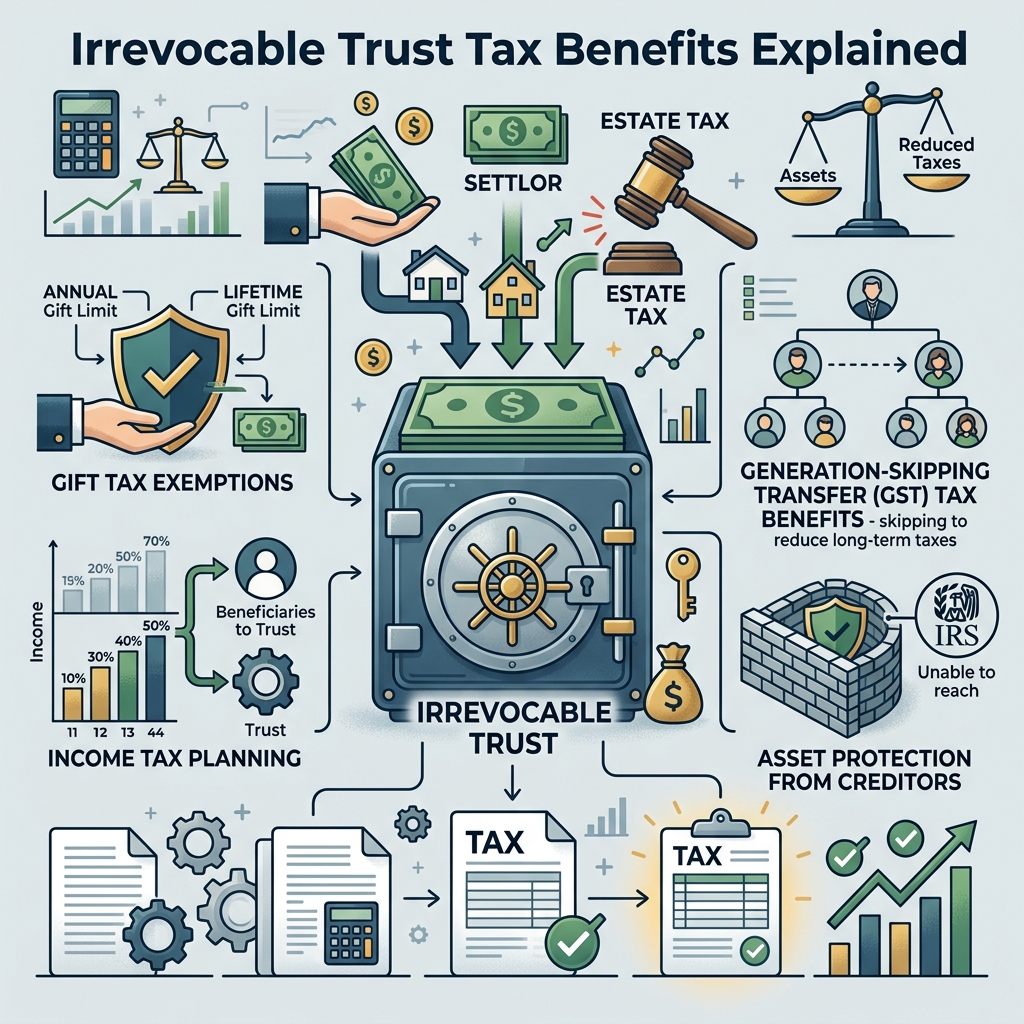
Irrevocable trusts are widely used in modern estate planning to shift wealth, manage taxes, and shield assets from future risks. By permanently transferring ownership of property into a separate legal entity, families can significantly reshape how those assets are taxed during life and at death. This guide explains the tax side of irrevocable trusts in clear, practical terms so you can better discuss options with a qualified advisor.
What Makes a Trust “Irrevocable”?
A trust is a legal arrangement where a grantor transfers assets to a trustee to hold and manage for one or more beneficiaries. A trust is considered irrevocable when, after it is properly created and funded, the grantor generally cannot unilaterally change its terms, reclaim the property, or terminate the trust. That loss of control is precisely what generates many of the trust’s tax advantages.
- Grantor: Person who creates the trust and contributes assets.
- Trustee: Individual or institution that manages trust assets under the trust document.
- Beneficiaries: People or organizations entitled to receive income or principal from the trust.
Once assets are placed in an irrevocable trust, the grantor has effectively given them away, usually as a completed gift for tax purposes. In exchange, those assets can often be removed from the grantor’s taxable estate, which is a core estate tax planning objective.
Irrevocable vs. Revocable Trusts: Tax-Oriented Comparison
Irrevocable and revocable trusts can both provide privacy, avoid probate, and simplify management of assets, but they differ substantially in tax treatment. The table below highlights key distinctions relevant to tax planning.
| Feature | Revocable Trust | Irrevocable Trust |
|---|---|---|
| Ability to change terms | Grantor can modify or revoke at any time. | Generally cannot be changed without beneficiary consent or court order. |
| Who owns the assets for tax purposes? | Assets treated as owned by the grantor. | Assets treated as owned by the trust or beneficiaries, not the grantor. |
| Estate tax impact | Assets typically remain in grantor’s taxable estate. | Properly structured assets are often removed from the grantor’s taxable estate. |
| Income tax reporting | Grantor reports income on personal return (Form 1040). | May be taxed as a grantor trust (to grantor) or non‑grantor trust (trust/beneficiary); trust generally files Form 1041. |
| Asset protection | Typically limited, since grantor still owns assets. | Stronger protection against creditors and lawsuits if properly structured. |
Because irrevocable trusts separate legal ownership from the grantor, they are particularly useful for estate tax reduction, government benefit eligibility, and creditor protection—three common reasons practitioners consider them essential tools.
Core Tax Advantages of Irrevocable Trusts
Irrevocable trusts create tax benefits through a combination of estate, gift, income, and transfer tax rules. Below are the main advantages families and planners seek.
1. Removing Assets from the Taxable Estate
For federal estate tax purposes, a person’s taxable estate includes property they own or control at death, plus certain lifetime transfers. When assets are transferred into an irrevocable trust and the grantor relinquishes control, the transfer is typically treated as a completed gift. The practical result is:
- Assets in the trust usually are not counted in the grantor’s estate at death.
- Future appreciation on those assets occurs outside the grantor’s estate. This is especially valuable for high‑growth investments, closely held businesses, or real estate.
For individuals whose wealth exceeds or may later exceed the federal estate tax exemption, moving appreciating assets to an irrevocable trust can significantly reduce potential estate tax liability for their heirs. Many states also impose separate estate or inheritance taxes, increasing the importance of this strategy in high‑tax jurisdictions.
2. Strategic Use of Gift and Generation‑Skipping Taxes
Transferring assets into an irrevocable trust can use portions of the grantor’s lifetime gift tax exemption and, where applicable, the generation‑skipping transfer (GST) tax exemption. When properly planned:
- The initial transfer may be a taxable gift, but covered by the grantor’s lifetime exemptions, so no tax is due at the time of transfer.
- Once assets and future growth are inside the trust, they can pass to children, grandchildren, or other beneficiaries with reduced or no additional transfer taxes, depending on how exemptions are allocated.
Specialized irrevocable trusts, such as dynasty trusts, intentionally combine these rules to keep wealth in trust structures across multiple generations with minimized estate and GST tax exposure.
3. Income Tax Planning Through Grantor vs. Non‑Grantor Status
For income tax purposes, an irrevocable trust is classified either as a grantor trust or a non‑grantor trust under the Internal Revenue Code. The classification drives who pays tax on income generated by trust assets:
- Grantor trusts: Income, deductions, and credits are treated as belonging to the grantor, who reports them on a personal income tax return.
- Non‑grantor trusts: The trust is a separate taxpayer with its own tax identification number, filing a fiduciary return (Form 1041).
Although non‑grantor trusts face compressed brackets (reaching top rates at relatively low income levels), planners may deliberately design trusts either way to achieve specific tax outcomes.
Grantor Trust Advantages
In a grantor trust arrangement, the grantor effectively pays income tax on earnings that ultimately benefit others. This can produce several advantages:
- Tax burden shifted to the grantor: Beneficiaries may receive distributions that are effectively income‑tax free to them because the grantor has already paid the tax.
- Additional estate reduction: The grantor’s payment of income taxes on trust earnings can be seen as an indirect, tax‑free transfer to beneficiaries, gradually reducing the grantor’s estate without additional gift tax.
- Simplified reporting for beneficiaries: Beneficiaries may avoid complex K‑1 reporting from the trust when all income is reportable on the grantor’s individual return.
Grantor trust status is widely used for life insurance trusts and certain grantor‑retained annuity or unitrust structures where the goal is to combine estate tax removal with ongoing grantor tax payments.
Non‑Grantor Trust Considerations
When an irrevocable trust is classified as a non‑grantor trust, it becomes a separate taxpayer. That status can be desirable when the grantor no longer wishes to bear the tax burden or when planners are targeting particular state tax outcomes.
- Trust‑level income tax: Undistributed trust income is taxed directly to the trust, often at high marginal rates due to compressed brackets.
- Distributions carry out income: When income is distributed to beneficiaries or used for their benefit, the trust generally receives a deduction, and that income is taxed to the beneficiaries instead.
- Multi‑state taxation: Non‑grantor trusts may be subject to tax in several states depending on the residence of the grantor, trustee, and beneficiaries and the location of trust assets.
This structure creates planning opportunities: trustees can manage timing and character of distributions to align tax burdens with beneficiaries’ brackets and locations, potentially lowering overall tax paid.
4. Estate Tax Minimization for High‑Net‑Worth Families
Professionals often note that irrevocable trusts are most compelling for individuals who:
- Expect their estate to exceed available federal and state exemptions.
- Own rapidly appreciating assets or interests in closely held businesses.
- Are willing to surrender control in exchange for long‑term tax savings.
By shifting ownership to irrevocable structures during life, such families can compress taxable estate value while allowing beneficiaries to benefit from growth in a tax‑efficient manner. Some planning strategies combine annual exclusion gifts, grantor‑retained interests, and life insurance inside irrevocable trusts to further leverage exemptions.
Additional Non‑Tax Benefits That Support Tax Planning
Tax considerations rarely exist in isolation. Irrevocable trusts also offer non‑tax advantages that make them attractive vehicles for achieving broader planning goals.
- Asset protection: Properly structured irrevocable trusts can help shield assets from future creditors, lawsuits, or personal liabilities of the grantor.
- Probate avoidance: Trust assets generally pass outside of probate, reducing delay, cost, and public disclosure of estate details.
- Eligibility for government programs: In some circumstances, shifting assets to an irrevocable trust can assist with qualifying for means‑tested benefits, subject to complex rules and look‑back periods.
- Management for vulnerable beneficiaries: Irrevocable trusts can be tailored to support minors, individuals with disabilities, or beneficiaries with limited financial skills while protecting assets from mismanagement.
These features often complement tax planning: for instance, a trust that keeps assets outside the grantor’s estate can simultaneously protect them from creditor claims and provide structured, tax‑aware distributions to heirs.
Key Tax Drawbacks and Tradeoffs
Despite their advantages, irrevocable trusts are not universally appropriate. The very features that create tax benefits also impose limits and costs.
Loss of Step‑Up in Basis
Under current IRS guidance, assets held in many irrevocable trusts may not qualify for a step‑up in income tax basis at the grantor’s death, because they are not included in the grantor’s taxable estate. Without step‑up:
- Beneficiaries may owe larger capital gains taxes when they later sell trust assets.
- Planners must weigh the benefit of estate tax reduction against the cost of potentially higher capital gains for heirs.
This issue is especially relevant for low‑basis assets such as long‑held real estate or closely held business interests. In some cases, planners may intentionally retain certain assets outside irrevocable trusts to preserve step‑up.
Compressed Income Tax Brackets
Taxable trusts reach high federal income tax rates at relatively modest levels of undistributed income. Because the trust exemption is small and brackets are compressed, retaining income inside a non‑grantor trust can trigger top marginal rates quickly.
This drawback reinforces the importance of:
- Thoughtful distribution policies to align income with lower‑bracket beneficiaries where appropriate.
- Careful asset selection within trusts, such as emphasizing tax‑efficient investments.
Administrative Complexity and Cost
Irrevocable trusts introduce ongoing compliance responsibilities:
- Obtaining and maintaining a separate tax identification number for many trusts.
- Preparing annual fiduciary income tax returns (Form 1041) and beneficiary information forms where required.
- Coordinating legal, accounting, and investment oversight, often with professional trustees or advisors.
For smaller estates, these costs may outweigh the potential tax savings, which is why experts often limit recommendations to situations where clear tax, asset protection, or benefit‑eligibility objectives exist.
When an Irrevocable Trust May Be Appropriate
Given the tradeoffs, irrevocable trusts tend to be most useful in specific scenarios. Common situations where they are seriously considered include:
- High‑net‑worth estates: Anticipated estate tax exposure makes removing appreciating assets from the estate a priority.
- Business or real estate owners: Desire to lock in current values for estate tax purposes while shifting future growth to heirs.
- Long‑term asset protection goals: Concern about future liability, professional risks, or creditor exposure.
- Special needs or vulnerable beneficiaries: Need for structured support, tax‑efficient management, and protection from loss or misuse.
- Government benefit planning: Complex strategies where asset transfers are part of qualifying for certain programs, undertaken with specialized counsel.
Because rules are technical and highly fact‑specific, individuals should consult experienced estate planning and tax professionals before creating an irrevocable trust.
Practical Planning Tips for Using Irrevocable Trusts
If you are considering an irrevocable trust as part of your plan, focus on both legal design and tax implications. Key practical steps include:
- Clarify primary goals: Decide whether your priority is estate tax reduction, asset protection, income tax planning, or beneficiary management.
- Determine appropriate trust type: Evaluate options such as grantor‑style irrevocable trusts, non‑grantor structures, life insurance trusts, or specialized vehicles for business interests.
- Assess the impact on step‑up in basis: Identify low‑basis assets and discuss whether they should stay in your estate instead of being transferred to the trust.
- Select a qualified trustee: Choose an individual or corporate trustee comfortable with fiduciary duties, tax reporting, and long‑term administration.
- Coordinate multi‑state tax issues: Consider where the grantor, trustee, and beneficiaries reside; these factors can influence state‑level income taxation.
- Review regularly: Laws and personal circumstances change. While the trust itself may be irrevocable, related planning and surrounding structures can be updated over time.
Frequently Asked Questions (FAQs)
Does an irrevocable trust always reduce my taxes?
Not always. An irrevocable trust can reduce estate and transfer taxes by removing assets from your taxable estate, but it may increase income taxes if trust income is taxed at compressed trust brackets. Whether your overall tax burden falls depends on asset types, trust design, and distribution patterns.
Who pays income tax on an irrevocable trust?
It depends on whether the trust is classified as a grantor or non‑grantor trust. In a grantor trust, the grantor pays income tax on trust earnings. In a non‑grantor trust, the trust pays tax on retained income, and beneficiaries pay tax on distributed income reported to them, usually via a Schedule K‑1.
Can I change or revoke an irrevocable trust if I change my mind?
By design, irrevocable trusts cannot be freely changed or revoked by the grantor once established. In limited circumstances, modifications may be possible with beneficiary consent, court approval, or state law procedures such as decanting, but these are fact‑specific and require legal counsel.
Will my beneficiaries have to go through probate to receive trust assets?
Generally, assets held in a properly funded irrevocable trust pass outside of probate. The trustee distributes assets according to the trust document, which can save time, reduce costs, and maintain privacy compared with a probate estate.
Is an irrevocable trust right for a moderately sized estate?
For modest estates without potential estate tax exposure, the administrative complexity and loss of flexibility may outweigh the benefits. Many advisors reserve irrevocable trust strategies for situations involving significant wealth, asset protection needs, or specialized beneficiary care.
References
- How Revocable and Irrevocable Trusts are Taxed — Special Needs Alliance. 2020-02-10. https://www.specialneedsalliance.org/the-voice/a-short-primer-on-trusts-and-trust-taxation-2/
- Revocable vs Irrevocable Trusts — New York Life Insurance Company. 2021-07-15. https://www.newyorklife.com/articles/revocable-vs-irrevocable-trust
- Irrevocable Trusts Explained: How They Work, Types, and Uses — Investopedia. 2024-01-05. https://www.investopedia.com/terms/i/irrevocabletrust.asp
- Trusts: Income and Estate and Gift Tax Issues — Congressional Research Service. 2019-01-18. https://www.congress.gov/crs-product/R48879
- IRS Changes Rules on Irrevocable Trusts: What It Means for Your Estate Plan — BNCJ Law. 2023-08-09. https://www.bncjlaw.com/posts/irs-changes-rules-on-irrevocable-trusts-what-it-means-for-your-estate-plan
- Irrevocable Trusts: What Beneficiaries Need to Know to Optimize Their Resources — J.P. Morgan Private Bank. 2022-05-11. https://privatebank.jpmorgan.com/nam/en/insights/wealth-planning/irrevocable-trusts-what-beneficiaries-need-to-know-to-optimize-their-resources
Similar Articles








Read full bio of Sneha Tete




