
Police K-9 Deployments: Legal Boundaries of Force
Understanding when law enforcement can legally deploy K-9 units, the limits of their use, and your rights if bitten by a police dog.
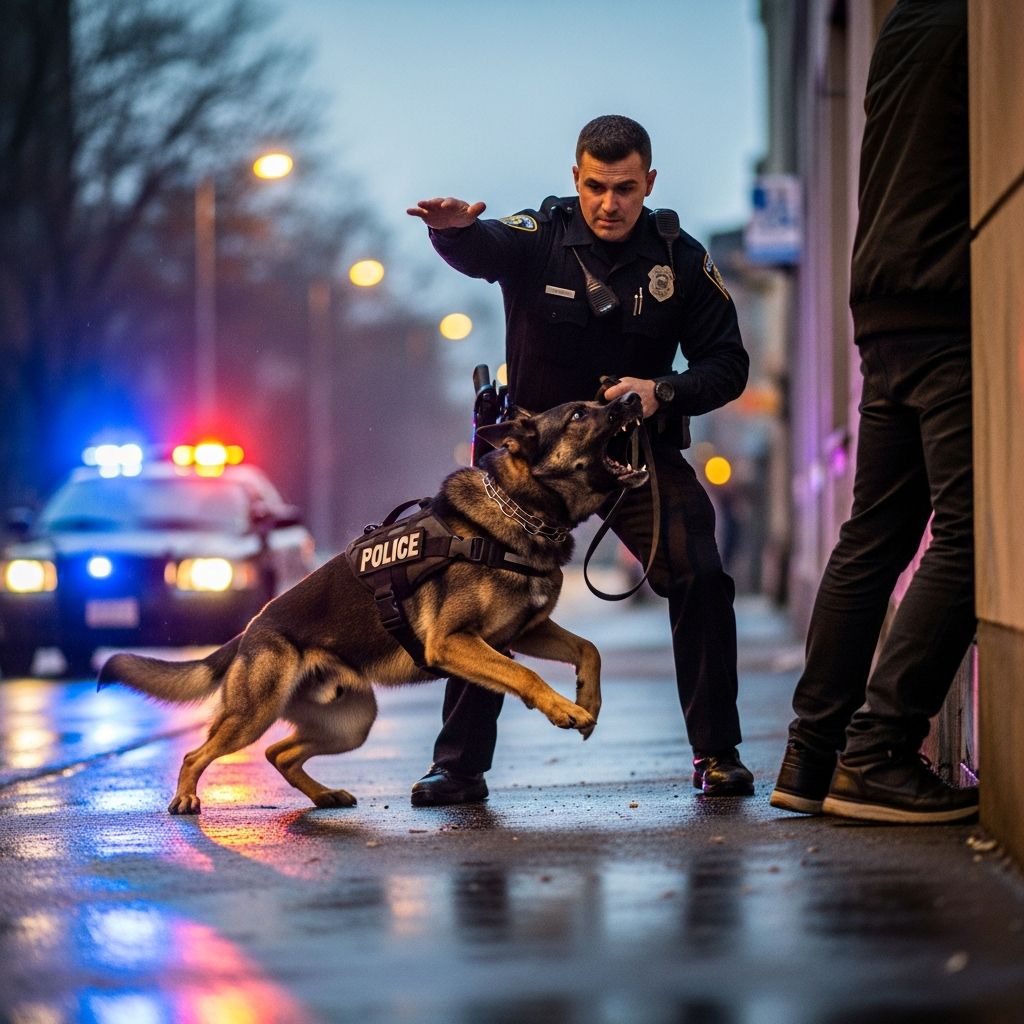
Police dogs, or K-9 units, serve critical roles in law enforcement, from suspect apprehension to detection tasks. However, their deployment raises complex legal questions about the balance between public safety and individual rights. Under the Fourth Amendment, any use of a K-9 constitutes a ‘seizure,’ and courts scrutinize whether it qualifies as reasonable force. This article delves into the circumstances permitting K-9 attacks, tests for excessive force, exceptions for liability, real case examples, and practical advice for those affected.
Constitutional Framework Governing K-9 Use
The foundation for evaluating police dog deployments lies in the Fourth Amendment, which protects against unreasonable searches and seizures. A K-9 bite is treated as a seizure because it physically restrains a person. Reasonableness hinges not just on the need for seizure but on the method employed. Courts apply an ‘objective reasonableness’ standard, asking what a prudent officer would do under similar circumstances.
Key Supreme Court precedents shape this analysis. In Graham v. Connor (490 U.S. 386, 1989), the Court established factors for assessing force: severity of the crime, whether the suspect poses an immediate threat, and resistance or flight. These Graham factors directly apply to K-9 cases, determining if a dog’s release was justified.
Unlike deadly force cases under Tennessee v. Garner (471 U.S. 1, 1985), K-9 bites are not presumed deadly, allowing broader deployment options when threats are present but not lethal.
When Law Enforcement Can Legally Deploy a K-9
Officers may release a police dog in specific high-risk scenarios:
- Active flight or evasion: If a suspect flees after committing a serious crime, a K-9 can pursue and detain without violating rights, provided no safer alternatives exist.
- Immediate danger to officers or public: Suspects armed or aggressive toward police justify canine intervention to neutralize threats quickly.
- Resistance to arrest: Non-compliant individuals posing risks during handcuffing may warrant a bite-and-hold tactic.
Departments train K-9s, often German Shepherds or Belgian Malinois, for ‘bite-and-hold’ methods targeting limbs until handlers intervene. Verbal warnings beforehand strengthen the legality of deployment.
Indicators of Excessive Force in K-9 Incidents
Not every bite is lawful. Excessive force occurs when deployment disregards the Graham factors or ignores less intrusive options. Common red flags include:
- Using K-9s for minor, non-violent offenses like traffic stops.
- Failing to issue warnings before release.
- Allowing prolonged bites after surrender.
- Deploying against unarmed, compliant, or mentally distressed individuals.
- Attacking bystanders uninvolved in the crime.
Courts weigh additional elements: number of officers present, event speed, backup availability, and crime severity. For instance, multiple officers could contain a suspect without a dog.
State-Specific Rules: Focus on California
California imposes strict liability for civilian dog bites under Civil Code § 3342, but exempts police and military dogs acting in official duties, such as apprehending suspects or defending handlers. No liability arises if the dog responds to provocation or assists in warrants, investigations, or arrests.
Exceptions apply: innocent bystanders bitten erroneously can sue. Police may also face claims if force exceeds constitutional bounds or dogs attack post-subdual. Multiple departments can be liable if involved.
| Scenario | Liability for Police? | Reason |
|---|---|---|
| Suspect fleeing violent crime | No | Reasonable under Graham factors |
| Innocent bystander bitten | Yes | Not reasonably suspected |
| Mental health crisis, no threat | Potentially | Excessive if alternatives available |
| Prolonged bite after compliance | Yes | Force must cease when threat ends |
Notable Court Cases Shaping K-9 Liability
Real-world rulings illustrate boundaries. In City of Huntington Beach v. City of Westminster (1997), a robbery victim mistaken for a suspect suffered severe bites; the court awarded $250,000, affirming bystander protections.
An 86-year-old man, Robert Rose, received $135,000 from Garden Grove and $105,000 from Anaheim after a K-9 injured him in his backyard, highlighting multi-agency accountability.
Vallejo settled for $40,000 with a driver bitten through his car window for 23 seconds post-pursuit, citing excessive force. A Half Moon Bay rescuer, unarmed and cooperative, endured multiple bites, fueling ACLU critiques of K-9 use on vulnerable groups.
These cases underscore that while K-9s aid policing, misuse invites scrutiny, especially absent statewide protocols.
Victim Rights and Pursuing Claims
If bitten, document everything: photos of injuries, witness contacts, officer names, and medical records. Seek immediate care, as punctures risk infection.
Claims fall under 42 U.S.C. § 1983 for Fourth Amendment violations, seeking damages for medical costs, lost wages, pain, and trauma. In California, file against involved agencies within six months via government tort claims.
- Consult a civil rights attorney experienced in police misconduct.
- Gather body cam footage via public records requests.
- Prove unreasonableness using Graham factors.
Qualified immunity may shield officers, but egregious violations overcome it. Success rates improve with clear excessive force evidence.
Training Standards and Department Policies
K-9 handlers undergo rigorous training, but variations exist. Federal guidelines recommend warnings and de-escalation first. Some departments limit use to felonies or armed suspects.
Critics, including the ACLU, argue inconsistent policies lead to overuse against minorities or in crisis situations. Ongoing lawsuits may prompt reforms, like mandatory body cams during deployments.
Preventing Unnecessary K-9 Encounters
Compliance reduces risks: stop fleeing, show hands, follow commands. If mentally distressed, inform officers early. Bystanders should retreat from scenes.
Communities push for transparency: audit K-9 incidents, diversify training, and prioritize non-lethal tools like tasers.
Frequently Asked Questions (FAQs)
Can I sue if a police dog bites me during an arrest?
Possibly, if the deployment was unreasonable under the Graham factors, such as for a minor crime or without warning. Suspects fleeing serious offenses typically cannot.
Are police immune from dog bite lawsuits in California?
No, immunity applies only during official duties against suspects. Bystanders or excessive force victims can claim compensation.
What damages can I recover from a K-9 bite?
Medical bills, lost income, pain and suffering, and emotional distress via § 1983 claims or state tort actions.
Does a verbal warning always precede K-9 release?
Not required by law, but its absence weighs against officers in court.
Can multiple cities be sued for one incident?
Yes, if officers from various departments participated.
References
- Are K-9 Dog Bites Excessive Force? — Shealey Law. 2023. https://shealeylaw.com/are-k-9-dog-bites-excessive-force/
- Are Police in California Liable for Dog Bites? — Maison Law. 2024. https://maisonlaw.com/personal-injury/dog-bites/police-liable/
- Know Your Rights in a Police Dog Bite Case — Michael Kahn Law. 2023. https://www.michaelkahnlaw.com/know-rights-police-dog-bite-case/
- California Dog Bite Law — California Dog Bite. 2024. https://californiadogbite.com/laws/
- Will California Limit Use of Canine Units? — Venardi Zurada LLP. 2023. https://www.vzlawfirm.com/blog/after-numerous-excessive-force-lawsuits-will-california-limit-its-use-of-canine-units-during-police-encounters/
Similar Articles








Read full bio of Sneha Tete




