
Capital Improvements vs. Repairs: Tax Rules for Property Owners
Learn how to distinguish capital improvements from repairs so you can apply the correct tax treatment and avoid costly IRS mistakes.
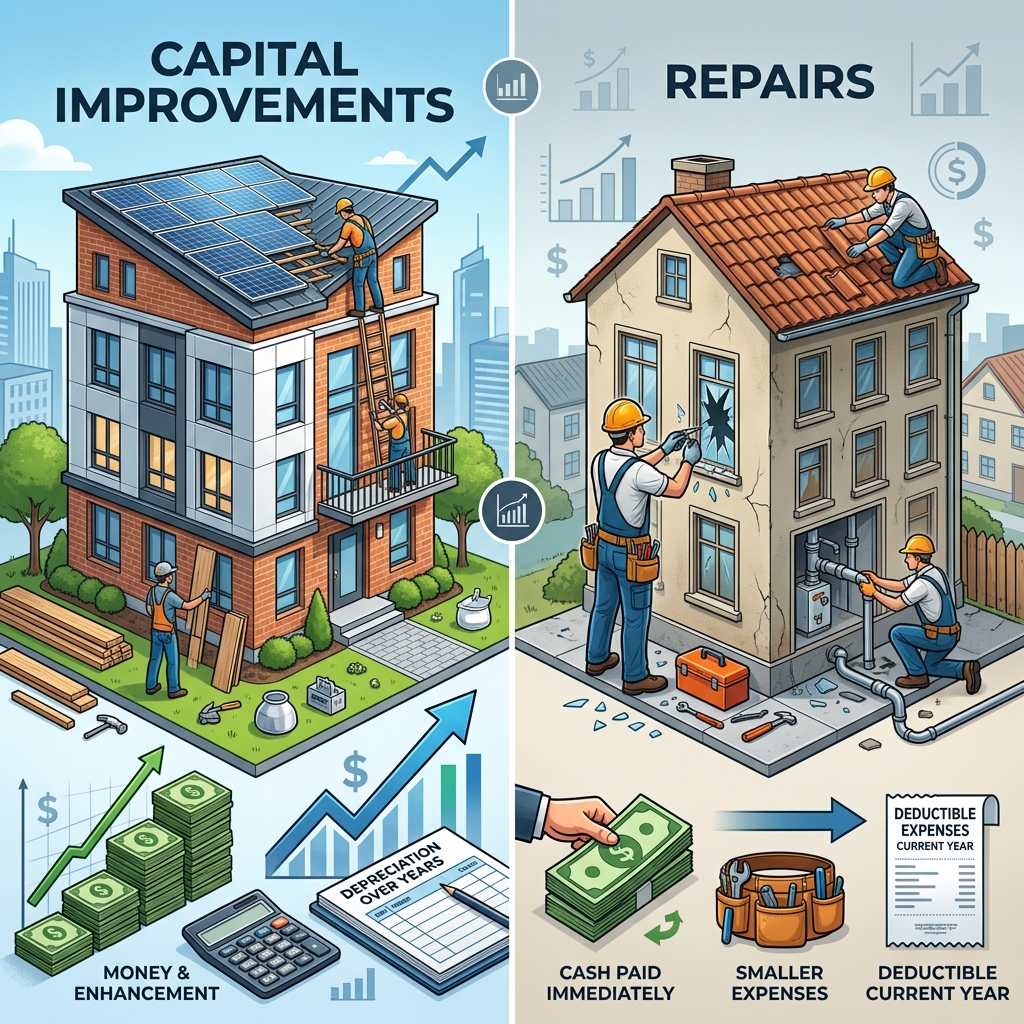
Property owners often face a critical tax question: is a particular project on their real estate a capital improvement or a deductible repair? The answer determines whether you deduct the cost immediately, spread it over years through depreciation, or add it to the property’s cost basis for future capital gains calculations.
This article explains the legal and tax distinctions between non-deductible capital improvements and deductible maintenance and repairs, drawing on IRS concepts and widely used tax guidance while presenting the information in practical, plain language.
Why the Distinction Matters for Your Taxes
The tax treatment of property expenditures depends heavily on whether the work is classified as an improvement, a repair, or routine maintenance.
- Repairs and maintenance are generally current operating expenses. They are typically deducted in full in the year you incur them, reducing your taxable income immediately.
- Capital improvements are usually treated as capital expenditures. Their cost is not fully deductible right away. Instead, it is capitalized and either depreciated over time or added to the property’s cost basis.
- The distinction affects your cash flow, recordkeeping, and long-term tax planning, especially for landlords and real estate investors.
Classifying a project correctly can prevent IRS disputes and ensure you capture all deductions you are entitled to.
Key Definitions: Improvements, Repairs, and Routine Maintenance
Understanding how the IRS and tax professionals describe these concepts is the foundation for proper classification.
What Is a Capital Improvement?
Under IRS rules and common tax practice, a capital improvement is generally an expenditure that:
- Adds substantial value to the property,
- Prolongs its useful life in a meaningful way, or
- Adapts the property to a new or different use beyond its original purpose.
Examples often include replacing an entire roof, adding a new room, installing central air where none existed before, or converting a residential building into mixed-use commercial space.
For tax purposes, amounts paid for betterments, restorations, or adaptations to a unit of property are generally considered improvements that must be capitalized.
What Is a Repair?
A repair is an expenditure that keeps the property in ordinary efficient operating condition without materially increasing its value or extending its life.
- Repairs restore the property to its previous state.
- They do not create a new asset, significantly upgrade the property, or change its intended use.
- They are typically deducted in full in the year you pay them, as ordinary and necessary business expenses or rental expenses.
Common examples include patching a roof leak, fixing a broken window, or replacing a few damaged floor tiles.
What Counts as Routine Maintenance?
Routine maintenance refers to recurring activities performed to keep a property in its ordinary operating condition, such as inspections, cleaning, testing, and the periodic replacement of small parts.
- These tasks are expected to be performed more than once during the property’s life.
- They are aimed at preventing deterioration rather than improving or restoring the property.
- Routine maintenance is typically treated as a deductible expense and need not be capitalized.
Tax Treatment: Immediate Deduction vs. Capitalization
The classification affects how and when you get tax benefits from your spending.
Repairs and Maintenance: Current-Deductible Expenses
Most repairs and maintenance costs are treated as operating expenses and are deductible in the tax year they are incurred.
- You typically claim them as rental or business expenses on your tax return.
- They reduce your taxable income for that year, improving cash flow.
- They do not increase the property’s cost basis and generally do not affect capital gains calculations later.
Because they are deducted immediately, misclassifying a repair as an improvement can delay tax benefits unnecessarily.
Capital Improvements: Depreciation and Cost Basis
Capital improvements are treated differently:
- The cost is capitalized, meaning it is added to the value of the property rather than deducted all at once.
- For rental or business property, the improvement is typically depreciated over the recovery period set by tax law (e.g., 27.5 years for residential rental buildings).
- The capitalized amount increases your cost basis, which can reduce taxable gain when you sell the property.
From a planning perspective, improvements may yield smaller annual deductions but can provide significant long-term tax benefits through cost basis adjustments and cumulative depreciation.
Cost Basis and Capital Gains
Your property’s cost basis usually starts with the purchase price plus certain closing costs and eligible capital improvements, minus any depreciation claimed.
- A higher cost basis means lower taxable profit when you eventually sell.
- Capital improvements that qualify and are properly documented can materially reduce capital gains tax.
- Repairs, even though deductible, do not increase the cost basis.
Practical Criteria for Classifying a Project
In real life, many projects sit in a gray area between obvious repairs and obvious improvements. To help decide, consider these guiding questions drawn from IRS regulations and professional practice.
Three Core Tests from IRS Guidance
The IRS requires capitalization when an expenditure results in a betterment, restoration, or adaptation of a unit of property.
| Test | Capital Improvement Indicators | Repair/Maintenance Indicators |
|---|---|---|
| Betterment | Fixes a material defect, adds a significant component, or increases capacity, efficiency, or strength. | Addresses minor wear and tear without significant enhancement. |
| Restoration | Rebuilds, replaces a major component, or restores property to like-new condition. | Patches, repairs or replaces small portions of the asset. |
| Adaptation | Alters the property so it can be used for a new or different function. | Leaves the intended use unchanged and merely maintains operability. |
Questions to Ask Before You Categorize
- Does the work add value beyond the original condition? If it materially increases the property’s value or function, it likely belongs in the improvement category.
- Does it extend the useful life of the property? A major extension of life expectancy points toward capitalization.
- Is the task recurring and expected? Recurring tasks that keep property in ordinary condition often qualify as deductible maintenance.
- Is a substantial part of a major component being replaced? Replacing a large portion of a structural element, such as most of a roof system, usually counts as an improvement rather than a repair.
Special Rules and Safe Harbors for Small Taxpayers
Tax regulations provide certain safe harbors and exceptions that can allow some smaller projects to be deducted even if they might otherwise be considered improvements.
- Under specific conditions, qualifying small taxpayers may elect to deduct the cost of improvements made to eligible building property, as long as total annual costs for repairs, maintenance, and improvements do not exceed thresholds such as the lesser of a fixed dollar amount (e.g., $10,000) or a percentage of the building’s unadjusted basis.
- These safe harbors are designed to simplify compliance for small property owners and reduce disputes over minor projects.
Because the details are technical and may change over time, small business owners and landlords should consult current IRS guidance or a tax professional before relying on these rules.
Recordkeeping: Documenting Your Decisions
Whatever classification you choose, solid documentation is critical.
- Maintain invoices, contracts, photos, and descriptions of the work performed.
- Keep records of how the project affects the property’s functionality, value, or remaining life.
- Track capital improvements separately from repairs in your accounting system to avoid confusion.
- For improvements, retain depreciation schedules and cost basis calculations.
Good records support your tax return positions and can be invaluable if the IRS questions your classifications.
Common Pitfalls and Gray Areas
Some situations routinely cause confusion because they contain elements of both repair and improvement.
- Projects done before first rental use: Work performed to put a property into service for the first time is often treated as part of the capital investment rather than deductible repairs.
- Multiple tasks in a single project: A renovation might include both clear improvements (e.g., structural changes) and repair-like tasks (e.g., patching walls). In some cases, the entire project is viewed as one improvement package.
- Incremental upgrades: Repeated smaller upgrades to the same system may collectively be seen as a betterment, requiring capitalization if they materially increase capacity or value.
When in doubt, evaluating the project under the IRS tests for betterment, restoration, and adaptation and seeking professional advice is prudent.
Frequently Asked Questions
Is repainting my rental unit a repair or an improvement?
In many cases, repainting is considered routine maintenance or a repair, especially when it simply refreshes worn paint and does not significantly increase value or extend the property’s life. As such, it is typically deductible in the year incurred. However, if painting is part of a larger project that substantially improves or transforms the property, it may be treated as part of an improvement package.
Does replacing an entire roof count as a capital improvement?
Replacing an entire roof usually qualifies as a capital improvement because it restores a major structural component and significantly extends the building’s useful life. The cost would generally be capitalized and depreciated over time for rental or business property.
Can I deduct the cost of installing energy-efficient windows?
Installing energy-efficient windows is commonly treated as a capital improvement because it adds value and can improve the property’s efficiency. The cost is capitalized and may be depreciated for rental property. In some cases, energy-related improvements may also qualify for specific credits or incentives, depending on current law.
Do repairs ever get added to cost basis?
Ordinary repairs and routine maintenance generally do not increase the property’s cost basis; they are treated as current expenses. Cost basis typically reflects the purchase price, certain closing costs, and qualifying capital improvements, reduced by depreciation, not routine repairs.
How can small landlords avoid mistakes with classification?
Small landlords can reduce errors by separating their accounting into repair/maintenance and capital improvement categories, applying IRS tests for betterment, restoration, and adaptation, using available safe harbors where appropriate, and keeping thorough documentation of every project.
Best Practices for Property Owners
To manage tax exposures and maximize deductions, property owners should adopt structured practices.
- Plan projects with tax in mind: Before major work, consider whether it is likely to be classified as a repair or an improvement and how that affects cash flow and long-term gains.
- Apply consistent criteria: Use the same decision framework year to year to avoid inconsistent classifications that might raise questions.
- Consult professionals for large or complex projects: Tax advisors and CPAs familiar with real estate can interpret current IRS guidance and help you select appropriate treatment.
- Update your understanding regularly: Tax rules and safe harbors can change, so periodic review of IRS publications and reputable tax sources is important.
By combining clear conceptual understanding with systematic recordkeeping and professional guidance, property owners can navigate the line between capital improvements and deductible repairs with confidence.
References
- Capital Improvements vs. Repairs and Maintenance — Landlord Studio. 2023-05-10. https://www.landlordstudio.com/blog/capital-improvements-vs-repairs
- Capital Improvements vs. Repairs and Maintenance — TurboTenant. 2023-04-18. https://www.turbotenant.com/property-management/capital-improvements-vs-repairs-and-maintenance/
- Capitalized improvements vs. deductible repairs — The Tax Adviser (AICPA). 2021-10-01. https://www.thetaxadviser.com/issues/2021/oct/capitalized-improvements-vs-deductible-repairs/
- Which Home Improvements are Tax-Deductible? — Nationwide Insurance. 2022-06-15. https://www.nationwide.com/lc/resources/home/articles/tax-deductible-home-improvements
- Tax deductions for capital improvements — Rocket Mortgage. 2023-03-22. https://www.rocketmortgage.com/learn/capital-improvement
- Rental Property Repairs vs. Improvements: A Guide — DoorLoop. 2023-02-10. https://www.doorloop.com/blog/repairs-vs-improvements-to-your-rental-property
- Understanding Capital Improvements vs. Repairs — Landlord Tax (YouTube). 2022-08-05. https://www.youtube.com/watch?v=X7pqtypwBUw
Similar Articles








Read full bio of medha deb


