
Use Of Force At Protests: Legal Limits, Rights, And Best Practices
Understanding when law enforcement can legally use lethal force against demonstrators and your rights during public assemblies.
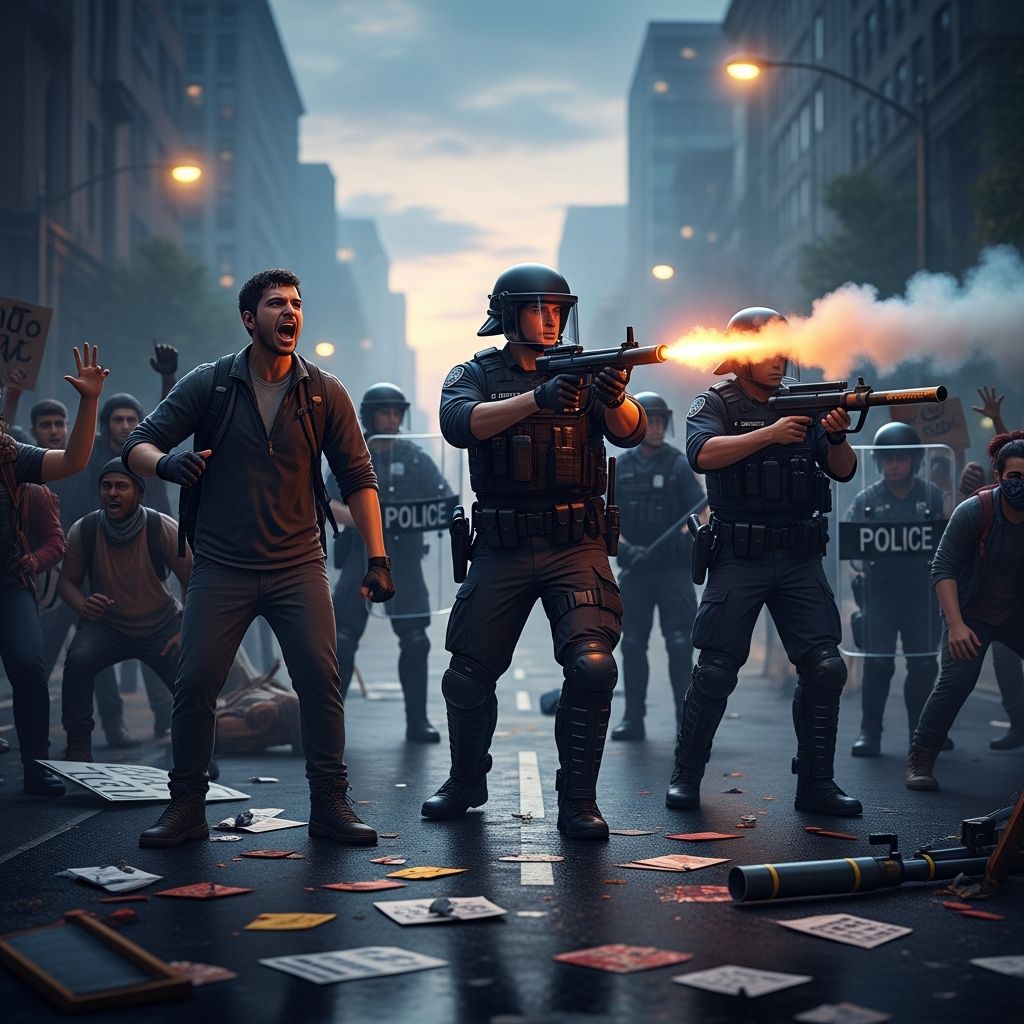
Law enforcement officers may deploy deadly force against protesters only when there is an imminent threat of death or serious injury to officers or others, as established by Supreme Court precedent and federal policy.
Constitutional Foundations of Force in Public Assemblies
The First Amendment safeguards the right to peaceably assemble and petition the government, forming the bedrock for protest activities across the United States. However, this protection does not extend to violence or imminent threats of harm. Courts have consistently ruled that police must balance public safety with these rights, intervening only when necessary to prevent clear dangers.
In Graham v. Connor (490 U.S. 386, 1989), the Supreme Court set the standard for evaluating police use of force: it must be ‘objectively reasonable’ based on the totality of circumstances, including the severity of the crime, whether the suspect poses an immediate threat, and resistance or evasion attempts. This framework applies directly to protest scenarios, where officers cannot use lethal measures against non-violent crowds.
When Deadly Force Becomes Permissible
Deadly force is reserved for extreme situations. According to the U.S. Department of Justice policy, officers may use it only when they reasonably believe a subject poses an imminent danger of death or serious physical injury to the officer or another person. Firearms discharge from moving vehicles is prohibited except in exigent circumstances, and verbal warnings must be given if feasible without increasing danger.
- Imminent Threat Requirement: Force is justified only if a protester or group actively endangers lives, such as wielding weapons or charging officers aggressively.
- Proportionality Principle: Responses must match the threat level; lethal options are inappropriate for property damage or minor disruptions alone.
- Warning Protocols: Officers should issue clear, audible dispersal orders before escalating, allowing non-violent individuals to comply.
For unlawful but non-violent assemblies, international standards echoed in U.S. practice emphasize avoiding force altogether or limiting it to the minimum necessary. In violent assemblies, less-lethal options like chemical irritants must be exhausted first.
Distinguishing Peaceful from Unlawful Demonstrations
Peaceful protests, even if loud or boisterous, do not justify forceful intervention. Police must facilitate First Amendment expression while protecting public safety through measured responses. Declarations of unlawful assemblies require evidence of violence or imminent violence by the group, not isolated acts by individuals.
| Scenario | Permissible Police Action | Prohibited Actions |
|---|---|---|
| Peaceful chanting and signs | Monitor and protect | Any physical force or dispersal |
| Blocking roads without violence | Negotiate and warn | Indiscriminate tear gas or arrests |
| Throwing objects at officers | Targeted less-lethal force | Blanket gunfire or mass kettling |
| Armed assault on police line | Deadly force if imminent harm | Firing into fleeing crowd |
This table illustrates key distinctions, emphasizing tailored responses over blanket tactics.
Less-Lethal Alternatives and Their Limits
Before considering firearms, officers must employ de-escalation, barriers, or non-lethal tools like tear gas or rubber bullets—but only against those posing threats, following warnings. Indiscriminate use against peaceful crowds violates constitutional norms and can lead to lawsuits. Best practices recommend advance planning with community leaders to de-escalate tensions proactively.
Training is crucial: officers should master de-escalation, peer intervention, and equipment use to minimize injuries. Agencies must avoid militarized gear escalation, which can inflame situations, especially during protests criticizing police conduct.
Real-World Cases Highlighting Boundaries
Recent litigation underscores these principles. In Scott et al. v. Louisville/Jefferson County Metro Government (filed 2020), plaintiffs challenged the Louisville Metro Police Department’s militaristic tactics against peaceful racial justice protesters, seeking injunctions against excessive force. A 2023 Department of Justice investigation confirmed unconstitutional conduct, leading to consent decree talks.
Such cases demonstrate that even ‘non-lethal’ munitions like rubber bullets cause serious harm when misused, reinforcing the need for probable cause in arrests and proportionate force.
Protester Rights and Police Accountability
Protesters retain rights to record police, assemble without permits in traditional public forums, and move as directed for safety. Unlawful arrests occur without probable cause, such as mere presence at a protest. Victims of excessive force can pursue civil remedies under 42 U.S.C. § 1983 for Fourth and First Amendment violations.
- Right to observe and film without interference.
- Protection from retaliation for criticism.
- Access to medical care post-force.
Agencies should document decisions on force, ensuring transparency and accountability.
Best Practices for Law Enforcement at Protests
Leading agencies advocate proportionality: tailor responses to crowd behavior, communicate arrest thresholds clearly, and avoid mass arrests or restrictive tactics like kettling without exits. Coordination with legal counsel and community groups prevents escalation.
Officers must prioritize life preservation, using force only as a last resort after feasible alternatives fail.
Frequently Asked Questions
Can police use tear gas on peaceful protesters?
No, chemical irritants should target only violent actors after warnings; broad deployment against non-violent groups is unlawful.
What constitutes an ‘imminent threat’ for deadly force?
An immediate risk of death or serious injury, such as a protester advancing with a deadly weapon.
Do protesters need permits for all gatherings?
No, spontaneous assemblies in public spaces are protected; permits apply to large, planned events with infrastructure needs.
Can police declare a protest unlawful for noise alone?
No, loud protests are protected speech; unlawfulness requires violence or clear danger.
What if a protest turns violent—can police shoot indiscriminately?
No, force must be targeted and minimal; firing into crowds or over heads endangers innocents and is prohibited.
Navigating Escalation: Strategies for Safety
For both officers and demonstrators, de-escalation saves lives. Protesters should comply with lawful orders while asserting rights verbally. Law enforcement benefits from body cameras, fatigue management, and post-event reviews to refine tactics. Ongoing training on constitutional limits ensures compliance amid high-stress environments.
Public trust hinges on restraint: when police uphold proportionality, protests proceed safely, preserving democratic expression.
References
- Department of Justice Policy on Use of Force — U.S. Department of Justice. 2023-11-15. https://www.justice.gov/jm/1-16000-department-justice-policy-use-force
- Crime Prevention & Criminal Justice Module 4: Use of Force During Assemblies — United Nations Office on Drugs and Crime. 2022-01-01. https://www.unodc.org/e4j/en/crime-prevention-criminal-justice/module-4/key-issues/7–the-use-of-force-during-assemblies.html
- Law Enforcement Guidance for Policing Public Demonstrations — Georgetown Law ICAP. 2021-04-19. https://www.law.georgetown.edu/icap/wp-content/uploads/sites/32/2021/04/ICAP-Law-Enforcement-Demonstrations-Guidance-4-19.21.pdf
- Protecting Protesters from Police Violence: Scott v. Louisville — NAACP Legal Defense Fund. 2023-01-01. https://www.naacpldf.org/protecting-protest-from-police-violence/
- Policing at Protests: Best Practices — Constitutional Protest Guide. 2022-06-01. https://constitutionalprotestguide.org/policing-at-protests-best-practices/
- Overview of Police Use of Force — National Institute of Justice. 2020-03-05. https://nij.ojp.gov/topics/articles/overview-police-use-force
Similar Articles








Read full bio of Sneha Tete




