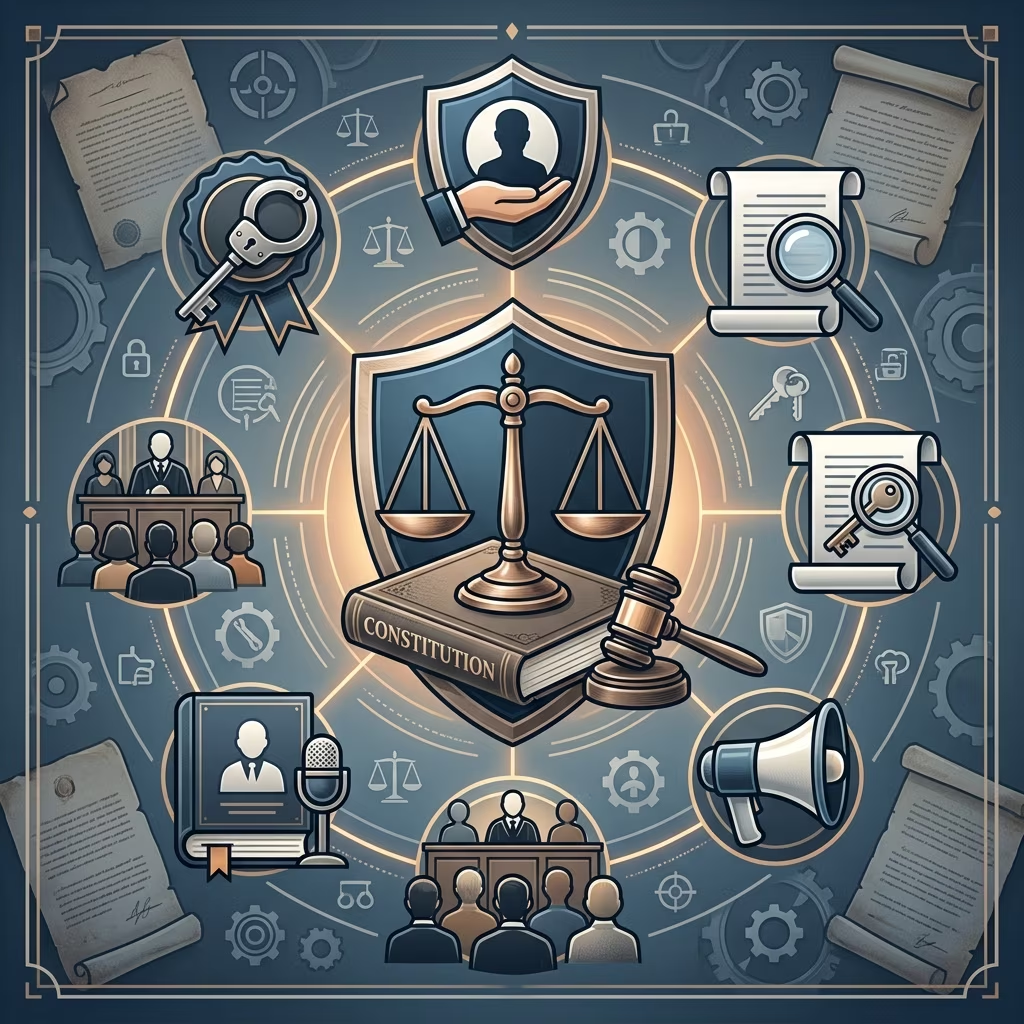
People accused of a crime are not expected to defend themselves on an uneven playing field. The U.S. Constitution gives criminal defendants a set of protections designed to prevent coercion, reduce unfair surprise, and limit the government’s power at each stage of a prosecution. Among the most important are the rights to remain silent, to have a lawyer, to know the charges, to face witnesses, and to receive a fair and public trial.
These safeguards are not abstract principles. They affect how police question a suspect, how prosecutors build a case, how judges manage hearings, and how juries evaluate guilt. Some protections come from the Fifth Amendment, while many of the core trial rights are found in the Sixth Amendment and applied in state courts through the Fourteenth Amendment.
Why these rights matter
Criminal cases can lead to jail, fines, probation, loss of professional licenses, immigration consequences, and a lasting public record. Because the stakes are so high, the law places limits on what the government can do and gives defendants tools to challenge mistakes, unreliable evidence, and unfair procedures.
- They help prevent forced confessions and other forms of self-incrimination.
- They require prosecutors to prove guilt rather than forcing defendants to prove innocence.
- They create meaningful opportunities to challenge witnesses and evidence.
- They promote transparency by keeping criminal proceedings open to the public.
The right to remain silent
One of the first protections many people hear about is the right to remain silent. The Fifth Amendment states that no person may be compelled to be a witness against themselves in a criminal case. In practical terms, that means a defendant generally does not have to answer questions from police, prosecutors, or even testify at trial.
This right is important because statements made under pressure can be misunderstood, incomplete, or taken out of context. A person who is arrested or questioned may think they are helping themselves by talking, but even innocent explanations can create problems if they are inconsistent with later evidence.
The right to silence does not stop law enforcement from asking questions, but it does give the suspect a lawful way to decline to answer. Once a person clearly invokes the right, questioning on that topic should stop unless the person chooses to speak with counsel present.
The right to a lawyer
The Sixth Amendment guarantees the assistance of counsel for the defense. This is one of the most important rights in the criminal justice system because most accused people do not have the legal training needed to navigate rules of evidence, criminal procedure, plea bargaining, or sentencing.
If a defendant cannot afford an attorney, the court must appoint one in qualifying cases. The right to counsel is not limited to the moment of trial. According to criminal defense authorities, it also applies during critical stages of the case, including formal proceedings that may shape the outcome long before a jury is seated.
Legal representation matters because criminal cases often turn on fast-moving decisions. A lawyer can evaluate whether a search was lawful, whether a confession was voluntary, whether a plea offer is fair, and whether key evidence can be excluded. In many cases, early legal advice can affect the entire direction of the prosecution.
Public trial and openness in the courtroom
The Constitution also protects the right to a public trial. Open proceedings help ensure accountability by allowing the public, the press, and the parties’ supporters to observe what happens in court. Transparency can discourage misconduct and make it easier to detect errors.
A public trial does not mean every detail of a case is broadcast to the world. Courts may still protect sensitive information in limited circumstances, such as when privacy, safety, or other legal concerns justify restrictions. But the basic presumption is openness, not secrecy.
An impartial jury
The Sixth Amendment promises an impartial jury in criminal prosecutions. An impartial jury is one that can decide the case based only on the evidence and the law, not on bias, outside influence, or preconceived ideas about the defendant.
In many cases, the jury is the centerpiece of the trial process. Jurors listen to witnesses, review exhibits, and decide whether the prosecution has met the burden of proof. The jury system is intended to spread decision-making across a group of ordinary citizens rather than leaving the outcome entirely in the hands of a single government official.
Impartiality is protected through jury selection, where lawyers and judges identify potential bias before trial begins. If a juror cannot be fair, that person should not decide the case. The Constitution’s promise of an impartial jury is meaningful only if courts actively guard against prejudice.
Knowing the charges and the evidence
A defendant has the right to be informed of the nature and cause of the accusation. This means the government must clearly state what crime is alleged, so the accused can prepare a defense rather than guess at the theory of the case.
Notice is not a technicality. A person cannot effectively challenge allegations without knowing the exact conduct at issue. Clear notice helps the defense investigate witnesses, gather records, and identify legal arguments that may weaken the prosecution’s position.
Courts also recognize that meaningful defense preparation requires access to evidence. While discovery rules vary by jurisdiction, the constitutional framework is built around the idea that the accused should not be ambushed by hidden accusations.
Confronting and cross-examining witnesses
The Confrontation Clause gives defendants the right to face the witnesses against them. This right usually includes the ability to cross-examine witnesses in open court. Cross-examination is a powerful safeguard because it allows the defense to test credibility, expose contradictions, and reveal gaps in the story presented by the prosecution.
This protection matters especially when a case depends on eyewitness testimony or statements from people with motives to exaggerate, minimize their own role, or shift blame. A witness who must answer questions in front of the judge, jury, and defense counsel is less likely to present a one-sided account without challenge.
The right to confrontation also limits the government’s ability to rely on certain out-of-court statements from witnesses who do not appear at trial, although the exact rules can be complex and depend on whether the statement is considered testimonial.
The speed of the process matters
The Sixth Amendment guarantees a speedy trial. This protection exists because delay can harm defendants in many ways: evidence may disappear, memories may fade, employment can be disrupted, and people may spend months in custody before their guilt is even decided.
A speedy trial right does not always mean a trial must begin immediately. Courts balance several considerations, including the length of delay, the reason for the delay, whether the defendant asserted the right, and whether the delay caused prejudice. The point is to prevent the government from holding a case open indefinitely while the accused waits for resolution.
Protection against double jeopardy
Another important safeguard is the rule against double jeopardy, which comes from the Fifth Amendment. In general, the government may not prosecute a person twice for the same offense after an acquittal or conviction.
This protection prevents repeated attempts to convict someone until the prosecution gets the result it wants. It also helps preserve finality, so a defendant who has already been judged by the legal system is not forced to live under endless uncertainty.
Double jeopardy rules can be complicated, especially when there are mistrials, separate sovereigns, or overlapping charges, but the basic purpose is clear: the state gets one fair opportunity to prove its case.
The burden remains on the prosecution
Although not always described as a single standalone constitutional clause in the same way as counsel or confrontation, the presumption of innocence is a foundational principle of American criminal law. A defendant does not have to prove innocence. The government must prove guilt beyond a reasonable doubt.
This standard is crucial because criminal punishment is serious and sometimes irreversible. Requiring proof beyond a reasonable doubt helps reduce the risk of convicting an innocent person based on suspicion, weak testimony, or incomplete evidence.
How these rights work together
These protections do not operate in isolation. A defendant who remains silent may still need a lawyer to defend that choice. A person who has counsel may still need a speedy trial. A trial may be public, but the evidence must still satisfy the confrontation and notice requirements.
| Right | What it protects | Why it matters |
|---|---|---|
| Right to remain silent | Protection against self-incrimination | Prevents forced or careless statements from being used unfairly |
| Right to counsel | Access to legal representation | Helps defendants navigate procedure, strategy, and negotiations |
| Speedy trial | Protection from unreasonable delay | Reduces anxiety, loss of evidence, and prolonged detention |
| Confrontation | Ability to question accusers | Improves reliability by testing testimony in open court |
| Public trial | Transparency in criminal proceedings | Encourages accountability and confidence in the system |
What defendants should remember
- Do not assume that cooperating with police is always the safest choice; silence is a protected option.
- Ask for a lawyer as soon as legal trouble begins, especially before answering questions or signing anything.
- Keep track of deadlines, hearing dates, and delays that may affect the right to a speedy trial.
- Challenge evidence that cannot be properly tested through cross-examination or that was obtained unfairly.
- Remember that the prosecution must prove guilt; the defendant is not required to prove innocence.
Frequently asked questions
Do criminal defendants have the same rights in state court and federal court?
Yes, many core rights apply in both systems. The Sixth Amendment sets out essential trial protections, and the Fourteenth Amendment makes many of those guarantees applicable to the states.
Can a defendant testify if they want to?
Yes. The right to remain silent belongs to the defendant, and choosing to testify is generally a strategic decision made with counsel. If the defendant does not testify, that choice should not be treated as proof of guilt.
Does having a lawyer guarantee an acquittal?
No. The right to counsel guarantees assistance, not a particular result. However, legal representation improves the defendant’s ability to raise defenses, negotiate, and protect constitutional rights.
Why is confrontation so important?
Because criminal trials often turn on testimony. The ability to question witnesses helps reveal bias, memory problems, and inconsistencies, which can be critical to a fair verdict.
Can the government delay a case indefinitely?
No. The speedy trial right exists to limit unreasonable delay, although courts evaluate delay through a balancing test rather than a fixed universal deadline.
Closing perspective
The rights of criminal defendants form a constitutional safety net. They are designed to make the criminal process more reliable, more transparent, and less vulnerable to abuse. Silence, counsel, confrontation, notice, public proceedings, an impartial jury, and a timely trial all work together to make sure punishment follows proof rather than pressure.
For anyone facing charges, understanding these protections is not optional. These rights can shape whether evidence is admissible, whether a statement can be used, whether a delay is lawful, and whether a case is decided fairly from start to finish.
References
- Sixth Amendment | U.S. Constitution — Cornell Law School. 2026-07-10. https://www.law.cornell.edu/constitution/sixth_amendment
- What are My Rights as a Criminal Defendant in Texas? — Casedarwin Law. 2026-07-10. https://casedarwinlaw.com/blog/what-are-my-rights-as-a-criminal-defendant-in-texas/
- U.S. Constitution – Sixth Amendment — Library of Congress. 2026-07-10. https://constitution.congress.gov/constitution/amendment-6/
- Criminal Rights Law — FindLaw. 2026-07-10. https://www.findlaw.com/criminal/criminal-rights.html
- What Rights Does a Defendant in a Criminal Case Have? — David Lee Sellers, Attorney at Law. 2026-07-10. https://www.davidleesellers.com/blog/what-rights-does-a-defendant-in-a-criminal-case-have/
- Constitutional Rights of Criminal Defendants — Nolo. 2026-07-10. https://www.nolo.com/legal-encyclopedia/defendants-rights-during-court-trial-29793.html
- Constitutional Rights in Criminal Law Proceedings — Justia. 2026-07-10. https://www.justia.com/criminal/procedure/other-constitutional-rights/
- Right to Counsel — National Association of Criminal Defense Lawyers. 2026-07-10. https://www.nacdl.org/Landing/Right-to-Counsel
- Due Process Rights in Criminal Case: The Right To Counsel — LawShelf. 2026-07-10. https://www.lawshelf.com/shortvideoscontentview/due-process-rights-in-criminal-case-the-right-to-counsel/