
Open Container Laws: What To Know For Vehicles And Public Space
A practical guide to open container rules, public drinking bans, and the penalties that can follow.
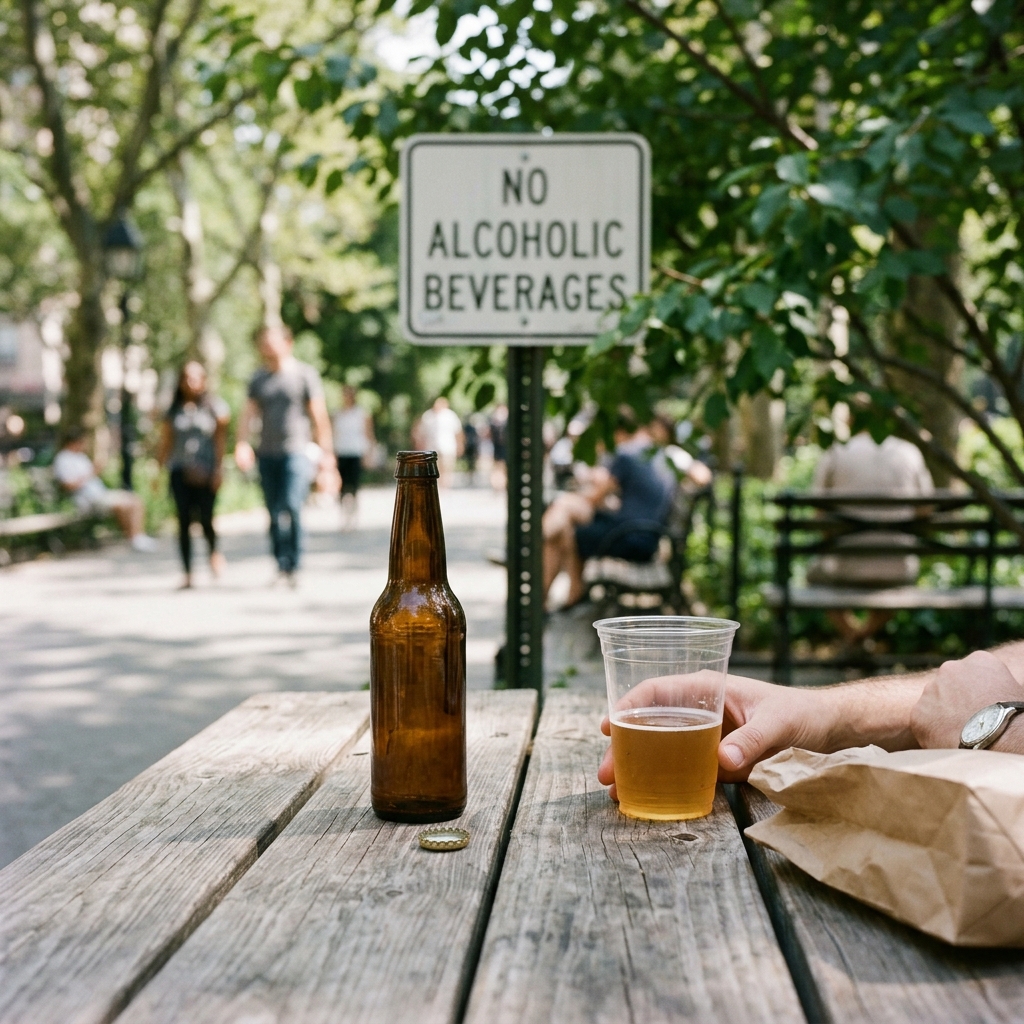
Understanding Open Container Laws
Open container laws regulate the possession and consumption of alcoholic beverages in public places and vehicles. These rules are designed to reduce public intoxication, discourage drinking while driving, and give law enforcement a clear standard for when alcohol is being carried or consumed illegally.
Although the basic idea sounds simple, the details vary widely by state and even by city. In some places, an open container violation is only a traffic infraction or civil fine. In others, it can carry misdemeanor consequences or become part of a larger alcohol-related case.
Because the law is not uniform nationwide, the first question is usually not whether alcohol is present, but where it is being carried, who has it, and whether the container is considered open under local law.
What Counts as an Open Container?
An open container is generally any alcoholic beverage container that has been opened, has a broken seal, or has had some of its contents removed. That definition can apply to bottles, cans, flasks, jars, and similar containers holding beer, wine, spirits, or mixed drinks.
Some states define the term very specifically. For example, Florida law defines an open container as one that is immediately capable of being consumed from or one with a broken seal. Other states use broader wording that covers any container that has been opened or partially used.
- Broken or missing seal
- Cap removed or no longer secure
- Alcohol already poured out or partially consumed
- Container that is immediately drinkable
In practice, the label on the container matters less than the container’s condition. A bottle with the cap off may be treated as open even if it has only been carried briefly and not actually drunk from.
Where Open Container Rules Usually Apply
Most open container laws focus on two settings: public spaces and motor vehicles. Public spaces usually include streets, sidewalks, parks, and other areas where drinking is not allowed by local ordinance or state law.
Vehicle rules are often stricter than rules for public sidewalks. Many states prohibit the driver from possessing or consuming alcohol in a vehicle, and some also extend that prohibition to passengers.
That means a person may be violating the law even if the car is parked, if the container is open in a location covered by the statute. In some states, the law applies not only while the vehicle is moving, but also when it is stopped or parked on a public road.
| Setting | Common Rule | Typical Consequence |
|---|---|---|
| Public sidewalk or park | Drinking may be banned | Fine, citation, or misdemeanor in some places |
| Passenger vehicle | Open containers may be prohibited | Traffic infraction, civil penalty, or misdemeanor |
| Highway or controlled-access road | Rules are often stricter | Higher likelihood of citation |
| Private property | Usually allowed unless local rules say otherwise | Depends on venue or permit conditions |
Why States Treat Vehicles Differently
The main reason open container laws are more aggressive in cars is that alcohol in the passenger area can support impaired driving and make DUI enforcement harder. Federal policy has also encouraged states to adopt laws banning open containers in the passenger area of a motor vehicle.
In many states, the law applies to both the driver and passengers. Florida, for example, makes it unlawful for a person to possess or consume an open container while operating a vehicle or riding in one. New Jersey likewise treats possession and drinking in a moving vehicle as violations for both drivers and passengers.
Some states also distinguish between the passenger compartment and areas of the vehicle that are not readily accessible, such as the trunk. That distinction can matter when a person has an unopened bottle in one part of the car and an open bottle in another.
Public Drinking Isn’t Treated the Same Everywhere
Outside vehicles, public drinking laws vary sharply from place to place. Some jurisdictions strictly ban alcohol in public, while others allow limited drinking in designated districts, event spaces, or licensed entertainment areas.
Washington law, for example, states that no person may open the package containing liquor or consume liquor in a public place, subject to legal exceptions. Other states rely on municipal ordinances or permit-based systems to decide when public drinking is allowed.
That variation is why a person can legally drink in one neighborhood and be cited for the same conduct a few blocks away. Local rules often matter as much as state law.
Common Exceptions and Special Permissions
Open container laws often include exceptions, especially for private property, regulated venues, and certain types of transportation. The exact list depends on the state, but several patterns appear repeatedly.
- Private property such as a home, yard, or rented venue often allows alcohol use.
- Motor homes may be exempt under certain vehicle statutes.
- Passengers in limousines or similar for-hire vehicles may be allowed to drink in limited circumstances.
- Special events may permit alcohol in defined areas under a license or local authorization.
- Designated entertainment districts may create narrow public drinking zones.
New Jersey, for instance, has exceptions for the living area of recreational vehicles and for some mobile-home or camper settings. Florida also exempts certain passengers in vehicles designed primarily for compensation, as well as motor homes, from part of its open container restriction.
Some venues operate under permit systems that change the ordinary rule. Pennsylvania law includes a number of location-specific exceptions, such as certain performance venues, festival spaces, and designated outdoor refreshment areas. These exceptions do not make public drinking broadly legal; they only permit it in defined spaces under defined conditions.
Penalties Can Range from Minor to Serious
The consequences for an open container violation depend on the state, the local ordinance, and whether the violation is tied to other conduct such as reckless driving or DUI. In some jurisdictions, the punishment is a modest fine. In others, repeat violations or related conduct can bring more serious consequences.
North Carolina examples described in secondary legal commentary show how penalties may begin with a fine and grow with repeat offenses. New Jersey treats a basic open container violation as a traffic offense rather than a crime, but still allows fines and record consequences. Pennsylvania distinguishes between simply possessing an open container and actually drinking in public, with the latter carrying more severe misdemeanor penalties.
Possible outcomes may include:
- Citation or traffic ticket
- Monetary fine
- Community service
- License-related consequences in some cases
- Misdemeanor charge if the conduct is aggravated or repeated
- Additional alcohol-related charges if impairment is suspected
When police believe a driver has been drinking, an open container may also become evidence supporting a DUI investigation. In those situations, the open container is rarely the only legal issue.
Empty Bottles and Other Borderline Situations
Not every bottle or can found in public creates the same legal risk. Some laws focus on containers that still hold alcohol or can immediately be used for drinking. Others may treat a container as open even if little remains inside.
Borderline issues can include:
- Whether the container is truly empty
- Whether condensation or temperature suggests recent use
- Whether the container is in a vehicle or on a sidewalk
- Whether the container is accessible to passengers
- Whether the location is subject to a special event rule or local permit
Because these cases are fact-sensitive, the same container can be harmless in one setting and problematic in another. A truly discarded empty can may be treated as trash, while a partly used bottle may trigger a citation.
How Open Container Laws Interact with DUI Enforcement
Open container violations are often not isolated cases. Police may use the presence of an open container as one factor in deciding whether to investigate impaired driving. If an officer smells alcohol, sees an open drink, or observes signs of impairment, the stop may expand into a broader alcohol-related investigation.
That does not mean every open container leads to DUI charges. It does mean that carrying an open bottle in a vehicle can create legal exposure beyond the immediate ticket. A person who is only trying to transport leftovers from a restaurant, for example, may still need to know how the state handles sealed versus open packaging.
Practical Ways to Avoid a Violation
Because the rules vary, the safest approach is to assume that alcohol should remain sealed in public and in cars unless a clear exception applies. A few simple habits can reduce risk.
- Keep alcoholic beverages sealed during transport.
- Use the trunk or another non-passenger area when local law allows it.
- Check local event rules before attending festivals or outdoor venues.
- Do not assume a public park, beach, or street allows drinking.
- Remember that passengers may be covered by the law, not just drivers.
These precautions matter because a misunderstanding of the law is not always a defense. In many places, the legal question is objective: was the container open, was the person in a regulated place, and did a statutory exception apply?
When Legal Help May Be Useful
Many open container cases are resolved as minor citations, but legal advice may be helpful when the matter is connected to DUI, repeat offenses, or a state with harsher penalties. An attorney may review whether the container was actually open under the statute, whether the location qualified as public, and whether a recognized exception applied.
Legal help can also matter if the ticket appears to be part of a broader enforcement action. For example, a stop that begins with an alleged open container may lead to driving-record consequences, license issues, or separate criminal allegations. The details of the stop and the wording of the statute often control the result.
Frequently Asked Questions
Are open container laws the same in every state?
No. Open container laws are controlled by state and local law, and the penalties and exceptions differ widely from one jurisdiction to another.
Can a passenger get in trouble for an open container?
Yes. In many states, passengers are covered by the law, especially in vehicles on public roads.
Is drinking in public always illegal?
Not always. Some places allow drinking in designated districts, venues, or special event areas, but ordinary public drinking is often restricted.
Does an open container violation count as a crime?
Sometimes it does, and sometimes it does not. Depending on the state, it may be a civil infraction, traffic offense, or misdemeanor.
Can an open container lead to DUI charges?
Yes. An open container can be used as evidence in a broader alcohol-related investigation, especially if there are signs of impairment.
References
- Open Container Laws by State — FindLaw. 2026-07-10. https://www.findlaw.com/dui/laws-resources/open-container-laws-by-state.html
- New Jersey Open Container Law — New Jersey Criminal Law Attorney. 2026-07-10. https://www.newjerseycriminallawattorney.com/dui-drunk-driving/new-jersey-open-container-law/
- RCW 66.44.100 — Washington State Legislature. 2026-07-10. https://apps.leg.wa.gov/rcw/default.aspx?cite=66.44.100
- 2025 Florida Statutes, Section 316.1936 — Florida Legislature. 2025-01-01. https://www.leg.state.fl.us/statutes/index.cfm?App_mode=Display_Statute&URL=0300-0399/0316/Sections/0316.1936.html
- Sipping Smart: North Carolina’s Open Container Laws — King Law Offices. 2026-07-10. https://kinglawoffices.com/criminal-disputes/sipping-smart-north-carolinas-open-container-laws/
- Understanding Pennsylvania’s Open Container Regulations — Youngstown Criminal Lawyer. 2026-07-10. https://www.youngstowncriminallawyer.com/areas/mercer/criminal-defense/understanding-pennsylvanias-open-container-regulations/
- What Are the Open Container Laws Within the United States? — Alcohol.org. 2026-07-10. https://alcohol.org/laws/open-container/
Similar Articles








Read full bio of Sneha Tete




