The Evolution of American Surveillance Programs
Legal Foundations and Warrantless Monitoring
Before the digital revolution redefined communication, the Church Committee of the 1970s exposed rampant, unchecked domestic spying by U.S. intelligence agencies against civil rights leaders, political dissidents, and journalists. It was this precise overreach that spurred the creation of the Foreign Intelligence Surveillance Act in 1978. The objective was to bring the shadow operations of intelligence agencies into the light of judicial oversight. The newly established Foreign Intelligence Surveillance Court (FISC) was tasked with acting as a neutral arbiter, requiring intelligence agencies to secure a warrant based on probable cause before monitoring domestic entities.
For a time, this system maintained a delicate equilibrium. However, the tragic events of September 11, 2001, triggered a seismic shift in the nation’s security posture. The subsequent executive authorizations paved the way for massive, warrantless wiretapping programs. When these secret programs were exposed, rather than dismantling them, Congress effectively legalized their framework through the FISA Amendments Act of 2008. By creating Section 702, lawmakers fundamentally severed the warrant requirement for targets deemed to be foreign entities. The narrative presented to the public was one of surgical precision—a necessary adaptation to an increasingly interconnected, digital threat landscape. Yet, in practice, this modernization birthed a colossal data-collection apparatus that inevitably and routinely ensnares the private data of the very citizens it was established to protect.
Legislative Battles and the Illusion of Reform
Bypassing the Fourth Amendment in the Digital Age
Watching a reauthorization vote for surveillance authorities unfold on the legislative floor is often a masterclass in parliamentary sleight of hand. When civil liberties advocates and a bipartisan coalition of privacy-minded legislators attempt to introduce amendments—most notably, a requirement that intelligence agencies obtain a probable cause warrant before searching the Section 702 database for Americans’ communications—they are consistently met with fierce resistance from the executive branch and intelligence committees.
The recent passage of the Reforming Intelligence and Securing America Act (RISAA) serves as a prime example of this dynamic. Lawmakers were presented with a binary choice: either allow vital intelligence authorities to lapse, supposedly blinding the nation to imminent threats, or vote for a package that contained only cosmetic reforms. While RISAA introduced new training mandates and disciplinary rules for noncompliance, it decisively rejected the foundational demand for a warrant requirement. In fact, privacy advocates argue that the reauthorization left the most critical vulnerability untouched.
More distressingly, bills presented as reform often camouflage expansions of power. For instance, recent reauthorizations expanded the definition of an “electronic communications service provider,” effectively widening the net of businesses obligated to assist the government in its surveillance efforts. For those who place their faith in the legislative process to act as a bulwark against executive overreach, witnessing these votes can lead to a profound loss of faith in systemic checks and balances.
The Human Cost of Expanded Intelligence Gathering
Impact on Journalists, Activists, and Everyday Citizens
The consequences of untethered surveillance are not abstract legal theories; they carry a tangible, everyday human cost. When the government vacuums up the communications of foreign targets, it simultaneously collects the emails, text messages, and phone calls of any American interacting with them. This phenomenon is politely termed “incidental collection,” but for the citizens caught in the web, it is a direct invasion of privacy.
Once this data is housed in government servers, domestic law enforcement agencies, including the FBI, can query the database using the identifiers of U.S. citizens. This practice—widely criticized as the “backdoor search loophole”—allows authorities to access the contents of Americans’ communications without demonstrating probable cause to a judge.
The chilling effect on a free society is palpable. Journalists communicating with overseas sources, activists coordinating with international human rights organizations, and businesses negotiating foreign deals all operate under the shadow of potential monitoring. When the sanctity of private communication is compromised, the foundations of free press and free association begin to crumble. People alter their behavior, self-censor, or avoid controversial topics altogether, fundamentally changing the democratic fabric of the nation.
Navigating the Complexities of National Security and Civil Liberties
Arguments for Robust Intelligence Tools
It is crucial to acknowledge the formidable responsibilities shouldered by the intelligence community. The government’s perspective on this issue is not without merit; agencies face a daunting array of asymmetrical threats. According to statements from the Federal Bureau of Investigation (FBI) and the Office of the Director of National Intelligence (ODNI), maintaining immediate access to Section 702 data is a matter of critical national defense. Intelligence officials argue that the agility provided by warrantless queries is critical in identifying fast-moving cyber espionage campaigns, tracking hostile state actors launching ransomware attacks against critical U.S. infrastructure, and disrupting complex supply chains utilized by international cartels to distribute fentanyl precursors.
They warn that mandating a time-consuming warrant process for U.S. person queries could create dangerous blind spots, potentially delaying the prevention of terrorist activities on American soil. From their vantage point, the data has already been lawfully collected, and internal auditing by the Department of Justice, combined with FISC oversight, provides an adequate shield against abuse.
The Civil Rights Counterbalance
However, the civil rights counterbalance paints a much grimmer picture of these so-called safeguards. Privacy advocates, constitutional scholars, and civil liberties organizations point out that the FISC operates entirely in secret and entirely ex-parte—meaning only the government presents its case. Without an adversarial process, the court often approves surveillance procedures that stretch the bounds of the Constitution.
Furthermore, declassified reports have exposed systemic, widespread compliance failures. The FBI, for instance, has been cited for conducting tens of thousands of improper backdoor searches, utilizing the database to look up individuals involved in purely domestic matters, ranging from political activists to individuals reporting crimes to the police. This reality shatters the illusion that internal guidelines can substitute for strict judicial review. To civil liberties defenders, allowing intelligence analysts to independently decide when they can bypass the Fourth Amendment fundamentally betrays the democratic principles of the United States.
Mechanisms of Government Data Acquisition
How Domestic Communications Get Caught in the Net
Understanding the mechanics of surveillance helps illuminate why civil liberties are at risk. The architecture of modern digital communication means that data often travels across international borders, even when the sender and recipient are in the same country. In addition to traditional internet communications, the rise of cloud computing and interconnected devices means that an unimaginable volume of personal data is continuously flowing through the servers of a handful of tech giants.
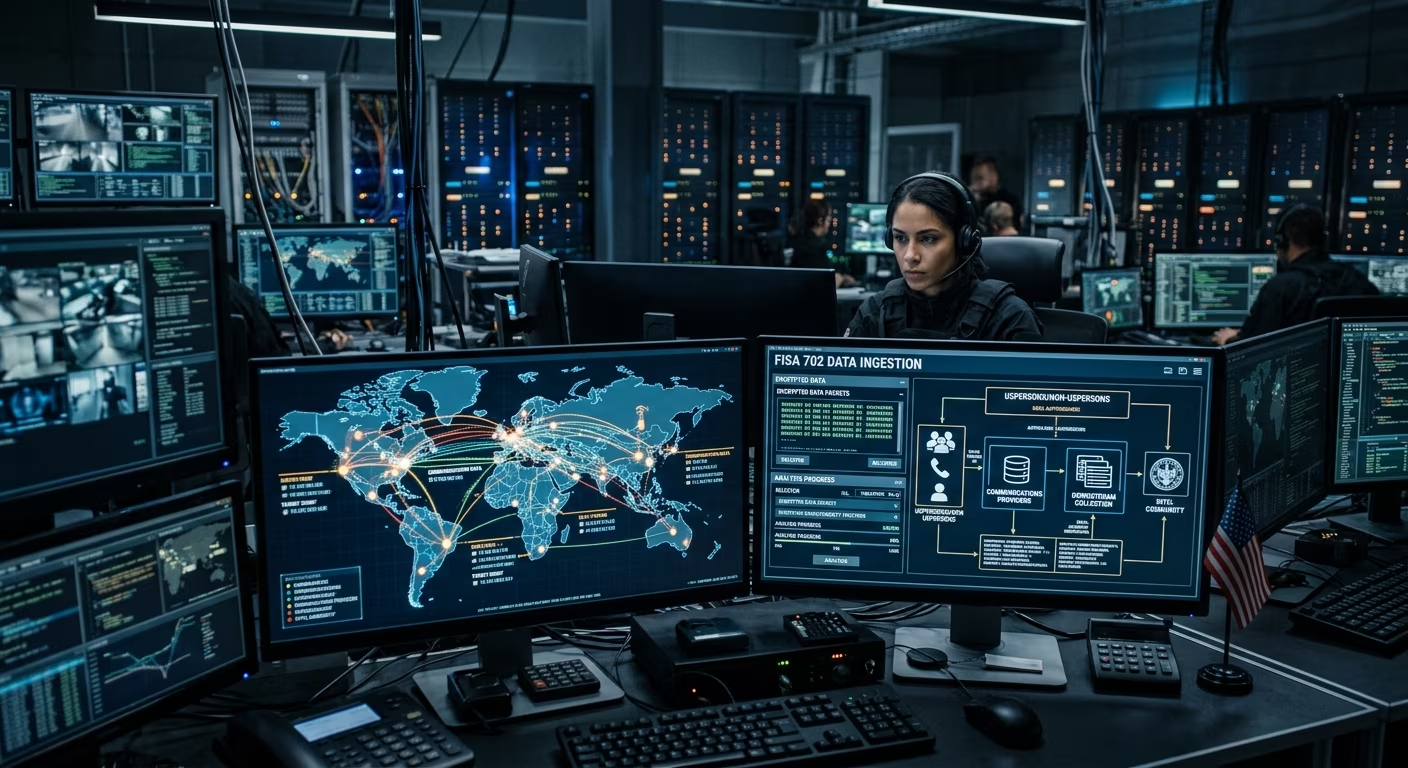
Here is a breakdown of how the surveillance net operates:
- Targeting: The government identifies a non-U.S. person located abroad who possesses foreign intelligence value.
- Compelled Assistance: The government issues a directive to a U.S.-based technology company (e.g., an email provider or cloud storage service) to turn over all communications associated with the target’s account.
- Incidental Collection: As the provider hands over the data, it includes all communications the target had with U.S. citizens.
- Retention and Querying: The data is stored in massive databases for years. Agents can later query these databases using the identifiers of U.S. citizens to pull up their side of the conversations.
When the government issues a directive for collection, companies are legally compelled to surrender vast repositories of data. This doesn’t just include emails; it encompasses photographs, documents, chat logs, and contact lists. The scope of incidental collection is magnified by the fact that global business, academia, and social interactions are inherently transnational. The sheer volume of this incidentally collected domestic data is so massive that the government has historically struggled to quantify exactly how many Americans have their communications swept up in the dragnet.
A Call for Comprehensive Legislative Safeguards
Concrete Steps Toward Accountability
Restoring faith in our democratic institutions requires more than legislative lip service; it demands comprehensive, structurally sound safeguards that prioritize the constitutional rights of the populace over administrative convenience. First and foremost, Congress must pass an ironclad warrant requirement for all U.S. person queries. If an intelligence agency wants to read the communications of an American, they must go to a judge, present probable cause, and obtain a warrant.
Secondly, transparency must be radically improved. The intelligence community must be mandated to provide accurate, unclassified estimates of how many Americans have their communications swept up in these programs annually. Without baseline metrics, effective oversight by the public and lawmakers is virtually impossible.
Finally, compliance mechanisms must have definitive consequences. Internal reprimands for agents who violate querying rules are insufficient. The law must establish severe, enforceable penalties for intentional misuse of surveillance databases, alongside a clear statutory pathway for individuals to seek redress if they are unconstitutionally surveilled. Until lawmakers decide to champion these definitive guardrails, the digital privacy of every citizen remains subject to the unyielding appetite of the surveillance state.
Frequently Asked Questions (FAQs)
What is FISA Section 702?
Section 702 is a provision of the Foreign Intelligence Surveillance Act that allows the U.S. government to conduct targeted, warrantless surveillance of non-U.S. persons located abroad to acquire foreign intelligence information.
What does “incidental collection” mean?
Incidental collection occurs when the government, while surveilling a foreign target, captures the private communications of Americans who are interacting with that target.
What is the backdoor search loophole?
The backdoor search loophole refers to the controversial practice where U.S. intelligence and law enforcement agencies search through the data collected under Section 702 using the names, emails, or phone numbers of U.S. citizens, thereby accessing their private communications without a warrant.
Are U.S. citizens legally targeted under Section 702?
No, Section 702 explicitly prohibits the intentional targeting of U.S. citizens or anyone located within the United States. However, their data is routinely collected incidentally and can be searched later.
How do recent reforms affect privacy?
Recent legislative updates introduced stricter compliance and training rules, but also expanded the definitions of who must assist in surveillance. Crucially, these reforms failed to include a probable cause warrant requirement for domestic data searches, leading privacy advocates to argue that core vulnerabilities remain.
References
- FISA Section 702 – A One Page Overview — Office of the Director of National Intelligence (ODNI). https://www.dni.gov/
- Incidental Collection in a Targeted Intelligence Program — Office of the Director of National Intelligence (ODNI). https://www.dni.gov/
- In Senate Floor Speech, Durbin Calls For Opposition To FISA Section 702 Reauthorization Without Serious Reforms — U.S. Senate Committee on the Judiciary. 2026-06-03. https://www.judiciary.senate.gov/
- Foreign Intelligence Surveillance Act (FISA) and Section 702 — Federal Bureau of Investigation (FBI). https://www.fbi.gov/
- FISA Section 702 – Oversight Projects — Privacy and Civil Liberties Oversight Board (PCLOB). 2023. https://pclob.gov/Oversight/Section702
- Targeting Under FISA Section 702 — Office of the Director of National Intelligence (ODNI). https://www.dni.gov/
- Signals Intelligence – FISA — National Security Agency (NSA). https://www.nsa.gov/
- A key intelligence law expires in April and the path for reauthorization is unclear — The Brookings Institution. 2026-02-10. https://www.brookings.edu/