
Navigating Shared Amenity Disputes in HOA and Condo Communities
Understand your rights, common conflicts, and practical legal options when shared amenities become a source of tension in your community.
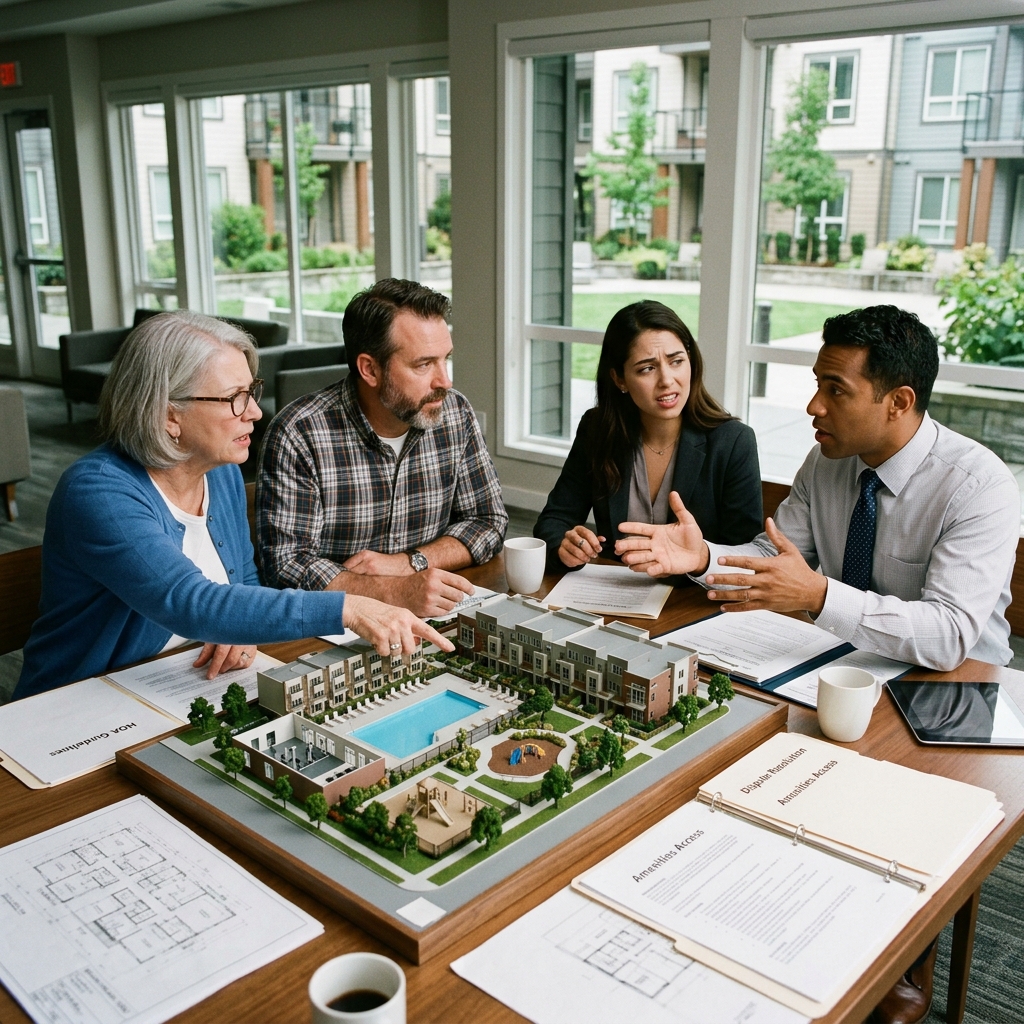
Shared amenities such as pools, fitness centers, parking areas, playgrounds, and clubhouses are a major attraction in homeowner association (HOA) and condominium communities. They also create some of the most frequent and emotionally charged disputes between residents and community management. When questions arise about access, safety, maintenance, or rule enforcement, understanding your rights and options is essential.
This guide explains how shared amenity disputes commonly arise, what rights owners and tenants typically have, what duties HOAs and condo associations owe, and the practical steps you can take to resolve conflicts, including when mediation or legal action may be appropriate.
What Are Shared Amenities and Why Do Disputes Arise?
Shared amenities are facilities or spaces owned or controlled collectively by a community association and intended for use by multiple residents, rather than by a single household.
Typical Shared Amenities in Community Associations
- Swimming pools and hot tubs
- Fitness centers and recreational rooms
- Parking lots, garages, and assigned spaces
- Playgrounds, dog parks, and landscaped common areas
- Clubhouses, event spaces, and business centers
- Shared roofs, hallways, elevators, and building infrastructure in condominiums
These facilities are usually governed by the association’s declaration, bylaws, rules, and regulations (often collectively referred to as governing documents), which define who may use them, when, and on what conditions.
Common Sources of Conflict
Disputes over shared amenities often center on fairness, safety, and compliance with rules. Frequent issues include:
- Access restrictions – limitations on pool use, guest policies, age limits, or closure of facilities for extended periods.
- Parking problems – unauthorized use of spaces, towing disputes, blocked driveways, or perceived favoritism in enforcement.
- Noise and nuisance – loud gatherings in clubhouses or pool areas, late-night use of gyms, or children playing in common spaces.
- Maintenance lapses – deteriorating equipment, unsafe playgrounds, broken lighting, or unclean pools.
- Rule enforcement disagreements – allegations of inconsistent or discriminatory enforcement of community rules.
- Cost and fee allocation – disputes over assessment increases, amenity-specific fees, or how costs are shared between units.
When residents feel that management is not following the governing documents or that certain people receive favored treatment, trust erodes and disputes escalate quickly.
Your Core Legal Rights Regarding Shared Amenities
Although specific rights depend on state law and your community’s governing documents, certain principles are widely recognized in HOA and condo settings.
1. Right to Use and Enjoy Common Areas
Owners and, in many cases, tenants generally have a contractual and property-based right to use common amenities in accordance with community rules. These rights are typically derived from:
- The recorded declaration of covenants, conditions, and restrictions (CC&Rs).
- Association bylaws and rules adopted by the board.
- Lease agreements (for tenants) that incorporate association requirements.
Restrictions on use must usually be reasonable, consistent with the governing documents, and applied uniformly to similarly situated residents.
2. Right to Fair and Consistent Rule Enforcement
Most community association laws and best practices require that rules be enforced in a non-arbitrary manner. Homeowners often have the right to:
- Question rules they believe are inconsistent with the governing documents or state law.
- Challenge fines or penalties imposed without proper notice or opportunity to be heard.
- Seek remedies if enforcement appears discriminatory or retaliatory, particularly when protected characteristics or fair housing rights are involved.
3. Right to Due Process Before Penalties
In many jurisdictions, associations must provide owners with notice of alleged violations and an opportunity to respond before imposing fines, suspending amenity privileges, or taking other adverse actions. Typical due process features include:
- Written notice describing the alleged violation and the relevant rule or covenant.
- A reasonable time to cure the violation, when applicable.
- An opportunity to attend a hearing before the board or designated committee.
- A written decision explaining the outcome and any penalties.
4. Right to Safe and Properly Maintained Amenities
Associations generally have a duty to maintain common areas in a reasonably safe condition. Failure to repair known hazards in pools, parking areas, stairways, or playgrounds can expose the HOA or condo association to claims for negligence or breach of covenant.
Homeowners can often:
- Request repairs and document unsafe conditions.
- Invoke governing document provisions that obligate the association to maintain specific amenities.
- Pursue legal action if serious hazards are ignored and injuries or property damage result.
5. Right to Challenge Unlawful or Ultra Vires Actions
When an association acts beyond its authority (known as acting ultra vires) or fails to follow its own documents, owners may seek court orders to stop or correct those actions. Examples include:
- Closing amenities indefinitely without authority in the documents.
- Charging special amenity fees that are not authorized.
- Enforcing rules that were never properly adopted.
Key Responsibilities of HOAs and Condo Associations
Understanding the association’s obligations helps frame what you can reasonably demand when shared amenities become a problem.
Maintenance and Safety Duties
Associations typically must:
- Maintain, repair, and replace common facilities as required by the CC&Rs.
- Act as a reasonably prudent property manager in addressing safety hazards.
- Keep adequate records of maintenance decisions and expenditures.
Failure to meet these obligations may support claims for:
- Breach of covenant or contract (not following governing documents).
- Negligence if injuries or property damage occur due to poor maintenance.
Rulemaking and Enforcement Responsibilities
Boards are empowered to adopt reasonable rules concerning amenity use and to enforce them consistently. Good governance standards include:
- Ensuring rules align with CC&Rs and state law.
- Providing clear written policies and posting amenity rules where appropriate.
- Establishing a fair complaint and enforcement process with documented steps.
Fair enforcement generally involves:
- Prompt acknowledgment of complaints from residents.
- Objective fact-gathering, including site visits and document review.
- Notifying alleged violators and allowing them to respond.
- Formal board decisions with written explanations and references to governing documents.
Fiduciary Duty and Neutrality
Association boards owe a fiduciary duty to act in the best interests of the community, which includes impartial enforcement and avoiding favoritism. If an HOA consistently ignores certain violations or protects particular residents from enforcement, owners may question whether this duty is being breached.
Practical Steps to Resolve Shared Amenity Disputes
Most disputes can be resolved without litigation if residents follow a structured approach and use the tools built into association governance.
Step 1: Review Governing Documents Thoroughly
Your first step should be to understand the legal framework controlling the amenity in question. Key documents include:
- Declaration or CC&Rs (recorded with the county).
- Bylaws and any rules or regulations adopted by the board.
- Any amenity-specific agreements or easements, particularly when facilities are shared between multiple associations.
Look for provisions related to:
- Access rights and restrictions.
- Maintenance responsibilities.
- Cost-sharing and special amenity assessments.
- Mediation or arbitration requirements for disputes.
Step 2: Document the Problem Carefully
Accurate documentation strengthens your case and helps management understand the issue. Consider:
- Photographs or videos of the condition (e.g., broken equipment, blocked parking).
- Dates, times, and descriptions of incidents (noise, denied access, unsafe situations).
- Copies of relevant communications, notices, or board decisions.
Step 3: Communicate Directly with Management or the Board
Informal communication often resolves misunderstandings before they escalate. Effective approaches include:
- Sending a concise, factual email or letter to the property manager or board.
- Requesting clarification of the rule or decision you believe is being misapplied.
- Proposing reasonable solutions, such as adjusted hours or improved signage.
Clear, respectful communication is generally the most cost-effective way to resolve disputes and maintain good neighbor relationships.
Step 4: Use Formal Complaint Procedures
Most HOAs and condo associations have written procedures for submitting complaints or violation reports. To use them effectively:
- Follow the specified format (online portal, written form, or letter).
- Include supporting evidence and references to governing documents.
- Request confirmation of receipt and an expected response timeline.
A formal complaint creates a paper trail, which can be important if the matter later moves to mediation or court.
Step 5: Consider Mediation or Other Alternative Dispute Resolution
In many states, associations are encouraged or required to offer mediation or other forms of alternative dispute resolution (ADR) before litigation. Mediation involves a neutral third party helping the sides communicate and explore settlement options. Its benefits include:
- Lower cost compared to court proceedings.
- More flexible and creative solutions (e.g., schedule changes, partial fee waivers).
- Preservation of ongoing relationships in the community.
Arbitration, another ADR method, is more like a private judge issuing a binding or non-binding decision, depending on the agreement. Many condominium legal frameworks recommend or require ADR clauses to be included in governing documents.
Step 6: Evaluate Legal Options if the Dispute Persists
If informal communication and ADR fail, and the issue involves serious harm, discrimination, safety hazards, or clear violations of governing documents, consulting a real estate or HOA attorney may be appropriate. Potential legal avenues include:
| Type of Claim | Typical Scenario | Possible Outcome |
|---|---|---|
| Breach of Covenant / Contract | Association ignores maintenance duties or changes amenity rules without authority. | Court order enforcing the governing documents; damages or fee adjustments. |
| Negligence | Injuries from unsafe pools, parking areas, or walkways due to poor maintenance. | Compensation for injuries or property damage; incentives for improved safety. |
| Injunctive Relief | Association refuses to repair essential amenity or wrongly restricts access. | Court order compelling repairs, reopening facilities, or halting improper actions. |
| Fair Housing or Civil Rights Claims | Unequal amenity access based on protected characteristics (race, disability, family status, etc.). | Potential federal or state enforcement, damages, and policy changes. |
Preventing Shared Amenity Disputes Before They Start
Prevention is often more effective than attempting to resolve entrenched conflicts. Boards, managers, and residents can take proactive steps to reduce the risk of disputes.
For Associations and Boards
- Draft clear easements and agreements for shared facilities, especially when multiple communities use the same amenities.
- Specify maintenance responsibilities for each shared area, including cost-sharing formulas and reserve planning.
- Adopt transparent complaint and enforcement procedures and ensure residents know how to use them.
- Provide regular communication about amenity changes, repairs, and rules to avoid surprises.
- Offer ADR options and encourage mediation before disputes escalate into lawsuits.
For Homeowners and Residents
- Read the governing documents when you buy or move into the community, and ask questions about amenity rules.
- Observe posted rules in pools, gyms, and parking areas, and explain them clearly to guests.
- Report hazards promptly and follow up if problems are not addressed.
- Avoid confrontational interactions with neighbors; use the association’s processes instead.
- Participate in meetings or committees dealing with amenity planning and budgets.
FAQs About Shared Amenity Disputes
Can my HOA suspend my pool or gym privileges?
Associations can sometimes suspend amenity privileges as a consequence of rule violations or unpaid assessments, but they must act within the authority granted by the governing documents and applicable law. You are generally entitled to notice and an opportunity to be heard before such penalties are imposed.
What if the HOA refuses to fix a dangerous condition in a common area?
If the association fails to address a clearly unsafe condition, such as broken pool fencing, poor lighting in parking areas, or damaged playground equipment, this may violate its duty to maintain common areas in a reasonably safe manner. You can document the hazard, submit a formal repair request, and consider mediation or legal advice if the danger persists.
How do I know whether a dispute is an HOA issue or a private neighbor dispute?
Boards typically have authority over matters that involve the governing documents, common areas, or violations of community rules. Private disagreements that do not implicate these areas may fall outside HOA jurisdiction. Reviewing the CC&Rs and consulting management can help clarify whether the association should be involved.
Is mediation mandatory before I sue the HOA?
Whether mediation is mandatory depends on your state and your association’s governing documents. Some states and many condo documents include ADR clauses that require mediation or arbitration before court action. Even when not required, mediation is often recommended because it can resolve disputes faster and at lower cost than litigation.
Should tenants, not just owners, be involved in amenity disputes?
Tenants commonly use shared amenities and may be directly affected by rules and maintenance issues. While legal rights typically flow through the property owner, tenants can often raise concerns with the owner, property manager, or association and may participate in mediation by agreement of the parties.
References
- Shared Amenity Disputes: Know Your Rights and Legal Options — FindLaw. 2024-04-02. https://www.findlaw.com/realestate/neighbors/neighbor-disputes/shared-amenity-disputes-know-your-rights-and-legal-options.html
- What Florida Law Says About HOA Control of Shared Amenities — T. Gaines, PLLC. 2023-08-15. https://tgaineslaw.com/what-florida-law-says-about-hoa-control-of-shared-amenities/
- HOA & Owners’ Association Disputes in NC: Legal Guide — Parton & Associates, PLLC. 2022-06-10. https://www.partonnc.com/hoa-and-owners-association-disputes/
- When HOAs Fail to Maintain Common Areas — The Humphries Law Firm. 2021-09-30. https://www.wilmingtonlawyers.com/frequently-asked-questions/hoa-disputes-faqs/when-hoas-fail-to-maintain-common-areas/
- Six Tips for Avoiding Disputes with Your Master Homeowners Association — Makower Abbate Guerra Wegner Vollmer PLLC. 2021-11-18. https://micondolaw.com/2021/11/18/six-tips-for-avoiding-disputes-with-your-master-homeowners-association/
- Homeowners Rights Against HOA and How Boards Should Respond — HOAExplore. 2023-03-21. https://www.hoaexplore.com/homeowners-rights-against-hoa/
- Resolving Neighbor Disputes in HOAs: A Comprehensive Guide — LS Carlson Law. 2022-05-05. https://www.lscarlsonlaw.com/articles/hoa-neighbor-disputes-resolution-guide
Similar Articles








Read full bio of Sneha Tete


