Trees add shade, beauty, and value to property, but they also create legal responsibilities. When branches cross a boundary line, roots damage a sidewalk, or a dead tree falls during a storm, the question of who is legally responsible becomes critical. Tree maintenance laws are largely determined by state statutes, local ordinances, and court decisions, and they can differ significantly between jurisdictions. This guide explains the core rules that commonly govern tree ownership, maintenance duties, permits, and liability so that property owners can make informed decisions and avoid costly disputes.
1. Who Owns a Tree and Why It Matters
Legal responsibility usually begins with ownership. In most U.S. jurisdictions, a tree is considered owned by the person on whose land the trunk is located. When a tree trunk is completely on one parcel, that owner generally controls trimming, removal, and overall care. However, ownership becomes more complex for trees located in public rights-of-way or straddling property lines.
1.1 Trees on Private Property
For trees planted entirely on private land:
- Trunk location is the primary test of ownership; roots and branches that extend beyond the boundary usually do not change ownership.
- The owner typically has the right to trim and remove the tree, subject to local ordinances and protected-tree rules.
- The owner is usually responsible for reasonable maintenance to reduce foreseeable hazards, such as removing clearly dead or structurally unsound trees.
1.2 Trees in Public Rights-of-Way
Trees located within a public right-of-way (such as street parkways) are frequently treated differently:
- Some states treat these trees as owned by the abutting property owner but controlled by the municipality or a designated public agency.
- The municipality may regulate pruning, removal, and planting through a tree ordinance and require permits for any work.
- Responsibility for safety on roads and sidewalks (for example, preventing hazardous tree failures into the roadway) often lies with the government entity that maintains that road.
1.3 Boundary and Shared Trees
In some cases, a tree trunk may sit directly on the property line or a boundary fence. In many jurisdictions, such a tree can be treated as a shared tree, with both neighbors having some rights and responsibilities. Local law may require joint consent for removal or major trimming, and costs for maintenance are sometimes shared by agreement or court order. Because rules on boundary trees vary, property owners should consult local ordinances or legal counsel before acting.
2. Maintenance Duties: Branches, Roots, and Safety
Tree maintenance duties focus on two main concerns: preventing nuisance or property damage to neighbors, and reducing risks of injury to people using adjacent land, roads, or sidewalks. Statutes and case law often distinguish natural conditions from negligent maintenance, and public versus private property.
2.1 Encroaching Branches and Roots
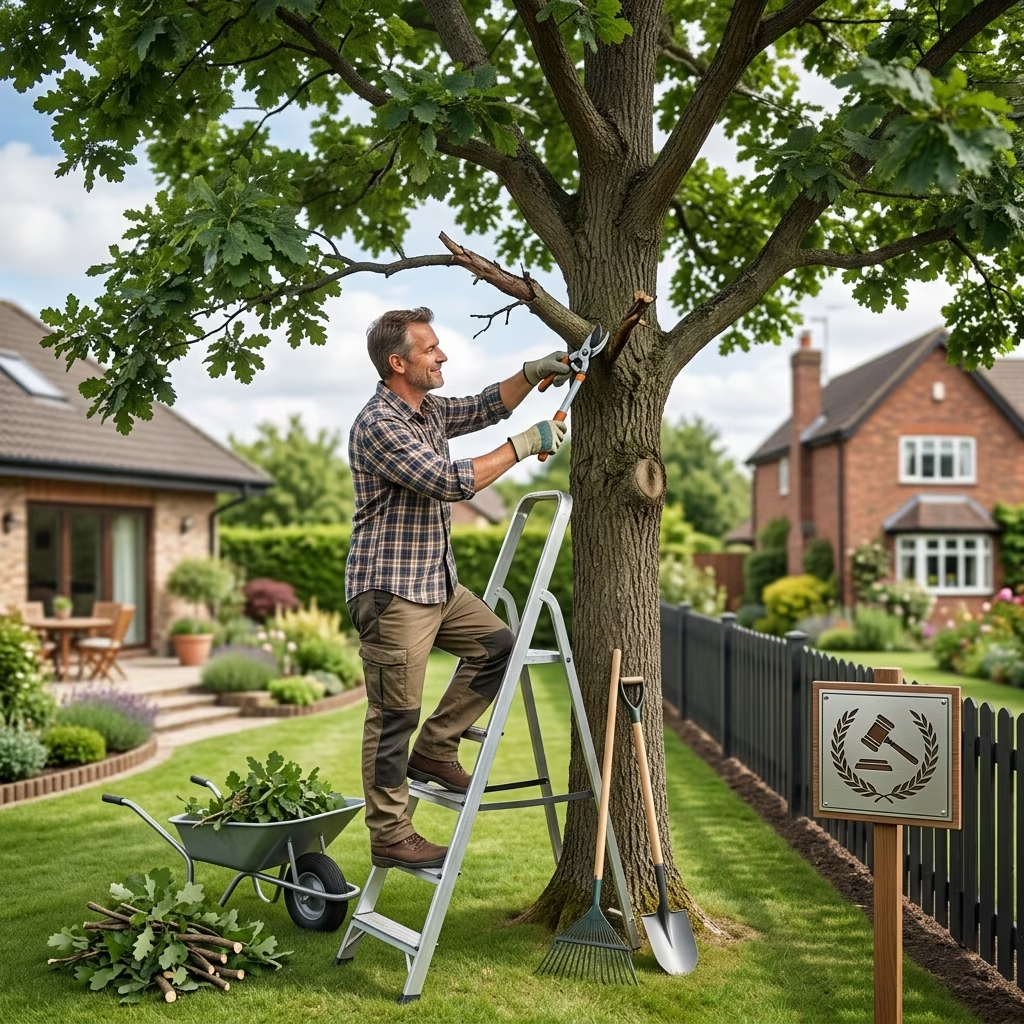
One of the most common issues arises when branches hang over a neighbor’s land or roots extend under their soil. Many states recognize a form of “self-help”—the right of the neighbor to trim back encroaching vegetation to the property line, provided they do not unreasonably harm the tree.
Typical principles include:
- A neighbor may prune branches or roots that cross into their property up to the boundary line, using reasonable care.
- Improper or reckless cutting that kills or seriously injures the tree can expose the neighbor to damages, sometimes including statutory penalties.
- When roots cause damage, such as cracking a driveway or infiltrating a sewer, the affected neighbor can usually request remedial action and may seek compensation if the owner fails to act.
2.2 Sidewalks and Public Walkways
While municipalities often control street trees, the duty to maintain adjacent sidewalks may fall on the abutting property owner. Under some statutes, if tree roots uplift a sidewalk and create a tripping hazard, the adjoining owner must repair the sidewalk even if the tree itself is municipally maintained. Failure to maintain safe walkways can lead to civil liability for injuries.
2.3 Hazardous and Dead Trees
Owners are generally expected to address obviously dangerous conditions. Law often distinguishes between:
- Natural conditions (for example, a healthy tree falling in an unprecedented storm), which sometimes limit liability, particularly on land opened to the public without charge.
- Known or reasonably knowable hazards, such as dead limbs over a public path or visibly decayed trunks. If the owner, or in some cases the municipality, knew or should have known of the hazard and failed to act, liability for resulting injuries is more likely.
Regular inspections, especially of large or aging trees, can help owners show they took reasonable steps to prevent harm.
3. Local Tree Ordinances and Permit Requirements
Many cities, towns, and villages adopt tree ordinances to protect urban forests, regulate tree work, and assign authority for decisions. A tree ordinance typically identifies the government office responsible for trees, sets standards for pruning and removal, and outlines when a permit is required.
3.1 What Tree Ordinances Usually Cover
Although details vary, local ordinances commonly address:
- Tree authority: which department or official can authorize removal, trimming, and planting of public trees.
- Care standards: reference to technical standards such as ANSI A300, which sets nationally accepted guidelines for pruning, maintenance, and safety.
- Protection rules: designation of heritage, landmark, or protected species and limits on removal of large or healthy trees.
- Permit procedures: application requirements, review processes, and conditions for approval, including replacement planting.
3.2 Tree Removal Permits
In many municipalities, a permit is required before cutting down a tree, particularly when:
- The tree is above a specified diameter or trunk size.
- The tree is located in a public right-of-way or on public property.
- The tree is a protected or heritage specimen.
- Multiple trees will be removed as part of construction, excavation, or major landscaping.
Permit applications usually require:
- Species and size information for each tree.
- Photographs and site diagrams showing tree locations and property boundaries.
- Justification for removal, such as disease, structural hazard, or necessary construction.
- A tree preservation or replacement plan, specifying where new trees will be planted and which species will be used.
3.3 Construction Near Trees
Local rules often restrict how construction can proceed around trees to reduce damage to roots and crowns. Common protections include:
- Requiring protective fencing around the tree’s critical root zone before work starts.
- Limiting mechanical grading and excavation within a set distance from the fencing or trunk.
- Controlling the depth of root pruning so it does not exceed the depth required for new curbs or sidewalks.
- Mandating that pruning for construction maintain the tree’s natural form and prohibit excessive limb removal, such as clear cutting directly above the curb.
Failure to comply with these standards can result in fines, permit revocation, or requirements to replace damaged trees with new plantings of comparable size.
4. Neighbor Disputes: Nuisance, Damage, and Legal Remedies
Disagreements over trees frequently escalate into legal disputes. Typical conflicts involve blocked sunlight, falling debris, structural damage, or safety concerns. Courts often apply nuisance principles and specific tree statutes to determine rights and remedies.
4.1 When a Tree Becomes a Legal Nuisance
A tree may be considered a nuisance if it unreasonably interferes with a neighbor’s use and enjoyment of their property. Examples include:
- Persistent root damage to foundations, drives, or underground utilities.
- Overhanging branches causing significant debris or shading that materially affects use of the property.
- Trees leaning dangerously toward a neighbor’s building or play area.
In some jurisdictions, longstanding trees can still be treated as nuisances even decades after planting if their impact becomes unreasonable as conditions change.
4.2 Cutting or Damaging a Neighbor’s Tree
States often impose enhanced damages for wrongful cutting of trees on another’s property. For example, some statutes provide:
- Up to three times the market value of timber for deliberate, unauthorized cutting.
- Double damages where the cutting is negligent rather than intentional.
- Separate criminal penalties for reckless destruction of trees or shrubs.
These rules are designed to deter unauthorized removal and encourage property owners to resolve disputes through negotiation or legal processes rather than unilateral action.
4.3 Steps to Resolve Tree-Related Disputes
Effective resolution usually follows a graduated approach:
- Informal discussion: Talk to your neighbor, share photographs, and propose practical solutions such as selective pruning or cost-sharing for professional assessment.
- Review local rules: Check municipal tree ordinances, neighborhood association policies, and state statutes that address trimming rights and responsibilities.
- Professional evaluation: Engage a certified arborist to assess tree health, structural risk, and appropriate mitigation measures that comply with ANSI standards.
- Mediation or legal advice: If conversations stall, consider mediation or consult an attorney to clarify your rights and possible court remedies.
- Formal legal action: In severe cases, courts may order pruning, removal, or compensation for damage, based on evidence of nuisance, negligence, or statutory violations.
5. Liability for Injuries and Property Damage
Liability depends on where the tree is located, whether the hazard was foreseeable, and which party had the duty to maintain safety. Different rules apply to public and private entities, and to natural versus negligent conditions.
5.1 Public Entities and Roadway Safety
States commonly impose duties on public entities to keep highways and municipal streets safe for travel. If a tree within the public right-of-way fails and causes injury, the government agency responsible for the road may be liable when it knew or should have known of the dangerous condition and failed to correct it.
Key considerations include:
- Whether the hazard was documented or obvious (for example, repeated complaints or visible decay).
- Whether reasonable inspection and maintenance practices were in place.
- Whether the injured party was lawfully using the road or public space.
5.2 Private Owners and Falling Trees
For private land, liability often turns on negligence. Courts ask whether a reasonable property owner would have recognized and addressed a risk, such as dead or structurally compromised trees near buildings, sidewalks, or play areas.
Property owners can reduce risk by:
- Conducting periodic inspections, especially after storms or visible changes in tree condition.
- Promptly removing or stabilizing clearly hazardous trees.
- Using qualified professionals to perform major pruning or removal.
6. Practical Compliance Tips for Property Owners
Given the complexity of tree laws and local ordinances, property owners benefit from a proactive approach. The following best practices support both legal compliance and long-term tree health:
- Know your boundaries: Verify property lines with a plat of survey before planting or removing trees, especially near fences or structures.
- Check local rules: Review municipal codes and any homeowners’ association policies regarding tree planting, trimming, and removal, including permit thresholds.
- Use professional standards: Ensure that pruning and maintenance follow recognized industry standards such as ANSI A300 to reduce liability and preserve tree health.
- Document inspections: Keep records of tree assessments, arborist reports, and maintenance work to show that you exercised reasonable care.
- Communicate with neighbors: Discuss tree issues early and cooperatively to avoid escalation into legal disputes.
7. Summary Table of Common Responsibilities
| Scenario | Typical Responsible Party | Key Legal Principle |
|---|---|---|
| Tree trunk entirely on private property | Private owner | Owner controls maintenance and can be liable for negligent hazards. |
| Tree in public right-of-way along a street | Municipality or road authority | Government must keep streets reasonably safe; ordinances govern tree work. |
| Roots uplifting a public sidewalk | Abutting property owner | Statutes often place sidewalk maintenance duty on adjacent owners. |
| Branches overhanging neighbor’s yard | Neighbor may trim to boundary | Self-help trimming allowed but must avoid reckless damage. |
| Unauthorized cutting of neighbor’s tree | Person who cut the tree | Statutory damages may be multiplied for intentional or negligent injury. |
8. Frequently Asked Questions (FAQs)
8.1 Can I trim branches from my neighbor’s tree that hang over my yard?
In many jurisdictions, you may trim branches and roots from a neighbor’s tree that cross into your property, up to the boundary line, as long as your actions are reasonable and do not unnecessarily injure or kill the tree. It is good practice to inform your neighbor and consider hiring an arborist to ensure the pruning is safe and compliant with accepted standards.
8.2 Do I need a permit to remove a tree on my own land?
Local ordinances frequently require a removal permit for trees above a certain size, for protected species, or for trees located in public or semi-public areas. Even on private property, some cities mandate permits for trees over a specified diameter or for mass removal during development. Check your municipal code or contact the local forestry or planning department before scheduling removal.
8.3 Who is responsible if a street tree falls into the road and causes an accident?
Responsibility typically falls on the public entity that is legally obligated to keep that road or street safe for travel, such as the state highway department or municipality. Liability usually requires proof that the agency knew or should have known the tree was hazardous and failed to take reasonable corrective action.
8.4 What happens if I accidentally damage my neighbor’s tree while trimming?
If trimming on your side of the boundary is performed carelessly and the tree dies or suffers serious injury, you may be liable for damages. Some states provide double or triple damages for unlawful cutting or destruction of trees on another’s property. To avoid liability, trim conservatively, follow professional standards, and consider hiring a qualified arborist.
8.5 Are municipalities bound by professional tree care standards?
Many state laws now require utilities and public entities performing vegetation management to follow current industry standards, including ANSI A300, when trimming or maintaining trees. These standards help ensure safety, reduce conflicts with property owners, and guide proper pruning techniques.
References
- Tree Law in Pennsylvania — WeConservePA. 2021-03-01. https://library.weconservepa.org/guides/197-tree-law-in-pennsylvania
- Technical Resources: Tree Care Ordinances — Illinois Department of Natural Resources. 2020-06-15. https://dnr.illinois.gov/conservation/forestry/urbanforestry/trtreecareordinances.html
- City of Chicago Standard Tree Protection Instructions — City of Chicago Bureau of Forestry. 2019-05-10. https://www.chicago.gov/city/en/depts/streets/provdrs/forestry/svcs/city_of_chicago_standardtreeprotectioninstructions.html
- Tree Removal Permit Guide for Chicago Suburbs Homes — Piekarski & Sons Tree Service. 2023-04-05. https://piekarskitree.com/tree-removal-permit-chicago-suburbs/
- Village of Northfield Frequent Citizen Inquiries — Village of Northfield, Illinois. 2018-08-01. https://www.northfieldil.org/DocumentCenter/View/593
- Your Trees and the Law — Woodland Tree Service. 2017-02-10. https://www.woodlandtree.com/terrans-tips/posts/your-trees-and-the-law
- Legal Q & A Vegetation Management / Tree Trimming — Illinois Municipal League. 2016-11-01. https://legal.iml.org/file.cfm?key=420