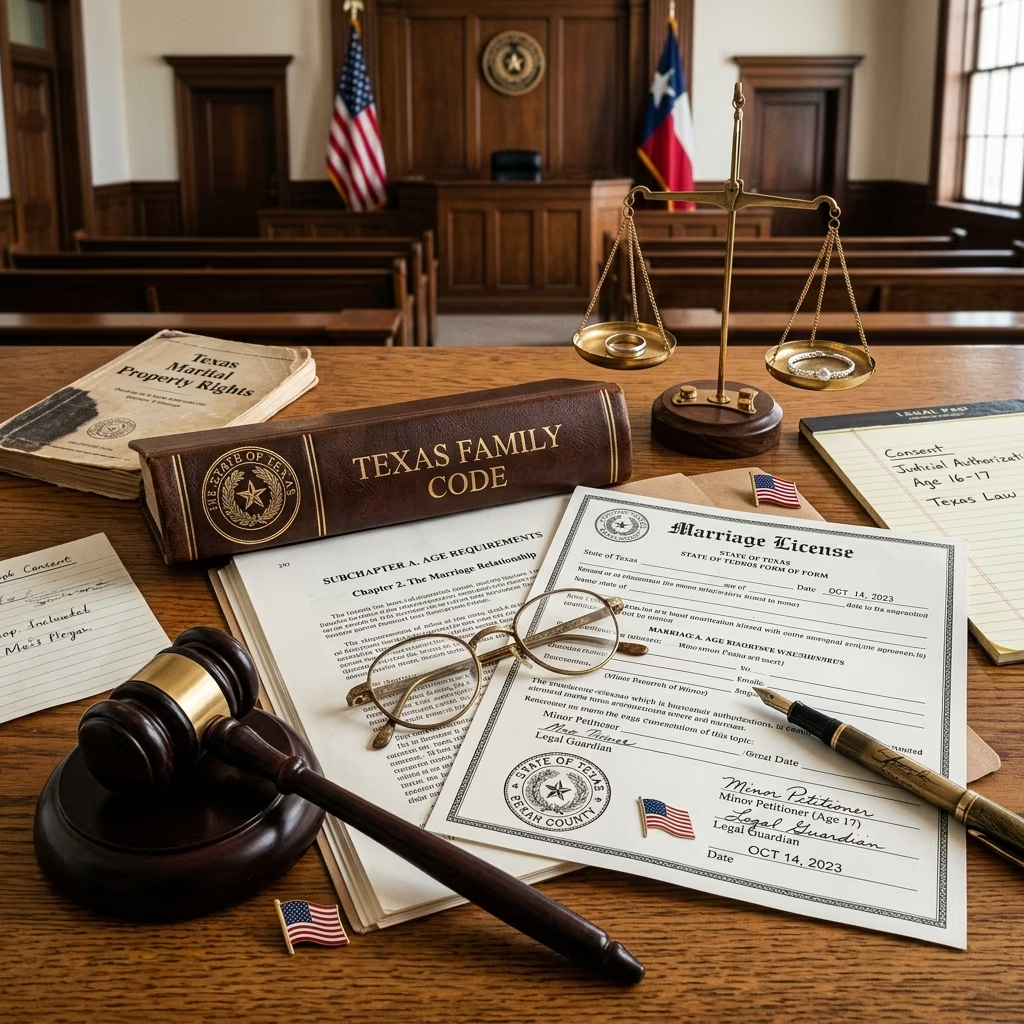
Texas treats marriage as a legal status reserved for adults, but the law also creates a narrow path for some minors to marry. In practice, that means age, emancipation, and court paperwork all matter. If a person is under 18, the rules are stricter, and the steps to obtain a valid marriage license depend on whether the minor has been emancipated and whether the county clerk can verify the required documents.
This article explains the current Texas framework in plain language. It covers who may marry, what emancipation does, when court approval may matter, how the license process works, and why the state’s rules are designed to limit underage marriage while still recognizing limited exceptions.
Who can marry in Texas?
As a general rule, a person must be at least 18 years old to marry in Texas without special legal status. For minors, the key exception is emancipation, which removes the legal disabilities of minority for general purposes. Texas law also distinguishes between a marriage license and an informal marriage, and minors cannot use the informal-marriage route to get around age rules.
- Adults 18 and older may marry on their own if they meet the other basic requirements.
- Minors who have been legally emancipated may marry if they can provide proof of that status.
- Persons under 18 who are not emancipated do not have an open-ended right to marry simply by obtaining parental approval.
- Minors cannot enter an informal marriage or file a declaration of informal marriage.
Texas Law Help states that a person under 18 cannot marry unless they have been emancipated, and the Texas Attorney General’s marriage guidance likewise says that a person must be 18 to marry on their own, with emancipation creating the relevant exception for younger applicants.
What emancipation means in the marriage context
Emancipation is often described as the removal of the legal disabilities of minority. For marriage purposes, that status matters because it changes how the state treats an underage applicant. An emancipated minor may be allowed to apply for a marriage license, but the clerk will expect formal proof, not a verbal statement or family agreement.
In Texas, emancipation is not just a general idea of independence. It is a legal status established through court proceedings. That is why the county clerk must see a certified copy of the court order removing the disabilities of minority for general purposes before processing a minor’s marriage application.
| Issue | General rule in Texas |
|---|---|
| Age to marry on one’s own | 18 |
| Can a minor marry? | Only if legally emancipated, subject to documentation |
| Can parental consent alone authorize a minor marriage? | Not as a general standalone workaround under the current framework |
| Can a minor enter an informal marriage? | No |
How the marriage license process works for underage applicants
The marriage-license process in Texas is handled at the county clerk’s office. Underage applicants who qualify through emancipation must still complete the same basic administrative steps that other applicants complete, but they must also prove their eligibility with extra documentation.
According to Texas Law Help, a person under 18 seeking a marriage license must appear before the county clerk, show proof of identity and age, provide the information required on the application, submit a certified copy of the emancipation order, and sign the oath on the marriage application before the clerk. The Texas Attorney General’s marriage requirements similarly note that couples apply in person and must bring acceptable identification.
- Appear in person at the county clerk’s office.
- Present valid identification and proof of age.
- Complete the application with the required personal information.
- Provide a certified court order showing emancipation.
- Sign the application oath before the clerk.
These steps are important because county clerks are responsible for confirming that the application is legally valid. A minor who lacks the proper court order should not expect a clerk to issue a license based only on parental statements or informal assurances.
Parental consent, court permission, and changing rules
Texas has gone through important changes in how it regulates child marriage. Older descriptions of Texas law sometimes refer to parental consent and separate court permission procedures for minors, but the modern framework has moved toward a more restrictive model. Current public guidance emphasizes emancipation as the central exception for minors rather than a broad parental-consent pathway.
This shift reflects a policy goal of limiting marriage to legal adults while preserving a narrow exception for minors who have already obtained a court order recognizing their legal independence. Legislative and policy discussions in Texas have also focused on closing remaining gaps that could permit marriage involving minors under limited circumstances.
For anyone researching the issue, that means it is essential to distinguish between older materials and current legal guidance. If a source describes a parental-consent path for under-18 marriage, it may be outdated unless it specifically reflects the present law. The safer reading of the current materials is that emancipation, not parental preference alone, is the meaningful legal gateway for a minor marriage application.
Waiting periods, fees, and other practical details
Age is only one part of the marriage-license process. Texas also has administrative requirements that apply to eligible couples generally. The Texas Attorney General’s marriage packet explains that couples usually face a 72-hour waiting period after receiving a license before the ceremony can take place, although this period may be waived for certain people, including members of the armed forces, or through judicial action or completion of an approved premarital education course.
The same guidance notes that the license fee is $60 in cash, with fee waivers available in some circumstances, including for couples who complete an approved premarital education course. Texas Law Help also explains that a minor applicant must provide the documents required by the clerk, which means the process can be more demanding than it is for adults because proof of emancipation becomes essential.
- Texas generally uses a 72-hour waiting period after license issuance.
- Certain applicants may qualify for a waiver of the waiting period.
- The standard fee is set by county procedure and state law guidance, with some waiver options available.
- Underage applicants must be ready to prove their legal status with certified court documents.
Why Texas limits marriage by age
The legal structure around minors and marriage is not only about paperwork. It also reflects a broader public policy choice. Supporters of stricter age rules argue that marriage is a serious legal and economic commitment, and that people under 18 are generally not ready to assume those obligations without full legal adulthood or a court determination of emancipation.
Research and policy discussions about child marriage in Texas have emphasized the risks of coercion, reduced autonomy, and long-term consequences for education and well-being. The Tahirih Justice Center’s background materials describe the state’s laws as part of a larger effort to prevent forced child marriage, while recent legislative reporting shows continued movement toward a stricter minimum-age framework.
That policy context matters because the law is not just asking whether a couple wants to marry. It is also asking whether the state should permit a person still treated as a minor in most legal settings to enter a binding adult relationship. Texas’s answer is to require adulthood, or a court-recognized exception, before the marriage license is issued.
Common questions about minors and marriage in Texas
Below are several recurring questions that arise when families, minors, and legal professionals look at Texas marriage rules.
Can a 16- or 17-year-old marry in Texas?
Only if the minor has been legally emancipated and can prove that status to the county clerk. Texas Law Help states that a person under 18 may not marry unless emancipated, and the clerk requires a certified copy of the court order.
Can parents sign a form and allow a minor to marry?
Current public guidance does not treat simple parental permission as enough to authorize a minor marriage on its own. The controlling issue is whether the minor meets the legal standard recognized by the clerk, which in the current materials is emancipation.
Can a minor use common-law marriage instead of a license?
No. Texas Law Help states that a person under 18 may not be a party to an informal marriage or execute a declaration of informal marriage.
Does Texas require residents to live in the state before marrying?
No. The Texas Attorney General’s guidance says couples do not have to be Texas residents to apply for a marriage license.
What should applicants bring to the clerk?
At a minimum, applicants should bring identification and any required court documentation. The Attorney General’s materials mention common forms of identification such as a driver’s license, birth certificate, passport, or military identification card, along with Social Security cards.
Practical checklist for families and applicants
Anyone dealing with a minor marriage issue in Texas should review the process carefully before visiting the clerk’s office. The document requirements are strict, and a missing court order can prevent the application from moving forward.
- Confirm the applicant’s age and legal status.
- Obtain a certified emancipation order if the applicant is under 18.
- Gather identification documents before applying.
- Review waiting-period rules and possible waivers.
- Ask the county clerk what local procedures or forms are required.
Because marriage creates major legal consequences, even a small paperwork error can matter. If there is uncertainty about emancipation, custody, or the validity of a court order, the safest approach is to resolve that issue before applying for the license.
Where the law appears to be heading
Recent reporting indicates that Texas lawmakers continue to consider changes aimed at eliminating any remaining route to child marriage. A 2025 legislative report described a bill that would prohibit counties from issuing marriage licenses to minors, including emancipated minors, and would close the loophole completely if enacted. That proposal shows that the policy debate is not finished, even though the current administrative guidance already places strong limits on marriage by minors.
For now, the most reliable practical takeaway is straightforward: Texas marriage law centers on adult status, with emancipation serving as the main exception for minors. Anyone under 18 who is considering marriage should verify the current rule set with official sources before relying on older summaries or informal advice.
References
References
- SB 1705 / HB 3932 Backgrounder on Forced Child Marriage in Texas — Tahirih Justice Center. 2017-02. https://www.tahirih.org/wp-content/uploads/2017/02/FINAL-Backgrounder-on-Forced-Child-Marriage-in-TX.pdf
- Bill to ban child marriages in Texas advances in the House — Texas Tribune. 2025-05-13. https://www.texastribune.org/2025/05/13/texas-child-marriages-ban/
- Minors and Marriage — Texas Law Help. 2026-07-10. https://texaslawhelp.org/article/minors-and-marriage
- Texas Marriage Requirements — Texas Office of the Attorney General. 2026-07-10. https://www2.texasattorneygeneral.gov/files/cs/8marriage.pdf
- Protecting the Child Bride: Following Texas’ Middle Ground Approach — University of Missouri-Kansas City School of Law. 2020-01-01. https://irlaw.umkc.edu/cgi/viewcontent.cgi?article=1970&context=faculty_works
- State-by-State Marriage “Age of Consent” Laws — FindLaw. 2026-07-10. https://www.findlaw.com/family/marriage/state-by-state-marriage-age-of-consent-laws.html
Frequently Asked Questions
Can a minor marry in Texas without emancipation? No. Current guidance indicates that a person under 18 cannot marry unless emancipated and able to provide the required court order.
Does Texas allow informal marriage for minors? No. A person under 18 may not be part of an informal marriage or sign a declaration of informal marriage.
Do minors need to apply in person? Yes. The county clerk application process is handled in person, and the applicant must present the necessary documents.
Is parental consent alone enough? The current official guidance does not treat parental consent alone as sufficient for a minor’s marriage application.
Could the law change again? Yes. Recent legislation and reporting show that Texas continues to debate whether to remove remaining exceptions and fully end marriage involving minors.