
Understanding the Burden of Proof in Civil and Criminal Law
Learn how different burdens and standards of proof shape outcomes in civil lawsuits and criminal prosecutions across the legal system.
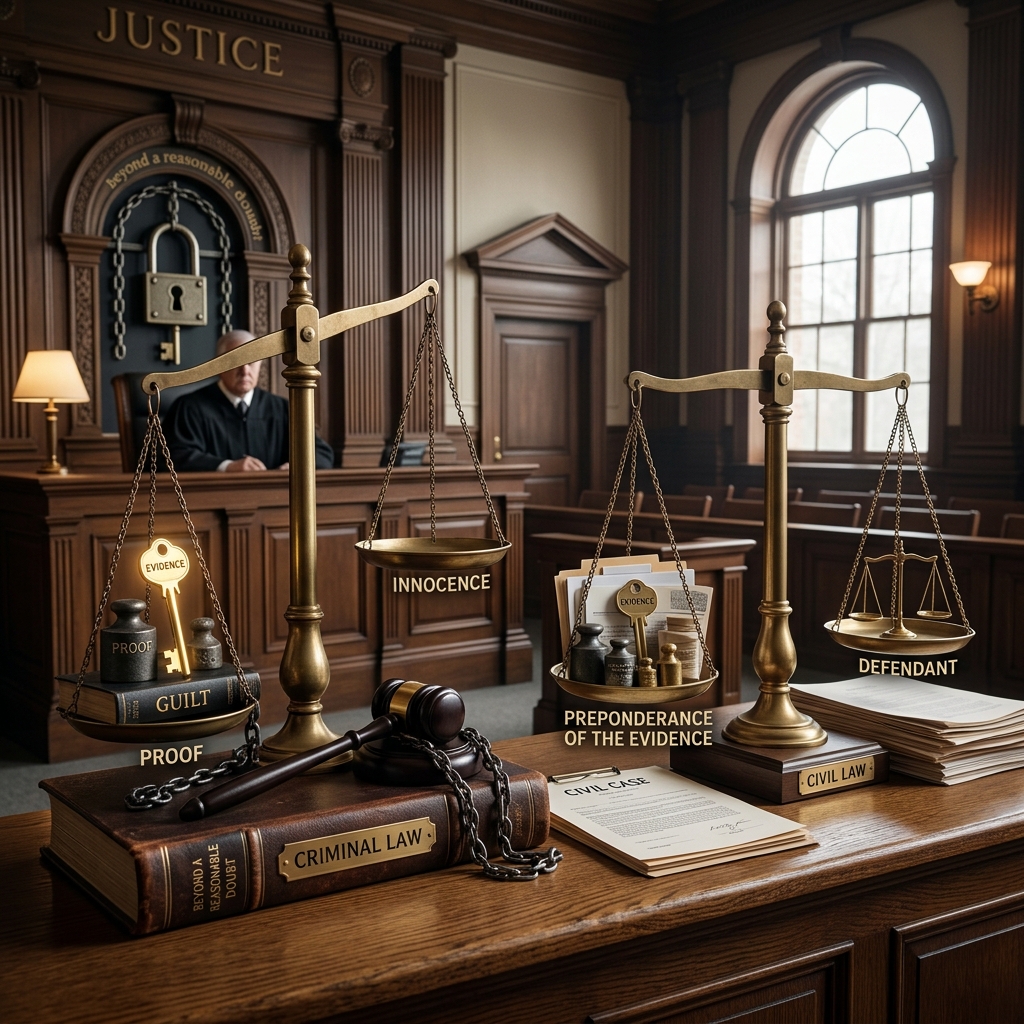
The concept of burden of proof lies at the heart of every court case. It determines who must convince the judge or jury, what they must prove, and how strongly they must establish their version of events. These rules differ sharply between civil lawsuits and criminal prosecutions, and those differences can completely change the legal outcome.
This article provides a structured, practical explanation of the burden of proof, the major standards of proof used in civil and criminal cases, and why the law imposes stricter requirements before someone can be found guilty of a crime.
1. What Does “Burden of Proof” Mean?
In law, the burden of proof is the obligation placed on a party to establish particular facts to a specified level of certainty. It answers two basic questions:
- Who must prove the facts? (the burden of production and burden of persuasion)
- How convincing must the evidence be? (the standard of proof)
Legal scholars often separate the burden of proof into two related components:
- Burden of production – the duty to present enough evidence to allow an issue to be considered by the court. If this minimum threshold is not met, the claim or defense can be dismissed before trial.
- Burden of persuasion – the duty to persuade the judge or jury that the contested fact is true, meeting the required standard of proof.
Different types of cases assign these burdens to different parties. In most disputes, the party who makes a claim must carry both burdens for that claim.
2. Who Carries the Burden in Civil vs. Criminal Cases?
| Type of case | Party with main burden | Core goal |
|---|---|---|
| Civil case | Usually the plaintiff (person or entity bringing the lawsuit) | Prove liability and obtain compensation or other remedies |
| Criminal case | Usually the prosecution/government | Prove guilt and justify punishment, such as imprisonment or fines |
2.1 Civil cases: The plaintiff’s responsibility
In civil litigation, such as personal injury, contract disputes, or civil rights claims, the person or organization filing the case is known as the plaintiff. Courts in the United States generally place the burden of proof on the plaintiff.
The plaintiff must show that:
- The defendant owed a legal duty.
- The defendant breached that duty.
- The breach caused harm.
- Recognizable damages resulted, such as medical bills or financial losses.
The plaintiff meets this burden by presenting testimony, documents, expert opinions, and other evidence that make their version of events more likely than not].
2.2 Criminal cases: The prosecution’s duty
In a criminal prosecution, the government (usually through a prosecutor’s office) bears the burden of proving the defendant’s guilt. This is a direct consequence of the constitutional principle that individuals are considered innocent until proven guilty.
To secure a conviction, the prosecution must persuade the jury or judge that the defendant committed the charged offense and satisfied each legal element of the crime beyond a reasonable doubt.
This strict requirement reflects what is at stake in criminal cases: loss of liberty, criminal record, and sometimes very severe penalties. The law deliberately makes it difficult to punish someone unless the evidence is extraordinarily strong.
3. Key Standards of Proof Explained
The standard of proof describes how firmly the evidence must convince the decision-maker before a party wins on a particular issue. Different legal contexts use different standards, ranging from relatively modest to extremely demanding.
3.1 Preponderance of the evidence (civil baseline)
The most common standard in civil cases is the preponderance of the evidencemore likely true than not — often explained as a greater than 50% likelihood.
Civil courts sometimes describe this standard using simple images:
- Imagine a scale: if the plaintiff’s evidence tips the scale even slightly in their favor, they have met the preponderance standard.
- Legal commentators sometimes call it the “51%” test, contrasted with “99%” for criminal guilt.
This is a relatively flexible standard because civil cases typically involve disputes over money, property, or rights rather than personal liberty.
3.2 Clear and convincing evidence (higher civil standard)
Some civil issues demand a more rigorous test: clear and convincing evidence. This standard sits between preponderance and beyond a reasonable doubt.
Courts use this heightened standard for matters such as:
- Certain fraud claims.
- Challenges to wills or trusts.
- Some civil rights or punitive damages issues, depending on jurisdiction.
To meet this burden, the evidence must make the disputed fact highly probable and leave no serious doubt as to its truth, though not absolute certainty.
3.3 Beyond a reasonable doubt (criminal guilt)
The highest commonly used standard is beyond a reasonable doubt, which governs proof of guilt in criminal cases. The prosecution must provide such strong evidence that a reasonable person, after carefully considering it, would be firmly convinced of the defendant’s guilt.
Courts usually avoid assigning a numerical percentage to this standard, but legal explanations often characterize it as requiring that the jurors be sure of guilt, leaving no reasonable alternative explanation consistent with innocence.
Because criminal convictions can lead to imprisonment, loss of rights, and long-term stigma, the legal system strongly favors the risk of acquitting some guilty defendants over the risk of convicting an innocent person.
3.4 Other legal thresholds
Apart from these three main standards, U.S. law uses several additional thresholds in specific contexts:
- Probable cause – required for warrants or arrests; involves reasonable grounds to believe a person committed a crime.
- Reasonable suspicion – used for brief investigative stops and searches; a lower threshold than probable cause.
- Substantial evidence – frequently used in administrative and appellate review, asking whether enough evidence supports a decision.
These standards illustrate that the burden of proof is not a single rule but a spectrum tailored to the consequences of each legal decision.
4. Why Criminal Cases Require a Higher Burden of Proof
There is a deliberate policy choice behind the stricter criminal standard. The law demands proof beyond a reasonable doubt for criminal guilt because of the profound consequences of a conviction.
- Protection of individual liberty: Criminal penalties can involve incarceration, probation, and long-term restrictions on freedom. Requiring stronger proof reduces the risk of punishing the innocent.
- Moral condemnation: A criminal conviction formally brands a person as a wrongdoer, carrying social and professional stigma. This reputational harm justifies demanding very persuasive evidence.
- State power and fairness: Because the government has significant investigative resources, the law counters this imbalance by imposing a heavy burden before it can penalize citizens.
By contrast, civil disputes generally concern financial liability or private rights rather than physical liberty. As a result, the law accepts the lower preponderance standard as sufficient to decide which party should bear the loss or receive compensation.
5. How Different Burdens Shape Legal Outcomes
The difference between civil and criminal burdens of proof produces real-world consequences: the same underlying conduct can lead to different results in different courts.
5.1 Divergent outcomes from the same facts
Consider a situation where a driver causes a serious accident:
- In a criminal court, the prosecution may file charges such as reckless driving or vehicular assault. To convict, it must prove guilt beyond a reasonable doubt.
- In a civil court, the injured person may sue for damages. To win, the plaintiff generally needs only to show, by a preponderance of the evidence, that the driver’s negligence more likely than not caused the harm.
The same evidence might fail to meet the criminal standard but still be sufficient for civil liability. Thus, a defendant can be acquitted in criminal court yet be held financially responsible in a civil case because the required level of certainty differs.
5.2 Shifting burdens within a case
Although the overall burden usually lies with the plaintiff or prosecution, specific issues can cause the burden to shift to the other party.
- Affirmative defenses: When a defendant raises a defense such as insanity or self-defense, they may bear the burden of proving that defense, often to a civil standard like the balance of probabilities.
- Procedural questions: Courts sometimes require a party to show a “good arguable case” on matters like jurisdiction before fully hearing the dispute.
Understanding these internal shifts is important for lawyers planning how to present evidence and for parties evaluating the strength of their position.
6. Practical Implications for Litigants and Lawyers
The burden of proof affects strategy, case valuation, and expectations. Both litigants and attorneys must tailor their approach to the relevant standard.
- Evidence planning: In criminal cases, prosecutors aim to build an overwhelmingly persuasive record, often using corroborating witnesses, forensic evidence, and expert testimony to meet the high threshold.
- Settlement decisions: Civil parties consider whether their evidence is likely to satisfy the preponderance standard; this assessment influences whether they settle or go to trial.
- Jury instructions: Judges instruct jurors on the applicable standard (e.g., “more likely than not” versus “beyond a reasonable doubt”) so jurors understand how to evaluate the evidence.
Accurate understanding of burdens and standards helps parties realistically appraise their chances and avoid misconceptions—for instance, expecting criminal-level certainty in a civil dispute.
7. Frequently Asked Questions (FAQs)
Q1: Is the burden of proof always on the plaintiff or prosecution?
Not always. While the plaintiff in civil cases and the prosecution in criminal cases generally carry the main burden, specific defenses or procedural issues can shift the burden to the other party. For example, some affirmative defenses must be proven by the defendant to a civil standard.
Q2: Does “beyond a reasonable doubt” mean 100% certainty?
No. The law does not demand absolute certainty, which is rarely possible in human affairs. Instead, beyond a reasonable doubt means the evidence leaves no reasonable, logical doubt about guilt in the mind of a typical juror. Courts emphasize that it is the highest standard used in regular trials but still short of mathematical certainty.
Q3: Can the same person be found not guilty in criminal court but still lose a civil case?
Yes. Because civil cases use the lower preponderance of the evidence standard, it is possible for the evidence to be insufficient for a criminal conviction yet strong enough to show that it is more likely than not that the defendant caused harm, resulting in civil liability.
Q4: Why do some civil issues require clear and convincing evidence?
Courts reserve the clear and convincing standard for cases with especially serious consequences, such as fraud, will contests, or certain civil rights matters. The law demands more robust proof in these situations to reduce the risk of wrongly depriving someone of important rights or interests.
Q5: How can I know which standard of proof applies to my case?
The applicable standard depends on the type of case and the specific legal issue. Most ordinary civil claims use preponderance of the evidence, while criminal guilt requires beyond a reasonable doubt. Certain claims—particularly fraud or constitutional issues—may require clear and convincing evidence. Consulting a qualified attorney is the best way to determine which standard governs your situation.
References
- burden of proof | Wex — Legal Information Institute, Cornell Law School. 2023-08-01. https://www.law.cornell.edu/wex/burden_of_proof
- Burden and standard of proof — The Incorporated Council of Law Reporting for England and Wales (ICLR). 2021-05-10. https://www.iclr.co.uk/knowledge/glossary/standard-and-burden-of-proof/
- Burden of Proof in a Civil Case: Legal Standards Explained — Ben Crump Law. 2022-06-15. https://bencrump.com/burden-of-proof-in-a-civil-case/
- What is the burden of proof in a civil case? — Munley Law. 2023-03-20. https://munley.com/what-is-the-burden-of-proof-in-a-civil-case/
- Burden of Proof in Civil Cases in New York — RRSLAW. 2022-09-01. https://rrslaw.com/what-is-the-burden-of-proof-in-new-york-state/
- A Guide to Burden of Proof in a Civil Rights Case — Abramson & Denenberg, P.C. 2024-02-05. https://abramsondenenberg.com/2024/02/a-guide-to-burden-of-proof-in-a-civil-rights-case/
- How Different Civil and Criminal Burdens of Proof Shape Legal Outcomes — Monmouth University Law Review. 2019-01-15. https://library.monmouth.edu/the-monmouth-university-law-review/volume-ii-issue-i/how-different-civil-and-criminal-burdens-of-proof-shape-legal-outcomes/
Similar Articles








Read full bio of Sneha Tete




