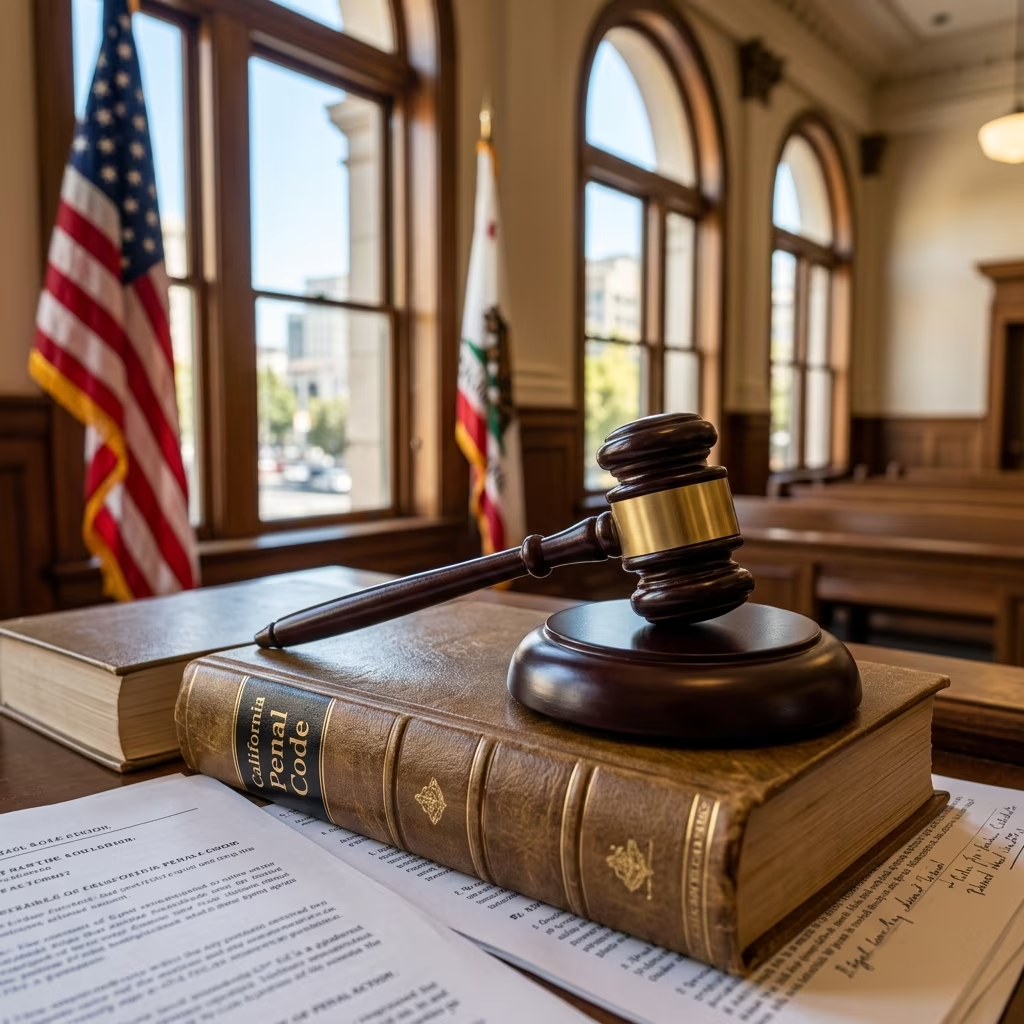
Driving under the influence in California already carries significant consequences, but certain circumstances can trigger sentence enhancements that substantially increase jail time, fines, license suspensions, and other penalties beyond the normal DUI punishment. Understanding these enhancement rules is essential for anyone facing a DUI charge or advising someone who is.
This guide explains what DUI sentence enhancements are, outlines the most common aggravating factors, summarizes the additional penalties they can cause, and highlights key legal issues that often arise in enhanced DUI cases under California law.
Baseline California DUI Penalties Without Enhancements
To grasp how enhancements work, it helps to first understand the typical penalties for a first‑offense, non‑injury DUI in California when no aggravating factors are alleged. While exact outcomes vary by county and case, a basic first conviction often exposes a driver to:
- Fines roughly in the range of a few hundred dollars up to about $1,000, plus substantial penalty assessments and fees.
- County jail time, commonly up to six months for a standard misdemeanor DUI.
- DUI education program lasting several months, often between three and nine months, focused on alcohol and drug awareness.
- Summary probation (informal probation) for approximately three years, subject to conditions such as obeying all laws and not driving with any measurable alcohol.
- Ignition interlock device (IID) installation on any vehicle the person drives, for a court‑determined period.
Separate administrative action by the California Department of Motor Vehicles (DMV) may include:
- Driver’s license suspension of several months (often 6–10 months for a first offense).
- Eligibility for a restricted license that permits limited driving to work or DUI programs if conditions are met.
- Requirement to obtain SR‑22 insurance, which is specialized high‑risk coverage documenting financial responsibility.
Sentence enhancements do not replace these baseline penalties; instead, they add extra punishment on top of them when certain aggravating circumstances are proven.
What Is a DUI Sentence Enhancement?
A sentence enhancement in the DUI context is an additional penalty that attaches to a conviction when the prosecution proves specific aggravating facts beyond the basic elements of driving under the influence. These facts are often called enhancement allegations or aggravating factors.
Key features of DUI sentence enhancements in California include:
- They are tied to statutes that authorize or require extra punishment when conditions are met (for example, speeding enhancements or prior‑conviction enhancements).
- They can increase jail or prison time, extend probation, lengthen license suspensions, raise fines, or add conditions like IID installation and community service.
- They must ordinarily be charged in the complaint so the defense has notice and can contest the allegations.
- Judges may have discretion for some enhancements (for example, high blood‑alcohol concentration), while other statutes mandate additional penalties once the enhancement is found true.
From a practical standpoint, enhancements can turn what might otherwise be a short jail term and moderate fines into a significantly harsher sentence.
Common Aggravating Factors in California DUI Cases
California uses several widely recognized circumstances to justify enhanced penalties in DUI prosecutions. Although details depend on the specific statute and local practice, the following factors frequently appear in charging documents and plea negotiations.
1. Prior DUI or Related Convictions
Having one or more prior DUI convictions within a 10‑year window is one of the most significant enhancement triggers under California law. The look‑back period generally runs from the commission date of one offense to the commission date of the next, not the conviction date.
Consequences of qualifying prior convictions include:
- Higher mandatory minimum jail terms and longer maximum sentences for each subsequent DUI.
- Extended DUI education or treatment program requirements.
- Longer driver’s license suspensions or revocations.
- Escalation to a felony DUI in some circumstances when multiple priors are present, exposing the defendant to state prison.
Because prior convictions substantially increase exposure, they are often central to sentencing discussions and plea bargaining.
2. High Blood‑Alcohol Concentration (High BAC)
California recognizes high BAC as an aggravating circumstance. Many courts treat a BAC of 0.15% or higher as grounds for enhanced penalties or more restrictive conditions.
When BAC exceeds this threshold, judges may:
- Order longer DUI school or treatment programs.
- Impose additional jail time beyond the baseline term.
- Increase fines and fees.
- Add stricter probation conditions, such as more intensive monitoring or abstinence requirements.
High BAC enhancements send a message that extremely elevated alcohol levels pose heightened public safety risks.
3. Refusal to Submit to Chemical Testing
Refusing to provide a chemical breath or blood sample after a lawful DUI arrest can serve as an enhancement, separate from the DMV’s administrative suspension for refusal.
Potential consequences include:
- Additional jail time added to the sentence for the underlying DUI.
- Stricter license consequences, including longer suspensions.
- Use of the refusal incident as a factor supporting harsher overall sentencing.
California law thus discourages refusal by making it a costly decision both in the criminal case and at the DMV.
4. Excessive Speeding and Reckless Driving (VC 23582)
Under California Vehicle Code section 23582, driving at excessive speeds in a reckless manner while committing a DUI can trigger a special speed enhancement. To apply this enhancement, prosecutors must generally prove that:
- The defendant was convicted of a qualifying DUI offense, such as driving with 0.08% BAC or DUI causing injury.
- The driver exceeded the speed limit by 30 mph or more on a freeway or 20 mph or more on other public roads.
- The driving was performed in a reckless manner, not merely at high speed.
If found true, this enhancement can add a mandatory jail term that runs consecutively to the base DUI sentence and may also require completion of a drug and alcohol education program.
5. Child Passenger / Child Endangerment
Driving under the influence with a minor passenger in the vehicle is treated as particularly serious. Many jurisdictions, including California, treat transporting a child under a defined age (often under 14 years) as an aggravating circumstance warranting enhanced penalties.
Depending on the facts, prosecutors may seek:
- Additional jail time or separate child‑endangerment charges.
- More stringent probation terms, sometimes including restrictions relating to child safety.
The underlying rationale is that impaired driving with children in the car exposes a vulnerable group to heightened risk.
6. DUI Causing Injury or Accident
Where a DUI involves a collision that causes bodily injury to one or more victims, penalties can be dramatically increased and may elevate the case to a felony.
In felony DUI injury cases, courts may impose:
- Additional prison or jail time for each injured victim, often up to one extra year per person, subject to statutory limits.
- Mandatory restitution to compensate victims for medical bills, lost wages, and other losses.
- Long‑term license revocations and more intensive treatment requirements.
Property damage alone may not always trigger separate statutory enhancements, but it can influence sentencing decisions and liability for restitution.
How Enhancements Change Sentencing Outcomes
When one or more enhancements attach to a DUI conviction, the overall sentence is typically harsher in several dimensions.
| Penalty Area | Standard DUI (No Enhancements) | DUI with Enhancements |
|---|---|---|
| Jail / Prison Time | Up to 6 months jail on a typical first misdemeanor DUI. | Extra days, months, or years required for priors, speeding, injury, or other factors; may become a felony with state prison exposure. |
| License Consequences | Suspension of several months; possible restricted license. | Longer suspensions or revocations, especially for priors, refusals, and injury cases. |
| Financial Penalties | Base fine plus assessments and fees. | Higher fines, more assessments, restitution to victims, and increased insurance costs. |
| Programs & Conditions | Standard DUI school; possible IID; basic probation terms. | Longer DUI school or treatment, mandatory IID, extended probation, community service, and stricter conditions. |
Some statutes specify fixed additional jail terms (such as mandatory days for repeat offenses), while others give judges flexibility to tailor the enhancement based on the circumstances.
Procedural and Legal Considerations in Enhanced DUI Cases
Sentence enhancements introduce several important legal issues beyond those in a standard DUI prosecution:
- Pleading and notice: Enhancement allegations are typically included in the charging document so defendants are aware of the extra exposure and can prepare to challenge them.
- Proof requirements: The prosecution must prove the enhancement facts, often beyond a reasonable doubt, such as prior convictions, BAC level, speed, or injury.
- Plea bargaining: Negotiations may focus heavily on whether specific enhancements will be dismissed, reduced, or admitted, which can significantly change the sentencing range.
- Sentencing discretion: In some enhancement statutes, judges retain discretion to impose or strike the additional penalty in the interests of justice; in others, certain minima are mandatory once the enhancement is found true.
Because enhancements can drastically alter outcomes, it is common for defense strategies to focus on limiting or contesting aggravating allegations.
Frequently Asked Questions About California DUI Enhancements
Do all DUI cases involve sentence enhancements?
No. Many first‑offense DUIs without aggravating factors are prosecuted and sentenced without any formal enhancements. Enhancements are only applied when specific statutory conditions—such as prior convictions, high BAC, speeding, or injury—are charged and proven.
How far back can California look at prior DUIs to enhance a sentence?
California generally uses a 10‑year look‑back period to determine whether previous DUI convictions can enhance current charges. The key measure is whether the underlying offenses occurred within 10 years of each other and resulted in qualifying convictions.
Can sentence enhancements be negotiated or dismissed?
In many cases, yes. Prosecutors sometimes agree to dismiss or reduce specific enhancement allegations as part of plea agreements, especially if evidence is weak or mitigating factors are present. Judges may also have limited power in certain situations to strike or lessen enhancements, depending on the statute and case facts.
Is refusing a chemical test during a DUI stop always a good strategy?
Refusing a chemical test usually carries serious consequences in California, including an administrative license suspension and potential enhanced criminal penalties if a DUI conviction follows. Because of these risks, refusal is typically viewed as a high‑stakes decision rather than a safe option.
How does speeding affect a DUI case compared with a normal speeding ticket?
In a routine traffic stop, speeding may result only in a citation. In a DUI case, however, driving 20 mph or more over the limit on surface streets or 30 mph or more over the limit on freeways, combined with reckless driving, can trigger a specific sentencing enhancement that adds mandatory jail time on top of the DUI punishment.
Practical Takeaways
California’s DUI sentencing scheme is structured so that the severity of punishment increases with risk and repeat behavior. Baseline penalties are serious on their own, but enhancements for prior convictions, high BAC, refusal, excessive speed, child passengers, and injury can quickly compound the consequences.
- Even a first DUI can lead to substantial costs and restrictions.
- Repeat offenses and dangerous circumstances dramatically raise jail and license exposure.
- Charged enhancements often become a focal point of litigation and plea bargaining.
For anyone confronting a California DUI charge, understanding these enhancement rules is critical for evaluating risk and planning an effective legal response.
References
- California DUI Enhancements — San Francisco DUI Defense. 2023-05-01. https://www.sanfranciscoduidefense.com/dui-defense/dui-penalties/dui-enhancements/
- What are Sentence Enhancements and How Can They Affect My DUI Case? — The Law Offices of Randy Collins. 2022-06-15. https://www.duicentral.com/blog/2022/june/what-are-sentence-enhancements-and-how-can-they-/
- Enhanced DUI Penalties — California Drunk Driving Law. 2021-09-10. http://www.california-drunkdriving.org/enhanced_penalties.html
- California DUI Enhancements — Cronis, Israels & Stark. 2023-04-20. https://www.cronisraelsandstark.com/california-dui-enhancements
- California Vehicle Code Section 23582 VC: DUI Speed Enhancement — Los Angeles Criminal Lawyer. 2022-03-05. https://www.losangelescriminallawyer.pro/california-vehicle-code-section-23582-vc-dui-speed-enhancement.html
- Things To Know When Facing A DUI Trial: Prior Enhancements — Wallin & Klarich. 2022-08-12. https://www.wklaw.com/things-to-know-when-facing-a-dui-trial-prior-enhancements/
- Driving Under the Influence (DUI) Addendum to Change of Plea — San Diego Superior Court. 2020-01-01. https://www.sdcourt.ca.gov/sites/default/files/sdcourt/generalinformation/forms/criminalforms/crm133.pdf