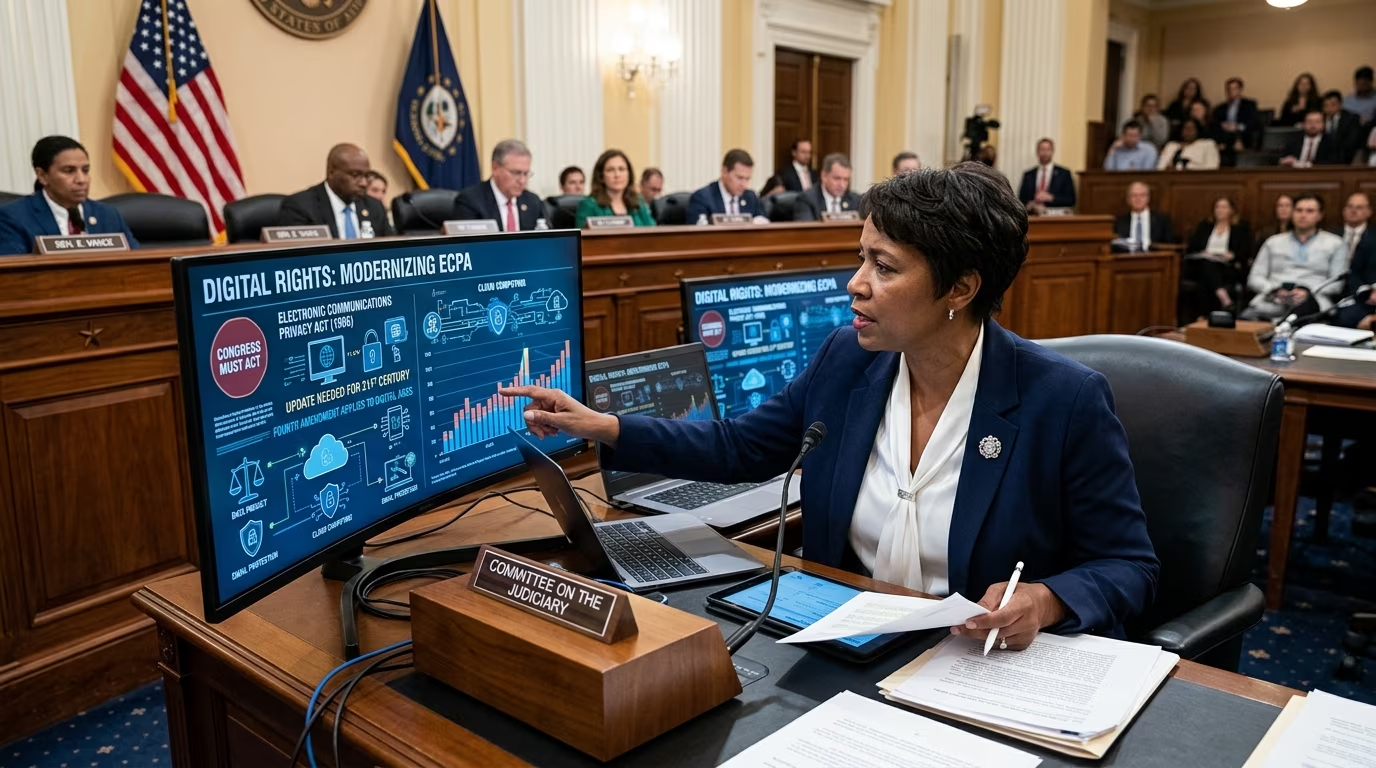
The Urgent Need for a Privacy Upgrade: Modernizing the ECPA
Imagine attempting to regulate modern commercial air travel using the local traffic laws originally designed for horse-drawn carriages. This stark mismatch perfectly encapsulates the current state of digital privacy law in the United States. When the United States Congress passed the Electronic Communications Privacy Act (ECPA) in 1986, the World Wide Web was still a nascent concept waiting to be introduced to the public. The primary forms of electronic communication at the time were primitive, localized email systems utilized almost exclusively by academic researchers, defense contractors, and massive corporations.
Today, the landscape is entirely different. Billions of people across the globe rely on cloud computing infrastructures, hyper-connected smartphones, and instantaneous digital messaging for virtually every single facet of their personal and professional lives. We manage our bank accounts, share our most intimate medical data, and document our daily movements through digital channels. Despite this monumental and irreversible technological paradigm shift, the foundational federal law governing how government agencies and law enforcement can access our personal digital lives remains stubbornly stuck in the 1980s. The ECPA is dangerously obsolete, creating a sprawling landscape filled with legal loopholes that threaten the constitutional privacy rights of all citizens. It is time for Congress to execute a comprehensive, long-overdue privacy upgrade.
The Relic of 1986: Understanding the Core of the ECPA
To fully grasp why immediate legislative reform is an absolute necessity, one must first understand the complex architecture and original intent of the ECPA. Enacted primarily to extend the physical restrictions on government wiretaps to include new forms of computer data, the ECPA was, paradoxically, hailed as a pioneering and forward-thinking legislative effort at its inception. It comprises three primary statutory components: the Wiretap Act, the Pen Register Act, and the Stored Communications Act (SCA).
The Stored Communications Act is the specific legal battleground for modern digital privacy disputes. It explicitly dictates how, when, and under what specific conditions Internet Service Providers (ISPs) and large technology companies must hand over private user data to law enforcement entities. In 1986, the SCA was logically designed to protect the electronic files of that specific era. However, the drafters of the legislation could not possibly foresee a future where individuals would store decades’ worth of personal correspondence, banking records, health information, and intimate photographs on remote, third-party servers rather than in physical filing cabinets securely locked inside their private homes. Consequently, the SCA is riddled with archaic, technology-specific distinctions that law enforcement agencies have actively exploited for years.
The 180-Day Rule: A Glaring and Dangerous Loophole
The most notorious, widely criticized, and fundamentally flawed component within the ECPA is the infamous “180-day rule.” To understand the inherent absurdity of this provision, one must look at how digital storage physically and economically functioned during the 1980s. During that era, electronic server storage space was incredibly expensive and severely limited in capacity. Email service providers typically deleted messages automatically shortly after they were read by the recipient simply to free up expensive server space. Lawmakers at the time reasoned that if an email happened to remain on a third-party provider’s server for more than six months without being deleted, it had effectively been abandoned by the user.
Operating on this outdated logic of “abandoned property,” the ECPA stipulates that law enforcement needs a search warrant—which explicitly requires proving probable cause to an impartial judge—to compel a service provider to hand over emails that are less than 180 days old. However, the moment an email crosses that arbitrary 180-day threshold, it instantly loses its robust constitutional protection. Government agencies can access these older, often deeply personal messages using a simple administrative subpoena. A subpoena, unlike a warrant, requires neither a demonstration of probable cause nor strict prior judicial oversight.
In our modern era of ubiquitous cloud computing, individuals do not download and delete their emails to save space. We perpetually archive them on massive platforms like Gmail, Outlook, or iCloud, organically building a comprehensive digital timeline of our entire lives. The legal premise that a five-year-old email is somehow “abandoned” is intellectually bankrupt. Yet, because the underlying law has never been modernized, American citizens are routinely stripped of their constitutional protections simply due to the passage of a few arbitrary months.
A Snapshot: The Evolution of Technology (1986 vs. Today)
| Technological Factor | 1986 (When ECPA Passed) | Today (The Modern Era) |
|---|---|---|
| Data Storage Norms | Local floppy disks; high cost per megabyte. | Infinite, low-cost remote cloud storage. |
| Email Retention | Deleted immediately after reading to save space. | Archived permanently for decades. |
| Mobile Devices | Bulky car phones with zero internet capability. | Smartphones that constantly transmit location data. |
| Expectation of Privacy | Information stored at home in physical cabinets. | Private lives managed entirely on third-party servers. |
The Fourth Amendment in the Age of Cloud Computing
The Fourth Amendment of the United States Constitution explicitly guarantees the fundamental right of the people to be secure in their persons, houses, papers, and effects against unreasonable searches and seizures. If state or federal law enforcement officers want to rifle through a physical desk drawer in your home looking for correspondence, they are constitutionally required to obtain a warrant based on probable cause. In every practical sense, a digital email inbox is the exact modern equivalent of that physical desk drawer.
The federal judiciary has slowly begun to recognize this glaring statutory discrepancy. In a highly consequential 2010 decision, United States v. Warshak, the Sixth Circuit Court of Appeals decisively ruled that individuals retain a reasonable expectation of privacy in their personal emails. The court determined that the government must obtain a probable cause warrant to access these communications, entirely regardless of their age. The appellate court drew a brilliant analogy to the postal service, noting that just as an individual expects a physical letter to remain private while in transit or stored in a post office, an email user rightfully expects their digital messages to remain private while securely stored on an ISP’s server.
While the Warshak decision represented a monumental victory for digital privacy advocates, its legal jurisdiction is strictly limited to the Sixth Circuit. Until Congress formally updates the ECPA to reflect this constitutional standard nationwide, the foundational privacy rights of millions of Americans will remain precariously dependent on a fragmented patchwork of regional judicial rulings.
Beyond Email: Location Tracking and the Metadata Dilemma
Private email correspondence is far from the only area where the 1986 ECPA falls desperately short of modern expectations. When the legislation was originally drafted, cellular phones were extremely rare luxury items that certainly did not actively track an individual’s every physical movement. Today, however, modern smartphones are essentially sophisticated tracking devices. They constantly ping nearby cell towers and Wi-Fi networks, generating a precise, minute-by-minute historical log of a person’s exact whereabouts.
While the Supreme Court’s landmark 2018 ruling in Carpenter v. United States successfully mandated that the government generally needs a warrant to obtain historical cell-site location information (CSLI) from telecommunications providers, the actual statutory language of the ECPA still glaringly lacks explicit, comprehensive safeguards for all emerging forms of location data and metadata. Metadata—which includes crucial information about a communication, such as exactly who you emailed, when the message was sent, how long a call lasted, and from what IP address you connected—can effortlessly reveal highly intimate details about a person’s medical associations, political affiliations, and daily habits. The current, outdated legal framework still allows law enforcement to sweep up massive amounts of this revealing metadata with minimal judicial scrutiny.
The Legislative Push for Reform: A Bipartisan Effort
For several years, prominent civil liberties advocates, major technology companies, and bipartisan coalitions of pragmatic lawmakers have aggressively pushed for a comprehensive ECPA upgrade. The most prominent and widely supported legislative effort has been the Email Privacy Act, a crucial bill explicitly aimed at formally abolishing the outdated 180-day rule and implementing a strict, uniform warrant requirement for all stored digital communications.
Historically, the Email Privacy Act has enjoyed immense bipartisan popularity in the House of Representatives, even managing to pass unanimously in past congressional sessions. However, the legislation has repeatedly stalled upon reaching the Senate. The primary and most vocal resistance originates from powerful civil regulatory agencies, such as the Securities and Exchange Commission (SEC). Because civil and administrative agencies do not possess the legal authority to obtain criminal search warrants from judges, they rely heavily on the lower standard of subpoenas to quietly gather evidence for their investigations. They fiercely argue that requiring a warrant for older emails would severely hamper their ability to swiftly investigate complex white-collar crime and corporate fraud. While balancing regulatory enforcement is undoubtedly important, constitutional scholars and civil rights advocates rightfully maintain that bureaucratic administrative convenience should never be allowed to override the fundamental, constitutional privacy rights of American citizens.
Five Pillars for a 21st-Century Privacy Upgrade
To truly modernize digital rights and restore constitutional balance, Congress must rapidly adopt a comprehensive reform package that addresses the multifaceted nature of modern technology. An effective and lasting ECPA upgrade should be structurally built upon five key legislative pillars:
- A Universal Warrant Requirement: The law must universally mandate that all government entities obtain a probable cause warrant before compelling technology companies to hand over the actual content of any electronic communication, completely regardless of how old the data is or whether it has already been opened by the recipient.
- Robust Location Privacy Safeguards: Strict statutory protections must be formally enacted to prevent the warrantless tracking of individuals via their personal electronic devices, explicitly encompassing both historical and real-time location data gathering.
- Mandatory User Notification: The revised law should strictly enforce transparency requirements. Except in incredibly narrow, judicially approved emergency situations where notification would actively jeopardize a criminal investigation, users must be promptly informed when their digital data is requested by and subsequently handed over to the government.
- Suppression of Illegally Obtained Digital Evidence: Under traditional Fourth Amendment jurisprudence, the “exclusionary rule” ensures that illegally obtained evidence cannot be used in a trial. The ECPA must be amended to include a statutory exclusionary rule for digital data, creating a powerful deterrent against prosecutorial overreach.
- Clear, Defined Emergency Exceptions: While individual privacy is absolutely paramount, law enforcement occasionally needs the ability to act swiftly in imminent, life-or-death situations. The law should carefully craft emergency exceptions that allow immediate access to data, but it must strictly mandate post-event judicial review to aggressively prevent systemic abuse.
Frequently Asked Questions (FAQs)
What exactly does the acronym ECPA stand for?
ECPA stands for the Electronic Communications Privacy Act. It is a foundational federal statute originally enacted in 1986 to regulate how the United States government can legally access private electronic communications and digital records.
Why is the “180-day rule” considered so problematic today?
The 180-day rule is a legal loophole that allows law enforcement to access user emails older than 180 days using only a subpoena, rather than a judge-issued warrant. It was created during an era when server storage was incredibly scarce and old emails were logically considered “abandoned.” Today, citizens store years of highly sensitive personal data indefinitely in the cloud, making the rule fundamentally flawed and unconstitutional in practice.
What is the Stored Communications Act (SCA)?
The SCA is a specific section (Title II) of the broader Electronic Communications Privacy Act. It was established to legally address the privacy of files and communications held by third-party service providers. It outlines the specific legal standards that the government must meet to force internet service providers to disclose private customer data.
How would the proposed Email Privacy Act change the current law?
The bipartisan Email Privacy Act aims to fundamentally amend the ECPA by entirely eliminating the arbitrary 180-day age distinction. It would legally require law enforcement to obtain a probable cause warrant to access any and all stored digital communications, protecting data regardless of its age.
Why do civil agencies like the SEC oppose updating the ECPA?
The Securities and Exchange Commission (SEC) and other civil regulatory bodies oppose removing the subpoena provisions for older emails primarily because they do not have the legal authority to seek criminal search warrants. If a strict warrant is required for all stored emails, civil agencies fear they will lose direct, speedy access to crucial digital evidence in their ongoing investigations involving corporate fraud and insider trading.
Conclusion
The modern digital revolution has completely transformed our global society, economy, and culture, bringing about unprecedented levels of convenience and connectivity. However, the foundational laws protecting our civil liberties have tragically failed to keep pace with these advancements. The Electronic Communications Privacy Act of 1986 is an outdated artifact of a bygone technological era, leaving millions of Americans completely vulnerable to unwarranted and invasive government intrusion. Modernizing the ECPA is no longer merely a technological necessity; it has become an urgent constitutional imperative. Congress must take immediate, decisive action to pass reform measures like the Email Privacy Act and establish robust, comprehensive digital privacy protections that guarantee our Fourth Amendment rights remain firmly intact well into the 21st century.
References
- Reforming The Electronic Communications Privacy Act — Department of Justice. 2015-09-16. https://www.justice.gov/
- Davidson Introduces Bill to Require Warrants to Access Americans’ Emails and Other Electronic Communications — Office of Rep. Warren Davidson. 2026-06-02. https://davidson.house.gov/
- Bipartisan Bill Would Protect Archived Emails from Warrantless Searches — Broadband Breakfast. 2026-06-03. https://broadbandbreakfast.com/
- United States v. Warshak, 631 F.3d 266 — United States Court of Appeals, Sixth Circuit. 2010-12-14. https://casetext.com/case/united-states-v-warshak-5
- Electronic Communications Privacy Act (ECPA) — Electronic Privacy Information Center (EPIC). 2024-01-15. https://epic.org/