
Militarized Policing and the Criminalization of Dissent
How military tactics and terror laws threaten domestic civil rights movements.
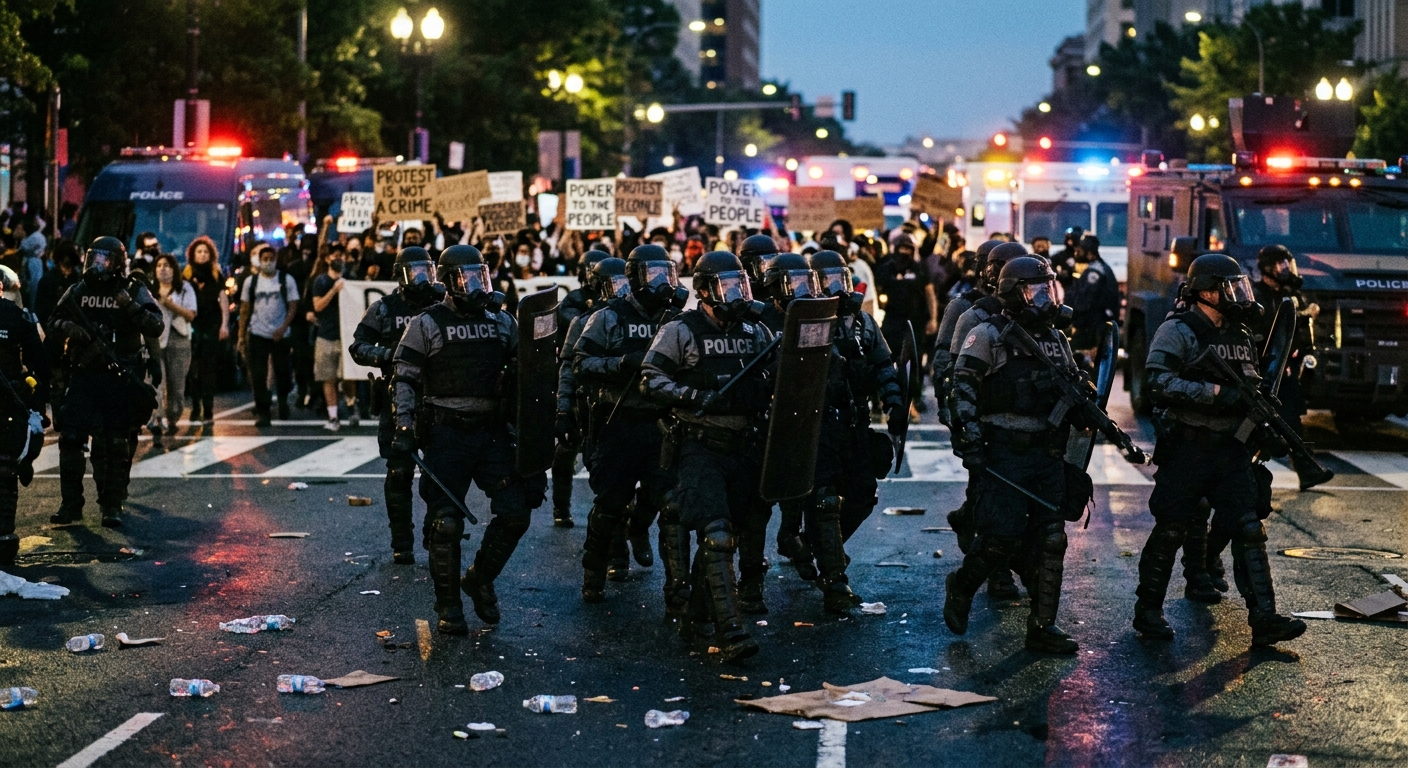
Protest is universally recognized as a foundational pillar of any functioning democratic society. It is the raw, unfiltered mechanism through which marginalized voices demand visibility, challenge systemic injustices, and force the hand of legislative reform. Without the right to peaceably assemble, the public loses its most potent tool for holding the government accountable. However, in the United States, the response to movements advocating for civil rightsparticularly those led by minority communities expressing profound grief and anger over systemic violencehas increasingly mirrored military occupations rather than domestic peacekeeping operations.
The deployment of heavily armed tactical units, the use of combat-grade equipment on civilian streets, and the initiation of domestic terrorism investigations against grassroots activists represent an alarming escalation in the criminalization of dissent. Instead of protecting the constitutional right to free expression, federal and local agencies have repeatedly weaponized national security apparatuses against their own citizens. By treating protesters as enemy combatants, the state not only suppresses immediate demonstrations but also inflicts long-lasting damage on the civil liberties that define a free society. This paradigm shift requires a rigorous examination of how local policing has become militarized and why anti-terrorism frameworks are wholly inappropriate for managing domestic civil rights movements.
The Architecture of Militarization: Transforming Officers into Combatants
The visual transformation of local police officers into heavily armored soldiers did not happen overnight; it is the result of decades of federal policy that blurred the lines between the armed forces and civilian law enforcement. The core driver of this physical and psychological shift is the unchecked flow of surplus military equipment to local municipalities.
At the center of this pipeline is the federal 1033 Program. The 1033 Program, named for the section of the National Defense Authorization Act (NDAA) of 1997 that codified it, granted permanent authority to the Secretary of Defense to transfer excess defense materials to federal and state agencies. Originally intended to assist in counter-drug and counter-terrorism activities, the program is administered by the Law Enforcement Support Office (LESO) of the Defense Logistics Agency (DLA). Through this initiative, local police departments have received billions of dollars worth of equipment, ranging from office supplies to highly lethal military gear, including armored vehicles, assault rifles, and riot control armaments.
When police departments acquire the tools of war, a dangerous psychological shift often follows. The traditional policing ethos of “protect and serve” is subtly replaced by a “search and destroy” mentality. Officers outfitted in camouflage and tactical gear, riding in Mine-Resistant Ambush Protected (MRAP) vehicles, are inherently conditioned to view the environments they patrol not as communities, but as hostile war zones. Consequently, the civilian populationincluding peaceful protestersis recast as an opposing force. Deployments of riot gear, chemical irritants, and stun grenades during the exercise of First Amendment rights inevitably transform peaceful assemblies into violent flashpoints. This aggressive posture rarely de-escalates tension; instead, it provokes fear, resentment, and further conflict, fundamentally severing the trust between law enforcement and the communities they are sworn to protect.
Joint Terrorism Task Forces and the Surveillance of Activists
Beyond the physical militarization of the police, there is a parallel, invisible threat to civil rights: the application of counter-terrorism surveillance frameworks against domestic activists. Following the events of September 11, 2001, the United States vastly expanded its national security infrastructure, creating a sprawling network of agencies and task forces designed to preempt catastrophic attacks. While originally aimed at international threats, this immense investigative power has increasingly been turned inward.
The Federal Bureau of Investigation’s Joint Terrorism Task Forces (JTTFs) act as the nation’s frontline on terrorism, coordinating efforts between federal, state, and local law enforcement agencies. However, the mandate of these task forces has expanded over the years to encompass domestic extremism. While preventing genuine acts of mass violence is a critical government function, the shifting definitions of what constitutes a “threat” have swept up peaceful civil rights organizers, environmental activists, and racial justice advocates into the dragnet of national security surveillance.
The Government Accountability Office (GAO) has highlighted the complexities of this domestic pivot, noting that the constantly evolving threat landscape has required agencies like the FBI and the Department of Homeland Security (DHS) to continually assess and refine their collaborative efforts to counter domestic terrorism. Unfortunately, when civil disobediencesuch as marching in the streets, participating in sit-ins, or occupying public squaresis conflated with domestic terrorism, the consequences for civil liberties are severe. Activists find themselves subjected to wiretaps, undercover infiltration, and inclusion on federal watchlists. This aggressive surveillance creates a profound chilling effect. Knowing that participation in a racial justice rally could result in being monitored by a Joint Terrorism Task Force deters citizens from exercising their democratic rights, effectively silencing dissenting voices through intimidation.
Historical Context: A Legacy of Suppressing Minority Voices
The militarized and surveilled response to contemporary protests is not a modern aberration; it is deeply rooted in a historical continuum of state suppression of minority voices. Throughout American history, when marginalized groupsparticularly Black Americanshave mobilized to demand equality, their actions have frequently been met with disproportionate force and systemic criminalization. The pain, grief, and anger stemming from generational trauma and police violence are routinely invalidated and recast by authorities as urgent threats to public order.
During the Civil Rights Movement of the 1960s, peaceful marchers were met with police dogs, fire hoses, and state troopers operating with military-like precision. Similarly, the FBI’s COINTELPRO operations deliberately targeted civil rights leaders, utilizing espionage and sabotage tactics usually reserved for hostile foreign operatives. The modern iteration of this dynamic simply utilizes more advanced weaponry and sophisticated digital surveillance. The underlying premise remains unchanged: challenges to the status quo, especially those originating from Black and Brown communities, are treated not as legitimate democratic petitions, but as insurgencies that must be suppressed at all costs.
This divergent treatment becomes glaringly obvious when contrasting the policing of civil rights protests with the law enforcement response to other public gatherings. Demonstrations advocating for racial equity are frequently met preemptively with phalanxes of riot police and National Guard deployments. Conversely, protests led by predominantly white groups concerning issues like pandemic mandates or land disputes have historically experienced a much more restrained law enforcement presence, even when demonstrators are heavily armed. This stark disparity underscores the implicit biases embedded within law enforcement threat assessments.
Constitutional Collisions: First and Fourth Amendment Concerns
The aggressive suppression of protests via military tactics and anti-terror investigations triggers profound constitutional crises, striking at the very heart of the Bill of Rights. The most immediate casualty is the First Amendment, which guarantees the right of the people to peaceably assemble and to petition the government for a redress of grievances. When the state responds to a petition with tear gas, rubber bullets, and armored vehicles, it fundamentally denies the public its constitutional voice. The mere presence of sniper rifles and military-grade machinery at a peaceful march acts as a physical barrier to free speech, signaling to citizens that their assembly is a criminal act.
Furthermore, the surveillance tactics employed by fusion centers and JTTFs raise serious Fourth Amendment concerns regarding unreasonable searches and seizures. When authorities monitor the social media accounts, track the cell phone locations, and infiltrate the organizational meetings of peaceful protest groups without a warrant or probable cause of a specific crime, they violate the fundamental right to privacy. The designation of activist organizations under vague “domestic terrorism” umbrellas allows agencies to exploit legal loopholes, bypassing the stringent judicial oversight required for standard criminal investigations.
Additionally, the involvement of federal troops and federalized National Guard units in local crowd control introduces dangerous violations of traditional legal boundaries. The Posse Comitatus Act of 1878 was specifically designed to generally prevent the president from using the federal military as a domestic police force. The American tradition of separating military action from civil law enforcement is vital for maintaining civilian control and democratic integrity. However, during large-scale civil rights demonstrations, administrations have exploited statutory loopholessuch as broad interpretations of the Insurrection Actto flood urban centers with military personnel. This erosion of Posse Comitatus threatens to normalize military occupation as a standard response to domestic political dissent.
Comparative Analysis: Traditional Policing vs. Militarized Response
To fully understand the shift in law enforcement dynamics during protests, it is necessary to contrast the traditional community policing model with the militarized approach.
| Factor | Traditional Community Policing | Militarized Law Enforcement Response |
|---|---|---|
| Primary Objective | De-escalation, preserving public safety, and protecting constitutional rights to assemble. | Crowd control, dominating physical space, and viewing protesters as potential adversaries. |
| Equipment Utilized | Standard uniforms, high-visibility vests, standard patrol vehicles, and barriers. | Camouflage, tactical riot gear, long rifles, chemical irritants, and MRAP vehicles. |
| Threat Assessment | Evaluates specific individuals for criminal behavior while protecting the broader crowd. | Treats the entire assembly as a hostile entity or a monolithic threat to national security. |
| Psychological Impact | Fosters a sense of civic safety and encourages peaceful expression and dialogue. | Instills fear, creates an “us vs. them” dynamic, and inevitably escalates tensions. |
Reimagining Public Safety: A Path Forward
Addressing the profound damage caused by militarized policing requires a radical reimagining of public safety. True security cannot be achieved by waging war on communities that are expressing legitimate grievances. The path forward demands legislative action, structural divestment, and a renewed commitment to constitutional liberties.
First, the federal government must dramatically reform or abolish the 1033 Program. The transfer of combat-grade weaponry to local municipalities serves no legitimate domestic peacekeeping purpose and only fuels the escalation of violence. Police departments must be stripped of the tools of war to force a return to community-oriented service. Second, strict limitations must be placed on Joint Terrorism Task Forces and federal surveillance programs. Clear, unambiguous legislative barriers must be erected to prevent the use of counter-terrorism laws against citizens engaged in First Amendment-protected activities.
Ultimately, municipalities must shift their resources away from bloated, militarized police budgets and invest instead in the communities themselves. Expanding funding for community-led safety initiatives, mental health crisis response teams, and social services addresses the root causes of societal distress. When a society responds to the pain, grief, and anger of its citizens with empathy and systemic reform rather than tear gas and terror investigations, it takes a crucial step toward genuine justice and lasting peace.
Frequently Asked Questions (FAQs)
What is the 1033 Program?
The 1033 Program is a federal initiative managed by the Defense Logistics Agency (DLA) that allows the Department of Defense to transfer excess military equipment to state and local law enforcement agencies. This equipment ranges from office furniture to high-powered weapons and armored vehicles, significantly contributing to the militarization of local police forces.
How does militarized policing affect First Amendment rights?
Militarized policing chills First Amendment rights by creating an intimidating, war-zone-like atmosphere during public assemblies. The deployment of tactical gear, snipers, and chemical weapons against peaceful protesters deters citizens from exercising their right to free speech and peaceable assembly due to fear of physical harm or violent escalation.
What is the Posse Comitatus Act?
The Posse Comitatus Act of 1878 is a federal law designed to limit the powers of the federal government in using military personnel to enforce domestic policies within the United States. It generally prohibits the use of the military as a domestic police force, aiming to protect civilian populations from military overreach, though certain statutory exceptions exist.
Why are domestic terrorism frameworks problematic when applied to protests?
Applying domestic terrorism frameworks to protests is problematic because it conflates civil disobedience and political dissent with acts of mass violence. This allows law enforcement to bypass standard judicial oversight, subjecting peaceful activists to extreme surveillance, wiretaps, and placement on terror watchlists, which severely undermines democratic freedoms and privacy rights.
References
- The “1033 Program,” Department of Defense Support to Law Enforcement Government Accountability Office / DTIC. 2018-05-18. https://apps.dtic.mil/sti/citations/AD1124694
- The Image of Combat, Not Community: A Critique on Law Enforcement Use of Military Equipment Harvard Law School Journals. 2025-05-23. https://journals.law.harvard.edu/
- Threat Screening Center – Terrorism Federal Bureau of Investigation (FBI). 2024-04-01. https://www.fbi.gov/investigate/terrorism
- Domestic Terrorism: Further Actions Needed to Strengthen FBI and DHS Collaboration to Counter Threats U.S. Government Accountability Office (GAO). 2023-03-02. https://www.gao.gov/products/gao-23-104720
- The Posse Comitatus Act, Explained Brennan Center for Justice. 2021-10-14. https://www.brennancenter.org/our-work/research-reports/posse-comitatus-act-explained
Similar Articles








Read full bio of medha deb




