
Michigan Sexual Assault Medical Record Rules
How Michigan health providers document, keep, and share records after sexual assault care.
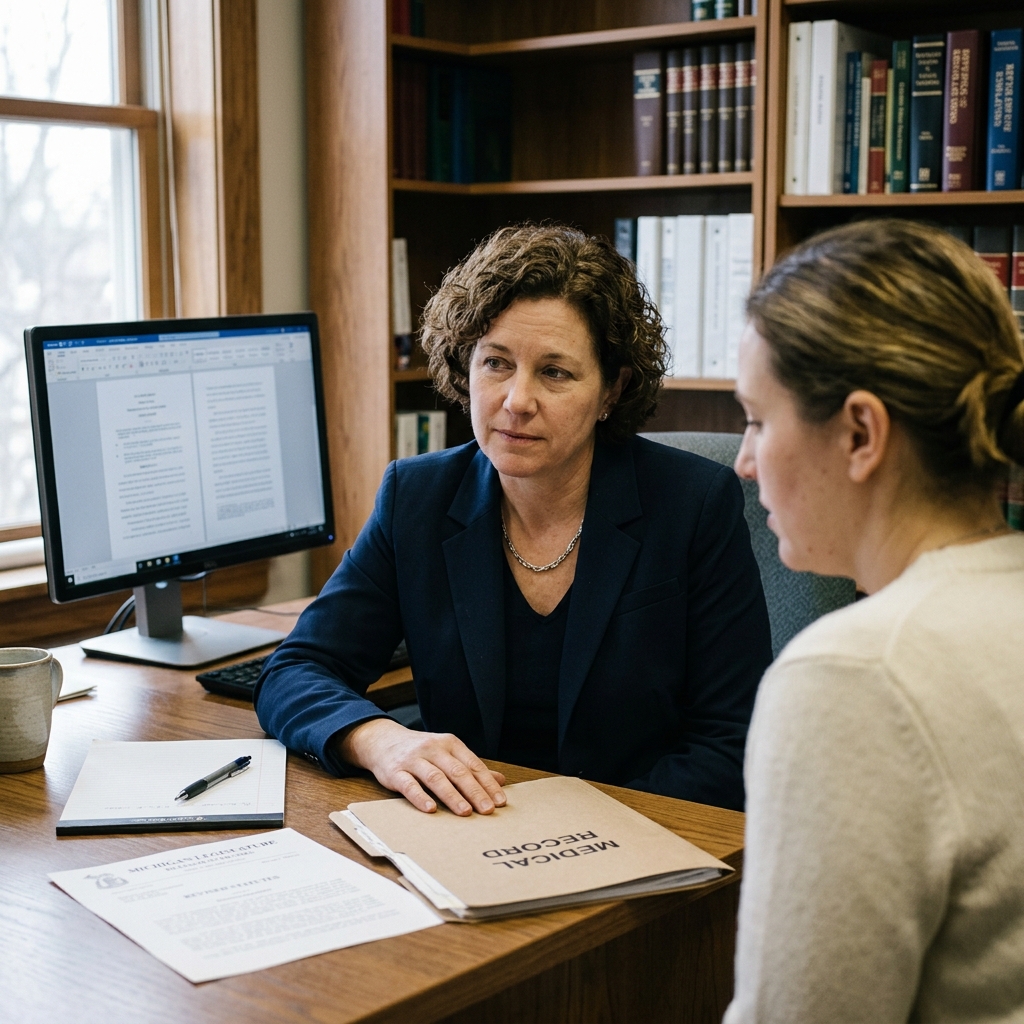
When a patient receives care after a sexual assault, the medical record can serve more than one purpose. It supports treatment, preserves clinical facts, and may later become important evidence in a civil or criminal case. Michigan law also places specific expectations on health care providers about what must be documented, how long records should be kept, and how patient information may be released.
For clinicians, administrators, and compliance teams, the practical question is not only what happened during the visit, but how to record it in a way that protects the patient and preserves the integrity of the evidence. The rules intersect with medical privacy, record retention, consent, and forensic examination standards.
Why documentation matters after a sexual assault
Medical records created after a sexual assault may become part of both treatment and legal review. They can help show the timing of symptoms, the nature of injuries, the care provided, and whether a forensic exam or evidence collection kit was used.
Accurate documentation is important because it may later be reviewed by prosecutors, defense attorneys, insurers, licensing authorities, or a civil court. A record that is clear, complete, and contemporaneous is more useful than one that is vague or reconstructed long after the visit.
- Clinical value: supports diagnosis, treatment decisions, referrals, and follow-up care.
- Evidence value: helps preserve facts that may matter in a criminal or civil case.
- Compliance value: shows the provider met statutory and institutional obligations.
What should be recorded in the chart
Michigan materials addressing sexual assault care emphasize that encounters involving vaginal or anal penetration must be documented in the patient’s medical record. The documentation should reflect that the procedure or examination occurred and should be maintained as part of the provider’s health care records.
In practice, a strong record should be factual, specific, and limited to what the provider observed, was told, and did. The chart should avoid speculation and should distinguish the patient’s statements from the clinician’s own findings.
| Record element | Why it matters |
|---|---|
| Patient history as reported | Separates the patient’s account from the clinician’s observations. |
| Exam findings | Documents physical condition, injuries, and other clinically relevant facts. |
| Procedures performed | Shows treatment, evidence collection, or forensic steps taken. |
| Consent details | Demonstrates that required permissions were obtained. |
| Referrals and follow-up | Supports continuity of care and safety planning. |
Forensic standards also favor careful recording of who was present, whether an interpreter was used, and whether any evidence kit or specialized exam process was involved.
Retention periods can be longer than routine medical storage
One of the most important compliance issues is how long the record must be kept. The source material indicates that, after these Michigan legislative changes, providers were advised to retain medical care records for at least 10 years when a sexual assault claim could arise, and to keep records for a minor patient until age 33.
Other reporting on the legislation indicates that records connected to certain medical encounters involving vaginal or anal penetration may need to be maintained for at least 15 years, and that consent forms for minors must also be preserved for at least 15 years. Because these retention periods appear in different summaries of the law and related proposals, providers should confirm the exact current rule with counsel and their compliance team before setting policy.
- Adult patients: keep records long enough to satisfy the applicable statutory and risk-management period.
- Minor patients: retain records until the patient reaches the required age or the longer statutory period applies.
- Institutional policy: should be aligned with the longest applicable legal retention rule.
Health systems often build their record-retention schedules around the longest potential exposure period, especially when trauma care, malpractice risk, or sexual misconduct allegations may later be litigated.
Consent and the special rules for minors
Michigan reporting on the legislation indicates that written parental consent is required before procedures involving vaginal or anal penetration may be performed on a minor, and that a standardized consent form is to be created for use by licensed and registered health professionals.
This makes documentation especially important in pediatric and adolescent settings. The chart should show that the correct consent was obtained before the procedure began, and the signed form should be stored with the medical record.
For providers, that means the record should clearly answer several questions:
- Who gave consent?
- What procedure was authorized?
- When was consent obtained?
- Was the required form completed and filed?
- Were any limits or conditions noted by the parent or guardian?
When a case involves a minor, incomplete consent documentation can create legal and operational risk even if the clinical care itself was appropriate.
Who may be in the room during the encounter
Michigan reporting on the legislation states that such procedures must be within the scope of practice of the treating health professional and that a medical assistant or another licensee or registered health professional must be present in the room during the encounter.
This requirement is part of the broader effort to add safeguards in sensitive examinations. Documentation should identify the additional person present, because that can matter later if the encounter is reviewed for compliance or credibility.
- Record the observer: note the name and professional role of the person in the room.
- Record the timing: identify when that person entered and left if relevant.
- Record the purpose: note whether the person was present for safety, assistance, or procedural compliance.
How sexual assault evidence collection fits into the record
Michigan guidance for professionals explains that sexual assault victims should be encouraged to seek a sexual assault medical forensic examination when the assault occurred within the previous 120 hours, and hospitals are required to provide or arrange that examination. The same guidance also notes that evidence collection can occur even if the victim does not want to participate in the criminal justice process.
That distinction is important. A medical record can document treatment without forcing a police report, but it should still preserve the fact that evidence collection was offered or completed when appropriate. If a sexual assault evidence kit was used, the chart should reflect that the kit was collected, sealed, transferred, and routed according to facility procedure.
Relevant details can include:
- time of arrival and time of examination
- whether the patient agreed to evidence collection
- the type of exam performed
- the identities of staff involved
- where the kit and associated materials were sent
Good documentation helps ensure that the chain of events is understandable without relying on memory alone.
Patient access to records and response time
Michigan law gives patients, or their authorized representatives, the right to examine or obtain copies of medical records. A written request must generally be signed and dated, and the provider must act promptly, usually within 30 days, with a possible one-time extension in limited circumstances.
For sexual assault survivors, access to their own records can be especially important because the chart may be used for ongoing medical care, counseling, legal consultation, or a claim for damages. Health care organizations should be ready to verify identity, process release requests correctly, and separate what can be released from what may be restricted by other law.
Privacy, sensitivity, and careful language
The legal rules do not replace the need for trauma-informed care. Providers should document in a way that is respectful, neutral, and clinically useful. That means avoiding loaded language, conclusions unsupported by the exam, or details that do not advance treatment or legal clarity.
Examples of better practice include:
- use direct quotations for the patient’s own words when important
- describe observed injuries in plain clinical terms
- avoid assuming what occurred unless it was directly reported or examined
- record offered services, follow-up plans, and referrals clearly
Because the record may later be reviewed by non-clinicians, readability matters. A chart that is organized and factual is easier to defend and easier to use for continuity of care.
How providers can reduce legal risk
Hospitals, clinics, and individual practitioners can reduce risk by adopting a consistent process for sexual assault cases. That process should be built into training, forms, retention schedules, and internal auditing.
- Use a checklist: make sure documentation, consent, staffing, and evidence handling are all completed.
- Train staff regularly: ensure every relevant team member knows the required steps.
- Standardize forms: use templates for consent, forensic exams, and release requests.
- Review retention schedules: confirm that sexual assault-related records are kept for the correct period.
- Consult counsel: verify how statutory changes apply to your facility and patient population.
Because the record may be central in later litigation, the safest approach is to treat every sexual assault-related encounter as a potential evidence-preservation event as well as a medical visit.
Common mistakes to avoid
Providers sometimes make avoidable documentation errors in sensitive cases. The most common problems are not dramatic; they are procedural and administrative.
- failing to document the procedure clearly
- omitting who was present during the exam
- losing or misfiling the consent form
- using vague shorthand that is hard to interpret later
- destroying records too early
- forgetting to note whether evidence collection was offered
Each of these mistakes can weaken a record that would otherwise support both care and accountability.
Frequently asked questions
Do Michigan providers have to document sexual assault-related encounters?
Yes. The source materials indicate that encounters involving vaginal or anal penetration must be documented in the patient’s medical record, and related records must be retained according to the applicable time period.
How long should these records be kept?
The source materials reference retention periods of at least 10 years in some guidance and 15 years in legislative summaries, with longer retention for minors in some circumstances. Providers should confirm the current rule before finalizing policy.
Can evidence be collected if the patient does not want to contact police?
Yes. Michigan guidance says victims may receive a sexual assault medical forensic examination and evidence collection even if they do not wish to participate in the criminal justice process.
Can patients obtain copies of their records?
Yes. Michigan law gives patients and authorized representatives the right to request and receive copies of medical records, subject to the statutory process and timing rules.
Why is a witness or second professional required in the room?
According to the legislative summary, a medical assistant or another licensee or registered health professional must be present during the encounter. That safeguard helps document the event and supports compliance.
References
- Michigan Sexual Assault: Evidence Collection Steps — Super Lawyers. n.d. https://www.superlawyers.com/resources/health-care/michigan/how-medical-records-must-document-sexual-assault-in-michigan/
- Michigan legislation on sexual assault … — Detroit Legal News. 2018-06-12. https://www.legalnews.com/Home/Articles?DataId=1463760
- Michigan Model Policy: The Law Enforcement Response to Sexual Assault — State of Michigan / training resource. 2015. https://knowledgebase.also-chicago.org/wp-content/uploads/2020/12/2015-Michigan-Model-Policy-1.pdf
- Sexual Assault Healthcare Toolkit — State of Michigan. n.d. https://www.michigan.gov/mdhhs/safety-injury-prev/publicsafety/crimevictims/resources-for-professionals/sexual-assault-healthcare-toolkit
- MCL – Section 333.26265 – Michigan Legislature — Michigan Legislature. n.d. https://www.legislature.mi.gov/Laws/MCL?objectName=mcl-333-26265
- Access to Medical Records Under Michigan Law — Lorman. n.d. https://www.lorman.com/resources/access-to-medical-records-under-michigan-law-17308
Similar Articles








Read full bio of Sneha Tete




