
McGirt v. Oklahoma and Criminal Jurisdiction in Indian Country
How the McGirt v. Oklahoma decision reshaped criminal jurisdiction on tribal lands in Oklahoma and beyond.
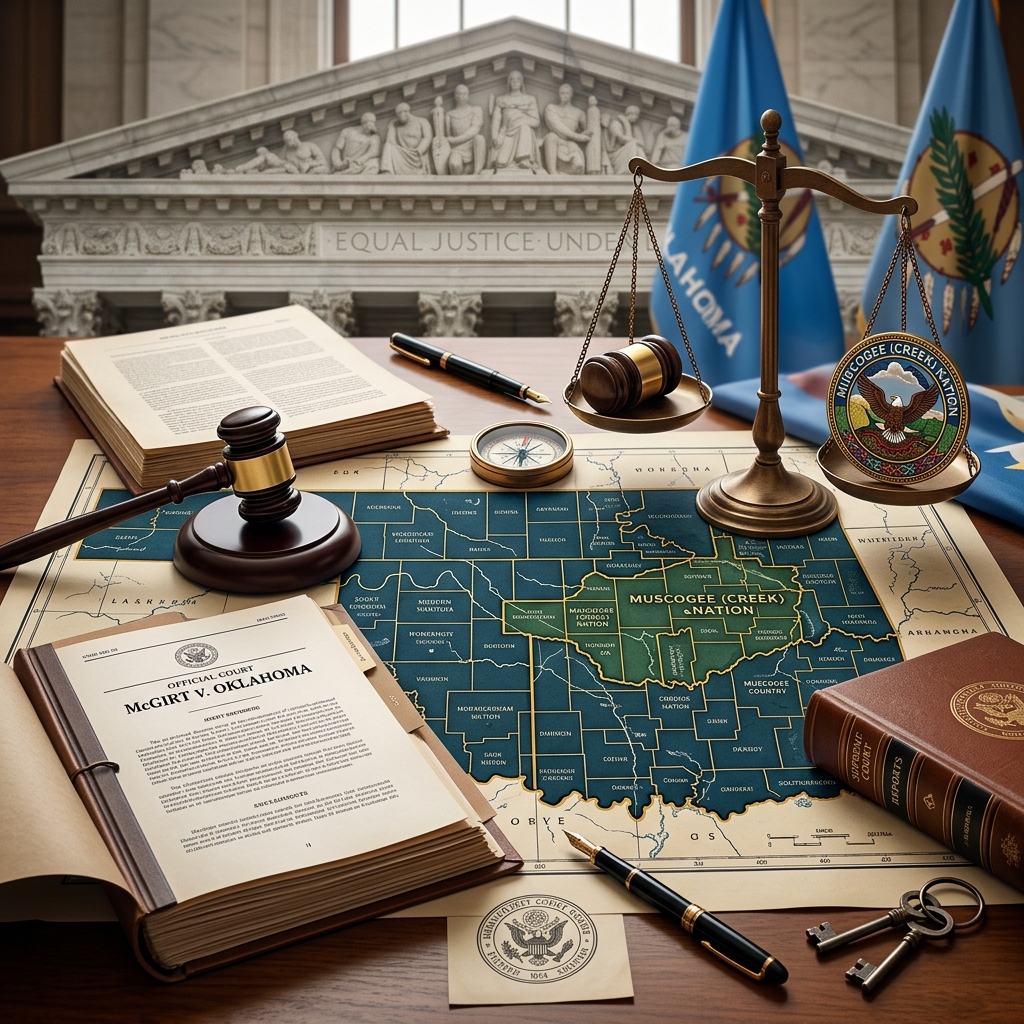
The United States Supreme Court’s decision in McGirt v. Oklahoma dramatically reshaped how criminal cases are handled on tribal lands in eastern Oklahoma and has become a touchstone for understanding jurisdiction in Indian Country nationwide. At its core, the ruling reaffirmed that only Congress can disestablish a reservation and that promises made in treaties must be honored unless Congress clearly says otherwise.
This article explains what the McGirt decision said, why it matters for criminal jurisdiction, how it interacts with long-standing federal statutes, and what it means in practice for tribal citizens, non-Indian residents, and law enforcement.
1. Background: How McGirt Reached the Supreme Court
McGirt v. Oklahoma, decided in 2020, involved Jimcy McGirt, a citizen of the Seminole Nation of Oklahoma who was convicted in Oklahoma state court for serious sexual offenses that occurred within the historical boundaries of the Muscogee (Creek) Nation. McGirt argued that, because he is an Indian and the conduct took place on reservation land, the state lacked authority to prosecute him under the federal Major Crimes Act (MCA).
The key question for the Court was not McGirt’s guilt or innocence but whether the Muscogee (Creek) Reservation still legally existed for criminal jurisdiction purposes. If it did, then under federal law Oklahoma courts had no power to try him.
- Date of decision: July 9, 2020.
- Vote: 5–4, with Justice Gorsuch writing the majority opinion.
- Central legal issue: Whether Congress had ever disestablished or diminished the Muscogee (Creek) Nation’s reservation.
The majority relied on a strongly textualist approach to the relevant treaties and statutes, insisting that only clear congressional language can erase a reservation.
2. What Counts as “Indian Country” for Criminal Law?
The term Indian Country is not just a historical label; it is a statutory term that defines where special federal and tribal jurisdictional rules apply. Under 18 U.S.C. § 1151, Indian Country includes:
- All land within the limits of any Indian reservation, regardless of who owns individual parcels;
- Dependent Indian communities (communities dependent on the federal government and set aside for Indians);
- Indian allotments, including rights-of-way, where the Indian titles have not been extinguished.
When a crime occurs in Indian Country, jurisdiction is determined by a combination of factors:
- Whether the accused is an Indian or a non-Indian;
- Whether the victim is Indian or non-Indian;
- Whether the offense qualifies as a major crime under the Major Crimes Act, 18 U.S.C. § 1153;
- Whether other federal statutes—such as Public Law 280—grant additional authority to the state.
McGirt turned on the first part of this framework: whether the land at issue is still Indian Country because it remains part of a reservation.
3. The Court’s Core Holding in McGirt
The Supreme Court held that the lands reserved for the Muscogee (Creek) Nation in 19th-century treaties were never disestablished and therefore remain reservation lands for purposes of federal criminal law. Because the crime at issue involved an Indian defendant and conduct in Indian Country, the state lacked jurisdiction under the Major Crimes Act.
Justice Gorsuch’s opinion emphasized several key principles:
- Congress must speak clearly to disestablish a reservation; historical practice and demographic change alone are not enough.
- Treaty promises are binding until Congress explicitly changes them.
- Subsequent statehood, settlement by non-Indians, or assumptions of state power cannot silently erase reservation status.
In practical terms, the ruling confirmed that much of eastern Oklahoma is still Indian Country for criminal jurisdiction purposes, not only for the Muscogee (Creek) Nation but also for other tribes whose reservations were treated similarly in subsequent litigation.
3.1 Impact on Other Tribal Nations in Oklahoma
Following McGirt, Oklahoma courts applied the same reasoning to confirm the continuing existence of several other reservations, including those of the Cherokee, Chickasaw, Choctaw, and Seminole Nations. As a result, a large portion of the state’s eastern half is now recognized as reservation land for federal criminal law purposes.
This does not mean that tribal governments suddenly acquired powers they never had; rather, it clarified that longstanding federal statutes govern criminal jurisdiction on these lands, and that Oklahoma lacked authority to override those rules.
4. The Major Crimes Act and Who Prosecutes What
The Major Crimes Act (MCA), codified at 18 U.S.C. § 1153, is central to understanding McGirt’s consequences. Enacted in 1885 in response to earlier Supreme Court decisions limiting federal jurisdiction over crimes between Indians on reservations, the MCA gives the federal government authority to prosecute certain serious offenses committed by Indians in Indian Country.
Covered crimes under the MCA include, among others:
- Murder
- Felony manslaughter
- Kidnapping
- Maiming
- Felony sexual abuse
- Arson
- Burglary
- Robbery
Post-McGirt, the division of authority in Oklahoma’s reservation areas can be summarized as follows (simplified):
| Defendant | Victim | Location | Type of Crime | Primary Jurisdiction |
|---|---|---|---|---|
| Indian | Indian or non-Indian | Indian Country | Major crimes under MCA | Federal court (United States) |
| Indian | Indian or non-Indian | Indian Country | Non-major offenses | Tribal court (subject to federal limits) |
| Non-Indian | Non-Indian | Indian Country | All crimes | State court |
| Non-Indian | Indian | Indian Country | All crimes | Federal and, after Castro-Huerta, state courts (concurrent) |
This table simplifies a complex system, but it reflects the general framework that McGirt reinforced and that later cases, including Oklahoma v. Castro-Huerta, modified in part.
5. Oklahoma v. Castro-Huerta and the Next Chapter
In 2022, the Supreme Court decided Oklahoma v. Castro-Huerta, addressing whether states share jurisdiction with the federal government when a non-Indian defendant commits a crime against an Indian victim in Indian Country.
The Court held that states have concurrent jurisdiction in such cases, unless Congress has expressly preempted state authority. This partially limited some of the practical effects that many observers had attributed to McGirt by expanding the circumstances in which Oklahoma can prosecute crimes in reservation areas.
Nonetheless, several core principles from McGirt remain unchanged:
- The Muscogee (Creek) and other reservations in eastern Oklahoma still exist for criminal law purposes.
- Crimes by Indians in Indian Country that fall under the Major Crimes Act remain within federal jurisdiction.
- Tribes retain authority over many offenses committed by their members, subject to federal limits on sentencing and jurisdiction.
6. Practical Implications for Tribal Citizens and Residents
For individuals living or doing business in eastern Oklahoma, McGirt raised questions about daily life, law enforcement responses, and existing convictions. The key takeaways are:
6.1 No One Is “Above the Law” in Reservation Areas
The recognition of reservation status does not create a lawless zone. Federal, tribal, and state governments all retain significant authority, but their roles are now more clearly delineated.
- Tribal citizens who commit crimes in Indian Country can face prosecution in federal or tribal courts, depending on the offense.
- Non-Indians who commit crimes generally remain subject to state prosecution, and in some cases federal prosecution as well.
- Law enforcement agencies have been developing cross-deputization agreements and cooperative protocols to ensure effective public safety.
6.2 Property Rights and Civil Law
McGirt concerned criminal jurisdiction, not ownership of land or private property rights. The ruling did not alter land titles, leases, or contracts that were valid before the decision. Civil regulatory authority—such as zoning, taxation, and environmental regulation—may involve different legal analyses and is not automatically controlled by the same rules that govern criminal jurisdiction.
6.3 Re-Examination of Past Convictions
Following McGirt, some defendants who are tribal citizens and were convicted in Oklahoma state court for crimes committed on reservation land sought to have their convictions vacated, arguing that the state lacked jurisdiction at the time of trial. The scope and retroactivity of these challenges have been addressed in subsequent state and federal decisions, often limiting how far back McGirt-based challenges can reach, but the decision prompted significant litigation and adjustment within the Oklahoma justice system.
7. How Jurisdiction Is Determined in Practice
When a crime occurs in eastern Oklahoma, authorities must now walk through several questions to determine which government has authority to investigate and prosecute.
7.1 Key Questions for Jurisdiction
- Where did the incident occur?
Is the location within the boundaries of a federally recognized reservation, a dependent Indian community, or on an Indian allotment? If so, it is Indian Country for criminal law purposes. - Is the accused an Indian?
Courts typically look to federal and tribal criteria for determining Indian status, including tribal membership or eligibility. - Is the victim an Indian?
This can influence whether state courts have jurisdiction, especially after Castro-Huerta. - What is the nature of the offense?
If it is one of the enumerated major crimes under the Major Crimes Act, federal jurisdiction is likely triggered for Indian defendants.
7.2 Law Enforcement Coordination
To manage this complexity, tribal, federal, and state agencies often rely on:
- Cross-deputization agreements, enabling officers from one jurisdiction (for example, a county sheriff) to enforce laws on behalf of another (such as a tribal police department);
- Intergovernmental compacts that share responsibilities and clarify procedures;
- Joint task forces focusing on particular types of crime, such as violent crime, drug trafficking, or missing and murdered Indigenous people.
These arrangements predate McGirt but have become more important in its wake, as more cases are routed to federal and tribal courts.
8. Common Misunderstandings About McGirt
The McGirt decision has generated extensive commentary, and several misconceptions have circulated in public debate.
- Misconception 1: McGirt “gave land back” to tribes.
The Court did not transfer ownership; it recognized that the reservation boundaries defined in 19th-century treaties were never legally disestablished for criminal jurisdiction purposes. - Misconception 2: State law no longer applies in eastern Oklahoma.
State law still applies in many situations, particularly involving non-Indians, and Oklahoma retains substantial civil and criminal authority. - Misconception 3: Tribal courts can now prosecute anyone for anything.
Tribal criminal jurisdiction over non-Indians remains limited by federal precedent and statute; much of tribal criminal authority still focuses on crimes committed by tribal members or, in some instances, other Indians. - Misconception 4: McGirt created new rights out of thin air.
The Court instead enforced existing treaties and statutes, emphasizing that Congress—not courts or states—must make clear decisions to alter reservation status.
9. Frequently Asked Questions (FAQs)
Q1. What did McGirt v. Oklahoma decide in one sentence?
McGirt held that the Muscogee (Creek) Reservation was never disestablished and therefore remains Indian Country for purposes of federal criminal law, so Oklahoma lacked jurisdiction to prosecute an Indian for a major crime committed there.
Q2. Does McGirt apply only to the Muscogee (Creek) Nation?
No. While McGirt directly addressed the Muscogee (Creek) Reservation, Oklahoma courts later applied its reasoning to other reservations in eastern Oklahoma, including those of the Cherokee, Chickasaw, Choctaw, and Seminole Nations.
Q3. How does McGirt affect non-Indian residents of eastern Oklahoma?
Non-Indian residents remain subject to state criminal law in most situations. McGirt primarily affects cases involving Indian defendants or Indian victims and crimes that occur within Indian Country.
Q4. What is the relationship between McGirt and Oklahoma v. Castro-Huerta?
McGirt confirmed reservation status and federal/tribal authority over many crimes involving Indians in Indian Country, while Castro-Huerta later held that states have concurrent jurisdiction to prosecute non-Indians who commit crimes against Indians in Indian Country, unless Congress has clearly said otherwise.
Q5. If I am a tribal citizen, where will I be prosecuted for a crime in eastern Oklahoma?
It depends on the offense and where it occurred. If the alleged crime is a major offense under the Major Crimes Act and occurred in Indian Country, it will typically be prosecuted in federal court. For less serious offenses, tribal courts often have primary jurisdiction, although specific facts and intergovernmental agreements can influence the outcome.
Q6. Did McGirt change who owns land or invalidate property titles?
No. The decision focused on criminal jurisdiction and the continuing existence of reservation boundaries; it did not alter the ownership of private land, leases, or contracts within the affected areas.
10. Why McGirt Matters Beyond Oklahoma
Although McGirt is closely associated with Oklahoma, the decision has broader implications for Indian law nationwide:
- It reinforces that treaty language must be taken seriously, and that historical and demographic changes cannot substitute for formal congressional action when it comes to disestablishing reservations.
- It strengthens the doctrinal rule that ambiguities in statutes and treaties involving tribes are often interpreted in favor of tribal interests, especially when promises of a permanent homeland were made.
- It encourages courts and policymakers to revisit assumptions about the jurisdictional status of lands where tribal reservations were long assumed to be defunct.
For tribal governments, McGirt underscores the importance of building robust justice systems and intergovernmental partnerships to exercise renewed or clarified jurisdictional authority effectively. For states and federal agencies, it highlights the need for cooperation and careful statutory analysis in Indian Country.
References
- McGirt v. Oklahoma, 591 U.S. 894 (2020) — Supreme Court of the United States. 2020-07-09. https://supreme.justia.com/cases/federal/us/591/18-9526/
- McGirt v. Oklahoma — Harvard Law Review, Vol. 134, No. 1. 2020-11-10. https://harvardlawreview.org/2020/11/mcgirt-v-oklahoma/
- McGirt v. Oklahoma: A Primer — Oklahoma Bar Association. 2022-03-01. https://www.okbar.org/barjournal/march-2022/cleary/
- The Jurisdictional Landscape of Indian Country After the McGirt and Castro-Huerta Decisions — American Bar Association. 2022-10-01. https://www.americanbar.org/groups/crsj/resources/human-rights/archive/jurisdictional-landscape-indian-country-after-mcgirt-castro-huerta/
- The Role of United States v. Cooley and McGirt v. Oklahoma in Determining Criminal Jurisdiction in Indian Country — Tribal Law Journal, University of New Mexico School of Law. 2021-01-01. https://digitalrepository.unm.edu/tlj/vol22/iss1/7/
- Frequently Asked Questions Related to McGirt v. Oklahoma — National Association of Insurance Commissioners. 2020-12-01. https://content.naic.org/sites/default/files/inline-files/FAQs%20McGirt%20.pdf
Similar Articles








Read full bio of Sneha Tete




