
Mass Acquittals and the Fight for Civil Liberties
How historic mass acquittals protect First Amendment protest rights.
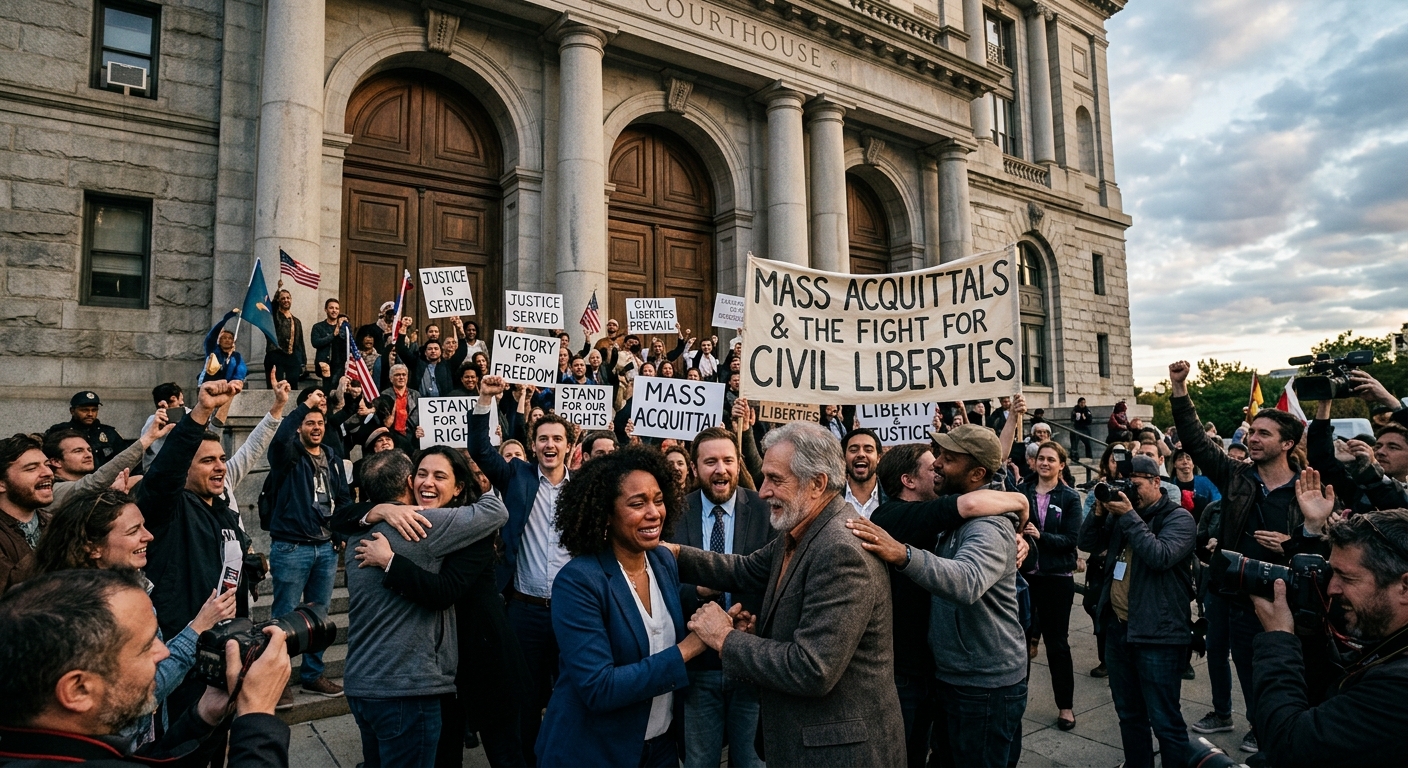
The right to peaceably assemble and petition the government for a redress of grievances is a foundational pillar of American democracy. Protected by the First Amendment, this right has been exercised by millions of citizens to challenge injustices, demand policy changes, and hold elected officials accountable. However, throughout United States history, the tension between public demonstrations and the state’s mandate to maintain public order has frequently resulted in aggressive law enforcement responses, including the deployment of unconstitutional mass arrests. When authorities sweep thousands of demonstrators and bystanders into custody without individualized probable cause, they ignite intense legal battles over the fundamental boundaries of constitutional freedom.
In these high-stakes clashes, the role of civil liberties defenders becomes crucial. By challenging the legality of widespread detentions, legal advocates have secured monumental mass acquittals that do much more than free the innocent—they establish vital jurisprudence that restrains executive overreach. The legacy of these legal victories continues to protect modern social movements from unconstitutional policing tactics, ensuring that the right to dissent remains a protected democratic exercise rather than a criminalized offense.
The Intersection of Protest and the Constitution
At the core of any mass demonstration is a complex interplay between the First and Fourth Amendments. While the First Amendment guarantees the freedom of speech and assembly, the Fourth Amendment protects citizens from unreasonable searches and seizures, dictating that arrests must be based on individualized probable cause. This means that law enforcement officers cannot legally arrest a crowd collectively simply because a few individuals within that crowd may have committed a crime. Guilt by association has no standing in constitutional law.
Despite these clear constitutional directives, authorities have historically utilized mass arrests as an indiscriminate tool for crowd control. Tactics such as “kettling”—where police encircle a crowd, trap them, and arrest everyone inside the perimeter—often ensnare peaceful protesters, journalists, legal observers, and casual bystanders. These sweeps are frequently justified by authorities under the guise of public safety or emergency declarations. However, when the dust settles, the judicial system is tasked with untangling the legality of these actions. The resulting legal scrutiny often exposes severe due process violations, as police rarely possess the requisite documentation or specific evidence linking individual detainees to specific unlawful acts.
A Historical Precedent: The 1971 May Day Protests
To understand the profound impact of mass acquittals on American civil liberties, one must examine the defining historical precedent: the 1971 May Day protests in Washington, D.C. As opposition to the Vietnam War reached a boiling point, an anti-war coalition known as the Mayday Tribe organized a massive demonstration with a radical objective. Their slogan was clear: “If the government won’t stop the war, we’ll stop the government.” The protesters planned to engage in widespread, nonviolent civil disobedience to block traffic and prevent federal employees from reaching their offices.
The administration’s response was unprecedented in its scale and severity. Viewing the protests as a direct threat to the functioning of the federal government, authorities mobilized thousands of police officers, federal troops, and National Guardsmen. Rather than targeting individuals actively committing crimes, the police executed indiscriminate sweeps across the city. Over a period of a few days, an estimated 12,000 to 14,000 people were arrested. To this day, it remains the largest mass arrest in United States history.
The logistical nightmare of processing thousands of detainees quickly overwhelmed the criminal justice system. Jails were filled beyond capacity, forcing authorities to hold protesters in makeshift detention centers, including the Washington Coliseum and the practice field of the Robert F. Kennedy Memorial Stadium. Conditions in these temporary holding areas were notoriously dismal, lacking adequate sanitation, food, and basic necessities. More importantly, the foundational tenets of due process were entirely abandoned. Police officers failed to fill out standard arrest forms, take photographs, or record the specific circumstances under which individuals were detained. The sheer volume of arrests made it impossible for the government to establish individualized probable cause.
The Legal Fight: Due Process and Mass Acquittals
The constitutional crisis sparked by the May Day arrests required a monumental legal response. Civil liberties organizations and volunteer lawyers rapidly mobilized to defend the thousands of detained individuals. The defense strategy was rooted in a straightforward but powerful constitutional argument: without individualized probable cause and proper documentation, the arrests were inherently illegal, and any subsequent prosecutions were a violation of due process.
Legal advocates filed habeas corpus petitions demanding the immediate release of the detainees. Furthermore, they challenged the government’s attempt to prosecute individuals based on collective presence rather than specific criminal conduct. The government, unable to produce the necessary arresting officers or match defendants to specific crimes, saw its cases collapse. Out of the thousands arrested, only a negligible fraction were ever convicted of any offense.
The legal battle culminated in landmark judicial rulings that vindicated the protesters. In the pivotal 1973 case Sullivan v. Murphy, the United States Court of Appeals for the District of Columbia Circuit addressed the constitutional fallout of the May Day sweeps. The court recognized that the mass arrests were conducted without probable cause and that the subsequent creation and maintenance of arrest records posed a severe threat to the plaintiffs’ rights. In a groundbreaking decision, the court ordered the expungement of the arrest records, effectively erasing the legal stain from thousands of innocent individuals. This ruling not only secured a mass acquittal in practical terms but also established a formidable precedent against the government’s use of dragnet arrests to stifle political dissent.
The Anatomy of a Mass Defense Strategy
The success of the legal defense following the 1971 May Day protests laid the groundwork for how civil rights attorneys approach mass arrest scenarios today. Defending thousands of individuals simultaneously requires immense coordination, specialized legal knowledge, and a deep commitment to constitutional principles. The anatomy of a successful mass defense strategy typically involves several critical components:
- Immediate Legal Triage: Attorneys and legal observers are deployed to the front lines of protests to monitor police activity and document potential abuses. When mass arrests occur, legal teams work rapidly to locate detainees, track their movement through the system, and ensure they are not held indefinitely without charges.
- Challenging Probable Cause: The cornerstone of the defense is scrutinizing the legality of the initial detention. Lawyers demand that the state produce specific evidence connecting each individual to a crime. If the state relies solely on a person’s presence at a demonstration, the defense will move for an immediate dismissal based on Fourth Amendment protections.
- Class-Action Litigation: In cases where a police department’s tactics systematically violate the rights of a large group, attorneys often file civil rights class-action lawsuits. These suits seek not only financial compensation for the victims of unlawful arrests but also injunctive relief—court orders compelling the police to change their policies and training.
- Record Expungement: A crucial element of the defense is ensuring that unconstitutional arrests do not leave a lasting mark on an individual’s record. As demonstrated in historic litigation, forcing the state to expunge the records of unlawfully arrested protesters is essential to preventing future employment or personal hardships.
Modern Implications: From 1971 to Today’s Movements
The historical mass acquittals of the 1970s continue to cast a long shadow over contemporary policing and protest rights. In recent years, the United States has witnessed massive waves of public demonstrations, from the Occupy Wall Street movement to the widespread racial justice protests of 2020. In many instances, law enforcement agencies have resorted to familiar, aggressive tactics, leading to mass arrests and widespread allegations of constitutional violations.
However, the legal precedents forged decades earlier remain a powerful weapon for today’s civil liberties defenders. When police departments utilize “kettling” or arbitrary sweeps to suppress modern protests, they frequently face massive legal pushback. For example, following the 2020 demonstrations, numerous cities faced class-action lawsuits resulting in millions of dollars in settlements and binding agreements to overhaul crowd control tactics. In 2023, the New York Police Department agreed to a landmark settlement that severely restricted the use of kettling and mandated a tiered, de-escalation-first approach to public demonstrations.
These modern legal victories echo the core lessons of historic mass acquittals: the state cannot suspend the Constitution in the name of crowd control. The continuous enforcement of these precedents ensures that law enforcement agencies are held financially and legally accountable when they infringe upon the First Amendment.
Key Takeaways for Civil Rights Defenders
The ongoing struggle to protect protest rights yields several enduring lessons for legal professionals, activists, and citizens alike:
- Individualized Suspicion is Non-Negotiable: The Fourth Amendment prohibits guilt by association. Law enforcement must have specific, individualized probable cause before depriving any citizen of their liberty, regardless of the size or nature of the crowd.
- Systemic Accountability Matters: Securing a mass acquittal or dismissal of charges is often just the first step. Filing civil rights lawsuits to demand structural changes in police policies is essential to preventing future abuses.
- The Chilling Effect Must Be Fought: Unlawful arrests, even if they never lead to convictions, can severely chill free speech by intimidating citizens. Aggressive legal defense and the expungement of records are vital to preserving a robust culture of democratic dissent.
- Preparation is Essential: Social movements must work closely with legal observers and civil liberties organizations before taking to the streets. Knowing one’s rights and having access to immediate legal support can dramatically alter the outcome of an encounter with law enforcement.
Frequently Asked Questions (FAQs)
What constitutes a mass arrest in the context of a protest?
A mass arrest occurs when law enforcement detains a large group of people simultaneously during a public demonstration. These arrests often involve the sweeping detention of protesters, bystanders, and journalists without law enforcement establishing individualized probable cause for each person detained.
Why are mass arrests during protests frequently ruled unconstitutional?
Mass arrests often violate the Fourth Amendment, which requires police to have specific, individualized probable cause that a person has committed a crime before making an arrest. When police arrest an entire crowd collectively simply because they are present in a specific area, courts typically rule the detentions unlawful.
What was the significance of the 1971 May Day protests for civil liberties?
The 1971 May Day protests in Washington, D.C., resulted in the largest mass arrest in U.S. history, with up to 14,000 individuals detained. The subsequent legal defense led to a historic mass acquittal, the dismissal of nearly all charges, and court orders mandating the expungement of arrest records, setting a major precedent against unconstitutional police sweeps.
What is “kettling” and how does it relate to mass arrests?
“Kettling” is a police tactic where officers encircle a crowd, block all exit routes, and trap everyone inside the perimeter. It frequently leads to the mass arrest of everyone contained within the kettle, often resulting in legal challenges over the false imprisonment of peaceful protesters and bystanders.
How do civil rights attorneys defend against unconstitutional mass arrests?
Civil rights attorneys defend against these arrests by demanding immediate release through habeas corpus petitions, challenging the lack of individualized probable cause, seeking the expungement of arrest records, and filing class-action lawsuits to secure financial compensation and policy changes from the offending police departments.
Conclusion
The history of mass demonstrations in the United States is intrinsically tied to the relentless legal battles waged to protect them. The historic mass acquittals stemming from events like the 1971 May Day protests serve as enduring reminders that constitutional rights do not evaporate in the face of executive power or police mobilization. By insisting on individualized probable cause and demanding the erasure of unlawful arrest records, civil liberties advocates have established a formidable defense against the criminalization of dissent. As modern social movements continue to push for progress and face new policing strategies, the legal frameworks forged in these past battles remain the ultimate safeguard for the First Amendment, ensuring that the voice of the people can never be permanently silenced by the threat of arbitrary detention.
References
- Exhibition Marks 50th Anniversary of May Day Protests — Georgetown University Library. 2021-04-26. https://library.georgetown.edu/news/exhibition-marks-50th-anniversary-of-may-day-protests
- Legal Digest: Picketers, Protesters, and Police – The First Amendment and Investigative Activity — Federal Bureau of Investigation (FBI) Law Enforcement Bulletin. 2012-08-01. https://leb.fbi.gov/articles/legal-digest/legal-digest-picketers-protesters-and-police-the-first-amendment-and-investigative-activity
- Sullivan v. Murphy, 478 F.2d 938 (D.C. Cir. 1973) — United States Court of Appeals for the District of Columbia Circuit / Justia Law. 1973-04-09. https://law.justia.com/cases/federal/appellate-courts/F2/478/938/337190/
- Attorney General James, The Legal Aid Society, and NYCLU Announce Agreement with NYPD to Reform Policing of Protests — New York State Office of the Attorney General. 2023-09-05. https://ag.ny.gov/press-release/2023/attorney-general-james-legal-aid-society-and-nyclu-announce-agreement-nypd
Similar Articles








Read full bio of medha deb


