
Divorce, Wiretapping, and Secret Recordings: What You Need to Know
Understand how federal and state wiretap laws affect recording your spouse and using those recordings in a divorce case.
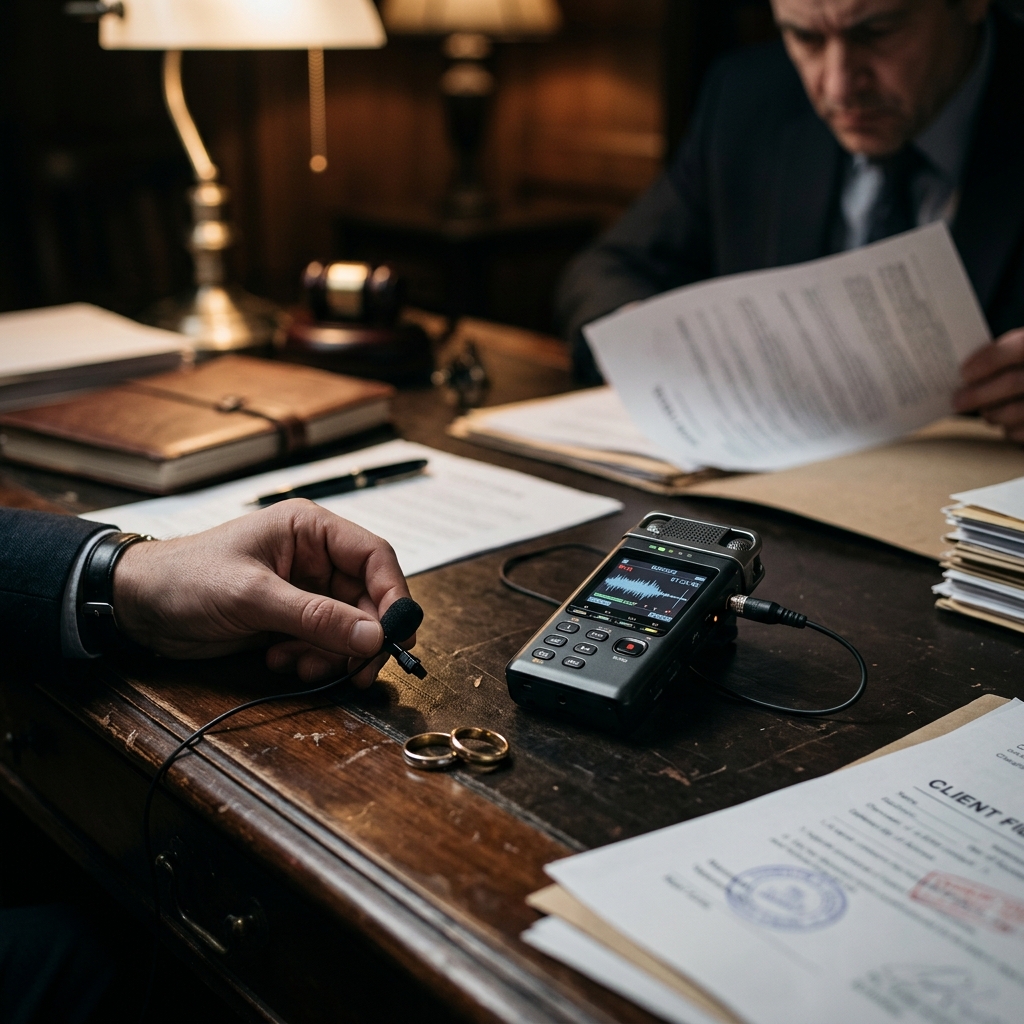
Secretly recording a spouse during a divorce can feel tempting when emotions are high and trust is low. Yet in the United States, recording conversations without proper consent can trigger serious criminal and civil consequences and may even harm your position in the divorce case. This guide explains how federal and state wiretap laws work, what counts as legal consent, and when recordings may be used as evidence.
Because wiretap rules differ from state to state and interact with federal law, anyone going through a divorce should understand the basics before pressing “record.” You should also consult a qualified family law attorney in your jurisdiction for advice about your specific situation.
Core Concepts: Wiretapping, Eavesdropping, and Secret Recording
Several legal terms frequently appear in divorce-related recording issues. They are related, but not identical.
- Wiretapping: Secret interception of wire, oral, or electronic communications, such as phone calls or electronic messages, usually in real time.
- Eavesdropping: Surreptitious listening to or recording conversations in which the listener is not a participant, often involving placing devices or software to capture communications between other people.[10]
- Secret recording: Capturing audio, video, or digital messages without the knowledge or informed consent of all people involved, whether the recorder is a participant or not.
In the divorce context, a spouse might attempt to:
- Record arguments or discussions with their partner.
- Place a hidden device on a phone or in a room to capture conversations.
- Install spyware or monitoring tools to read emails or messages.
Each of these behaviors can raise distinct legal questions under federal and state law.[10]
Federal Wiretap Act: The Starting Point
At the federal level, wiretapping is primarily governed by the Wiretap Act, part of Title III of the Omnibus Crime Control and Safe Streets Act of 1968.[10] Congress enacted this law partly in response to controversy over covert government surveillance of political activists.
Under the Wiretap Act, it is generally illegal for any person to intentionally and secretly intercept oral, telephonic, or electronic communications when the speaker could reasonably expect privacy. However, the statute contains important exceptions that shape how recordings work in practice.
Key Federal Rules
- Federal law follows a one-party consent rule: a conversation can be recorded if at least one participant consents to the recording.
- If you personally participate in a conversation, you may consent to its recording without telling the other participants, unless stricter state law applies.
- Recording a conversation between your spouse and a third person without either party’s consent is considered illegal eavesdropping or wiretapping under federal law.[10]
- Knowingly using or disclosing the contents of an illegally intercepted communication is also a federal offense.
Violations of the Wiretap Act can lead to:
- Up to five years in federal prison.
- Substantial fines.
- Civil liability, including potential damages and attorney’s fees in a private lawsuit.
Importantly, the Wiretap Act does not contain an interspousal exception. Courts have repeatedly rejected the idea that spouses lose their privacy rights simply because they are married.
State Consent Rules: One-Party vs. All-Party Consent
Federal law sets a baseline, but each state can enact its own wiretap and privacy statutes. The most important distinction is whether a state follows one-party consent or all-party consent for recording conversations.
| Consent Rule Type | Basic Requirement | Common Implication in Divorce |
|---|---|---|
| One-party consent | Any one participant may consent; others need not be told, unless state law adds conditions. | A spouse can often record their own conversations with the other spouse, but cannot secretly record conversations between the spouse and third parties.[10] |
| All-party consent | Every person in the conversation must know about and consent to the recording. | Secret recordings— even by a participant— can be criminal, and may be barred as evidence in a divorce or custody case. |
For example:
- Some states, such as Mississippi and Minnesota, generally follow a one-party consent approach, but still criminalize placing devices to secretly record conversations between other people.
- Other states, including Florida and Massachusetts, require all parties to consent or at least be informed that recording may occur, making secret recordings illegal.
Because these rules vary significantly, any spouse contemplating a recording should confirm their state’s statute and how local courts apply it in civil proceedings like divorce.
Are Secret Recordings a Crime?
Secretly recording conversations in violation of wiretap statutes can be charged as a felony in many jurisdictions. The specific penalties depend on the statute involved, but common consequences include:
- Criminal classification (often a felony).
- Possible jail or prison terms, sometimes up to five years.
- Substantial fines, frequently in the thousands of dollars.
- Restrictions on using the recording or any evidence derived from it in court.
Examples from state law and practice include:
- In Virginia, intentionally intercepting wire, electronic, or oral communications is a felony, and recordings obtained in violation of the statute are generally inadmissible in civil cases such as divorce.
- In Mississippi, secretly recording a spouse using pre-installed equipment can lead to up to five years in jail and large fines, and even installing such equipment with intent to intercept can be separately punishable.
- In Massachusetts, wiretap law is considered among the strictest; secret audio recording without the other party’s actual knowledge can be treated as a crime.
Criminal exposure is not limited to the act of pressing record. In some jurisdictions, placing a device or software to intercept communications can itself be a separate offense, even if no useful recording is ultimately captured.[10]
Can You Record Your Own Conversations with Your Spouse?
Whether you can legally record conversations in which you are personally involved depends on a combination of federal and state rules.
When Recording Is More Likely to Be Legal
- One-party consent states: If your state follows one-party consent and you are a participant, you may generally record your conversation without informing your spouse, as long as no other rule— such as a specific privacy statute— prohibits it.
- Expectation of privacy matters: Wiretap laws focus on conversations where the speaker reasonably expects privacy (for example, a private phone call at home). Recording conversations in public places where no privacy is expected may sometimes be treated differently, especially when state law focuses on private communications.
When Recording Can Be Illegal
- All-party consent states: In states like Florida and Massachusetts, recording any private conversation without the express consent and knowledge of all parties is illegal, even if you are one of the speakers.
- Third-party conversations: Secretly recording your spouse speaking with someone else when you are not part of the conversation is typically prohibited both under federal law and many state statutes.[10]
- Use of devices or spyware: Installing monitoring tools or hidden recorders to capture calls, messages, or in-person discussions can amount to unlawful interception or eavesdropping.[10]
In short, there is a significant legal difference between recording a conversation you are actively part of and secretly monitoring communications between your spouse and others.
Will Your Recordings Be Admissible in a Divorce Case?
A recording that is legally obtained under wiretap laws may still face separate hurdles under rules of evidence and privacy protections in family courts. Conversely, a recording that was made illegally is often excluded from evidence and can even harm the recorder’s case.
Legal vs. Illegal Recordings
- Legally obtained recordings in compliance with federal and state consent laws may be admissible, especially when the recorder is a party and the content is relevant to issues such as abuse, financial misconduct, or parenting.
- Illegally obtained recordings are commonly excluded, and some states explicitly bar courts from admitting such evidence or any derivative evidence in civil proceedings.
For instance:
- Virginia law not only criminalizes certain interceptions but also declares that unlawfully recorded communications cannot be received as evidence at trial, and evidence derived from them is likewise inadmissible.
- In Pennsylvania, secret recordings of a spouse are generally not admissible in divorce cases because they are treated as violations of privacy rights, although courts may consider exceptions where recordings document criminal conduct such as domestic violence.
Some jurisdictions impose additional restrictions on telephone recordings in divorce cases. A state may require that all parties were aware of the recording, or may prohibit admission of recorded phone calls in certain civil actions, regardless of consent.
Privacy, Stored Communications, and Digital Evidence
Issues around recording a spouse extend beyond live audio or video. Divorce cases increasingly involve digital communications— emails, messages, social media posts, and stored data on computers and phones.
- Stored messages: In many jurisdictions, retrieving a spouse’s emails or messages stored on a shared home or work computer may not be treated as “interception” under wiretap statutes, because the communication is no longer in transit.[10]
- Shared accounts: Accessing shared accounts or devices may be viewed differently from accessing accounts where a spouse has a clear expectation of exclusive privacy. Other laws, such as computer fraud or unauthorized access statutes, may still apply.[10]
- Social media and texts: Messages exchanged directly between spouses— such as text messages, emails, or social media direct messages— are often admissible if obtained lawfully, because both parties participated in the communication.
Even when recordings or messages are technically admissible, judges retain discretion to exclude evidence they consider unfairly prejudicial, invasive, or of limited probative value, particularly in sensitive family matters such as custody and visitation.
Practical Guidance Before You Hit Record
Given the complexity of wiretap laws and the serious penalties involved, spouses should exercise caution and seek legal advice before attempting to record any conversations. Consider the following practical points:
- Confirm your state’s consent rule: Determine whether your state is a one-party or all-party consent jurisdiction and whether special rules apply to phone calls or electronic communications.
- Assess privacy expectations: Ask whether the conversation occurs in a context where participants reasonably expect privacy, such as a private home, closed office, or telephone call.
- Avoid recording third-party calls: Do not secretly monitor conversations between your spouse and other people, including children, friends, or professionals, unless advised by counsel and compliant with law.[10]
- Do not install hidden devices or spyware: Placing equipment or software to capture communications without consent can create serious criminal liability, even if you believe it will help your case.[10]
- Consult a family law attorney: A lawyer can explain local law, evaluate potential risks, and advise whether existing recordings can be used or might expose you to prosecution or civil claims.
In many situations, there are safer ways to build evidence in a divorce— such as witness testimony, financial records, and legally obtained communications— that do not involve the hazards of secret recording.
Frequently Asked Questions
Can I legally record my spouse during a heated argument at home?
It depends on your state’s consent rules and whether your spouse has a reasonable expectation of privacy. In a one-party consent state, you may be allowed to record a conversation in which you participate, but in an all-party consent state, secretly recording a private argument can be illegal and inadmissible.
Is there a special exception for spouses under wiretap laws?
No. Federal law and most state statutes do not recognize an interspousal exception. Courts generally hold that spouses retain privacy rights against each other, and secret recordings may result in criminal charges or exclusion of evidence.
Can I use recordings of my spouse’s phone calls with other people in court?
Typically not, if those recordings were made without consent and in violation of wiretap statutes. Secretly monitoring calls between your spouse and third parties is usually considered illegal eavesdropping and the recordings are often inadmissible.[10]
What if the recording proves serious misconduct, like abuse?
Some courts may consider illegally obtained recordings in limited circumstances where there is strong evidence of criminal activity or safety concerns, but this is highly jurisdiction-specific and can still expose the recorder to prosecution. You should consult counsel before relying on such material.
Are text messages and emails between spouses treated differently from audio recordings?
Yes. Communications that both spouses send and receive— such as texts, emails, and social media messages— are often admissible if obtained lawfully, because both parties participated. However, accessing accounts without authorization or using spyware to collect messages may violate other laws.[10]
References
- Divorce Wiretapping — LegalMatch. 2024-03-01. https://www.legalmatch.com/law-library/article/divorce-wiretapping.html
- Wiretapping in Texas Divorce and Custody Cases — Tsaí & Family Law. 2023-08-10. https://www.tsaifamilylaw.com/post/wiretapping
- Virginia Code §19.2-62 and Recording in Divorce Cases — Krogmann Miller Dragone PLLC. 2021-06-15. https://familylawkmd.com/recordings-in-divorce-cases/
- The Law on Recording Your Spouse During Divorce in Florida — O’Mara Law Group. 2022-11-01. https://www.omaralawgroup.com/blog/the-law-on-recording-your-spouse-during-divorce/
- Listening In: Eavesdropping and Divorce — State Bar of Michigan. 2010-01-01. https://www.michbar.org/file/barjournal/article/documents/pdf4article455.pdf
- Before You Hit “Record” in Your Divorce, Consider This — Bowditch & Dewey. 2026-02-18. https://www.bowditch.com/allinthefamily/2026/02/18/before-you-hit-record-in-your-divorce-consider-this/
- Are Secret Recordings Acceptable or Relevant in a Mississippi Divorce? — DLH Attorneys. 2023-05-12. https://dlhattorneys.com/blog/are-secret-recordings-acceptable-or-relevant-in-a-mississippi-divorce/
Similar Articles








Read full bio of Sneha Tete


