
Understanding Bank Checks: Types, Uses, and Legal Considerations
Learn the major kinds of bank checks, how they work, and the legal protections and risks involved in using them for everyday and high‑value payments.
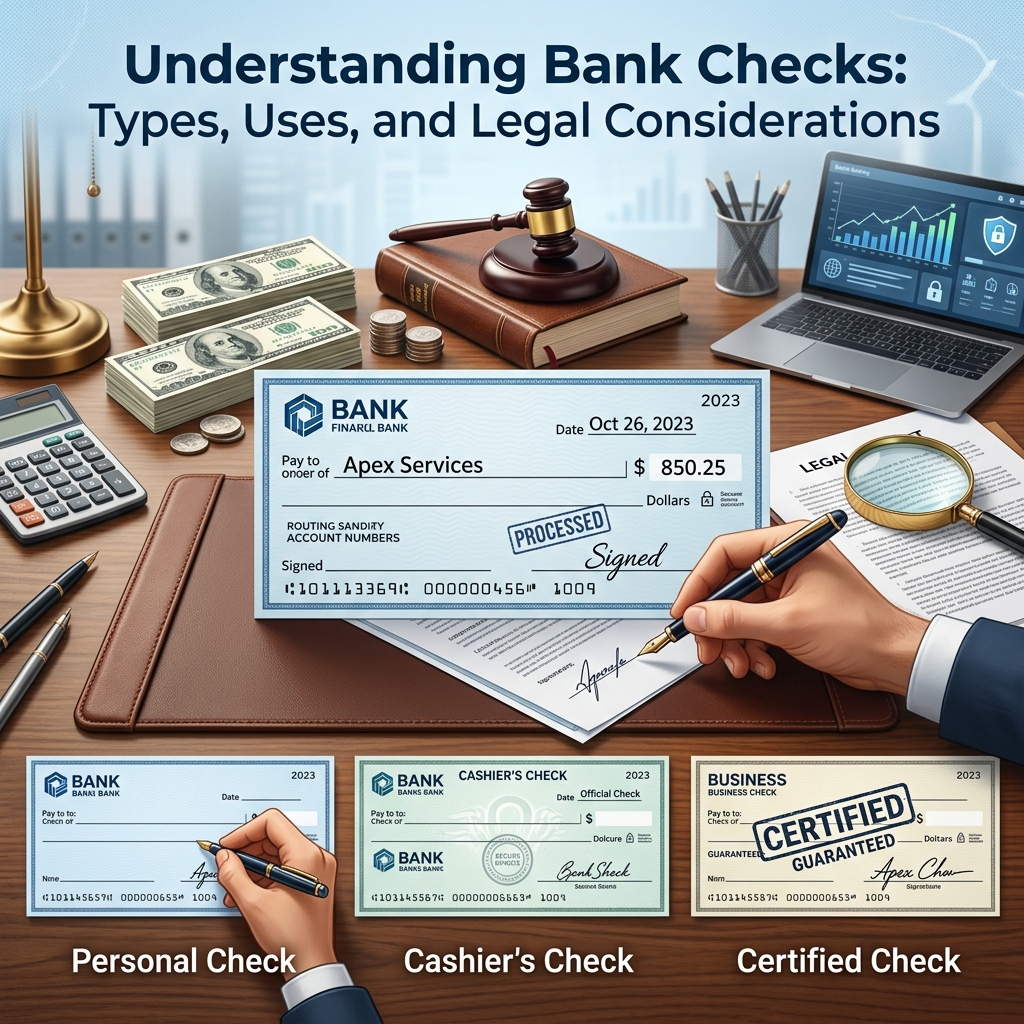
Bank checks remain an important payment tool despite the growth of digital banking. From buying a home with a cashier’s check to paying rent with a personal check, the type of check you choose affects how secure the payment is, how quickly funds clear, and what legal protections apply.
This guide explains the major kinds of bank checks, how each one works, when to use them, and the legal issues you should consider to avoid bounced payments, fraud, or disputes.
What Is a Bank Check?
A bank check is a written, signed instruction directing a bank or credit union to pay a specific amount of money to a named person or organization. While the format can be paper or electronic, the core idea is the same: the check acts as an order to move funds from one account (or the bank’s own funds) to another.
In everyday banking, checks are used for:
- Recurring payments such as rent, tuition, or utilities
- One-time large purchases, including cars or real estate
- Wage payments, especially for small businesses that still issue paper paychecks
- Situations where electronic transfers are unavailable or not preferred
The key difference among check types is who guarantees payment and where the money comes from—the customer’s account or the bank’s own funds.
Major Categories of Checks
Although banks offer many specialized instruments, most checks used in consumer and business transactions fall into several core categories.
- Personal checks – drawn on an individual’s checking account
- Business checks – issued from a company’s operating account
- Cashier’s checks – paid from the bank’s own funds and guaranteed by the institution
- Certified checks – personal checks verified and guaranteed by the bank, with funds reserved in the payer’s account
- Payroll checks – paychecks issued by employers, often used when direct deposit is not in place
- Electronic checks (eChecks) – digital versions of paper checks processed through clearing networks such as ACH
- Money orders – prepaid instruments that function similarly to checks but do not draw directly from a checking account
Personal and Business Checks
Personal Checks
A personal check is a paper document issued to an account holder by a bank or credit union, bearing the customer’s name, routing number, and account number. The account holder fills in the payee, date, amount, and signature, then gives it to the payee, who deposits or cashes it.
Key features of personal checks include:
- Funds are drawn directly from the writer’s checking account when the check clears.
- They can be used for everyday expenses such as rent, bills, or personal debts.
- Payment is not guaranteed by the bank; if the account has insufficient funds, the check can bounce.
Because the bank does not guarantee payment, personal checks carry a higher risk for the recipient compared with official checks like cashier’s or certified checks.
Business Checks
Business checks operate similarly to personal checks but are drawn from a business’s account. They typically include the company’s name, address, and sometimes a logo.
They are commonly used for:
- Supplier and vendor payments
- Refunds or reimbursements to customers
- Payroll, especially for small or newly formed businesses
Like personal checks, business checks can bounce if the company’s account balance is insufficient at the time the check is processed.
Official Checks: Cashier’s and Certified
Cashier’s Checks
A cashier’s check is an official bank check that is drawn on the bank’s own funds and signed by a bank employee, typically a teller or cashier. When a customer requests a cashier’s check, the bank either debits the customer’s account or accepts cash and then issues the check.
Defining characteristics:
- The bank guarantees payment by backing the check with its own funds.
- The check is signed by a bank representative, not by the customer.
- It is widely considered secure and is often required for large transactions such as vehicle purchases or real estate closings.
Because the bank assumes direct responsibility for payment, cashier’s checks generally provide high confidence to sellers and are less likely to be rejected or returned unpaid.
Certified Checks
A certified check starts as a personal check, but the issuing bank verifies that the check is genuine and that the account holds sufficient funds, then marks the check as certified and sets aside the funds.
Key aspects of certified checks:
- The check is signed by the customer, like a normal personal check.
- The bank stamps or indicates certification on the check, confirming that funds are reserved for that payment.
- Payment is effectively guaranteed, reducing the risk that the check will bounce due to insufficient funds.
Certified checks are often used when the payee wants more security than a personal check but the bank’s direct liability of a cashier’s check is not required.
Cashier’s vs. Certified Checks: Side-by-Side Comparison
| Feature | Cashier’s Check | Certified Check |
|---|---|---|
| Who signs the check? | Bank representative signs on behalf of the bank. | Customer signs; bank adds certification stamp. |
| Source of funds | Bank’s own funds, after taking money from customer or cash. | Customer’s account; funds reserved by bank. |
| Payment guarantee | Direct obligation of the bank; high level of security. | Bank verifies and earmarks funds; strong security but still linked to customer account. |
| Common uses | Home purchase, vehicle purchase, high-value transactions. | Medium- to large payments where payee wants assurance but may not require a cashier’s check. |
| Typical fees | Often around $10–$20, depending on bank policies. | Sometimes free, sometimes up to about $15. |
Payroll Checks
Payroll checks are paychecks issued by employers to employees to compensate them for work performed. While many employers now use direct deposit, some still rely on physical payroll checks, especially for contract workers or employees without bank accounts.
Important points:
- Issued from the employer’s business account.
- Include details such as gross pay, deductions, and net pay.
- Subject to payroll and tax laws; employees have rights regarding accurate payment and timely access to wages.
Employees typically cash or deposit these checks at their bank or at a check-cashing service, which may charge fees.
Electronic Checks (eChecks)
An electronic check or eCheck is a digital equivalent of a paper check. Instead of a physical document, the payment information is transmitted electronically and processed, often using the Automated Clearing House (ACH) network.
Core characteristics:
- Funds are drawn from the payer’s checking account, similar to a traditional check.
- The transaction is encrypted and processed electronically, often faster and with fewer errors than manual paper processing.
- Commonly used for recurring online payments, e-commerce purchases, and pay-by-phone or pay-by-web transactions.
eChecks offer many of the record-keeping advantages of paper checks with improved speed and convenience, but they still rely on sufficient funds being available in the account.
Money Orders and Other Check-Like Instruments
Money Orders
A money order is a prepaid payment instrument that functions similarly to a check but does not draw directly from a checking account. Buyers pay the face value plus a fee, and the issuer prints a money order payable to a specific recipient.
Key traits:
- Payment is guaranteed because the full amount is paid upfront.
- Available from banks, credit unions, post offices, and some retail locations.
- Often limited to a maximum amount (for example, $1,000 in many locations), making them less suitable for very large transactions.
Money orders are useful for people who do not have checking accounts or who want guaranteed funds without using an official bank check.
Traveler’s Checks and Government Checks
Although less common today, traveler’s checks and government-issued checks remain part of the broader landscape of check-based payments.
- Traveler’s checks were historically used as a secure way to carry money while traveling. They represent prepaid, fixed amounts and could be replaced if lost or stolen. With modern card and digital options, they are now less frequently used.
- Government or treasury checks are issued by government agencies for payments such as tax refunds or benefits. These checks are generally backed by public funds and are widely accepted.
Risks: Bounced and Voided Checks
Bounced Checks
A check bounces when the bank refuses to honor it, often because the account lacks sufficient funds. When this occurs:
- The payee may not receive the expected payment.
- The check writer may be charged non-sufficient funds (NSF) fees by the bank.
- Additional penalties, including merchant fees or legal consequences, may arise if the bounced check is considered a bad check under local law.
Using cashier’s or certified checks for high-value transactions can reduce the risk of bounced payments because the funds are reserved or backed by the bank.
Voided Checks
A voided check is a paper check that has “VOID” written across it, preventing anyone from using it for payment. Voided checks are often requested to provide account information for setting up direct deposit or automatic withdrawals, but they no longer function as negotiable instruments.
Legal and Practical Considerations When Using Checks
Different check types come with different legal implications, especially regarding responsibility when something goes wrong.
- Proof of payment: Checks can provide documentation of when and to whom payment was made, supporting disputes or audits.
- Fraud risk: Official checks are more secure, but counterfeit cashier’s or certified checks do exist. Recipients should verify suspicious checks with the issuing bank.
- Consumer rights: Financial regulations give consumers certain rights when unauthorized checks or fraudulent transactions occur. Many of these rights are tied to bank policies and regulatory frameworks such as those governing electronic transfers.
- Expiration and stale-dated checks: Some banks treat cashier’s and certified checks as valid indefinitely, while others establish expiration periods, often between 90 days and one year. It is best to confirm with the issuing bank.
Both payers and payees should keep records of issued and received checks, monitor account balances, and promptly address any discrepancies to minimize legal and financial risk.
Choosing the Right Type of Check
Selecting the appropriate check depends on the amount involved, the parties’ level of trust, and the need for guaranteed funds.
- Use personal or business checks for routine, lower-value payments where both parties accept the risk of possible delays or issues.
- Use a cashier’s check when the payee demands a high level of security and the transaction is substantial, such as a down payment on a home.
- Use a certified check when you want to guarantee funds from your own account without involving the bank’s direct obligation.
- Consider eChecks for recurring online payments that benefit from automation and encryption.
- Choose a money order if you do not have a checking account or need guaranteed funds for a moderate amount.
FAQs About Bank Checks
1. Are cashier’s checks safer than personal checks?
Yes. A cashier’s check is backed by the bank’s own funds and signed by a bank representative, so the bank guarantees payment. Personal checks are paid only if the account has enough money when the check clears, and they can bounce.
2. Can a certified check still bounce?
Certified checks are designed to prevent bouncing due to insufficient funds because the bank verifies and reserves the amount in the payer’s account. However, issues such as fraud or a closed account may still affect acceptance, so certification is a strong but not absolute safeguard.
3. Is a money order considered a type of check?
Technically, a money order is a separate prepaid instrument rather than a check drawn on a checking account, but it functions in a similar way for many purposes. It is widely treated as a secure, check-like tool for sending guaranteed funds.
4. What happens if my personal check bounces?
If your personal check is returned unpaid, your bank may charge non-sufficient funds fees, and the recipient may also impose penalties or pursue collection. In some jurisdictions, knowingly writing bad checks can carry legal consequences.
5. Do cashier’s and certified checks expire?
Policies differ among banks. Some institutions treat these checks as valid indefinitely, while others set expiration dates, often between 90 days and a year after issuance. Always check with the issuing bank and encourage payees to deposit official checks promptly.
References
- Five Common Types of Checks — JPMorgan Chase Bank, N.A. 2023-04-01. https://www.chase.com/personal/banking/education/basics/five-common-types-of-checks
- Understanding Check Basics — Central Bank. 2022-06-15. https://www.centralbank.net/learning-center/understanding-check-basics/
- Cashier’s Check vs. Certified Check: What’s the Difference? — KeyBank, N.A. 2022-11-10. https://www.key.com/personal/banking101/cashiers-vs-certified-checks.html
- Cashier’s Check vs. Money Order vs. Certified Check — Citizens Bank, N.A. 2023-02-20. https://www.citizensbank.com/learning/cashiers-check-vs-money-order-vs-certified-check.aspx
- What Are the Main Types of Checks? — PNC Bank, N.A. 2023-03-05. https://www.pnc.com/insights/personal-finance/spend/main-types-of-checks.html
- Check: Definition, Types, Components, and Clearing Process — Finance Strategists. 2021-09-30. https://www.financestrategists.com/banking/check/
- Different Types of Checks: A Brief Guide — Remitly, Inc. 2022-08-12. https://www.remitly.com/blog/finance/different-types-of-checks/
Similar Articles








Read full bio of medha deb




