
The Labyrinth of Justice: Failures at Guantánamo Bay
Unpacking the legal paralysis and extreme secrecy at Guantánamo Bay.
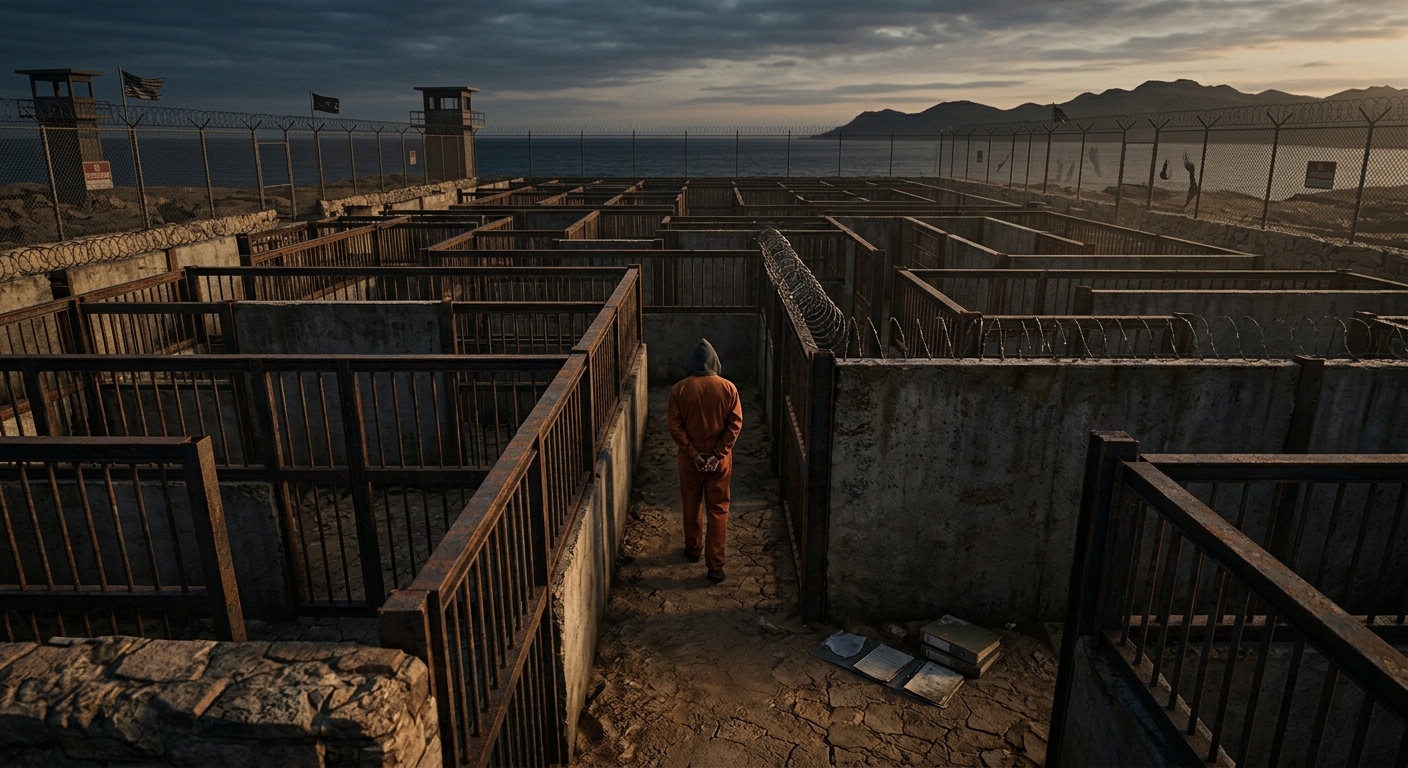
The Endless Wait for Accountability
More than two decades after the first detainees arrived in orange jumpsuits at the U.S. Naval Station in Cuba, the Guantánamo Bay detention camp remains one of the most controversial legal experiments in modern American history. Originally established to house individuals captured in the aftermath of the September 11 attacks, the facility was designed to operate outside the standard parameters of the U.S. federal judiciary. Today, instead of serving as a venue for swift and decisive justice, the military commissions at Guantánamo are bogged down in an unprecedented legal quagmire.
The system is paralyzed by a unique blend of extreme classification rules, the legacy of coercive interrogations, and an ad hoc legal framework that frustrates both prosecutors and defense attorneys alike. The result is a Kafkaesque environment where trials stall for years in pre-trial hearings, and the fundamental tenets of transparency and due process are constantly tested. The systemic failures, the weaponization of secrecy, and the immense human and financial costs of maintaining the military commissions at Guantánamo Bay have turned an initiative meant to ensure national security into a symbol of legal dysfunction.
The Architecture of Exceptionalism
The military commissions at Guantánamo Bay were not built on the bedrock of the standard American judicial system. Instead, they were constructed as an architecture of exceptionalism—a hybrid system drawing loosely from the Uniform Code of Military Justice and international laws of war, yet explicitly designed to restrict certain rights typically afforded to defendants in U.S. federal courts. The prevailing rationale at their inception was that prosecuting alleged terrorists required a specialized forum capable of handling highly sensitive intelligence without risking the exposure of state secrets.
However, this departure from established legal norms created immediate and enduring structural flaws. Federal courts have centuries of precedent guiding the handling of classified evidence, hearsay, and constitutional rights. The military commissions, by contrast, have had to invent their procedural rules in real-time. This lack of established precedent means that nearly every pre-trial motion, evidentiary dispute, and procedural decision is heavily litigated, appealed, and debated at length. The system’s novelty has proven to be its greatest weakness. Defense attorneys argue that the commissions are fundamentally tilted to favor the prosecution, while the sheer complexity of inventing a new legal apparatus has led to a judicial bottleneck that has lasted for over twenty years.
The Weaponization of Classification
Perhaps the most significant hurdle facing the military commissions is the extreme and often arbitrary application of classification rules. In standard federal courts, the Classified Information Procedures Act (CIPA) provides a reliable framework for handling sensitive information. At Guantánamo, the approach to secrecy is far more draconian, transforming the pursuit of justice into an exhausting logistical puzzle for legal teams.
Defense attorneys are required to operate within heavily restricted Sensitive Compartmented Information Facilities (SCIFs) just to read their own notes or communicate with co-counsel regarding their clients. The scope of what is considered classified extends far beyond operational intelligence, troop movements, or active sources. Often, mundane details regarding a detainee’s daily routine, basic physical conditions, or arbitrary institutional rules are heavily censored. This over-classification creates an environment of absurdity, where lawyers find themselves barred from mentioning seemingly trivial everyday objects, foods, or dietary restrictions under the guise of national security.
This weaponization of classification severely hampers the defense’s ability to cross-examine witnesses or investigate the conditions of their clients’ confinement. When a defense team must spend months filing motions simply to declassify a single paragraph of benign text, the entire judicial process grinds to a halt. The obsession with secrecy does not just protect state secrets; it insulates the system from public scrutiny and prevents the very transparency required for a trial to be considered fair and legitimate by the international community.
The Defense’s Uphill Battle: Navigating an Uneven Playing Field
In traditional legal environments, the defense and prosecution operate under established rules designed to maintain fairness and a relative balance of power. At Guantánamo, defense attorneys—who include both military officers and civilian lawyers—often report feeling as though the rules are written and rewritten specifically to hinder their efforts. The structural imbalance is evident in several key areas:
- Surveillance and Privilege: Defense teams have repeatedly raised alarms regarding the surveillance of their communications. Incidents involving hidden listening devices in meeting rooms and the monitoring of legal mail have deeply eroded the attorney-client privilege essential to a fair trial.
- Access to Witnesses: Prosecutors often have streamlined access to intelligence officials and military witnesses. Conversely, defense teams face insurmountable bureaucratic walls when attempting to depose the same individuals, especially those linked to classified intelligence operations.
- Technological and Resource Disparities: The government possesses vast resources to process and redact information, while defense teams operate with limited staff cleared to handle top-secret materials. This bottleneck forces defense lawyers to spend thousands of billable hours sorting through severely redacted documents just to glean basic context.
These disparities emphasize the systemic imbalance of the military commissions. The burden is consistently placed on the defense to prove why they need access to information, rather than on the government to justify its concealment. This uneven playing field not only extends the duration of the pre-trial phase but fundamentally compromises the integrity of any eventual verdict.
The Shadow of Interrogation and Torture
Looming over every legal proceeding at Guantánamo Bay is the dark legacy of the Central Intelligence Agency’s post-9/11 detention and interrogation program. The central paradox of the military commissions is the attempt to conduct a clean, legal trial using evidence that is inherently tainted by coercive interrogation techniques. The Senate Select Committee on Intelligence’s comprehensive report on the CIA’s program detailed the use of “enhanced interrogation techniques,” which international law and human rights organizations universally classify as torture.
This history creates an intractable legal dilemma. Under standard U.S. law, statements obtained through torture are strictly inadmissible due to their unreliability and the moral imperative of the justice system. At Guantánamo, defense teams spend years arguing over the admissibility of evidence, the timeline of when a detainee was subjected to coercion, and the extent to which subsequent statements made to investigators are legally contaminated as the fruit of the poisonous tree.
The government frequently invokes national security privilege to block defense teams from accessing the full details of what happened to their clients at undisclosed “black sites” before they were transferred to Cuba. The prosecution’s reliance on protecting the identities of interrogators and the specific methods used further delays the trials. Consequently, the commissions are not just trying the detainees; they are indirectly litigating the United States’ use of torture, creating an unending cycle of pre-trial hearings that prevent the actual cases from moving to a jury phase.
The Staggering Logistics and Cost of Legal Limbo
The financial and logistical burden of maintaining the Guantánamo Bay detention camp and its military commissions is astronomical. Operating an offshore penal colony and judicial center requires a staggering allocation of resources. Because the naval base is isolated, every judge, prosecutor, defense attorney, paralegal, and court reporter must be flown into Cuba on military charters for hearings. This constant transit is vulnerable to weather delays, scheduling conflicts, and the basic logistical friction of moving hundreds of people to an island base.
Financially, the cost is unprecedented. Estimates reported by prominent news organizations place the cost of operating the detention facility at approximately $13 million per detainee per year. This figure dwarfs the cost of housing inmates in maximum-security federal prisons on the U.S. mainland, which averages under $100,000 annually per inmate. The continuous construction of expeditionary legal complexes, secure facilities, and housing for guard forces only adds to the ballooning budget.
Furthermore, the sheer length of the proceedings has led to massive turnover among the legal and judicial staff. Judges retire or are reassigned; defense attorneys leave the military; prosecutors move on to other assignments. Each time a new judge or lawyer joins a complex case, they must be cleared to read millions of pages of classified documents and catch up on years of convoluted litigation history, perpetuating a cycle of delays that ensures the financial hemorrhage continues indefinitely.
International Condemnation and Human Rights Concerns
The global community has repeatedly expressed profound alarm over the ongoing legal and human rights crisis at Guantánamo Bay. United Nations human rights experts have consistently called for the immediate closure of the facility. In sweeping statements, UN experts have labeled the site a place of arbitrariness and abuse, highlighting that the rule of law is effectively suspended and justice is fundamentally denied to those trapped within its walls.
The indefinite detention of individuals—some of whom have been cleared for release for years yet remain behind bars due to bureaucratic inertia or geopolitical complications—constitutes a grave violation of international human rights standards. The psychological toll on the detainees is severe. Living in a state of perpetual legal limbo, without knowing if they will ever face a fair trial or see freedom again, has resulted in widespread mental and physical health deterioration.
Human rights organizations argue that the military commissions fail to meet the basic criteria of a fair and independent judicial process. By maintaining a parallel system that bypasses the constitutional protections of the U.S. federal courts, the United States continues to face international reputational damage. The insistence on utilizing the flawed commission structure undermines global efforts to promote human rights and the rule of law, casting a long shadow over American diplomatic and moral authority on the world stage.
Can the System Be Repaired?
After more than two decades of failure, the question remains whether the military commissions can be salvaged or if the entire paradigm must shift. Legal scholars and policymakers offer conflicting solutions. Some advocate for transferring the remaining detainees to the United States mainland to face trial in federal courts, which have a proven track record of successfully and securely prosecuting complex terrorism cases. However, strict legislative bans on transferring detainees to the U.S. currently block this path.
Others suggest that the only pragmatic way to close the cases is through negotiated plea agreements. By removing the threat of the death penalty in exchange for guilty pleas, the government could bypass the intractable evidentiary issues surrounding torture and classification, finally bringing closure to the victims’ families and ending the legal charade.
Maintaining the status quo is increasingly recognized as untenable. The military commissions stand as a stark warning about the dangers of prioritizing extreme secrecy over transparency, and expediency over established legal principles. Until a decisive policy shift occurs, Guantánamo Bay will remain a labyrinth of justice, capturing both detainees and the American legal system in a web of its own making.
Frequently Asked Questions (FAQs)
What are the military commissions at Guantánamo Bay?
The military commissions are a specialized legal framework established by the U.S. government to prosecute foreign individuals captured during the “War on Terror” for alleged war crimes and terrorism. They operate outside the standard U.S. federal court system, utilizing a hybrid set of rules drawn from military and international law.
Why do the trials at Guantánamo take so long?
The proceedings are severely delayed by complex, ongoing disputes over classified information, the immense logistical challenges of holding trials on an offshore naval base, high turnover of judicial and legal personnel, and extensive pre-trial battles regarding the admissibility of evidence obtained through coercive interrogations.
How much does it cost to operate Guantánamo Bay?
Guantánamo Bay is considered the most expensive prison on earth. Reports from major news organizations estimate the cost to American taxpayers at approximately $13 million per detainee per year, largely due to the massive logistical, security, and legal overhead of operating the offshore facility.
Why haven’t the detainees been moved to federal courts?
Despite federal courts having a strong track record of successfully trying terrorism cases, Congress has passed and continually renewed legislation explicitly barring the use of federal funds to transfer Guantánamo detainees to the United States mainland for trial, medical treatment, or imprisonment.
References
- ‘Disgraceful’ Guantánamo Bay detention facility must be closed now, say UN experts — Office of the United Nations High Commissioner for Human Rights (OHCHR). 2021-01-11. https://www.ohchr.org/en/press-releases/2021/01/disgraceful-guantanamo-bay-detention-facility-must-be-closed-now-say-un
- Committee Study of the Central Intelligence Agency’s Detention and Interrogation Program — Senate Select Committee on Intelligence. 2014-12-09. https://www.intelligence.senate.gov/sites/default/files/press/executive-summary_0.pdf
- Why the cost of holding prisoners at Guantanamo Bay keeps rising — PBS News. 2019-09-19. https://www.pbs.org/newshour/show/why-the-cost-of-holding-prisoners-at-guantanamo-bay-keeps-rising
- Office of Military Commissions: Organization Overview — U.S. Department of Defense. 2024-01-01. https://www.mc.mil/
Similar Articles








Read full bio of Sneha Tete


