
If You Are Arrested in Florida: Rights, Process, and Practical Steps
Essential guide to your legal rights, arrest procedures, and smart decisions to protect yourself if you are taken into custody in Florida.
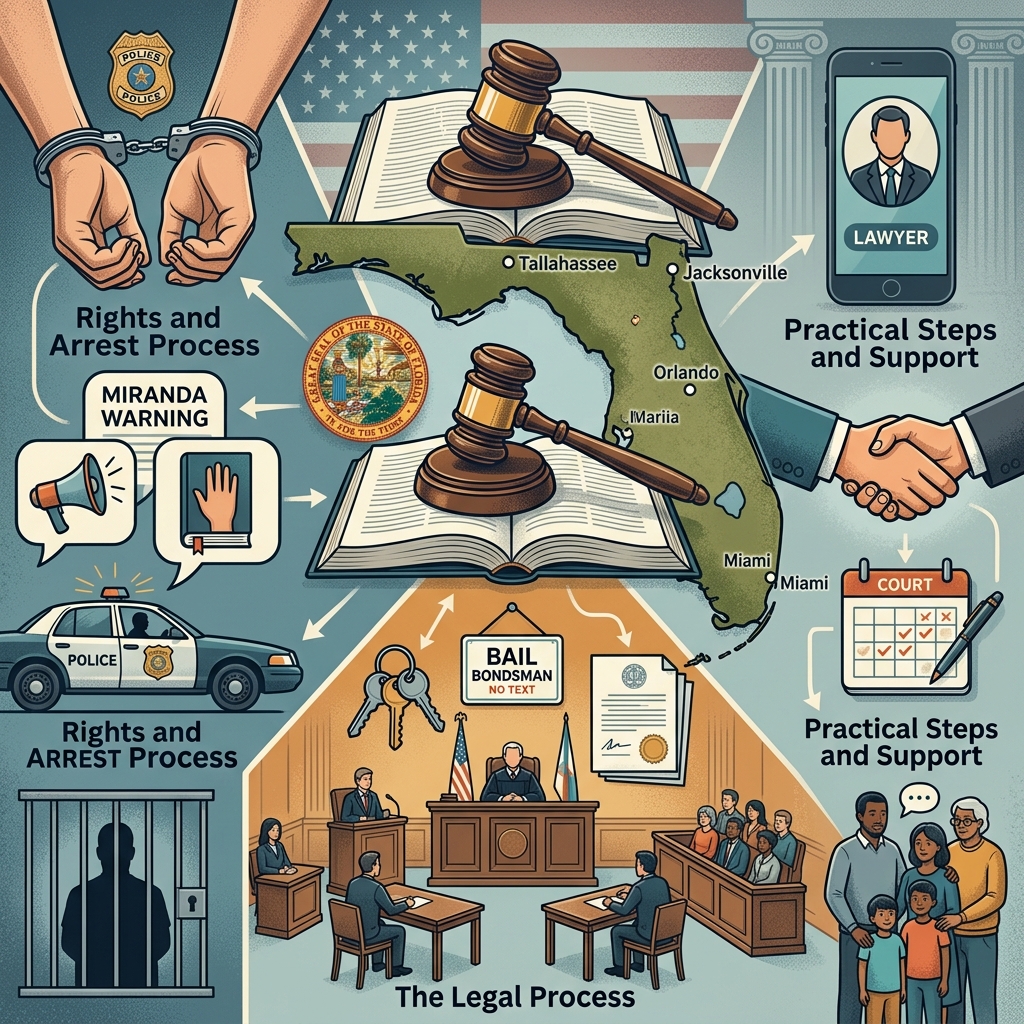
Being arrested is stressful, frightening, and confusing, especially if it is your first encounter with the criminal justice system. Yet what you do and say in the first hours can heavily influence how your case unfolds. This guide explains what it means to be arrested in Florida, the difference between detention and arrest, the rights you have at every stage, and practical steps to protect yourself and your future.
Detained vs. Arrested: Understanding Your Legal Status
Police encounters in Florida generally fall into two categories: temporary detention and formal arrest. Knowing the difference helps you understand what officers may lawfully do, and what you are legally required to do.
- Detention (“stop” or investigative stop): Officers briefly hold you to ask questions or investigate suspected criminal activity. You are not free to walk away, but you may not yet be under arrest.
- Arrest: Officers take you into custody because they have probable cause to believe you committed a crime. You may be handcuffed, transported, and booked into jail.
Florida’s stop-and-frisk law, found in Florida Statute 901.151, allows officers to stop and temporarily detain individuals based on reasonable suspicion, which is a lower standard than probable cause. Reasonable suspicion means specific, articulable facts suggest criminal activity. Probable cause requires stronger evidence that a crime actually occurred and that you were involved.
| Aspect | Detention | Arrest |
|---|---|---|
| Legal standard | Reasonable suspicion of criminal activity | Probable cause that a crime was committed and you are involved |
| Freedom to leave | Not free to leave until officer ends the stop | Definitely not free to leave; taken into custody |
| Searches | Limited pat-down for weapons if officer reasonably believes you are armed | More extensive searches allowed incident to arrest; additional searches generally require a warrant or exception |
| Record | Typically does not become an “arrest” on your record | Arrest appears on criminal history records |
| Miranda warning | Usually not required unless you are in custody and being interrogated | Required before custodial interrogation begins |
In both situations, anything you voluntarily say can be used against you later in court, even if officers never read you any warnings.
What Typically Happens During an Arrest in Florida
While every case is unique, many Florida arrests follow a recognizable pattern. Understanding these steps can help you stay calm and make informed decisions.
1. Establishing Probable Cause
Officers may arrest you when they have probable cause to believe you committed a crime. Probable cause can arise from:
- Witness statements
- Observations made by officers (for example, seeing a suspected crime occur)
- Physical evidence
- Information from investigations or prior calls
Probable cause can also be based on an arrest warrant issued by a court or a charging document filed by the State Attorney.
2. The Moment of Arrest
An arrest is usually clear: officers tell you that you are under arrest, restrain you (often with handcuffs), and limit your freedom of movement. You may be searched for weapons or evidence, then transported to a police station or county jail for booking.
- You should be told the reason for your arrest, or at least the offense suspected.
- Officers may seize items on your person and in your immediate reach, consistent with rules about searches after arrest.
Even if you feel the arrest is unfair or mistaken, resisting physically or arguing aggressively can lead to additional charges and increase your risk of injury.
3. Booking and Initial Processing
Once at the station or jail, you will likely go through a booking process, which may include:
- Recording your personal information
- Taking your photograph (mugshot)
- Fingerprinting
- Medical or safety screening
- Inventorying your personal property
In Florida, people arrested for certain felony offenses or qualifying crimes must provide a DNA sample as part of booking or incarceration procedures. This requirement is based on state law and applies to specific offense categories such as certain felonies and designated misdemeanors.
Your Core Rights If You Are Arrested in Florida
Even after you are arrested, you retain important constitutional and statutory rights. Knowing and using them is critical to protecting yourself.
Right to Remain Silent
You have the right to remain silent and cannot be forced to answer questions about the incident, your actions, or your background beyond basic identifying information.
- Anything you say can be used against you in court.
- You may assert your right to remain silent at any time, even if you initially started answering questions.
- The safest approach in most criminal cases is to clearly state that you choose not to answer questions without a lawyer present.
Right to an Attorney
Under Florida law, a person who has been arrested must be allowed to consult with an attorney who is authorized to practice in the state, in private and at reasonable times. This right is reinforced by the U.S. Constitution and applies to post-arrest questioning.
- You have the right to have an attorney present during any custodial interrogation.
- If you cannot afford an attorney, the court can appoint one in criminal cases where jail time is possible.
- You may request an attorney immediately after arrest, and officers must respect that request before continuing questioning.
Once you ask clearly for a lawyer (for example, “I want to speak to an attorney”), officers must stop interrogation until your counsel is present, or you voluntarily reinitiate conversation.
Miranda Warning and Custodial Interrogation
Before police conduct a custodial interrogation—meaning you are in custody and they intend to ask questions designed to elicit incriminating responses—they must recite the Miranda warning.
The warning typically informs you that:
- You have the right to remain silent.
- Anything you say can be used against you in court.
- You have the right to an attorney present during questioning.
- If you cannot afford an attorney, one will be appointed.
If officers question you in custody without providing a valid Miranda warning, statements you make in response to that questioning may be excluded from use in court proceedings. However, this does not automatically invalidate the arrest itself or guarantee dismissal of charges.
Right to Know the Charges Against You
After arrest, you have the right to be told what offense or offenses you are facing and which agency or authority is charging you. This information is important for preparing a defense and deciding whether to seek immediate legal help.
Protection Against Unlawful Searches
Generally, law enforcement must have a warrant or a legally recognized exception to the warrant requirement to search your home, your workplace, or other private spaces. If officers do have a warrant, you may ask to see it and confirm its scope.
- You can usually refuse consent to a search of your home or vehicle if officers do not have a warrant or specific probable cause.
- Searches incident to arrest and pat-downs for officer safety are allowed under certain conditions, even without a warrant.
Do not physically interfere with a search. Instead, calmly state that you do not consent, then allow your attorney to challenge the legality later.
Smart Steps to Take Immediately After Arrest
The choices you make in the moments after arrest can strongly affect your case. Following basic guidelines can reduce risk and preserve defenses.
Stay Calm and Avoid Resistance
- Do not run, fight, or struggle, even if you believe the arrest is unjust.
- Keep your hands visible and follow lawful commands.
- Avoid arguing on the scene; disputes about legality should be handled in court, not on the street.
Clearly Assert Your Rights
Once arrested or if you believe you are not free to leave, consider taking these steps:
- Say calmly: “I wish to remain silent.”
- Say: “I want to speak to an attorney before answering any questions.”
- Do not consent to searches beyond those clearly allowed incident to arrest.
Officers may continue talking to you, but you are under no obligation to respond once you have asserted your rights.
Limit What You Say
- Provide only basic identification information when required (such as your name and date of birth).
- Avoid explaining your side of the story at the scene or during booking.
- Do not try to “talk your way out” of the arrest—anything you say could be used against you.
Prepare for Bail and First Appearance
After booking, you may have a first appearance hearing where a judge reviews your arrest and considers bond. While this article does not fully cover Florida bail rules, it is useful to:
- Memorize or have access to phone numbers for family and your attorney.
- Inform trusted contacts that you have been arrested as soon as you have the opportunity to make a call.
- Begin planning for legal representation as quickly as possible.
Special Considerations: Vehicles, Homes, and Immigration
During a Traffic Stop
If you are pulled over while driving, officers can request your driver’s license, proof of registration, and proof of insurance. You should:
- Pull over safely and promptly.
- Keep your hands visible, ideally on the steering wheel.
- Provide required documents when asked.
You are generally not required to consent to a search of the interior of your vehicle. You may calmly say you do not consent if asked. If officers have probable cause, they may still search under established legal exceptions.
When Police Come to Your Home
If officers arrive at your home, you may ask if they have a court order or warrant. If they do, ask to review it carefully, including the address and scope of the search.
- If officers do not have a warrant, you typically have the right to refuse entry, subject to certain emergency exceptions.
- If they insist on entering, do not physically block them; instead, clearly state that you do not consent, and tell your attorney later.
If Immigration Issues Are Involved
If you are arrested in connection with immigration or deportation proceedings, the rules about appointed counsel differ. In such cases, you have the right to hire a lawyer, but the government will not automatically appoint one for you. You can ask for a list of free or low-cost legal service providers.
Frequently Asked Questions (FAQs)
Do police have to read me my rights when I am arrested?
Police are required to give you a Miranda warning before conducting a custodial interrogation—a situation where you are in custody and they ask questions likely to produce incriminating responses. If you are arrested but not questioned, or if you voluntarily speak without interrogation, the warning may not be required at that moment.
What happens if officers do not read my Miranda rights?
If officers question you in custody without properly reciting the Miranda warning, statements you make in response may be excluded from evidence in court. However, failure to give the warning does not automatically cancel the arrest or the charges. Other evidence may still be used against you.
Can I refuse to speak to police after I am arrested?
Yes. You have the right to remain silent at all stages after arrest, except for providing basic identifying information as required by law. You can simply say that you are choosing not to answer questions and that you want an attorney present.
Am I allowed to call someone after being arrested?
In criminal cases, you generally have the right to consult with an attorney and to make at least one phone call, often to a lawyer or close family member. Policies may vary by jail or agency, but you should be permitted to communicate with counsel at reasonable times.
What if I think the arrest was illegal?
The proper way to challenge an allegedly unlawful arrest is through the legal process, not at the scene. Your attorney may file motions in court to suppress evidence or dismiss charges if your rights were violated. Document everything you remember—times, locations, officer names, statements, and potential witnesses—and share this information with your lawyer.
Key Takeaways for Anyone Arrested in Florida
- Know your status: Distinguish between being briefly detained and being formally arrested, but remember that your words can be used against you in both situations.
- Use your rights: Assert your right to remain silent and your right to an attorney as early as possible.
- Avoid resistance: Stay calm, avoid physical or verbal confrontation, and let the legal system address disputes later.
- Limit consent: Do not consent to searches of your home, vehicle, or belongings unless advised by counsel.
- Get legal help quickly: Consult a qualified Florida criminal defense lawyer who can evaluate the legality of your arrest and guide you through next steps.
An arrest is a serious legal event, but it is also the beginning of a process in which you still have considerable rights and choices. Knowing those rights and exercising them thoughtfully is one of the most effective ways to protect yourself under Florida law.
References
- Detained vs. Arrested in Palm Beach County FL — Simko Law Group. 2023-06-01. https://www.simkolawgroup.com/detained-vs-arrested-in-palm-beach-county-fl/
- The 2025 Florida Statutes, Chapter 901 — Florida Legislature (Online Sunshine). 2025-01-01. https://www.leg.state.fl.us/Statutes/index.cfm?App_mode=Display_Statute&URL=0900-0999/0901/0901.html
- Criminal Defense Rights: NC & FL Arrests — Vasquez Law Firm. 2022-04-15. https://www.vasquezlawnc.com/blog/criminal-defense-rights-during-arrest-nc-fl
- What are My Rights if Arrested? — Adams & Luka, P.A. 2021-09-10. https://www.adamsluka.com/what-are-my-rights-if-arrested.html
- Arrests in Florida – FAQs — Law Offices of Jack Kaleita. 2020-11-05. https://www.jackklaw.com/faqs/arrest.html
- Understanding Your Rights When Arrested — Donet, McMillan & Trontz, P.A. 2022-02-20. https://www.dmtlaw.com/blog/understanding-your-rights-when-arrested/
- Know Your Rights: If you are approached or arrested by law enforcement — ACLU of Florida. 2019-08-01. https://www.aclufl.org/know-your-rights/know-your-rights-if-you-are-approached-or-arrested-law-enforcement-police/
- What Happens If Florida Police Do Not Read Your Miranda Rights? — The Law Offices of Michael Raheb, P.A. 2017-03-30. https://www.michaelraheb.com/what-happens-if-florida-police-do-not-read-your-miranda-rights/
- Know Your Rights Booklet — Florida Atlantic University Police Department. 2016-01-01. https://www.fau.edu/police/documents/know-your-rights.pdf
Similar Articles








Read full bio of Sneha Tete




