
DUI and Auto Insurance: Costs, Consequences, and Recovery
Understand how a DUI reshapes your car insurance, from rate hikes and SR-22 filings to long-term financial and legal impacts.
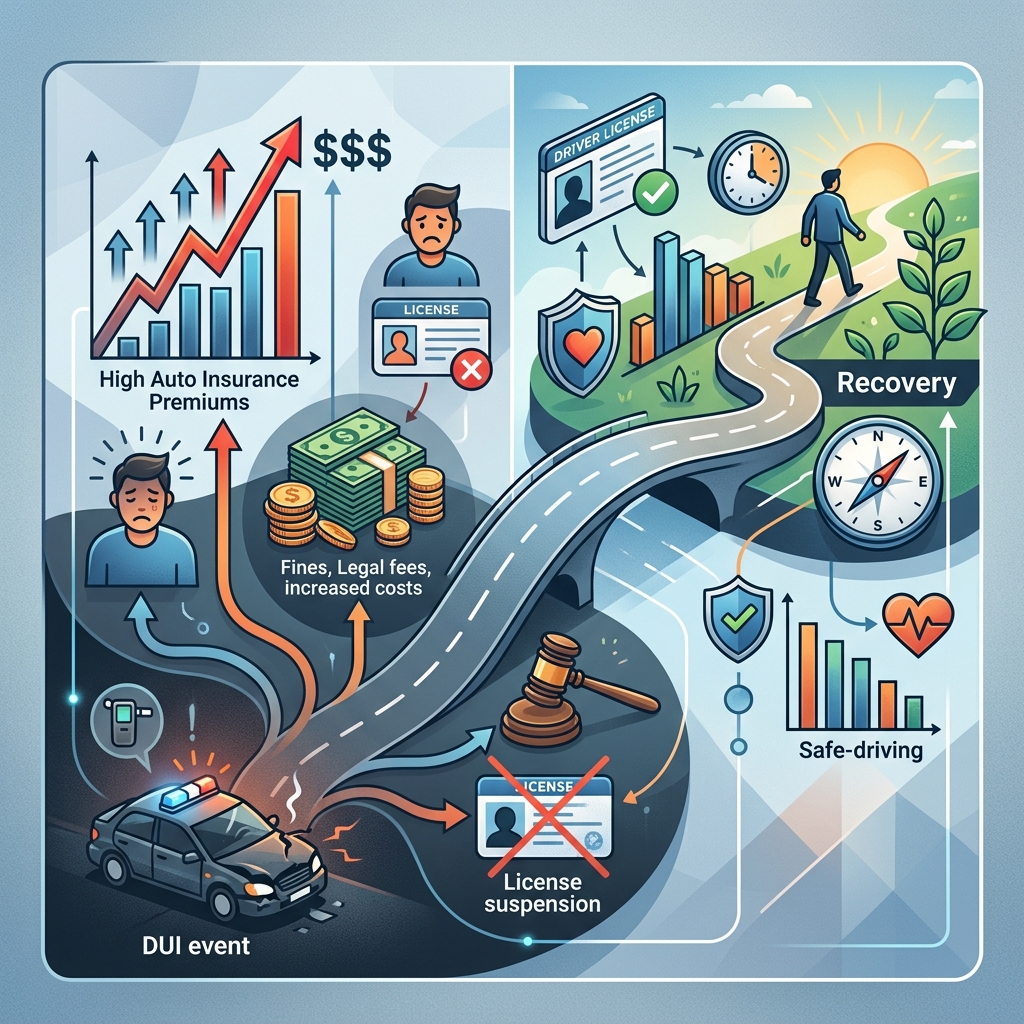
Being convicted of driving under the influence (DUI) or driving while intoxicated (DWI) does far more than create criminal and licensing problems. It also transforms how auto insurers view you, how much you pay for coverage, and in some cases, whether you can get coverage at all. Understanding these insurance consequences can help you prepare financially and make better decisions as you work to restore your driving privileges and rebuild your record.
Why a DUI Matters So Much to Insurers
Auto insurance is based on one core idea: risk. Companies collect data on millions of drivers to predict the likelihood of future claims. A DUI conviction is one of the strongest risk signals a driver can have, because alcohol- or drug-impaired driving is closely associated with serious crashes, injuries, and fatalities. As a result, a DUI typically pushes you into a high-risk driver category almost immediately.
- Insurers view impaired drivers as more likely to cause severe and costly accidents.
- DUI convictions often trigger additional state monitoring, such as SR-22 filing requirements.
- Companies adjust premiums and underwriting rules to reflect the higher projected cost of insuring these drivers.
The change in risk classification drives almost every downstream effect you will see in your premiums, coverage options, and the documentation your insurer must file with the state.
Typical Insurance Rate Increases After a DUI
There is no single nationwide number for how much your auto insurance will increase after a DUI, because rates depend on your state, insurer, coverage limits, driving history, and personal characteristics. However, credible analyses show that rate hikes are often substantial.
| Scenario | Pre-DUI Annual Premium | Post-DUI Annual Premium | Approximate Increase |
|---|---|---|---|
| National average estimate | $1,500 | $2,900 | Approximately 90% increase |
| Range reported by insurers | $1,200 | $1,440–$2,400 | About 20%–100% increase |
| High-risk state example | $1,400 | $2,800–$3,500 | 50%–150%+ increase |
Independent analyses of insurance quote data have found that a DUI can nearly double average premiums in many markets. Some insurers estimate increases between roughly 30% and over 100%, depending on state and company practices. Younger drivers and those who already have tickets or accidents on their record tend to see the largest jumps.
Key factors that influence the size of the rate increase
- Your driving history: A prior clean record may help, but a DUI usually eliminates most safe-driver discounts.
- Severity and number of violations: Multiple DUIs or DUIs involving crashes or injuries are treated more harshly.
- State rules: Some states require longer monitoring periods and higher minimum liability limits for DUI drivers.
- Insurer policy: Each company has its own underwriting standards, risk models, and tolerance for high-risk drivers.
Even at the lower end of the range, the increase is significant enough that you should plan for thousands of dollars in additional insurance costs over the years following a conviction.
Coverage Changes: From Preferred Customer to High-Risk Policyholder
A DUI does not only increase what you pay. It can also change the type of coverage available to you and the way your policy is structured. Many standard insurers are built around low- and moderate-risk drivers and may choose not to keep customers with serious violations.
Common coverage and policy impacts
- Loss of preferred or tiered rates: If you previously qualified for preferred or “good driver” tiers, you will usually be moved to a standard or non-standard tier.
- Loss of discounts: Safe-driver, accident-free, or loyalty discounts may be reduced or eliminated.
- Higher deductibles: Some insurers require higher deductibles for high-risk drivers.
- Non-renewal or cancellation: Certain companies will not renew your policy when the term expires, or may cancel it according to state law and policy terms after the DUI is reported.
- Shift to specialty insurers: If your current insurer will not keep you, you may need to obtain coverage from companies that focus on high-risk or non-standard auto insurance.
These changes can make it harder to find comprehensive coverage at an affordable price. Still, many drivers with DUIs are able to maintain at least the legally required liability coverage—particularly if they are willing to shop around and accept stricter policy conditions.
SR-22 and Similar Filings: Proof of Financial Responsibility
After a DUI, it is common for the state department of motor vehicles (DMV) or licensing authority to require additional proof that you carry minimum liability coverage. In many states, this comes in the form of an SR-22 certificate, and in some jurisdictions a similar FR-44 filing is used.
What is an SR-22?
An SR-22 is not a separate insurance policy. It is a document your insurer files with the state to show you have at least the minimum liability coverage required by law.
- Purpose: Demonstrates ongoing compliance with mandated insurance requirements after serious violations such as DUI.
- Who files it: Your insurance company submits the form to the DMV or equivalent agency.
- Cost: Insurers often charge a one-time filing fee, and your premiums may be significantly higher for the duration of the SR-22 obligation.
How long is an SR-22 required?
The duration varies by state, but a typical monitoring period is about three years after a DUI conviction or license reinstatement.
- Many states require SR-22 filing for around three years following DUI-related suspension or revocation.
- Some jurisdictions apply shorter or longer periods depending on prior violations and local law.
- Failure to maintain coverage during the SR-22 period usually leads to notification of the state and possible re-suspension of your license.
If you need an SR-22, it is important to work with an insurer that supports these filings and understands the administrative requirements. Not all companies offer SR-22 services, and those that do may specialize in high-risk drivers.
How Long a DUI Affects Your Driving Record and Insurance
Your driving record and your criminal record are separate, even though a DUI appears on both in many states and can have long-term consequences. For insurance purposes, companies focus mainly on your driving record when deciding how to price your policy.
Timeframes on your driving record
- In some states, a DUI remains on your driving record for 3–5 years for insurance rating purposes.
- Other states, such as California, keep a DUI on the driving record for up to 10 years, and insurers can consider it for that entire period.
- Within these windows, the impact on premiums may gradually decline if you avoid further violations, but the record of the DUI generally remains visible.
On the criminal side, a DUI can stay on your record much longer—sometimes indefinitely—unless specific legal steps are taken. Even if the criminal record is later sealed or expunged, insurers may continue to rely on the driving record history and internal claim data when pricing your policy.
Broader Financial Costs of a DUI
The increase in car insurance premiums is only one part of the financial burden created by a DUI conviction. When you add fines, court costs, legal fees, and administrative expenses, the total cost can be substantial.
- Fines and court fees: Many states impose hundreds or thousands of dollars in fines and mandatory surcharges.
- Legal representation: Retaining an attorney can cost several thousand dollars depending on case complexity.
- License reinstatement and administrative fees: You may need to pay reinstatement fees and other DMV charges.
- Alcohol education or treatment programs: Courts often require participation in programs that carry their own fees.
- Ignition interlock devices: In more serious or repeat cases, you may be required to install an ignition interlock, with installation and monthly monitoring costs.
When viewed over several years, the combination of direct court costs and elevated insurance premiums can easily reach tens of thousands of dollars. Factoring this into your financial planning can help prevent additional hardship.
Strategies to Manage Insurance After a DUI
Although you cannot erase a DUI from your driving history in the short term, you do have some control over how you navigate the insurance consequences. A proactive approach can reduce costs over time and improve your access to better coverage.
Immediate steps to take
- Confirm state requirements: Ask your DMV or attorney whether you need an SR-22 or equivalent filing and for how long.
- Communicate with your insurer: Be honest with your company or agent; they will learn about the DUI when checking your record, and transparency can help you identify options.
- Shop for quotes: Use quote comparison tools or independent agents to gather rates from insurers that accept high-risk drivers.
Ongoing ways to reduce costs
- Maintain a clean record: Avoid new tickets, collisions, and claims. A spotless record after your DUI is one of the most powerful ways to gradually lower premiums.
- Complete defensive driving courses: In some states and with some insurers, approved courses may lead to small discounts or demonstrate safer habits.
- Consider usage-based insurance: Programs that monitor your driving via telematics can reward careful driving even for high-risk drivers.
- Bundle policies: Combining auto insurance with homeowners or renters insurance may qualify you for multi-policy discounts.
- Review your coverage annually: As more time passes without additional violations, it may be possible to move to a different insurer or tier with lower rates.
While the financial impact may be unavoidable in the short term, consistent safe driving and strategic policy management can improve your situation over the longer term.
Frequently Asked Questions About DUI and Insurance
Will my current auto insurer automatically cancel my policy after a DUI?
Not always. Some insurers choose to cancel or decline renewal for high-risk drivers, including those with DUI convictions, but others will keep the policy and adjust rates. The decision depends on the company’s underwriting rules and whether it offers coverage to high-risk drivers.
Can I get car insurance at all after a DUI?
In most cases, yes. You may need to move to a non-standard or specialty insurer that focuses on higher-risk drivers, and you will almost certainly pay more, but legal minimum coverage is usually available. Availability may be limited in some markets, so working with an independent agent can help.
How long will my premiums stay high?
Premiums usually remain elevated for several years while the DUI is considered in your rating. Many insurers see the greatest impact in the first three years, with gradual improvement if you maintain a clean record. In states where a DUI remains on your driving record for up to 10 years, the violation can influence pricing for that entire period.
Is an SR-22 a separate type of insurance policy?
No. An SR-22 is a certificate your insurer files with the state as proof that you carry the legally required minimum liability coverage. It is attached to your existing policy rather than replacing it, and you must keep the underlying coverage active for the certificate to remain valid.
Can taking a defensive driving course erase the DUI from my record?
Defensive driving courses can improve your skills and may qualify you for small discounts, but they do not typically remove a DUI from your driving or criminal record. The presence and duration of a DUI on your record is determined by state law and court outcomes, not by optional training programs.
Should I tell my insurer about my DUI, or wait for them to find out?
Insurers routinely access driving records when underwriting or renewing policies, so they are likely to discover the DUI regardless. Being transparent allows you to discuss options early, confirm whether SR-22 support is available, and avoid surprises at renewal.
Practical Takeaways for Drivers Facing a DUI
A DUI conviction reshapes your relationship with auto insurance in ways that are immediate and long-lasting. You can expect higher premiums, possible changes in coverage, and additional reporting obligations to your state licensing authority. However, you also retain control over how you respond.
- Plan for a significant premium increase—often 30% to 100% or more—over a period of several years.
- Check whether your state requires an SR-22 or similar filing and make sure your insurer can handle it.
- Recognize that your driving record and criminal record are distinct; insurers focus mainly on the driving record when setting rates.
- Protect your future by avoiding further violations, keeping continuous coverage, and periodically reviewing your options.
With careful planning and consistent safe driving, many people are eventually able to move out of high-risk categories and secure more affordable coverage, even though the path takes time and discipline.
References
- Insurance Consequences of DUI — Justia. 2023-08-01. https://www.justia.com/criminal/drunk-driving-dui-dwi/dui-penalties/insurance-consequences-of-dui/
- How A DUI Affects Insurance — Otterstedt Insurance. 2024-04-15. https://www.otterstedt.com/blog/how-a-dui-affects-insurance/
- How a DUI Impacts Your Car Insurance Rates & Coverage — Allstate. 2023-10-10. https://www.allstate.com/resources/car-insurance/how-dui-impacts-car-insurance
- Here’s how a DUI impacts your car insurance — Yahoo Finance. 2023-06-20. https://finance.yahoo.com/personal-finance/insurance/article/car-insurance-after-dui-163728985.html
- How DUI Affects Car Insurance Premiums: What to Know — Texas DUI Law Firm. 2024-02-05. https://texasduilawfirm.com/texas-dui-car-insurance-premiums/
- How DUI Affects Car Insurance Rates in California — Wilber Law Offices. 2023-09-18. https://www.wilberlawoffices.com/practice-areas/dui-attorney/car-insurance-after-a-dui/
- Best Cheap Car Insurance After a DUI in 2026 — CNBC Select. 2025-02-12. https://www.cnbc.com/select/cheapest-car-insurance-after-dui/
- How Does a DUI Affect Car Insurance Costs? — U.S. News & World Report. 2024-05-30. https://www.usnews.com/insurance/auto/dui-car-insurance-cost
Similar Articles








Read full bio of Sneha Tete




