
Drug-Sniffing Dogs and the Home: When Police Need a Warrant
Understanding when police can use drug dogs near your home, what the Supreme Court has said, and how the Fourth Amendment protects your privacy.
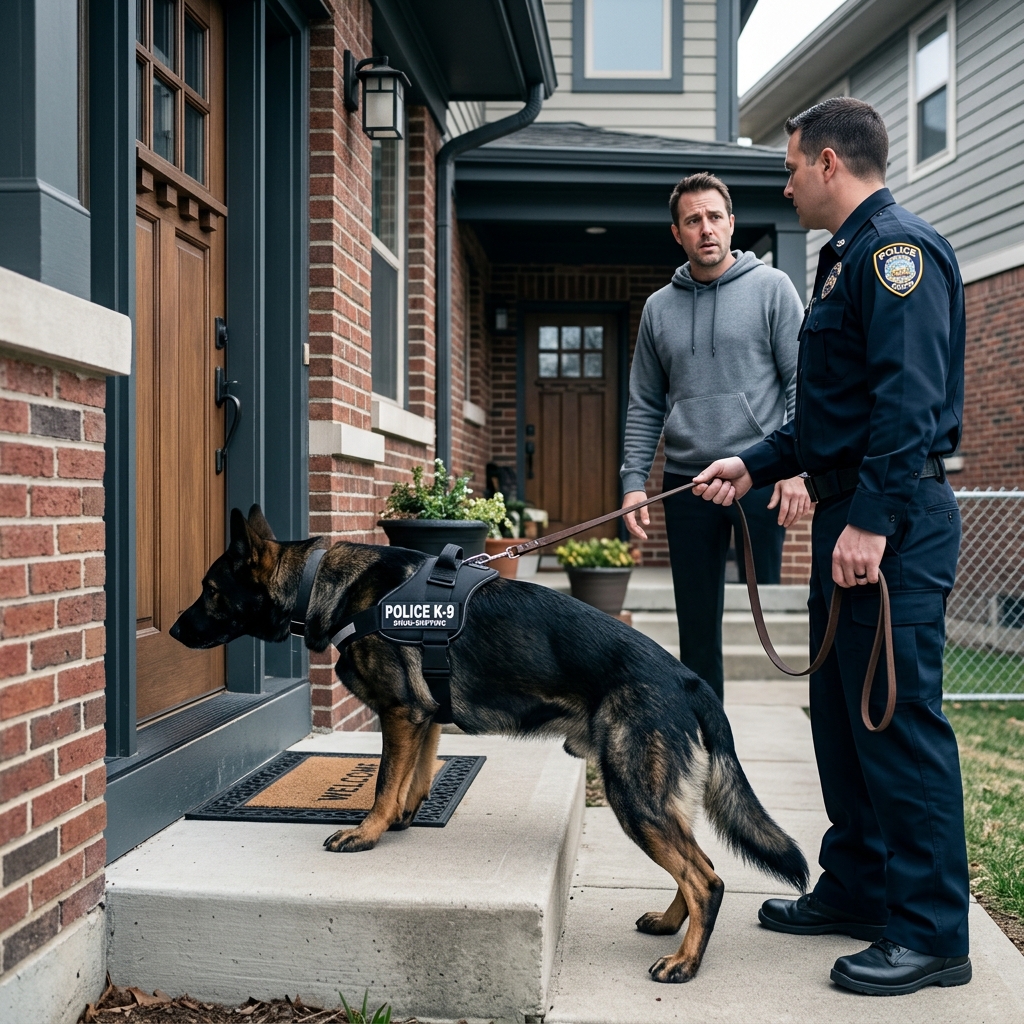
The use of drug-sniffing dogs has become a routine part of modern policing, especially in traffic stops, airports, and public spaces. But the rules change dramatically when officers bring a trained dog to the doorstep of your home. Under the Fourth Amendment, the U.S. Supreme Court has drawn a clear line: using a drug dog to investigate a home’s immediate surroundings is treated as a search and typically requires a warrant from a judge.
This article explains how the law distinguishes between a dog sniff of a car on a highway and a dog sniff on your porch, why the Supreme Court decided that the home deserves heightened protection, and what these rules mean for everyday encounters with law enforcement.
The Fourth Amendment and Privacy in the Home
The Fourth Amendment to the U.S. Constitution protects people against “unreasonable searches and seizures” by the government and generally requires police to obtain a warrant before searching a home. Courts have repeatedly emphasized that the home is at the core of this protection.
- Text of the Fourth Amendment: It safeguards people’s “persons, houses, papers, and effects” from unreasonable government intrusion.
- Heightened protection for homes: The Supreme Court has long treated the interior of the home and the area closely surrounding it as uniquely private.
- Warrants and probable cause: Before searching a home, officers must typically obtain a warrant by showing a judge there is probable cause to believe evidence of a crime will be found there.
Probable cause is more than a hunch; it requires facts and circumstances that make criminal activity more likely than not in a particular place.
Why Dog Sniffs Raise Special Legal Questions
Drug-sniffing dogs are trained to detect minute traces of controlled substances such as marijuana, methamphetamine, heroin, and cocaine. Police value them because a dog’s alert can provide grounds to investigate further, and historically courts treated dog sniffs in public places as minimally intrusive.
In earlier cases involving vehicles and luggage, the Supreme Court held that a dog sniff of the exterior of a car or bag did not qualify as a “search” for Fourth Amendment purposes, so long as officers were already lawfully present in that location. This meant that when a dog walked around a car during a legitimate traffic stop, the sniff was generally permissible without a warrant if it did not unduly prolong the stop.
The legal landscape changed when the Court had to decide whether those same principles apply at the threshold of a home, where privacy expectations are significantly higher.
The Concept of Curtilage: The Protected Area Around the Home
When the Supreme Court considered dog sniffs at residences, it focused on the idea of curtilage. Curtilage is the area immediately surrounding and associated with the home—such as the front porch, steps, and yard—that is treated as part of the home for Fourth Amendment purposes.
In Florida v. Jardines, the Court recognized that a person’s front porch falls within this protected curtilage. As a result, police activities in that space can be treated as searches of the home itself, especially when officers use specialized tools or techniques to discover information that would otherwise remain private.
| Location | Typical Legal Treatment of Dog Sniffs |
|---|---|
| Public highway (car exterior) | Generally not considered a search if officers are lawfully present and do not prolong the stop. |
| Airport baggage area | Typically treated as a minimal intrusion, often permissible without a warrant if the area is public. |
| Front porch or entryway of a home | Considered part of the home’s curtilage; dog sniff here is treated as a search requiring a warrant. |
| Driveway or private property areas near home | Legally contested; some courts treat dog sniffs as searches, others do not, depending on access and expectation of privacy. |
Florida v. Jardines: The Supreme Court’s Key Ruling
The leading case on drug dogs at homes is Florida v. Jardines, decided by the U.S. Supreme Court in 2013. In that case, police received a tip that a man was growing marijuana in his home. Officers brought a trained drug dog to the suspect’s front porch, where the dog alerted to the presence of narcotics. Based on that alert, they obtained a warrant, searched the home, and discovered marijuana plants.
The question before the Court was whether bringing the dog to the porch to investigate the home’s interior odors without a prior warrant violated the Fourth Amendment. In a 5–4 decision, the Court ruled that it did.
- Use of a dog is a search: The Court held that using a drug-sniffing dog in the immediate area outside a home constitutes a police search for Fourth Amendment purposes.
- Curtilage and property-based analysis: The decision rested on the idea that the porch is part of the home’s curtilage, and officers exceeded any implicit invitation to approach and knock by conducting a specialized investigation using a dog.
- Warrant requirement: Because the dog sniff was treated as a search, the officers were required to obtain a warrant before bringing the dog to the porch. Their failure to do so made the search unconstitutional.
- Exclusion of evidence: As a consequence, the marijuana evidence obtained after the dog’s alert could not be used to convict the homeowner.
In effect, the Court drew a line: police may walk up to your door and knock, as any visitor might, but they may not use that access as an opportunity to conduct a warrantless dog-based investigation of your home’s interior.
What Police Can Do Without a Warrant Near Your Home
Even with the Jardines ruling, officers retain certain powers to approach homes, knock on doors, and act on visible evidence. The distinction lies in whether they are behaving like ordinary visitors or using specialized investigative tools.
Permissible Actions Without a Warrant
- Approach and knock: Officers can walk up to your front door via customary access routes (such as the driveway or front walkway) and knock, hoping to speak with you.
- Observe items in plain view: If officers can see illegal items from a lawful vantage point—such as contraband openly visible through a window—they may rely on those observations to seek a warrant.
- Act in emergencies: In exigent circumstances, like responding to screams for help or imminent destruction of evidence, officers may enter or act without a warrant, subject to strict limits.
Actions That Typically Require a Warrant
- Using a drug dog on the porch: Bringing a trained dog to the front porch to sniff for evidence inside the home is treated as a search and requires a warrant.
- Deploying advanced surveillance technology: The Court has analogized drug dogs to other specialized tools, such as GPS trackers, that cannot be used to explore private spaces without warrant authority.
- Prolonged or intrusive investigations on curtilage: Systematic probing of the yard, porch, or other curtilage areas using investigative equipment generally triggers the warrant requirement.
The common thread is that ordinary approaches and brief observations are usually permissible, while targeted investigations using tools designed to uncover hidden information from within the home are not.
Gray Areas: Driveways, Shared Spaces, and Vehicles on Property
Not all locations around a home are treated the same way. Courts have wrestled with how to apply Jardines to driveways, parking areas, and shared spaces like apartment hallways. For example, one federal appellate court considered a case involving a drug dog sniffing a car parked in a homeowner’s driveway and concluded that the sniff did not amount to a search.
Legal scholars have criticized such rulings, arguing that when a dog is used on private property immediately adjacent to a home, the scenario should fall within the Fourth Amendment’s protections. As a result, the law in these areas remains unsettled and can vary by jurisdiction.
- Driveways: Some courts treat parts of a driveway as accessible to the public (for example, where delivery drivers routinely go), while others treat them as protected curtilage when they are clearly private.
- Multi-unit housing: Hallways in apartment buildings or shared entryways may offer less privacy than single-family porches, leading to more complex legal analysis.
- Vehicles on property: When a car is parked on private property near the home, courts must decide whether the dog sniff relates primarily to the vehicle (traditionally less protected) or to the home’s curtilage (more protected).
Because these edges of the doctrine are still evolving, residents in different states may experience different levels of protection in similar situations.
Probable Cause, Certification, and Reliability of Drug Dogs
Even when officers are in a location where they may lawfully use a drug dog, the dog’s alert cannot justify further intrusions or warrants unless its reliability is established. Courts require evidence that a given dog is properly trained and certified, and that the handler is experienced.
When reviewing whether a dog’s alert amounts to probable cause, judges may examine:
- Training protocols: How the dog was trained to detect particular drugs and respond to their odor.
- Certification records: Whether the dog has current certifications from recognized organizations or agencies.
- Performance history: Data on how often the dog’s alerts have led to actual discovery of drugs versus false positives.
- Handler expertise: The handler’s experience and adherence to procedures that reduce bias and misinterpretation.
These requirements help ensure that dog alerts are not treated as automatic proof of criminal activity, but instead as part of a broader factual showing.
Practical Tips: What Homeowners Should Know
Understanding how the law treats drug-sniffing dogs near your home can help you make informed choices in encounters with police. While individual circumstances vary and legal advice should come from a qualified attorney, several general points are useful.
- You can ask if officers have a warrant: If police appear with a dog near your home, you may calmly ask whether they have a search warrant authorizing the use of the dog on your property.
- Consent is powerful—and risky: If you voluntarily consent to a search, officers may not need a warrant. Consent can include allowing a dog to sniff in areas that would otherwise be off-limits without warrant or probable cause.
- Remaining silent: You typically have the right not to answer questions. Declining to consent does not, by itself, give officers probable cause.
- Documenting events: If it is safe to do so, make note of the time, location, and actions taken by officers and dogs. This information may be important if a court later reviews the legality of the search.
- Consulting counsel: If a search occurs or evidence is seized, contacting a criminal defense attorney promptly can help you understand whether your rights were violated and whether evidence might be excluded in court.
Because the law is complex and can differ across states and federal circuits, professional legal guidance is essential in specific cases.
Frequently Asked Questions (FAQ)
Can police bring a drug dog to my front porch without a warrant?
In light of Florida v. Jardines, bringing a drug-sniffing dog to your front porch to investigate what is inside your home is treated as a search and generally requires a warrant. Officers may walk up and knock like any visitor, but they may not use a dog for investigative purposes there without judicial authorization.
What if I live in an apartment—does Jardines still apply?
The principles of home privacy and curtilage extend to residences such as apartments, but how they apply to shared hallways and entryways can be more complicated. Courts may look at factors like control over the space, access by the public, and reasonable expectations of privacy.
Are dog sniffs of cars always allowed without a warrant?
No. While previous cases permit dog sniffs of car exteriors during lawful traffic stops without treating them as searches, officers must still have a legitimate reason for the stop and cannot extend it unreasonably just to conduct a dog sniff. Additionally, using a dog on a vehicle parked within the home’s curtilage may raise Jardines-style concerns.
What happens if evidence is found after an unlawful dog sniff at my home?
If a court determines that a dog sniff at your home violated the Fourth Amendment, evidence obtained as a result of that illegal search may be excluded from trial under the exclusionary rule. This can significantly weaken the prosecution’s case.
Does a dog alert alone create probable cause to search my home?
Courts may accept a dog’s alert as part of the probable cause showing, but only if the dog’s training, certification, and performance history demonstrate reliability. A bare assertion that a dog alerted, without supporting information, may not be enough.
References
- Drug Dogs Can’t Sniff Homes Without Warrant — FindLaw Legal Blog. 2013-03-27. https://www.findlaw.com/legalblogs/criminal-defense/drug-dogs-cant-sniff-homes-without-warrant/
- Supreme Court clarifies warrant requirement for drug-sniffing dogs — Goldberg Law Firm article. 2013-03-27. https://www.goldbergdefense.com/articles/supreme-court-clarifies-warrant-requirement-for-drug-sniffing-dogs/
- SCOTUS rules warrantless dog-sniff search of home unconstitutional — Illinois State Bar Association, Illinois Bar Journal LawPulse. 2013-05-01. https://www.isba.org/ibj/2013/05/lawpulse/scotusruleswarrantlessdogsniffsearc
- Can a police drug dog legally sniff your house? — R. Todd Bennett, P.C. Law Firm Article. 2012-11-15. https://www.rtoddbennettpc.com/articles/can-a-police-drug-dog-legally-sniff-your-house/
- The dog-sniffing cases: Made simple — SCOTUSblog. 2012-07-18. https://www.scotusblog.com/2012/07/jardines-and-harris-made-simple/
- FOURTH AMENDMENT: DRUG DOGS ON A DRIVEWAY — American Criminal Law Review (Georgetown Law). 2021-10-01. https://www.law.georgetown.edu/american-criminal-law-review/wp-content/uploads/sites/15/2021/10/53-0_Singh-_DRUG_DOGS_ON_A_DRIVEWAY.pdf
Similar Articles








Read full bio of medha deb




