
Drug Activity and Real Estate: Legal Risks and Property Strategies
How illegal drug activity impacts property owners, landlords, buyers and agents, and what legal tools and practical steps can reduce risk.
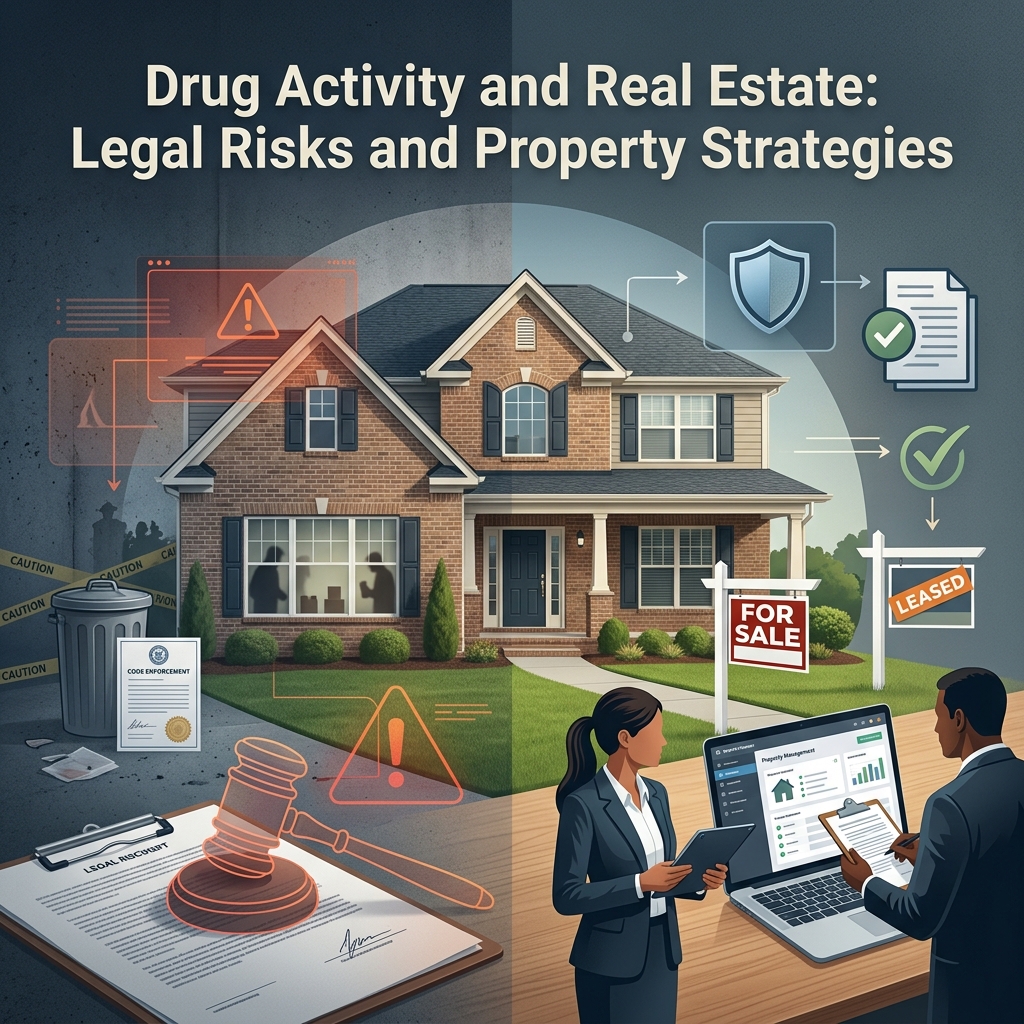
Illegal drug activity can transform an ordinary property into a focal point for crime, health hazards, and complex legal problems. For landlords, owners, buyers, and real estate professionals, understanding how drug use, manufacturing, and distribution intersect with property law is essential to protecting both investments and community safety.
This article explains how drug activity affects real estate value, landlord and owner liability, disclosure obligations, nuisance and forfeiture laws, and practical strategies to prevent and respond to problems while complying with fair housing and other legal requirements.
How Drug Activity Impacts Properties and Neighborhoods
Drug activity at or near a property affects much more than the individuals involved in the illegal conduct. It can reshape the economic and social environment of an entire building or neighborhood.
Economic and Market Consequences
When a property is known or suspected to be a site for drug use, dealing, or manufacturing, its marketability typically declines. Potential buyers and tenants worry about safety, police presence, and future legal issues, leading to lower demand and reduced prices.
- Depressed property values as buyers discount prices to account for perceived risk.
- Higher vacancy rates because quality tenants avoid drug-affected buildings.
- Increased operating costs for owners, including security measures, repairs, and legal fees.
- Insurance complications, such as higher premiums or coverage disputes after drug-related damage.
Where illegal drug markets become entrenched, neighboring properties can also suffer value declines due to reputation, visible disorder, and fear of crime.
Safety and Health Risks
Drug activity introduces both immediate safety concerns and long-term health hazards:
- Violence and victimization, including assaults, robberies, and conflicts among buyers and sellers.
- Overdoses on or near the premises, raising moral, legal, and reputational concerns.
- Environmental contamination in the case of methamphetamine or other drug manufacturing, which can leave toxic residues in walls, floors, and ventilation systems.
- Fire hazards due to volatile chemicals, overloaded electrical systems, or improvised equipment.
For multifamily housing, these risks affect every resident, not just those involved in drugs. Children, elderly tenants, and other vulnerable occupants may face increased danger simply by living nearby.
Key Legal Frameworks Governing Drug Activity and Real Estate
Multiple legal regimes shape how drug activity is treated when it intersects with property: criminal drug laws, nuisance and abatement statutes, civil forfeiture rules, and housing and anti-discrimination laws.
Criminal Drug Laws and “Drug Houses”
Most jurisdictions prohibit the manufacture, distribution, and possession of controlled substances, and some statutes specifically address properties used for drug purposes. For example, Florida law makes it a crime to keep or maintain a building or other place that is resorted to by people using controlled substances, or used for keeping or selling them in violation of drug laws.
These provisions allow prosecutors to target not only the individuals handling drugs, but also those who knowingly operate or maintain premises as drug venues. Owners or tenants who permit such use may face criminal charges depending on their level of knowledge and involvement.
| Type of conduct | Typical legal characterization | Possible consequences |
|---|---|---|
| Operating a residence used for selling drugs | Maintaining a drug house or premises for drug sales | Felony charges, fines, imprisonment |
| Using an apartment as a gathering place for drug users | Maintaining a place resorted to for drug use | Criminal liability and possible forfeiture |
| Manufacturing drugs (e.g., meth lab) inside a home | Manufacture of controlled substances; environmental violations | Criminal penalties, remediation orders, potential civil suits |
Nuisance, Abatement, and Community Remedies
Drug activity at a property can be treated as a public nuisance, allowing local governments or affected neighbors to seek court orders compelling changes or, in severe cases, closing the property. Nuisance abatement actions typically aim to stop ongoing illegal activity, improve property management, and restore community safety.
Common nuisance remedies include:
- Injunctions requiring owners to install better lighting, hire security, or evict problem tenants.
- Court oversight of property management practices with mandated reporting and compliance checks.
- Temporary closures of properties used persistently for illegal drug activity.
These civil actions often complement criminal enforcement, focusing on long-term changes rather than solely punishing individual offenders.
Civil Asset Forfeiture and Real Estate
Many jurisdictions allow civil asset forfeiture, enabling law enforcement to seize property that is connected to criminal activity even without a criminal conviction, subject to statutory safeguards. Real estate can be forfeited if it is proven to be used in or derived from drug offenses, although homes are less frequently seized than cash or vehicles.
Under such laws:
- Any real or personal property tied to illegal activities may be subject to forfeiture, including homes, land, and vehicles.
- Owners can challenge seizures by arguing lack of probable cause, disproportionality between the value forfeited and the alleged crime, or that they did not know about the illegal activity on the property.
Civil forfeiture raises significant due process concerns, so both property owners and buyers should be aware of the risk when a property has a history of serious drug offenses.
Landlord and Property Owner Liability
Landlords and owners may face civil or, in some cases, criminal liability for drug activity on their properties, particularly where they fail to respond to known problems or where their management practices facilitate illegal use.
Duties to Other Tenants and Neighbors
In many states, if one tenant’s illegal drug activity injures, disturbs, or endangers other tenants, the landlord can be sued for failing to maintain a reasonably safe environment. Liability exposure is highest where the landlord knows or should have known about the activity and does not act.
Situations that may create risk include:
- Ignoring repeated complaints about drug dealing and associated violence.
- Failing to investigate obvious signs of drug manufacturing or heavy traffic to a particular unit.
- Continuing to renew leases for tenants engaged in criminal drug activity.
Courts look at whether the actions were reasonably foreseeable and whether the owner took appropriate steps once alerted. Proactive screening, clear lease provisions, and prompt enforcement generally reduce liability.
Screening and Fair Housing Constraints
Owners have legitimate interests in screening out current illegal drug users and dealers, but they must do so within the boundaries of fair housing laws. Federal fair housing law does not protect individuals currently engaged in illegal drug use, and current drug use is recognized as legitimate grounds to reject a rental applicant or evict a resident.
However, drug dependence itself may be considered a disability in some contexts. Guidance from the U.S. Department of Housing and Urban Development (HUD) recognizes that certain individuals with histories of drug dependence who have successfully completed supervised rehabilitation programs, or who are currently participating and no longer using, may be protected from discrimination as persons with disabilities. This means landlords must distinguish between:
- Current illegal drug use, which is not protected and can justify denial or eviction.
- Former users in recovery, who may be entitled to reasonable accommodations unless they pose a demonstrable direct threat.
HUD guidance emphasizes a case-by-case “direct threat” assessment, considering the nature, duration, and severity of risk, and whether treatment or intervention has effectively mitigated it.
Lease Provisions and Property Management Strategies
Well-drafted leases and consistent management practices are central to preventing drug problems and defending against claims when they arise.
Model Lease Clauses on Criminal and Drug Activity
Many landlords include specific provisions in rental agreements that address illegal conduct, including drug-related activity. Typical clauses prohibit tenants and their guests from:
- Dealing, manufacturing, or distributing illegal drugs.
- Storing significant quantities of controlled substances on the premises.
- Using illegal drugs or being intoxicated in common areas.
- Allowing family members or visitors to engage in such conduct on the property.
Such clauses give owners clearer authority to act quickly when credible evidence of illegal activity emerges, including issuing notices and pursuing eviction in accordance with local law.
Practical Warning Signs and Monitoring
Although landlords are not expected to conduct invasive investigations or act as law enforcement, basic vigilance helps identify problems early. Real estate professionals and property managers often look for indicators such as:
- Unusual levels of foot or vehicle traffic at odd hours.
- Strong chemical or smoke odors suggesting manufacturing or heavy use.
- Excessive staining or fire damage inconsistent with ordinary wear and tear.
- Covered or blacked-out windows and disconnected smoke detectors.
When multiple indicators are present, landlords should document observations, respond in line with lease and legal requirements, and, where appropriate, contact law enforcement.
Disclosure Duties for Sellers and Real Estate Agents
Sellers and agents often have obligations to disclose known information that materially affects property value or desirability, which can include past or present drug activity.
Drug Activity as a Material Fact
In many U.S. states, sellers must disclose conditions that could materially impact the value of a property. In about half of states, specific laws require disclosure of properties that have been used as clandestine methamphetamine laboratories, or where there is a risk of meth exposure. Some states also require disclosure of cultivation or manufacturing of marijuana where the agent or broker is aware of the activity.
Even where no specific statute exists, pervasive drug activity that led to contamination, police raids, or serious crime may be considered a material condition that should be disclosed to avoid misrepresentation or fraud claims.
Scope of Investigation for Real Estate Professionals
Real estate agents are generally expected to conduct reasonable visual inspections, not exhaustive investigations. They must disclose what they know and what a reasonable inspection would reveal, and encourage buyers to perform due diligence where risk factors exist.
Best practices for agents include:
- Documenting inspections and any observed signs of past drug activity.
- Retaining records of conversations with sellers about the property’s history.
- Informing buyers about potential contamination issues and suggesting environmental testing where appropriate.
By focusing on prevention—clear disclosures, good recordkeeping, and professional errors and omissions insurance—agents can significantly reduce the likelihood of lawsuits related to undisclosed drug activity.
Community and Law Enforcement Collaboration
Single property actions are often insufficient to address entrenched drug markets. Successful responses usually involve collaboration among owners, residents, law enforcement, and community organizations.
Problem-Oriented Strategies for Multi-Unit Housing
Research on drug dealing in privately owned apartment complexes identifies several strategies that focus on altering the environment and management practices rather than only targeting individual offenders. These include:
- Information campaigns aimed at buyers, highlighting overdose risks, chemicals used to cut drugs, and heightened likelihood of arrest on the property.
- Improved management practices, such as stricter access control, tenant screening, and responsive maintenance.
- Coordinated efforts between owners, police, and law-abiding tenants to report problems and support enforcement.
Where owners resist change, communities may pursue nuisance abatement actions or seek temporary restraining orders requiring specific management reforms.
Frequently Asked Questions (FAQs)
Can a landlord evict a tenant for suspected drug activity without a criminal conviction?
Often, yes. Landlords do not need a criminal conviction to enforce lease provisions against illegal drug activity, although they should have credible evidence and follow local eviction procedures. Current illegal drug use is generally a legitimate basis for eviction, but landlords must ensure they are not discriminating against former users in recovery who are protected under disability provisions.
Is a seller always required to disclose past drug activity on a property?
Disclosure duties vary by state. In roughly half of U.S. states, laws explicitly require disclosure if a property was used as a meth lab or has contamination risks. In other jurisdictions, severe drug-related conditions may be treated as material facts even without specific statutes. When in doubt, more complete disclosure is usually safer than silence from a legal standpoint.
Can my home be seized through civil asset forfeiture if drugs were found there?
It is possible but relatively uncommon. Civil asset forfeiture laws allow real or personal property used in or derived from drug offenses to be seized, but homes are seized less frequently than cash or vehicles. Owners can challenge forfeiture by arguing lack of probable cause, disproportionality, or that they did not know about the criminal activity.
Are current drug users protected under fair housing laws?
No. Current illegal drug use is not protected and can be grounds for rejecting an applicant or evicting a tenant. However, individuals who have completed or are participating in supervised rehabilitation and are no longer using illegal drugs may be protected as persons with disabilities, and may be entitled to reasonable accommodations unless they pose a direct threat.
What should a real estate agent look for when inspecting a property that might have been used for drug activity?
Agents should conduct thorough visual inspections and look for signs such as strong chemical odors, excessive staining or fire damage, hydroponic equipment, disconnected smoke detectors, and covered windows. Observed conditions should be documented and, where material, disclosed to prospective buyers, who can then decide whether to order specialized environmental testing.
References
- Drug Dealing in Privately Owned Apartment Complexes — Center for Problem-Oriented Policing, Arizona State University. 2003-06-01. https://popcenter.asu.edu/content/drug-dealing-privately-owned-apartment-complexes-summary
- Dealing with Drug Use Without Violating Fair Housing Law — AJJCS / Affordable Housing Institute. 2017-11-30. https://www.ajjcs.net/news.php?artid=20964&pr=1
- Selling a Home Where Drug Activity Has Occurred — CRES Insurance Services. 2020-08-20. https://www.cresinsurance.com/selling-a-home-where-drug-activity-has-occurred/
- Are landlords liable for the drug activity of their tenants? — Good People Get Arrested (Florida criminal defense law firm). 2018-01-15. https://www.goodpeopledogetarrested.com/blog/2018/01/are-landlords-liable-for-the-drug-activity-of-their-tenants/
- Chapter 893, Section 13 — Florida Statutes — The Florida Senate. 2023-01-01. https://www.flsenate.gov/laws/statutes/2023/893.13
- What Can Be Taken Through Civil Asset Forfeiture? — Kaylor Law Group. 2019-05-10. https://www.kaylorlaw.com/what-can-be-taken-through-civil-asset-forfeiture
Similar Articles








Read full bio of medha deb


