Understanding DNA Collection Authority in Law Enforcement
DNA collection has become a standard procedure in modern criminal investigations, with law enforcement agencies across the United States authorized to gather genetic samples from individuals in various circumstances. The legality and scope of these collections, however, are governed by federal and state statutes as well as constitutional protections. Understanding when and how police can collect DNA samples is essential for anyone involved in the criminal justice system, whether as a suspect, arrestee, or defendant.
The authority for DNA collection originates from both federal legislation and individual state laws. At the federal level, the Attorney General possesses broad authority under 34 U.S. Code § 40702 to collect DNA samples from individuals who are arrested, facing charges, or convicted. This authority extends to individuals detained under federal jurisdiction and encompasses both U.S. citizens and non-U.S. persons held in federal custody. State governments have similarly enacted their own DNA collection statutes, creating a patchwork of requirements that vary significantly based on geographic location and the nature of criminal charges.
Landmark Supreme Court Decision on Arrestee DNA Sampling
The constitutional analysis of DNA collection took a decisive turn with the 2013 Supreme Court decision in Maryland v. King. In this closely divided 5-4 ruling, the nation’s highest court determined that collecting a DNA sample from an individual arrested for a serious felony does not violate Fourth Amendment protections against unreasonable searches and seizures. The majority opinion, authored by Justice Anthony M. Kennedy, established a pivotal legal framework for understanding governmental authority in this domain.
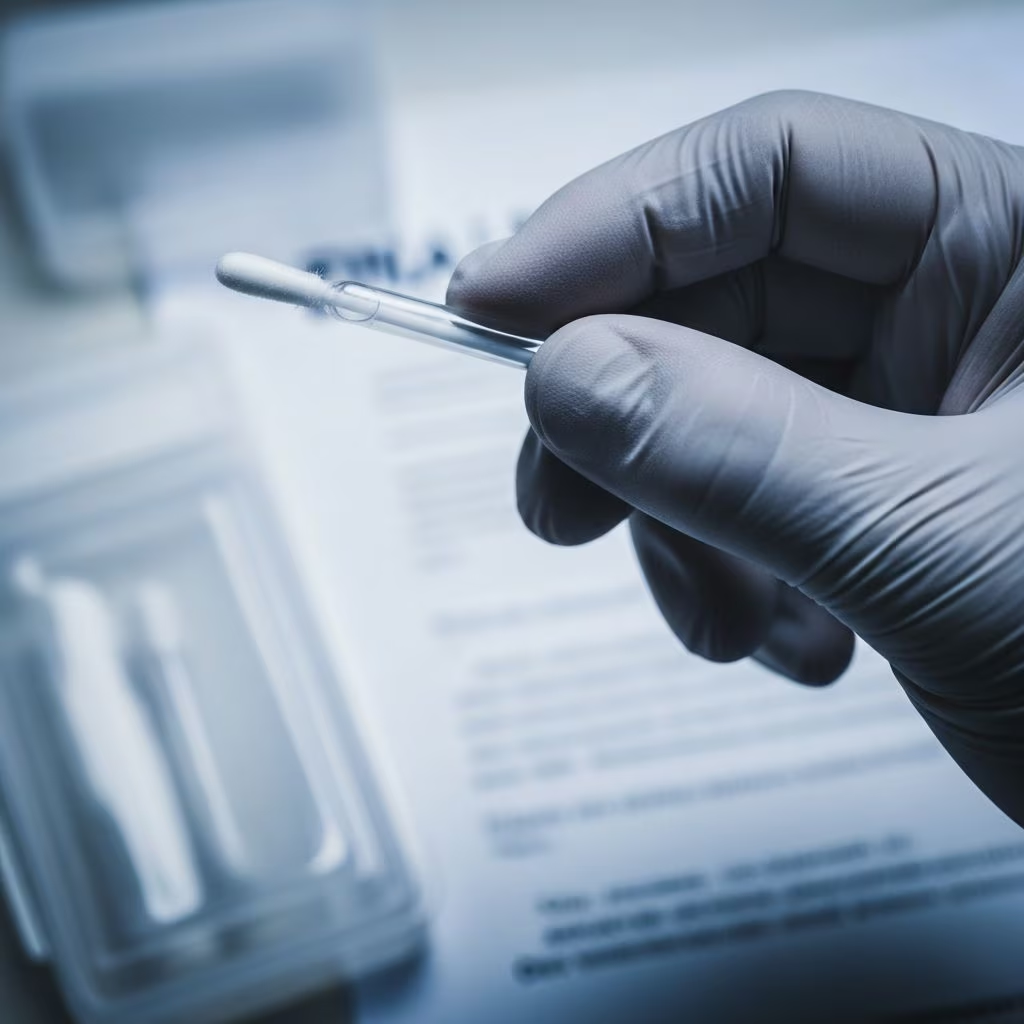
Justice Kennedy’s majority opinion drew a direct parallel between DNA collection procedures and established police booking practices. The Court reasoned that DNA swabbing through a cheek swab is fundamentally similar to fingerprinting and photographing arrestees—routine procedures that have long been accepted as reasonable police conduct. This comparison proved influential in establishing the legitimacy of DNA collection as a booking procedure rather than as an investigative search requiring heightened judicial scrutiny.
The dissenting justices raised significant concerns about privacy implications and the invasive nature of genetic sampling. They argued that DNA profiles reveal far more personal information than traditional fingerprints or photographs, potentially disclosing predispositions to medical conditions, family relationships, and other deeply private information. Despite these concerns, the majority’s reasoning has become the controlling law across the nation.
Federal Framework for DNA Collection Procedures
Federal DNA collection authority operates under carefully defined parameters. The Attorney General may authorize collection from individuals who are arrested, facing charges, or convicted, with the Department of Justice able to delegate collection responsibilities to other federal agencies that arrest or detain individuals. This decentralized approach allows various federal law enforcement entities, including the FBI, DEA, ICE, and other agencies, to conduct collections consistent with federal standards.
The federal system provides for collection procedures that may include the use of reasonable force or restraint when individuals refuse to cooperate. Specifically, the Attorney General, Bureau of Prisons Director, or probation offices may employ means reasonably necessary to detain and restrain an individual for sample collection purposes. Additionally, these authorities may enter into agreements with state and local government units or private entities to facilitate collection on their behalf, creating a hybrid system where federal, state, and local resources collaborate.
Federal law imposes criminal penalties for non-compliance with DNA collection procedures. An individual who refuses to cooperate in DNA collection following proper authorization faces charges as a Class A misdemeanor, punishable in accordance with federal criminal statutes. This deterrent reflects the federal government’s commitment to ensuring comprehensive DNA database participation.
State-by-State Variations in Collection Authority
DNA collection laws vary considerably across the fifty states, creating different legal landscapes depending on jurisdiction. All fifty states maintain some form of DNA collection mandate, and all participate in the Combined DNA Index System (CODIS), the national DNA database maintained by the Federal Bureau of Investigation. However, significant variations exist regarding when collection occurs and what offenses trigger collection requirements.
Currently, 31 states have enacted legislation requiring DNA collection from certain felony arrestees, with 19 states extending this requirement to all felony arrests regardless of specific circumstances. This expansion reflects growing recognition of DNA’s investigative value in solving both current and historical crimes. States without universal felony arrest collection typically limit sampling to convictions or specific offense categories.
Some states impose additional procedural requirements before collection or analysis may proceed. Only 13 states currently require a judicial determination of probable cause, a warrant, formal indictment, or arraignment before collecting or analyzing DNA samples. The remaining states permit collection based on arrest alone, provided the arrest was supported by probable cause for a serious offense. California’s Proposition 69, for example, requires DNA collection from all adults arrested for felonies, a requirement upheld in federal court litigation challenging its constitutionality.
Probable Cause as a Collection Prerequisite
Maryland v. King established that probable cause supporting an arrest for a serious offense constitutes the legal foundation necessary for DNA collection. The Supreme Court emphasized that officers must have probable cause to believe the arrestee committed a serious crime before obtaining and analyzing a DNA sample. This requirement ensures that DNA collection does not become a blanket procedure applied indiscriminately to all arrestees regardless of charge severity.
The probable cause standard functions as a protective mechanism, limiting collection to circumstances where law enforcement has a reasonable basis to believe an individual committed a crime warranting custody. Arrests lacking probable cause—such as arrests later determined to be unsupported—theoretically should not have triggered DNA collection. However, state procedures vary regarding how thoroughly courts review whether probable cause actually existed at the time of collection.
Thirteen states have enacted legislation requiring explicit judicial determination of probable cause before collection or analysis proceeds, adding an additional layer of protection beyond the requirement that the initial arrest be supported by probable cause. These jurisdictions recognize the heightened privacy interests implicated by genetic sampling and impose additional procedural safeguards.
Justifications Offered by the Supreme Court
The Supreme Court identified multiple policy interests supporting DNA collection authority. First, the Court emphasized DNA’s unparalleled accuracy in identifying perpetrators. DNA analysis provides identification capability exceeding even fingerprinting in certain respects, allowing positive matches across cases and enabling connection between evidence and individuals with near-certainty.
Second, the Court recognized DNA collection’s role in protecting public safety by informing law enforcement about arrestees’ identities and backgrounds. Officers and correctional staff benefit from access to criminal histories and other identifying information that DNA databases reveal, enabling more informed decisions about custody arrangements and security protocols.
Third, the majority highlighted DNA’s investigative utility in solving past crimes. Samples collected upon arrest are analyzed and compared against crime scene evidence in CODIS, potentially linking current arrestees to unsolved historical crimes. This investigative benefit extends to solving crimes committed before the arrestee’s current detention.
Fourth, DNA collection prevents future crimes by identifying individuals with existing criminal records who might otherwise evade detection. The preventive function operates across the criminal justice system, from identifying suspects during investigations to monitoring probationers and parolees.
Finally, the Court emphasized DNA’s exonerative potential, noting that DNA evidence has proven instrumental in exonerating innocent individuals wrongfully convicted or incarcerated. Access to comprehensive DNA databases facilitates identification of actual perpetrators when wrongful convictions are discovered.
DNA Collection From Shed Genetic Material
Beyond the arrestee DNA collection context addressed in Maryland v. King, law enforcement increasingly pursues DNA from material individuals shed during normal activities. Police collect discarded items such as eating utensils, napkins, cups, and other objects containing minute quantities of DNA left behind. This genetic material, sometimes called “abandoned DNA,” exists in an ambiguous legal space regarding Fourth Amendment protections.
The ACLU and other privacy advocates argue that police should be required to obtain warrants before collecting and analyzing shed DNA, emphasizing the profound privacy implications of genetic information. They contend that DNA reveals far more personal information than traditional evidence like fingerprints or photographs, including predispositions to medical conditions, family relationships, and ancestry information. Currently, however, federal courts have not consistently required warrant-based collection of shed DNA, particularly when individuals discard items in public places.
In investigative contexts involving genealogical DNA databases, police have employed novel investigative techniques involving indirect familial matching. These approaches have proven effective in solving cold cases and identifying suspects in ongoing investigations. The legal framework governing such techniques remains evolving, with courts grappling with privacy implications and Fourth Amendment applicability.
Expungement Rights and Database Removal
Individuals subjected to DNA collection possess rights to have samples removed from governmental databases under certain circumstances. The procedures and automatic availability of expungement vary significantly by state. Thirteen states implement automatic expungement processes, removing DNA profiles from databases when specified conditions are met without requiring individual requests for removal.
Sixteen additional states require individuals to submit formal requests for expungement to initiate the removal process. Even in these jurisdictions, expungement becomes available when individuals are not charged with crimes, receive misdemeanor convictions without prior felony records, or meet other statutory criteria. The remaining states do not provide routine expungement mechanisms, meaning DNA profiles remain permanently in databases regardless of criminal case outcomes.
California permits expedited expungement requests when individuals were not charged or convicted of felonies or received only misdemeanor convictions without prior felony records, unless individuals are registered arson or sex offenders. This structure attempts to balance investigative interests against the privacy interests of individuals who have not been convicted of serious crimes.
CODIS and National Database Integration
The Combined DNA Index System, maintained by the Federal Bureau of Investigation, serves as the central repository for DNA profiles generated from state and federal collections. All fifty states participate in CODIS, providing law enforcement nationwide with access to DNA profiles maintained in any state’s database. This integration creates a powerful investigative tool enabling identification of suspects and connections between cases across jurisdictional boundaries.
Federal law requires that DNA samples collected under federal authority be furnished to the FBI Director for analysis, with results included in CODIS. State-collected samples, through cooperation agreements and data-sharing arrangements, similarly feed into the national database. The FBI maintains quality standards and provides guidance regarding DNA analysis methods, though state laboratories retain primary responsibility for analyzing samples collected within their jurisdictions.
The Rapid DNA technology initiative permits the FBI to waive certain analysis requirements when Rapid DNA instruments are employed and results are included in CODIS. This emerging technology promises to accelerate the timeline for DNA analysis and database integration, potentially providing investigative leads more quickly than traditional laboratory procedures.
Fourth Amendment Privacy Protections Governing DNA
The Fourth Amendment provides constitutional protection against unreasonable searches and seizures, with courts applying a reasonableness analysis that balances individual privacy interests against governmental interests. Maryland v. King applied this balancing test to DNA collection from arrestees, determining that the governmental interest in identification, crime solving, and public safety outweighed privacy interests implicated by cheek swabbing.
However, the Supreme Court has not addressed all DNA collection scenarios comprehensively. The constitutional status of collecting shed DNA without warrants, accessing genealogical databases, or using advanced matching techniques remains contested. Some circuits have suggested greater protection for shed DNA, while others have afforded law enforcement broader collection authority.
Critics of extensive DNA collection authority argue that the Fourth Amendment’s protections should limit governmental access to genetic information because of the profound privacy implications. DNA reveals medical predispositions, family relationships, and other deeply personal information far beyond identification markers. This perspective suggests that traditional warrantless search authority should not extend to genetic material without specific statutory authorization and judicial oversight.
Procedural Safeguards and Collection Standards
DNA collection procedures typically involve non-invasive swabbing of the inside of an individual’s cheek, a procedure courts have characterized as minimally intrusive. Federal regulations and state statutes often specify approved collection methods, with most requiring swabbing rather than blood draws. The minimal invasiveness of swabbing procedures, compared to blood extractions, influenced the Supreme Court’s determination that collection constitutes a reasonable police booking procedure.
Law enforcement agencies have established protocols governing chain of custody, sample labeling, and analysis procedures designed to ensure accuracy and prevent contamination. These procedural safeguards protect both investigative integrity and individual rights by ensuring that DNA results can withstand judicial scrutiny and that samples are not misidentified or cross-contaminated.
Individuals undergoing collection may face criminal penalties for refusing cooperation. The federal framework imposes Class A misdemeanor charges for non-compliance, while state penalties vary. These enforcement mechanisms reflect the legislative determination that DNA collection constitutes a mandatory component of the criminal booking process rather than an optional procedure subject to individual consent.
Practical Implications for Criminal Defense
Criminal defense attorneys must understand the legal framework governing DNA collection to effectively protect client interests. In cases where collection was conducted without probable cause supporting the arrest, challenging collection legality may prove viable. Similarly, in jurisdictions requiring judicial authorization before collection, collection conducted without such authorization may violate statutory requirements or Fourth Amendment protections.
Defense counsel should investigate whether clients have expungement rights and, if applicable, pursue removal of DNA profiles from governmental databases. In states with automatic expungement procedures, counsel should ensure administrative processes proceed properly. In states requiring requests, counsel should timely submit formal expungement demands.
Defense attorneys should also recognize that DNA evidence cuts both directions. While DNA results may inculpate clients, they may also exonerate innocent individuals or support alternative suspect identification. Comprehensive defense strategy must account for DNA evidence in case evaluation and disposition negotiations.
Frequently Asked Questions
Q: Can police collect DNA from anyone they arrest?
A: Under Maryland v. King, police may collect DNA from individuals arrested for serious felonies supported by probable cause. However, state laws vary regarding whether collection extends to misdemeanor arrests, with only certain states authorizing collection for all felony arrests regardless of charge specificity.
Q: What if I refuse to provide a DNA sample?
A: Refusing DNA collection can result in criminal charges, typically as a Class A misdemeanor under federal law, with state penalties varying. Law enforcement may employ reasonable force or restraint to collect samples from individuals who refuse cooperation.
Q: Can DNA collected during arrest be used in unrelated investigations?
A: Yes, DNA samples analyzed through CODIS are compared against crime scene evidence in all cases within the database. This means DNA collected for one offense may be matched to evidence in entirely separate investigations.
Q: How do I get my DNA removed from the database if I’m not convicted?
A: Expungement procedures vary by state. Some states automatically remove DNA profiles when charges are dismissed or convictions are reversed, while others require formal expungement requests. Individuals should consult state-specific expungement procedures or contact criminal defense counsel for guidance.
Q: Is collecting shed DNA without a warrant constitutional?
A: This remains an unsettled legal question. While some courts have permitted warrantless collection of abandoned DNA, privacy advocates argue that genetic information’s sensitive nature warrants warrant requirements. Evolving case law may ultimately clarify constitutional protections for shed DNA.
Q: What information does my DNA reveal in law enforcement databases?
A: In law enforcement contexts, DNA profiles typically consist of 13-20 genetic markers used for identification purposes. However, DNA contains vast additional information about medical predispositions, family relationships, and ancestry that could theoretically be accessed with advanced analysis techniques.
References
- Maryland v. King, 569 U.S. 435 — U.S. Supreme Court. 2013-06-03. https://www.supremecourt.gov/opinions/12pdf/12-207_d18e.pdf
- 34 U.S. Code § 40702 – Collection and use of DNA identification information — U.S. Government Publishing Office. 2024. https://www.law.cornell.edu/uscode/text/34/40702
- DNA Collection Practices for Arrests by State — National Conference of State Legislatures. 2024. https://www.ncsl.org/research/civil-and-criminal-justice/dna-collection-practices-for-arrests-by-state.aspx
- Fourth Amendment Limitations on DNA Collection, Procurement, and Retention — Policing Institute, Yale Law School. 2024. https://www.policinginstitute.org/onpolicing/fourth-amendment-limitations-on-dna-collection-procurement-and-retention/
- Police Need a Warrant to Collect DNA We Inevitably Leave Behind — American Civil Liberties Union. 2024. https://www.aclu.org/news/privacy-technology/police-need-a-warrant-to-collect-dna-we-inevitably-leave-behind
- Combined DNA Index System (CODIS) — Federal Bureau of Investigation, Criminal Justice Information Services Division. 2024. https://www.fbi.gov/services/laboratory/biometric-analysis/codis