
Digital Speech, Section 230, and the First Amendment
Exploring the complex balance between government authority, platform autonomy, and online free expression.
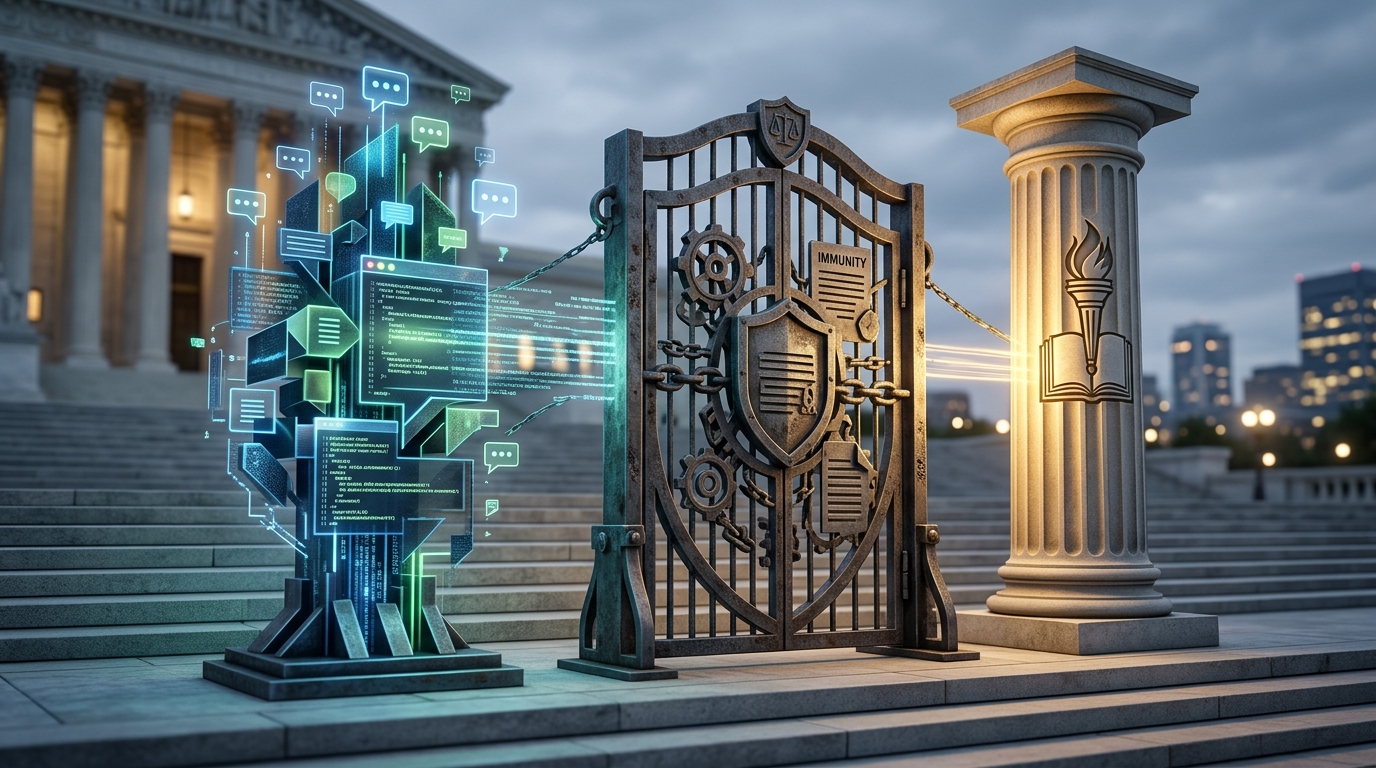
In the modern era, the internet has become the de facto public square, a digital arena where billions of individuals converge to share ideas, debate policy, and engage in civic discourse. However, unlike traditional public spaces owned by the government, this vast digital landscape is primarily owned and operated by private corporations. This reality has sparked intense friction between government leaders, who often feel their political messaging is being unfairly constrained, and technology companies, who assert their right to moderate their platforms as they see fit.
At the center of this tension lies a complex legal framework defined by the First Amendment of the U.S. Constitution and Section 230 of the Communications Decency Act of 1996. Over the years, political figures have repeatedly attempted to leverage the power of the federal government to compel social media networks into altering their editorial guidelines. These efforts frequently demonstrate a profound misunderstanding of how constitutional rights apply to private entities versus government actors, leading to high-profile legal clashes over the true nature of free speech online.
The Foundational Shield: Understanding Section 230
To grasp the mechanics of digital speech, one must first understand 47 U.S.C. § 230, often referred to as the twenty-six words that created the internet. Enacted as part of the Communications Decency Act of 1996, Section 230 provides a crucial liability shield for interactive computer services. The statute dictates that no provider or user of an interactive computer service shall be treated as the publisher or speaker of any information provided by another information content provider.
Congress passed this law in response to early internet litigation, specifically conflicting rulings involving online message boards. In one landmark case, Cubby, Inc. v. CompuServe Inc., a court ruled that an internet service provider could not be held liable for third-party defamation because it did not actively moderate the content. Conversely, in Stratton Oakmont, Inc. v. Prodigy Services Co., a court found a service liable precisely because it utilized content moderation guidelines to remove offensive material, thereby acting like a traditional publisher.
Realizing that the Prodigy ruling created a perverse incentive where platforms would abandon moderation entirely to avoid lawsuits, Congress authored Section 230. The law was explicitly designed to encourage the Good Samaritan blocking and screening of offensive material. It allows private companies to establish community guidelines, remove harmful content, and curate their platforms without assuming legal liability for every single piece of user-generated content hosted on their servers.
The First Amendment: A Protection Against the Government
A prevalent misconception in modern political discourse is the belief that private social media platforms are violating the First Amendment when they ban users or remove posts. The First Amendment strictly constrains state action; it dictates that Congress, and by extension the entire government apparatus, shall make no law abridging the freedom of speech. It does not impose this same restriction on private corporations.
In fact, the First Amendment protects the rights of private platforms to exercise editorial discretion. The legal precedent for this is firmly rooted in traditional media law. In the 1974 Supreme Court case Miami Herald Publishing Co. v. Tornillo, the Court unanimously struck down a state law that attempted to force newspapers to grant a right of reply to political candidates they had criticized. The Court ruled that the government cannot compel a private publisher to print material it disagrees with, as doing so violates the publisher’s own First Amendment right to editorial control and judgment.
When applied to digital platforms, this means that companies like Twitter, Facebook, and YouTube are exercising their own constitutional rights when they choose to label factually disputed content, de-amplify certain posts, or ban individuals who violate their terms of service. Government attempts to compel these companies to host all speech neutrally are widely viewed by constitutional scholars as a violation of the platforms’ right against compelled speech.
Executive Overreach vs. Statutory Law
The tension between political figures and tech platforms reached a crescendo when the executive branch attempted to unilaterally redefine these longstanding internet rules. A notable historical example is Executive Order 13925, titled Preventing Online Censorship, issued by President Donald Trump in May 2020. Prompted by social media companies adding fact-check labels to the President’s posts, the order directed federal agencies to interpret Section 230 in a way that would strip protections from platforms deemed to be engaging in deceptive or pretextual actions, essentially targeting platforms that exercised editorial discretion.
This attempt to bypass Congress highlighted a severe conflict with the separation of powers. Executive orders are directives managing the operations of the federal government; they cannot rewrite, erase, or reinterpret the explicit text of a federal statute passed by the legislative branch. Legal experts and civil liberties organizations quickly pointed out that the order was an unconstitutional act of retaliation designed to chill the protected speech of private companies.
The executive branch cannot compel independent agencies, such as the Federal Communications Commission (FCC) or the Federal Trade Commission (FTC), to act as a punitive arm against political adversaries. While the National Telecommunications and Information Administration (NTIA) did file a petition for rulemaking as directed by the order, the effort faced immense legal pushback. Ultimately, the executive order was officially revoked by the succeeding administration in May 2021 through Executive Order 14029, reinforcing the principle that changes to statutory frameworks must originate in Congress.
The Real-World Consequences of Altering Digital Protections
While there are legitimate policy debates surrounding the market dominance of large tech companies, algorithm transparency, and data privacy, aggressively dismantling Section 230 or forcing platforms to adhere to strict First Amendment neutrality would yield catastrophic results for online expression.
If platforms were stripped of their liability protections for curating content, the digital landscape would likely bifurcate into two extreme scenarios. The first is the cesspool effect. Afraid of being classified as publishers for attempting to moderate, platforms might abandon community guidelines entirely. This would turn mainstream networks into unnavigable hubs of harassment, spam, and extreme abuse, effectively drowning out constructive dialogue.
The alternative is the barren wasteland effect. To avoid lawsuits over user-generated content, platforms would proactively censor anything remotely controversial, risky, or unverified. In this heavily sanitized version of the internet, marginalized voices, independent journalists, and political activists would be the first to face sweeping bans, as their content inherently carries a higher risk of provoking legal challenges.
Comparing Legal Frameworks
To summarize the fundamental differences between these two critical pillars of online speech law, it is helpful to look at their distinct functions and protections:
| Framework | Primary Function | Who It Protects | What It Protects Against |
| The First Amendment | Protects free expression and editorial discretion from government interference. | Citizens, journalists, and private corporations. | Government censorship, retaliation, and compelled speech. |
| Section 230 (CDA) | Shields interactive computer services from civil liability regarding third-party content. | Internet Service Providers, website owners, and social media platforms. | Defamation lawsuits and liability for good-faith content moderation. |
Frequently Asked Questions (FAQs)
Does the First Amendment force social media platforms to host my speech?
No. The First Amendment only restricts government entities from suppressing speech. Private companies, including social media platforms, have their own First Amendment rights to establish community guidelines and decide what content they wish to host or remove. If a platform bans you, it is exercising its right to editorial discretion, not violating your constitutional rights.
Can a President change Section 230 with an Executive Order?
No. Section 230 is a federal statute passed by Congress. A President cannot unilaterally rewrite or repeal a law using an executive order. Executive orders can only direct how federal agencies operate within the bounds of existing law. Any substantive changes to the liability protections afforded to internet platforms must be legislated and passed by the U.S. Congress.
Why do we need Section 230 if the First Amendment already exists?
While the First Amendment protects a platform’s right to curate content, defending against lawsuits is incredibly expensive and time-consuming. Before Section 230, platforms risked being sued for defamation simply because they tried to remove offensive content. Section 230 provides an essential procedural shield, allowing courts to dismiss frivolous lawsuits quickly, which enables companies to moderate their platforms without the constant threat of bankruptcy through litigation.
Is content moderation considered censorship?
In a colloquial sense, people often use the word censorship when their content is removed. However, in legal terms, censorship strictly refers to the government suppressing speech. When a private platform removes content that violates its internal rules, it is engaging in content moderation and editorial discretion, which is a legally protected activity.
References
- Miami Herald Publishing Co. v. Tornillo, 418 U.S. 241 (1974) — Supreme Court of the United States. 1974-06-25. https://supreme.justia.com/cases/federal/us/418/241/
- 47 U.S.C. 230: Protection for private blocking and screening of offensive material — Office of the Law Revision Counsel / GovInfo. 2018-04-11. https://www.govinfo.gov/app/details/USCODE-2022-title47/USCODE-2022-title47-chap5-subchapII-partI-sec230
- Executive Order 13925—Preventing Online Censorship — Executive Office of the President / GovInfo. 2020-05-28. https://www.govinfo.gov/content/pkg/DCPD-202000404/pdf/DCPD-202000404.pdf
- Amdt1.7.12.1 Overview of Access and Editorial Discretion — Constitution Annotated, Library of Congress. 2024-07-01. https://constitution.congress.gov/browse/essay/amdt1-7-12-1/ALDE_00013540/
- Revocation of Certain Presidential Actions and Technical Amendment (EO 14029) — Federal Register. 2021-05-19. https://www.federalregister.gov/documents/2021/05/19/2021-10691/revocation-of-certain-presidential-actions-and-technical-amendment
Similar Articles








Read full bio of Sneha Tete


