
Determining Fault in Three-Car Accidents
Learn how fault is investigated, allocated, and argued in three-car crashes, and what it means for your insurance and legal rights.
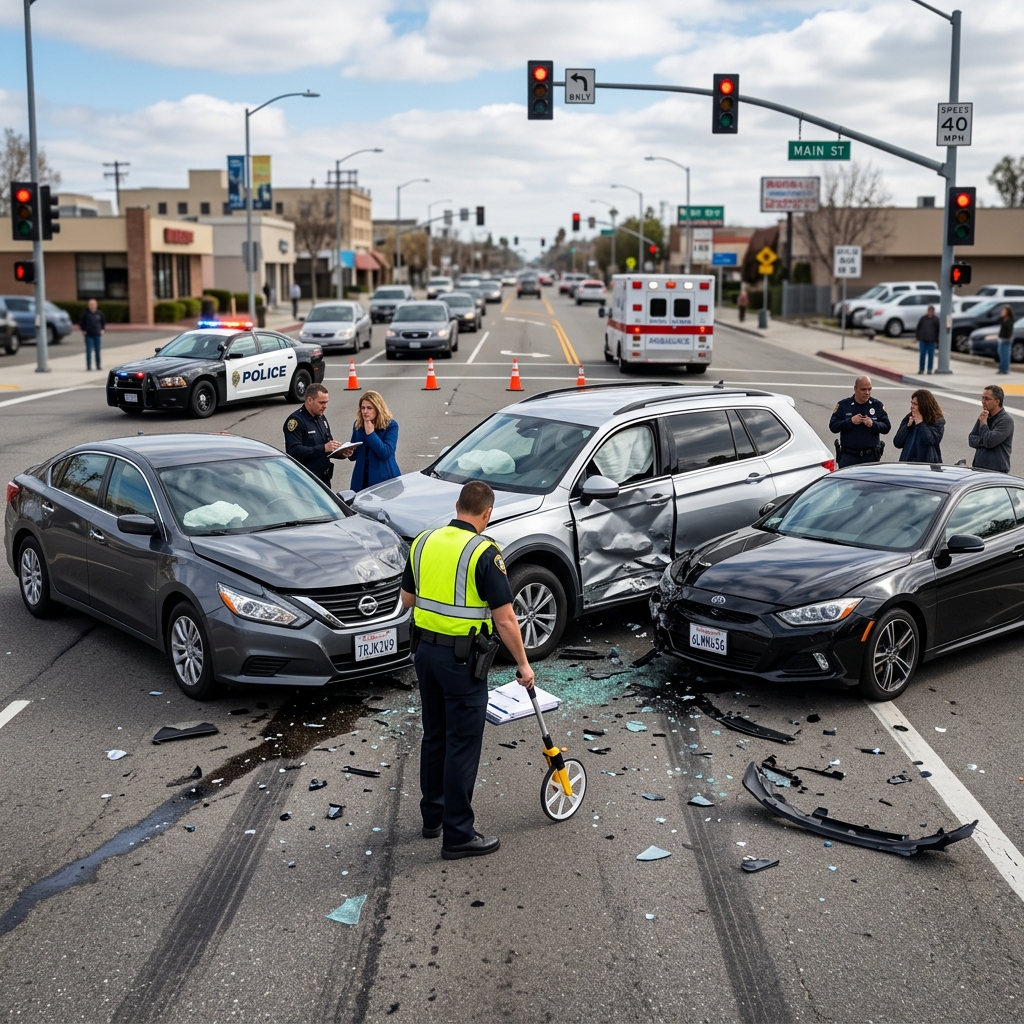
Three-car accidents are uniquely challenging because responsibility for the crash is rarely clear-cut. Instead of simply asking which of two drivers caused the collision, investigators, insurers, and attorneys must untangle how each driver’s decisions contributed to a chain of events. Understanding how fault is determined in these situations can help you protect your rights, communicate effectively with insurance companies, and decide whether to seek legal advice.
Why Three-Car Crashes Are More Complicated Than Two-Car Collisions
In a typical two-car accident, the central question is which driver acted negligently: who ran the red light, followed too closely, or failed to yield. In a three-car accident, several overlapping factors often come into play, and multiple drivers may share blame in different proportions.
Complexity arises because:
- More vehicles mean more possible sequences of impact, such as chain-reaction rear-end collisions or multiple side impacts.
- Different kinds of negligence can interact—for example, one driver speeding, another distracted, and a third following too closely.
- Road and traffic conditions may affect each vehicle differently, complicating the reconstruction of events.
- Insurance companies may disagree on how to apportion liability, leading to lengthy negotiations or litigation.
As a result, three-car crashes almost always involve a detailed investigation rather than a quick assignment of blame.
The Legal Foundation: Negligence and Fault
At the core of any car accident case is the legal concept of negligence. Negligence means failing to act with the level of care that a reasonably prudent person would use in similar circumstances.
In the context of driving, negligence can include:
- Ignoring traffic signals or signs.
- Speeding or driving too fast for conditions.
- Texting, calling, or otherwise driving while distracted.
- Following another vehicle too closely.
- Driving under the influence of alcohol or drugs.
To hold a driver legally responsible (liable) for a three-car accident, investigators and courts look for four elements:
- Duty of care: Every driver has a legal duty to operate their vehicle safely.
- Breach of duty: The driver failed to meet that duty through negligent behavior.
- Causation: The negligent act contributed to the collision and resulting injuries.
- Damages: The crash caused measurable losses, such as medical bills or property damage.
How Fault Is Investigated in a Three-Car Accident
Determining who is at fault in a three-car collision follows the same broad process as in a two-car crash but with more detail and coordination. Insurers and attorneys typically rely on several key forms of evidence.
Core Evidence Used to Determine Fault
- Police reports: Official crash reports often include diagrams, officer observations, suspected violations, and preliminary fault assessments.
- Witness statements: Bystanders and other drivers may help clarify the order of impacts, signal use, and driving behavior seconds before the collision.
- Photographs and videos: Scene photos, dashcam footage, and nearby surveillance video can show vehicle positions, skid marks, and traffic light status.
- Vehicle damage patterns: The location and severity of damage on each vehicle are often used to reconstruct who hit whom and in what sequence.
- Traffic laws: Investigators compare driver actions to applicable traffic rules to identify violations, such as failing to yield or following too closely.
- Accident reconstruction experts: In complex or high-damage crashes, specialists may be hired to model the collision using physics, vehicle data, and scene evidence.
- Medical records: Injury patterns sometimes help verify how and where occupants were struck.
Step-by-Step Investigation Approach
While each case is unique, the investigation into a three-car accident typically follows this general pattern:
- Collect information: Police respond to the scene, document basic facts, and gather driver and witness statements.
- Analyze vehicle positions: Investigators examine where the vehicles came to rest relative to lane markings, intersections, and traffic signals.
- Identify initial impact: Determining which vehicles collided first helps pinpoint the driver whose negligence set the chain reaction in motion.
- Apply traffic rules: Each driver’s actions are compared to relevant statutes and regulations to identify legal violations.
- Assign fault percentages: Insurers or courts allocate responsibility among the drivers based on how their actions contributed to the accident.
Common Three-Car Accident Scenarios and Fault Patterns
Although every crash is fact-specific, certain three-car scenarios occur frequently, and they illustrate how fault is often analyzed.
Chain-Reaction Rear-End Collision
One of the most common three-car accidents involves a line of vehicles traveling in the same direction. The rear vehicle hits the middle vehicle, which then strikes the front vehicle.
| Vehicle | Typical Position | Common Fault Considerations |
|---|---|---|
| Front car | Stopped or slowing | Usually not at fault unless it made a sudden, unsafe maneuver. |
| Middle car | Struck from behind, pushed into front | May share partial fault if following too closely, but often impacted primarily by rear car. |
| Rear car | Initiates chain reaction | Frequently bears the greatest share of responsibility for failing to maintain a safe distance. |
Insurance adjusters will examine whether the middle driver could have reasonably avoided hitting the front vehicle if they had maintained a safe following distance, and whether the front driver contributed by braking suddenly without cause.
Intersection Collisions Involving Three Vehicles
Another common scenario involves three vehicles meeting at an intersection, often with conflicting accounts of who had the right of way.
Key questions include:
- Which driver had the green light or the right of way at a stop sign?
- Did any driver run a red light or fail to yield while turning left?
- Was a third vehicle struck as a result of the first collision or because it entered the intersection unsafely?
Investigators may rely heavily on signal timing data, witness accounts, and video footage to build a timeline of events.
Lane-Change or Merging Crashes
Three-car accidents also arise during lane changes, merges onto highways, or attempts to avoid debris or hazards. Fault can be quite nuanced in these cases.
Questions that typically arise include:
- Did a driver change lanes without signaling or checking blind spots?
- Was another driver speeding or tailgating, reducing time to react?
- Did a third car have a realistic opportunity to avoid the collision?
Sometimes, one driver’s unsafe lane change triggers reactions from other drivers who then collide with each other. The driver who initiated the dangerous maneuver often bears substantial responsibility, but other drivers may share fault if they were distracted, speeding, or otherwise negligent.
How Different Negligence Rules Affect Your Recovery
Even after fault is assigned, the amount of compensation each driver can recover depends heavily on the negligence rules used in the state where the accident occurred. Laws differ significantly across the United States.
At-Fault vs. No-Fault Systems
- At-fault (tort) states: The driver or drivers found responsible must pay for damages, typically through their liability insurance. Injured parties usually pursue claims against the at-fault drivers’ insurers.
- No-fault states: For personal injury claims, drivers first seek benefits from their own insurance (usually personal injury protection coverage), regardless of who caused the accident. Property damage, however, often still depends on fault.
Comparative and Contributory Negligence
When more than one driver is at fault, states use different rules to decide how much each can recover.
- Pure comparative negligence: Each driver’s compensation is reduced by their percentage of fault, even if that share is very high. For example, in Arizona, a driver who is 80% responsible can still recover 20% of their damages.
- Modified comparative negligence: Drivers who are more than a set threshold (often 50% or 51%) at fault may be barred from recovering any damages. Those below the threshold receive compensation reduced by their fault percentage.
- Contributory negligence: In a small number of jurisdictions, a driver who is even 1% at fault cannot recover damages from other drivers. This rule can be harsh in multi-vehicle collisions.
These doctrines are crucial in three-car accidents because responsibility is often shared. Two drivers could each be partially at fault yet face different recovery rights depending on the state’s rules.
What Insurance Companies Do After a Three-Car Accident
Insurance adjusters play a central role in determining fault and negotiating settlements after a three-car crash. They conduct independent investigations and often interpret evidence differently from law enforcement or other insurers.
Insurer Investigation and Fault Allocation
Insurers typically:
- Review police reports and traffic citations for signs of negligence or rule violations.
- Interview their insured driver and, sometimes, other parties and witnesses.
- Examine photographs, vehicle repair estimates, and medical records.
- Apply relevant traffic laws and negligence rules in the state.
- Assign each driver a percentage of responsibility and calculate payouts accordingly.
Because each insurer is motivated to minimize its financial exposure, responsibility percentages may be disputed, especially when several drivers contributed to the crash. This can lead to delayed settlements or lawsuits to resolve disagreements.
Practical Steps to Protect Your Rights After a Three-Car Crash
If you are involved in a three-car accident, the actions you take immediately afterward can greatly influence how fault is determined and whether you receive fair compensation.
Immediate Actions at the Scene
- Ensure safety and call emergency services: Move to a safe location if possible and call 911 to report injuries and the collision.
- Cooperate with police: Provide factual information without speculating about fault or admitting liability.
- Gather contact information: Exchange details with all drivers and collect names and phone numbers of witnesses.
- Document the scene: Take photographs of vehicle positions, damage, skid marks, traffic signs, and road conditions.
Follow-Up Steps After Leaving the Scene
- Seek medical attention: Get evaluated, even if you feel fine; some injuries appear hours or days later.
- Notify your insurer promptly: Most policies require timely reporting of accidents. Provide necessary details but avoid giving recorded statements without understanding your rights.
- Keep a detailed file: Store police reports, medical bills, repair estimates, correspondence with insurers, and your own notes about symptoms and recovery.
- Consider legal advice: Because fault and compensation are often disputed in multi-vehicle crashes, many people consult a personal injury attorney to review evidence and negotiate with insurers.
Frequently Asked Questions About Three-Car Accident Fault
Can more than one driver be at fault in a three-car accident?
Yes. In many three-car accidents, multiple drivers share responsibility. Insurers or courts assign each driver a percentage of fault based on evidence, and compensation is adjusted accordingly under the state’s negligence rules.
Does the rear driver automatically bear full responsibility in a chain-reaction collision?
The rear driver often bears substantial responsibility for following too closely or failing to stop in time, but fault is not always automatic. Investigators also consider whether the middle and front drivers contributed through sudden braking, distraction, or other negligent acts.
What if my state uses no-fault insurance—does fault still matter?
In no-fault states, your own insurer typically covers medical expenses through personal injury protection, regardless of who caused the crash. However, fault still matters for property damage claims and for any lawsuits that exceed no-fault thresholds or involve serious injuries.
How can I strengthen my claim if I believe I am not primarily at fault?
Collect and preserve evidence: obtain the police report, gather photographs and video, document your injuries and treatment, and secure witness contact information. Consider speaking with an attorney who can analyze comparative negligence issues and present a clear argument to insurers or the court.
Is it worth hiring an accident reconstruction expert?
In serious or disputed three-car accidents, accident reconstruction experts can be valuable. They use engineering principles, physical evidence, and sometimes vehicle data to model the collision and help clarify the sequence of events and relative fault. These experts are often used in complex or high-value cases.
References
- Who Is At Fault In a Three-Car Accident? — FindLaw. 2024-05-01. https://www.findlaw.com/injury/car-accidents/who-is-at-fault-in-a-three-car-accident.html
- 3-Car Accidents: Who’s At Fault, Who Pays for Damages? — Davis, Saperstein & Salomon, P.C. 2023-08-10. https://injurylawyer.com/blog/3-car-accidents-whos-at-fault-who-pays-for-damages/
- How Is Fault Determined In A Car Accident In Tucson, AZ? — Zanes Law. 2023-06-15. https://zaneslaw.com/faq/how-is-fault-determined-in-a-car-accident-in-tucson-az/
- Who Is At Fault in a Three-Way Car Accident in Pennsylvania? — Kalray Law. 2022-11-20. https://kalraylaw.com/blog/three-way-car-accidents-whos-fault/
- How to Determine Fault in Multi-Vehicle Car Accidents — Resmini Law Offices. 2023-04-05. https://www.resminilawoffices.com/blog/how-to-determine-fault-in-multi-vehicle-car-accidents/
- How to Determine Liability in a Multi-Car Accident in Arizona — Valley Injury Team. 2023-02-18. https://valleyinjuryteam.com/how-to-determine-liability-in-a-multi-car-accident-in-arizona/
Similar Articles








Read full bio of medha deb


