
Key Legal Elements of a Breach of Contract Claim
Understand how valid contracts are formed, what constitutes a breach, and which elements you must prove to pursue a successful claim.
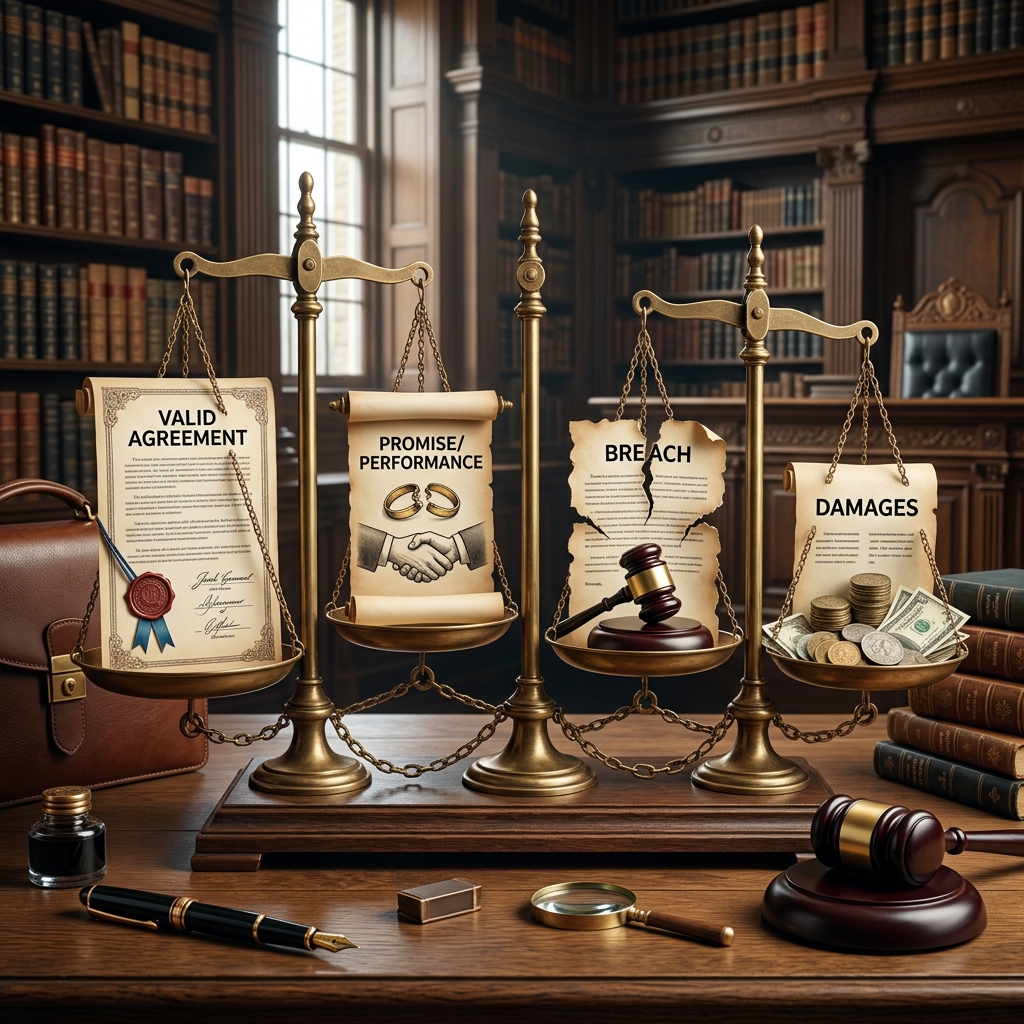
A breach of contract claim is one of the most common civil actions in modern courts. It arises whenever a party to a valid agreement fails to do what they promised, and that failure causes harm to the other party. To succeed, it is not enough to show that the agreement was broken. The claimant must prove several specific legal elements: a valid contract, performance or a lawful excuse, a breach, causation, and resulting damages.
This article explains those elements in plain language, shows how they work in practice, and highlights strategic issues you should consider before filing or defending a breach of contract lawsuit.
1. What Is a Breach of Contract?
At its core, a breach of contract occurs when a party bound by a valid contract fails to perform their promised obligations, either in whole or in part. If that failure is not legally justified and the other party suffers harm, the law may provide remedies.
Common ways a breach can occur include:
- Nonperformance: A party simply does not perform at all (for example, a seller never delivers goods).
- Defective performance: A party performs, but not in the manner or quality promised (such as delivering damaged goods).
- Late performance: Performance occurs, but after the time required in the contract, causing loss to the other party.
- Anticipatory breach: A party clearly indicates in advance that it will not perform, allowing the other party to treat the contract as broken before the due date.
Major vs. Minor Breach
Courts often distinguish between a material (major) breach and a minor (partial) breach. A major breach goes to the heart of the contract and usually excuses the non-breaching party from further performance, while a minor breach may entitle the injured party to damages but not to terminate the agreement entirely. Understanding this distinction is critical when deciding how to respond.
2. The Foundation: Existence of a Valid Contract
Without a valid contract, there can be no breach. The first and most fundamental element of any claim is proving that an enforceable agreement existed between the parties.
Core Requirements of a Valid Contract
While details vary by jurisdiction, U.S. contract law generally requires several key components for an agreement to be enforceable:
- Offer: One party makes a clear proposal to enter into a contract, specifying essential terms such as price, subject matter, and timing.
- Acceptance: The other party clearly agrees to the offer’s terms. Acceptance must usually mirror the offer; changing terms may be treated as a counteroffer instead of acceptance.
- Consideration: Each party gives something of value—money, goods, services, or a legal promise—in exchange for the other party’s promise.
- Mutual assent: Often described as a “meeting of the minds,” both sides must agree to be bound by the same essential terms.
- Capacity: The parties must have legal ability to contract (for example, not be minors or persons lacking mental capacity).
- Lawful purpose: The contract’s objective must be legal; agreements to engage in unlawful conduct are unenforceable.
Written vs. Oral Contracts
Many contracts can be formed orally and are still enforceable. However, certain types of agreements—such as those for the sale of real estate or contracts that cannot be performed within one year—typically must be in writing under statutes of frauds in various states. When available, a written contract makes it far easier to prove terms and obligations.
| Feature | Written Contract | Oral Contract |
|---|---|---|
| Proof of terms | Easier – terms appear in the document | Harder – relies on witness testimony and other evidence |
| Enforceability | Required for certain transactions (e.g., real estate) | Generally enforceable but subject to more disputes |
| Risk level | Lower; clearer record of obligations | Higher; greater chance of conflicting recollections |
3. Performance by the Claimant (or a Valid Excuse)
After establishing a valid contract, the claimant must show that they performed their contractual obligations or had a legally recognized excuse for not performing. Courts generally will not grant relief to a party who is themselves in substantial breach of the same contract.
Showing Performance
Proving performance often involves demonstrating that you:
- Delivered goods or services as promised.
- Paid amounts due under the contract on time.
- Complied with specified procedures, deadlines, or conditions.
Evidence might include invoices, delivery receipts, emails confirming completion, bank records, or testimony from witnesses who observed performance.
Lawful Excuses for Nonperformance
In some cases, a claimant can prevail even without full performance if there is a legitimate legal excuse, such as:
- Prior material breach by the other party: If the defendant seriously breached first, the claimant may be excused from further obligations.
- Impossibility or impracticability: Unforeseen events make performance truly impossible or extremely difficult, and the law recognizes this as a defense.
- Mutual rescission: The parties agree to cancel the contract.
The key question is whether the claimant acted in good faith and had a legally recognized reason for not strictly following the contract’s terms.
4. Identifying and Proving the Breach
The next essential element is showing that the defendant failed to perform as the contract required. This involves both identifying which provision was violated and explaining how the defendant’s conduct departed from what the agreement mandated.
Types of Breach Courts Commonly See
- Failure to deliver: Goods or services are not provided at all.
- Failure to pay: The defendant does not pay the agreed price or pays late.
- Quality defects: Performance is below the agreed standard or specifications.
- Violation of specific terms: The defendant breaks confidentiality, non-compete, or other special clauses.
Evidence of Breach
Establishing breach typically requires linking documentary and testimonial evidence to specific contractual obligations. Useful evidence can include:
- The written contract or proof of the oral agreement.
- Emails or letters acknowledging failure to perform.
- Inspection reports or expert opinions showing defective performance.
- Payment records demonstrating missing or late payments.
Courts ask: Did the defendant do what the contract required, when and how it was required? If not, and no valid defense applies, there is a breach.
5. Damages and Causation: Linking Harm to the Breach
Even with a clear breach, a claim will fail if the plaintiff cannot prove actual damages caused by that breach. Damages are the monetary measure of the loss suffered due to the defendant’s misconduct.
Essential Components
- Actual harm: The plaintiff was financially or otherwise harmed (for example, lost profits, replacement costs, or wasted expenditures).
- Cause in fact: The breach was a factual cause of the harm—the loss would not have occurred without it.
- Proximate cause: The harm was a reasonably foreseeable result of the breach, not a far-removed consequence.
Common Types of Contract Damages
Courts may award several categories of damages, depending on the jurisdiction and facts:
- Expectation damages: Aim to put the plaintiff in the position they would have been in if the contract had been properly performed (often lost profits or replacement cost).
- Reliance damages: Compensate expenses incurred relying on the contract, such as preparation and investment costs.
- Restitution: Return benefits conferred to the breaching party to prevent unjust enrichment.
- Consequential damages: Cover foreseeable secondary losses (for example, additional business losses due to late delivery), sometimes limited by the contract.
Proof of Damages
To recover, plaintiffs should present clear, organized evidence of their losses, such as:
- Invoices and receipts showing extra costs.
- Financial statements evidencing lost revenue.
- Expert testimony quantifying complex damages.
Courts will not award speculative damages; losses must be reasonably certain and tied to the breach.
6. Legal Defenses That Can Undermine a Breach of Contract Claim
Even when the plaintiff appears to meet all elements, the defendant may raise legal defenses. These defenses can defeat or reduce liability.
- No valid contract: Alleging that one of the foundational elements (offer, acceptance, consideration, capacity, lawful purpose) was missing.
- Statute of limitations: The claim was filed too late under state law, which often sets specific time limits for contract actions.
- Mutual mistake or misrepresentation: Both parties misunderstood essential facts, or one party was misled.
- Impossibility or frustration of purpose: Unforeseen events made performance impossible or destroyed the contract’s core purpose.
- Prior breach by plaintiff: The plaintiff’s own material breach excuses the defendant’s nonperformance.
Analyzing potential defenses early is crucial for both sides when assessing the strength of a case.
7. Practical Litigation Considerations
Bringing or defending a breach of contract case involves more than understanding legal elements. Strategic decisions about evidence, timing, and remedies strongly influence outcomes.
Gathering Evidence
Parties should systematically collect and preserve relevant documents and records, including:
- The contract or proof of the agreement (emails, proposals, purchase orders).
- Communications about performance problems.
- Financial records showing the impact of the breach.
- Photographs, inspection reports, or expert analyses.
- Internal notes or memos regarding decisions about performance.
Choosing Remedies
Depending on jurisdiction and the nature of the contract, available remedies may include:
- Monetary damages to compensate for losses.
- Specific performance – a court order requiring the breaching party to carry out their contractual promise, often used for unique items such as real property.
- Rescission – canceling the contract and restoring parties to their pre-contract positions.
- Declaratory judgment – a court’s formal interpretation of contract rights and obligations.
8. FAQ: Common Questions About Breach of Contract
Q1: Do I need a written contract to sue for breach?
No. Many contracts can be oral and still enforceable. However, certain agreements, such as those involving real estate or long-term obligations, generally must be in writing, and written contracts are far easier to prove in court.
Q2: What if both parties failed to perform?
Courts often examine which party’s breach was material and occurred first. If both sides are in breach, the party whose violation was more significant may be denied relief, or damages may be offset.
Q3: Can I recover for emotional distress from a contract breach?
Generally, contract damages focus on economic losses, not emotional harm. Only in rare circumstances—such as contracts that inherently involve personal interests—might non-economic damages be considered, and many jurisdictions still limit them.
Q4: How long do I have to file a breach of contract lawsuit?
Time limits vary by state. For example, some jurisdictions impose a four-year statute of limitations for certain written contracts. You should consult local law or an attorney quickly to avoid missing the deadline.
Q5: What should I do if I suspect a breach is about to occur?
If you reasonably believe the other party will not perform (anticipatory breach), you may have the right to treat the contract as broken and seek remedies earlier. It is often wise to document your concerns, request clarification in writing, and obtain legal advice before taking action.
References
- breach of contract | Wex — Legal Information Institute (Cornell Law School). 2023-05-01. https://www.law.cornell.edu/wex/breach_of_contract
- When a contract is broken (breach of contract) — California Courts Self-Help. 2024-01-10. https://selfhelp.courts.ca.gov/civil-lawsuit/breach-contract
- CACI No. 303. Breach of Contract – Essential Factual Elements — Judicial Council of California / Justia. 2024-01-01. https://www.justia.com/trials-litigation/docs/caci/300/303/
- Understanding Breach of Contract Elements — White and Bright, LLP. 2023-08-15. https://www.whiteandbright.com/breach-of-contract-elements/
- 4 Elements of a Breach of Contract Claim (and more) — Griffiths Law PC. 2023-06-20. https://www.griffithslawpc.com/resources/elements-of-a-breach-of-contract-claim/
- What Are the Elements of a Breach of Contract Claim? — Smid Law. 2022-11-30. https://www.smidlaw.com/blog/what-are-the-elements-of-a-breach-of-contract-claim/
- What Are the Elements of a Breach of Contract in Arizona? — Weiss Brown. 2023-04-05. https://www.weissbrown.com/what-are-the-elements-of-a-breach-of-contract-in-arizona/
Similar Articles








Read full bio of medha deb


