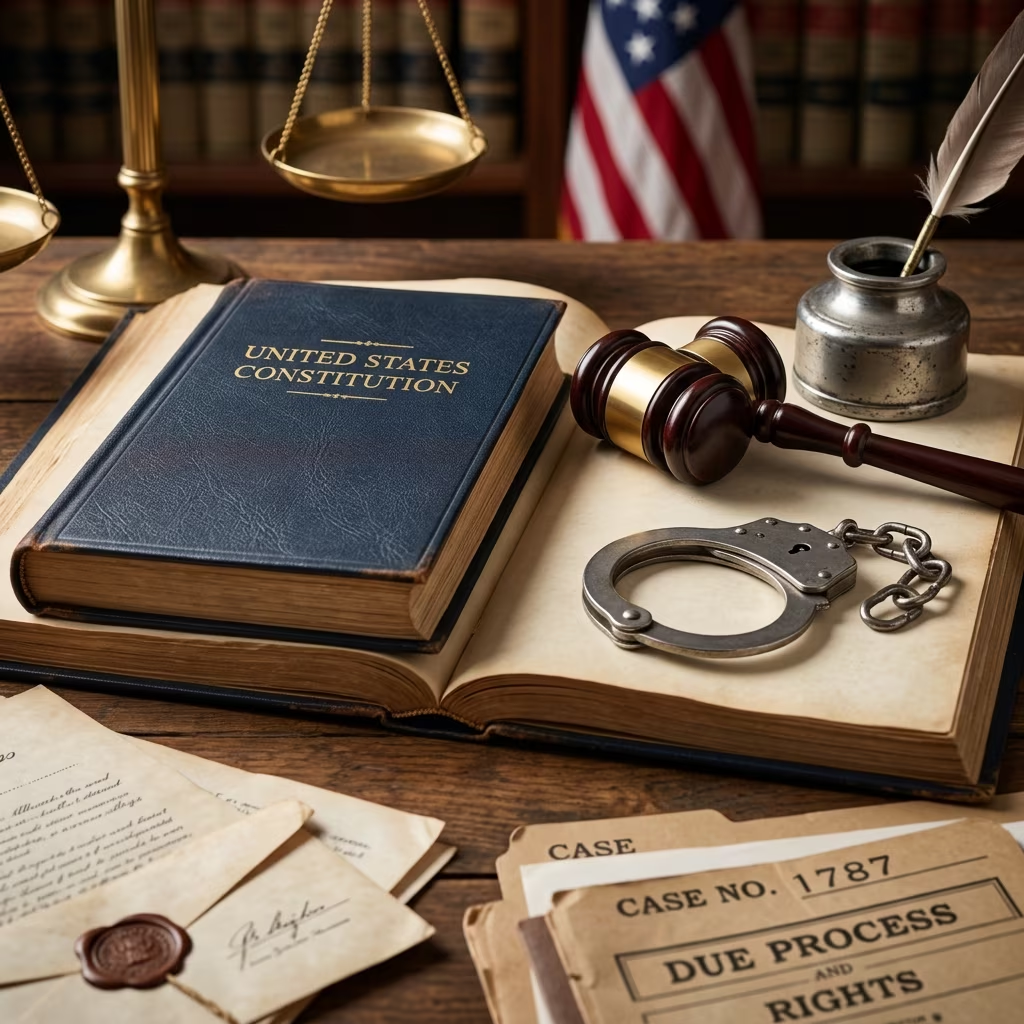
The U.S. Constitution places important limits on how the government investigates, charges, tries, and punishes people accused of crimes. These protections are designed to reduce unfair treatment, preserve reliable evidence, and make sure criminal cases are decided through lawful procedures rather than unchecked power.
Although the details can vary by case, the basic idea is consistent: the government must follow rules when it accuses someone of a crime. Those rules begin with police conduct, continue through the courtroom, and remain relevant at sentencing and in post-trial proceedings.
Why constitutional protections matter
Criminal cases can affect a person’s liberty, reputation, finances, and future opportunities. Because of that, constitutional law gives defendants a set of procedural safeguards that help ensure the government proves its case fairly and lawfully.
These protections are especially important because prosecutors and police usually have more power, more resources, and more tools than the person accused of a crime. Constitutional rights help balance that inequality by limiting what the state can demand or do.
The main amendments involved
Most of the core criminal protections come from the Fourth, Fifth, Sixth, and Eighth Amendments. In state cases, the Fourteenth Amendment makes many of those protections applicable to state governments through the doctrine of incorporation.
| Amendment | Main protection |
|---|---|
| Fourth Amendment | Limits unreasonable searches and seizures |
| Fifth Amendment | Protects against self-incrimination and double jeopardy |
| Sixth Amendment | Guarantees trial rights such as counsel, confrontation, and a speedy public trial |
| Eighth Amendment | Bars excessive bail and cruel and unusual punishment |
In practice, criminal defense lawyers often evaluate these protections together because one police action or courtroom ruling can affect several constitutional rights at once.
Protection against unreasonable searches and seizures
The Fourth Amendment prevents government agents from conducting unreasonable searches and seizures. As a general rule, police need a warrant supported by probable cause before they search a person, home, or private property, unless a recognized exception applies.
This protection matters because evidence found through an unlawful search may be challenged in court. The rule is meant to discourage arbitrary police action and protect personal privacy.
- Police usually need probable cause before seeking a warrant.
- Searches without proper legal authority may be disputed as unconstitutional.
- Evidence can sometimes be excluded if it was obtained through an illegal search.
The Fourth Amendment does not stop all searches, but it requires legal justification for government intrusion. That makes the amendment one of the first constitutional protections that may come into play in a criminal investigation.
The right to remain silent and avoid self-incrimination
The Fifth Amendment protects a person from being compelled to testify against themselves in a criminal case. In everyday terms, this means a suspect or defendant generally cannot be forced to provide the government with self-incriminating statements.
This right is closely associated with Miranda warnings, which inform a suspect of the right to remain silent and the right to an attorney during custodial questioning. While people often focus on the warning itself, the deeper constitutional principle is that the government should not coerce a person into supplying the evidence needed to convict them.
- A person may choose not to answer police questions.
- Silence cannot lawfully be treated as a forced confession.
- Statements made during interrogation may be challenged if rights were not properly explained or respected.
The privilege against self-incrimination helps preserve fairness by requiring the prosecution to prove guilt through lawful evidence rather than forced admissions.
Protection from double jeopardy
The Fifth Amendment also contains the double jeopardy rule, which bars a person from being prosecuted twice for the same offense after an acquittal or conviction. It also limits repeated punishments for the same criminal conduct.
This protection is important because the government should not be able to keep retrying a case until it gets the outcome it wants. Finality matters in criminal law, both for defendants and for the justice system as a whole.
Double jeopardy rules can be complex when cases involve mistrials, overlapping offenses, or both federal and state charges. Even so, the core principle remains the same: once the law has given the government its fair chance, it cannot endlessly relitigate the same case.
Trial rights guaranteed by the Sixth Amendment
After formal charges are filed, the Sixth Amendment becomes especially important. It gives criminal defendants several trial-related rights that are central to a fair proceeding, including the right to counsel, the right to a speedy and public trial, and the right to confront witnesses.
These rights work together. A public trial promotes transparency, counsel helps the defendant navigate the case, and confrontation allows the defense to test the credibility of adverse witnesses.
The right to counsel
The Sixth Amendment guarantees the assistance of counsel for the defense. If a defendant cannot afford a lawyer, the government must provide one in qualifying criminal cases.
This right is more than a formality. A lawyer can investigate facts, challenge illegal police conduct, negotiate with prosecutors, and present defenses that a layperson might overlook. The constitutional promise of counsel reflects the reality that criminal procedure is too complex for most people to handle alone.
The right to confront witnesses
The confrontation right allows the accused to face and question witnesses who testify against them. In practical terms, this means the defense can cross-examine adverse witnesses and test whether their statements are reliable.
This safeguard matters because criminal cases often depend on witness testimony. Cross-examination can expose bias, memory problems, inconsistent statements, or exaggeration, all of which help the factfinder evaluate credibility.
The right to a speedy and public trial
The Constitution requires that criminal proceedings move without unreasonable delay and that trials generally be open to the public.
A speedy trial protects defendants from prolonged uncertainty, lost evidence, and the stress of having unresolved charges hanging over them. A public trial helps prevent secret proceedings and increases confidence that the case is being handled fairly.
- Unreasonable delay can harm the defense.
- Public hearings promote transparency.
- Privacy concerns or safety concerns may affect access in limited circumstances.
The right to an impartial jury
The Sixth Amendment also guarantees an impartial jury in criminal prosecutions. The idea is that guilt should be decided by unbiased citizens, not by a judge alone or by a jury tainted by prejudice.
In federal criminal trials, the jury must generally reach a unanimous verdict. State rules can differ on certain details, but the constitutional commitment to impartial decision-making remains central.
The right to know the charges
Accused persons must be informed of the nature and cause of the accusation. This gives the defense enough notice to understand what the government claims happened and to prepare a response.
Without clear notice, a defendant cannot meaningfully challenge the prosecution’s theory. For that reason, charging documents must be specific enough to identify the alleged offense and the conduct at issue.
How these rights apply in state cases
Originally, many Bill of Rights protections restricted only the federal government. Over time, however, the Fourteenth Amendment extended most of the major criminal procedure guarantees to the states through incorporation.
That means state and local prosecutors must also respect core federal constitutional protections in criminal cases. This is a major reason defendants in both federal and state courts can invoke many of the same fundamental rights.
The Eighth Amendment and limits on punishment
The Eighth Amendment prohibits excessive bail, excessive fines, and cruel and unusual punishment.
This amendment matters at different stages of a criminal case. Bail rules affect whether a defendant can await trial at home or in custody. Sentencing rules affect the legality and severity of punishment after conviction. The amendment is meant to keep the punishment process within constitutional bounds.
- Courts may not impose bail that is excessive compared with the case.
- Fines cannot be disproportionate or abusive.
- Punishments may not cross the line into cruel and unusual treatment.
What happens when rights are violated
When constitutional rights are violated, the consequences can be significant. Depending on the issue, a defendant may seek to suppress evidence, challenge a confession, demand dismissal of charges, or appeal a conviction.
In some situations, a person may also pursue a civil claim against government actors if the violation was committed by someone acting on behalf of the state. Those claims are separate from the criminal case itself, but they can provide another avenue for accountability.
The remedy usually depends on the nature of the violation. A minor procedural mistake will not always undo a prosecution, but serious constitutional errors can affect the admissibility of evidence or the validity of the trial.
Common examples of constitutional issues in practice
Constitutional questions come up often in real criminal cases. Some of the most common issues involve police searches, interrogation practices, access to a lawyer, delays in getting to trial, and the fairness of witness testimony.
| Issue | Possible constitutional concern |
|---|---|
| Traffic stop and vehicle search | Whether officers had lawful grounds for the search |
| Police questioning | Whether the suspect was informed of the right to remain silent and counsel |
| Delayed prosecution | Whether the delay violated the right to a speedy trial |
| Trial testimony | Whether the defendant had a fair chance to cross-examine witnesses |
| Sentencing or bail | Whether the punishment or bail amount was excessive |
Because these issues can shape the outcome of a case, constitutional review is often a central part of criminal defense strategy.
Frequently asked questions
Can police search you without a warrant? Sometimes, but the Fourth Amendment generally requires warrants based on probable cause unless a recognized exception applies.
Do you have to answer police questions? No. The Fifth Amendment protects against compelled self-incrimination, and suspects commonly have the right to remain silent.
What does a speedy trial mean? It means the government cannot unreasonably delay a criminal case, although exact timing rules depend on the circumstances and applicable law.
Can a defendant get a lawyer for free? If the defendant is eligible and cannot afford counsel, the Sixth Amendment requires the government to provide one in qualifying criminal cases.
Do these rights apply in state court? Yes. Through the Fourteenth Amendment, many federal criminal procedure protections apply to state prosecutions as well.
Why these protections remain essential
Constitutional rights in criminal cases are not abstract legal ideas. They shape how evidence is gathered, how charges are defended, how juries hear cases, and how punishment is imposed.
By requiring lawful procedures, these protections help ensure that criminal verdicts are based on reliable proof and fair process rather than coercion, secrecy, or arbitrary power.
References
- Criminal Justice provisions in the Bill of Rights — EBSCO. 2025-01-01. https://www.ebsco.com/research-starters/law/criminal-justice-provisions-bill-rights
- Your Basic Constitutional Rights in the Criminal Justice System — Georgia Legal Aid. 2024-01-01. https://www.georgialegalaid.org/resource/your-basic-constitutional-rights-in-the-crimi
- Criminal Rights Law — FindLaw. 2025-01-01. https://www.findlaw.com/criminal/criminal-rights.html
- The United States Constitution and Criminal Defense — AR Smith Law Office. 2025-01-01. https://www.arsmithlawoffice.com/the-united-states-constitution-and-criminal-defense
- Constitutional Rights in Criminal Law Proceedings — Justia. 2025-01-01. https://www.justia.com/criminal/procedure/other-constitutional-rights/
- Amendment 6 – “The Rights of the Defendant” — Ronald Reagan Presidential Library. 2024-01-01. https://www.reaganlibrary.gov/education/lesson-plans/high-school/constitutional-amendments/constitutional-amendments-amendment-6
- Overview of Procedural Due Process in Criminal Cases — U.S. Constitution Annotated, Congress.gov. 2025-01-01. https://constitution.congress.gov/browse/essay/amdt14-S1-5-5-1/ALDE_00013759/
- What Are Your Rights If Accused of a Crime in Florida? — Michelle Suskauer. 2024-01-01. https://michellesuskauer.com/your-rights/