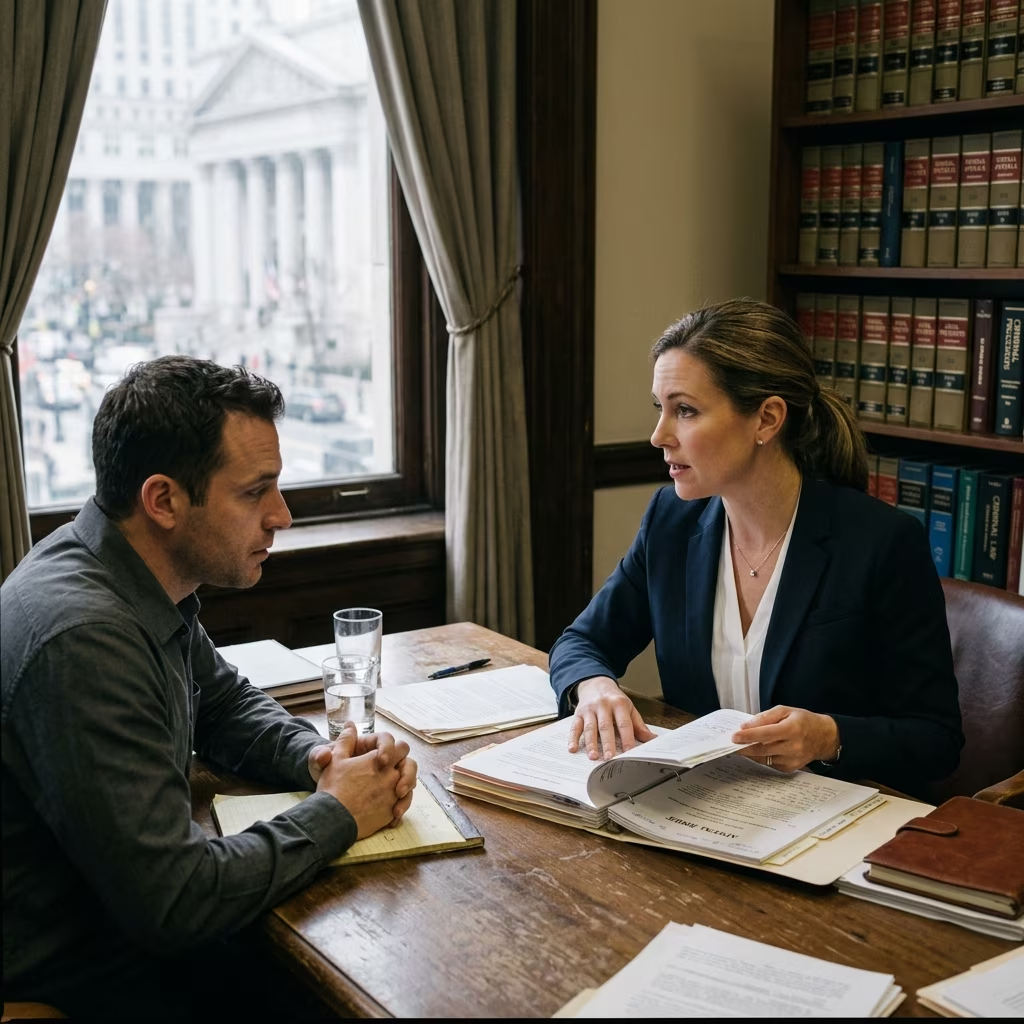
When a person is convicted of a crime, the case does not necessarily end with the verdict or sentencing. Many defendants pursue a criminal appeal, asking a higher court to review the case for legal errors or constitutional violations. In that process, having competent legal counsel is critical. The law not only guarantees a lawyer but, in many circumstances, guarantees effective assistance of counsel during appeals, especially in the first direct appeal as of right.
This article explains the role of legal counsel in criminal appeals, the constitutional right to effective assistance, what happens when counsel is ineffective, and how defendants can seek relief using appeals and post-conviction procedures.
Foundations of the Right to Counsel in Criminal Cases
In the United States, the right to counsel is primarily rooted in the Sixth Amendment to the Constitution, which guarantees criminal defendants the assistance of an attorney in serious criminal prosecutions. While the Sixth Amendment is often discussed in the context of trial representation, its protection extends to certain appellate stages as well.
- Trial level – Defendants facing possible imprisonment are entitled to a lawyer, and if they cannot afford one, the court must appoint counsel.
- Direct appeal – In most jurisdictions, defendants have a right to counsel for their first appeal from a criminal conviction.
- Post-conviction and collateral review – Later stages (such as state post-conviction motions or federal habeas petitions) often involve different rules. Some systems provide counsel, especially for complex cases or where an evidentiary hearing is required, while others do not.
The underlying purpose of the right to counsel is to ensure that defendants can navigate a complex legal system and that the adversarial process produces reliable, fair results.
Effective Assistance of Counsel: Legal Standard
The right is not merely to have a lawyer present; it is to have effective assistance of counsel. An attorney who is unprepared, uninformed, or grossly negligent can undermine the fairness of the proceedings.
The leading standard comes from the U.S. Supreme Court case Strickland v. Washington. Under Strickland, a defendant challenging counsel’s performance must show two separate elements:
- Deficient performance – The lawyer’s actions or omissions fell below an objective standard of reasonableness, judged in light of prevailing professional norms.
- Prejudice – There is a reasonable probability that, if the lawyer had acted competently, the result of the proceeding would have been different, and the deficiency undermines confidence in the outcome.
Courts typically presume that attorneys act reasonably. The defendant bears the burden of proving both deficient performance and resulting prejudice. If either element is missing, the ineffective assistance claim fails.
Common Examples of Deficient Performance
Deficient representation can occur in many ways. In the appellate context, common problems include:
- Missing filing deadlines or failing to timely file a notice of appeal.
- Overlooking strong legal issues that could lead to reversal.
- Ignoring constitutional claims such as unlawful searches or violations of due process.
- Submitting generic, boilerplate briefs without tailored legal analysis.
- Failing to review the trial record carefully, resulting in missed objections or errors.
Not every mistake amounts to ineffective assistance. Courts distinguish between reasonable strategic decisions and genuine errors that no competent lawyer would make.
Role of Counsel in the Criminal Appeals Process
A criminal appeal is a request to a higher court to review the trial court’s decision for errors of law. Appellate counsel plays a central role at each stage.
Key Stages of a Typical Appeal
| Stage | Primary Role of Counsel |
|---|---|
| Notice of Appeal | File the notice within the strict deadline to preserve the right to appeal. |
| Record Preparation | Ensure transcripts and exhibits are assembled properly for appellate review. |
| Appellate Briefs | Research, identify, and present legal errors and constitutional issues in written arguments. |
| Oral Argument | Address judges’ questions, clarify key points, and emphasize why relief is warranted. |
| Post-Decision Options | Advise on further appeals, petitions to higher courts, or post-conviction motions. |
Effective counsel must recognize which issues are strongest and avoid diluting the appeal with weak arguments. Strategic selection of issues is often as important as the drafting of the brief.
What Happens When Appellate Counsel Is Ineffective?
Sometimes the lawyer handling an appeal performs so poorly that the defendant’s rights are compromised. When that happens, the law provides avenues to challenge the conviction based on ineffective assistance of appellate counsel.
Direct Appeal vs. Post-Conviction Remedies
Claims of ineffective counsel are typically raised after the direct appeal, not during it. Many jurisdictions treat ineffective assistance as a separate, collateral claim requiring its own procedure.
- Direct appeal – Focuses on errors visible in the trial record, such as incorrect jury instructions or unlawful admission of evidence.
- Post-conviction motion or habeas corpus – Used to develop a new factual record showing counsel’s deficiencies (for example, through affidavits, new evidence, or hearings).
Because ineffective assistance often involves facts outside the trial record—like failure to investigate or failure to consult experts—courts usually prefer that these claims be raised in a dedicated post-conviction proceeding.
Procedures Vary by Jurisdiction
Each state has its own mechanism for challenging ineffective appellate counsel. For example, some jurisdictions use a specific motion in the appellate court that originally heard the case, whereas others integrate ineffective counsel claims into a broader post-conviction framework.
Though the labels differ, the core idea is consistent: defendants must follow the prescribed procedure and meet filing deadlines, or risk having their claims dismissed as untimely or procedurally barred.
Identifying Ineffective Assistance of Counsel
Determining whether counsel was ineffective requires a careful, case-specific analysis. Courts and practitioners generally look for both serious errors and a connection to the outcome.
Questions Defendants Should Ask
- Did my lawyer explain the appeals process and my options clearly?
- Were all important deadlines met, including the notice of appeal?
- Did counsel thoroughly review the trial transcript and evidence for possible errors?
- Were strong legal issues raised in the appellate brief, or were key points ignored?
- Did counsel respond adequately to motions and orders from the court?
A “bad outcome” alone does not prove ineffective assistance. Even excellent lawyers lose cases when the facts or law are unfavorable. The question is whether the representation fell below reasonable professional standards and affected the result.
Examples of Potential Ineffective Assistance
The following scenarios may raise concerns:
- Your lawyer missed the deadline for filing your appeal, causing the case to be dismissed.
- Counsel failed to challenge an obvious constitutional violation, such as a clearly unlawful search.
- Important exculpatory evidence or expert testimony was never examined or presented.
- The appellate brief was extremely short and lacked legal authority, suggesting minimal effort.
Even in such situations, courts will still ask whether the errors likely changed the outcome. If the evidence against the defendant was overwhelming, it may be harder to show prejudice.
Grounds for Criminal Appeal Beyond Counsel Issues
While ineffective assistance of counsel is one ground for relief, appeals commonly involve several other types of claims. Understanding these helps explain how counsel should properly structure an appeal.
- Legal errors – Misinterpretation or misapplication of the law by the trial judge.
- Procedural violations – Failures to follow fair trial procedures, such as improper jury instructions or evidentiary rulings.
- Constitutional violations – For instance, unlawful searches, coerced confessions, or violations of the right to confront witnesses.
- Insufficient evidence – Claims that no reasonable jury could have found guilt beyond a reasonable doubt based on the trial record.
- Sentencing errors – Mistakes in applying sentencing guidelines or statutory ranges.
Effective counsel must evaluate all potential grounds, select those with the greatest support in the record and law, and present them persuasively to the appellate court.
Strategic Considerations in Raising Ineffective Counsel Claims
Defendants and their lawyers must decide when and how to raise ineffective assistance claims. Doing so prematurely or in the wrong forum can harm the case.
Timing and Procedural Strategy
Many practitioners advise against raising ineffective assistance during the direct appeal unless the record already clearly shows the deficiencies. Because appeals are limited to the trial record, issues requiring new evidence are difficult to litigate at that stage.
- If the ineffective assistance is clear from the trial record (for example, counsel’s failure to object to obvious errors), the issue might be raised on direct appeal.
- If proof requires new evidence (such as proof that counsel failed to investigate alibi witnesses), post-conviction motions or habeas petitions are usually more appropriate.
Choosing the right procedural path is crucial. Missteps can lead to procedural default, meaning the claim is barred because it was not raised properly or timely.
How Defendants Can Protect Their Rights
Defendants who suspect ineffective assistance of counsel should act promptly and gather information to support their claims.
Practical Steps
- Request your case file – Obtain copies of the trial record, appellate briefs, and correspondence with your lawyer.
- Consult another attorney – Seek a second opinion from a lawyer experienced in criminal appeals and post-conviction litigation.
- Document concerns – Write down specific dates, actions, and omissions that you believe demonstrate ineffective assistance.
- Check deadlines – Learn the time limits for appeals and post-conviction motions in your jurisdiction. Missing these deadlines can be fatal to your claim.
- Consider expert input – In complex cases, consulting experts (such as forensic specialists) can help show what competent counsel should have done.
Because the standards and procedures are technical, most defendants benefit from professional legal advice rather than attempting to navigate the process alone.
Frequently Asked Questions (FAQs)
Do I always have a right to counsel for my appeal?
Most defendants have a right to counsel for their first direct appeal from a criminal conviction, especially when the appeal is considered part of the criminal process. Later discretionary appeals or collateral proceedings may have different rules, and appointed counsel is not guaranteed in every circumstance.
Can I raise ineffective assistance of counsel on direct appeal?
In some situations you can, particularly when the deficiencies are apparent from the trial record and no additional evidence is needed. However, many courts prefer ineffective assistance claims to be raised in post-conviction proceedings where new evidence can be presented and a fuller factual record developed.
Is poor communication by my lawyer enough to prove ineffective assistance?
Poor communication may be a sign of problematic representation, but courts look for both deficient performance and prejudice. To succeed, you must show that the lawyer’s failures were objectively unreasonable and that they likely changed the outcome of your case.
What if my appellate lawyer missed the deadline to file my appeal?
Missing a filing deadline can be a serious error and may support an ineffective assistance claim, especially if you clearly asked the lawyer to file the appeal and would otherwise have had a valid challenge. The appropriate remedy depends on jurisdiction, but can include reinstatement of appellate rights or other relief through post-conviction proceedings.
Can I get a new trial if I prove ineffective assistance of counsel?
If you successfully demonstrate both deficient performance and prejudice, courts may grant various forms of relief. Common outcomes include a new trial, resentencing, or restoration of appeal rights, depending on where the error occurred and how it affected the case.
Conclusion: The Importance of Competent Counsel in Appeals
Criminal appeals are highly technical, and the stakes—liberty, criminal records, and future opportunities—are significant. The law recognizes that without effective assistance of counsel, the appellate process cannot reliably correct trial-level errors or protect constitutional rights. By understanding the standards for ineffective assistance, the structure of appeals, and the procedures for challenging poor representation, defendants are better equipped to safeguard their rights and seek justice after conviction.
References
- Effective Assistance of Counsel — Legal Information Institute, Cornell Law School. 2023-01-01. https://www.law.cornell.edu/wex/effective_assistance_of_counsel
- Criminal Appeals — Office of the Missouri Attorney General. 2022-05-01. https://ago.mo.gov/divisions/criminal-appeals/
- Criminal Appeals Attorney in Kansas City, Missouri — John Picerno, Attorney at Law. 2021-09-15. https://johnpicerno.com/practice-areas/criminal-appeals/
- Fairfax Federal Criminal Appeals Attorneys — Sandground, West, Silek, Raminpour & Landers, PLC. 2023-03-10. https://www.swsrlaw.com/what-we-do/criminal-defense/federal-criminal-appeals/
- Ineffective Assistance of Counsel in Illinois Appeals — The Defense Group. 2020-11-20. https://www.defenseadvocates.com/ineffective-counsel-in-criminal-appeals/
- Appealing Your Conviction Based on Ineffective Assistance of Counsel — Columbia Jailhouse Lawyer’s Manual, Ch. 12. 2017-05-01. https://jlm.law.columbia.edu/files/2017/05/24.-Ch.-12.pdf
- The Promise of Effective Assistance of Counsel: Good Enough Isn’t Good Enough — National Association of Criminal Defense Lawyers. 2012-06-01. https://www.nacdl.org/Article/June2012-ThePromiseofEffectiveAssistanc