
Custodial Interrogation and Your Courtroom Rights
Understand how police questioning, Miranda warnings, and courtroom stages interact to shape your constitutional protections in a criminal case.
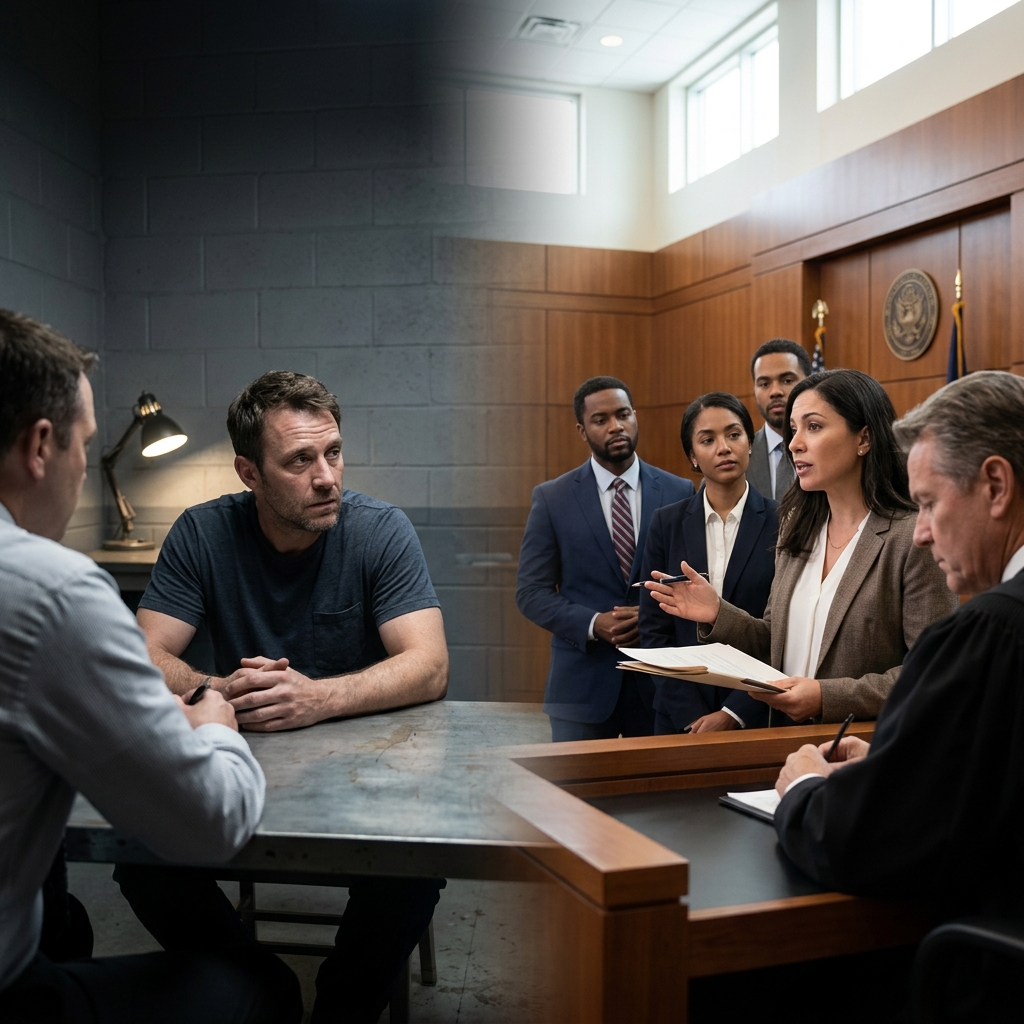
When a criminal case begins, two moments are especially critical for your constitutional rights: the custodial interrogation stage and the later judicial proceedings in court. Understanding how these phases work—and when Miranda and counsel rights apply—can make the difference between a fair process and a serious violation of your protections.
1. From Street Encounter to Courtroom: The Big Picture
A criminal case often moves through several distinct phases, each with different rules about what police and prosecutors can do, and what rights you can invoke.
- Pre-custody contact – Informal questioning, traffic stops, or brief investigative encounters.
- Custodial interrogation – You are in police custody and subject to questioning, triggering Miranda protections.
- Initial court appearance – A judge informs you of the charges and major rights in the case.
- Formal charging – The filing of an indictment, information, or complaint that starts adversarial proceedings.
- Later hearings and trial – Plea negotiations, motions, trial, and possible sentencing.
The rules governing police questioning shift as you move from one phase to another. Miranda warnings stem from the Fifth Amendment privilege against self-incrimination, while the Sixth Amendment right to counsel attaches when the government formally initiates prosecution against you.
2. What Counts as “Custodial” Interrogation?
Not every interaction with a police officer is a custodial interrogation. Courts use an objective test to decide when a person is in custody for Miranda purposes: whether a reasonable person in the suspect’s position would feel they were free to leave or otherwise terminate the encounter.
2.1 Defining Custody
A person is generally considered in custody when law enforcement has either formally arrested them or significantly restricted their freedom of movement in a way comparable to arrest.
- Being handcuffed and placed in a patrol car is typically custody.
- Being locked in an interview room at a police station for questioning usually qualifies as custody.
- A brief roadside stop or casual questioning where you are told you are free to leave often does not.
The focus is on how a reasonable person would perceive the situation, not on the officer’s subjective intent.
2.2 What Counts as Interrogation
Interrogation is broader than direct questions like “Did you do it?” The Supreme Court has held that Miranda safeguards apply whenever police use words or actions that they should know are reasonably likely to elicit an incriminating response from a suspect.
- Express questioning about the crime.
- Statements or conduct designed to provoke a confession or damaging admission.
- Confronting a suspect with evidence in a way intended to get them to talk about the crime.
Routine actions associated with arrest, such as basic booking questions (name, date of birth), normally do not amount to interrogation for Miranda purposes.
3. Miranda Warnings: When and Why They Matter
The famous Miranda warnings flow from the Fifth Amendment protection against self-incrimination. Police must provide these warnings before conducting custodial interrogation.
3.1 The Core Miranda Rights
Before questioning a person in custody, officers are required to advise them of key rights, in substance:
- You have the right to remain silent.
- Anything you say can be used against you in court.
- You have the right to talk to an attorney before and during questioning.
- If you cannot afford an attorney, one will be appointed for you, and you may consult the attorney before answering questions.
These warnings are designed to ensure that any statement you make is truly voluntary and informed, not the product of coercive pressure during custody.
3.2 Conditions for Miranda to Apply
Miranda warnings are required only when two conditions are met simultaneously:
- You are in custody (your freedom has been limited in a significant way).
- Police engage in interrogation or its functional equivalent.
If either element is missing—for example, you are free to leave or officers ask only routine administrative questions— the Miranda rule is generally not triggered.
3.3 What Happens if Miranda Is Violated?
Statements obtained during custodial interrogation without adequate Miranda warnings are usually inadmissible in the prosecution’s case-in-chief at trial.
- The government must show that proper warnings were given and that any waiver of rights was knowing, intelligent, and voluntary.
- If warnings were omitted or a suspect invoked rights but questioning continued, defense counsel can seek suppression of those statements.
- There may be limited exceptions, such as questions asked to address an immediate public safety threat.
Even when a statement is suppressed, other independent evidence may still be used; suppression mainly targets the improperly obtained confession or admission.
4. Exercising Your Right to Silence and Counsel
Knowing your rights is only half the battle; you must affirmatively assert them. Courts have emphasized that the protections are strongest when a suspect clearly expresses a desire to remain silent or to consult with an attorney.
4.1 Invoking the Right to Remain Silent
To invoke the right to silence, you should clearly state that you do not wish to answer any questions. Once you do so, officers must cease interrogation or honor the limits you set.
- Use unambiguous language, such as “I am not going to answer any questions” or “I want to remain silent.”
- If you later choose to speak, officers may resume questioning, but they must respect any renewed invocation of silence.
4.2 Invoking the Right to an Attorney
The consequences of invoking the right to counsel are particularly strong. If a person in custody asks for an attorney, officers are required to stop questioning immediately.
- Clear statements such as “I want a lawyer” or “I will not talk without an attorney” are sufficient.
- After counsel is requested, officers generally may not initiate further interrogation while the suspect remains in continuous pretrial custody.
- Any waiver obtained after a request for counsel faces close scrutiny and may be deemed invalid if police initiated the conversation.
These rules reflect the high value courts place on legal representation during the inherently pressured environment of custodial questioning.
5. Judicial Proceedings: When the Sixth Amendment Right to Counsel Attaches
While Miranda is grounded in the Fifth Amendment, the Sixth Amendment provides a separate right to counsel during critical stages of a criminal prosecution.
5.1 The Start of Adversarial Proceedings
The Sixth Amendment right to counsel attaches when the government formally initiates criminal proceedings against you—for example, through indictment, information, or an initial arraignment in court.
- After this point, police questioning about the charged offense is a “critical stage” where counsel protections apply.
- The right is offense-specific, meaning it applies only to crimes for which formal charges have been filed.
Even if you are not in physical custody, questioning by law enforcement about a charged offense after adversarial proceedings begin implicates the Sixth Amendment.
5.2 Interrogation After Charging
Once the Sixth Amendment right to counsel attaches, any police questioning about the charged offense is subject to heightened constitutional scrutiny.
- Statements obtained without counsel present or without a valid waiver of the right to counsel may be inadmissible.
- Officers may still question you about unrelated, uncharged offenses, but they must carefully avoid infringing the offense-specific counsel right.
This layer of protection is designed to ensure that people facing prosecution do not have their defense undermined by uncounseled interrogations about the very charges they must answer in court.
6. Special Considerations for Children and Youth
Juveniles present additional concerns in custodial interrogation because of their age, vulnerability, and limited understanding of legal rights. Several jurisdictions have enacted specific safeguards for children in custody.
6.1 Juvenile Miranda Warnings
Many legal systems require that youth in custody receive Miranda warnings tailored to their age and understanding. For instance, some states mandate that juvenile suspects be advised of their rights in language appropriate for children and recorded for later review.
- Youth are entitled to Miranda warnings before custodial interrogation, just like adults.
- Non-custodial questioning—where a reasonable child would feel free to end the interview and leave—generally does not trigger Miranda.
6.2 Additional Statutory Protections
Some laws go further, limiting when and how officers can interrogate children in custody. For example, certain statutes require that a child consult an attorney before custodial interrogation can begin.
- Mandatory consultation with counsel prior to questioning in some jurisdictions.
- Restrictions on waivers of rights by youth without appropriate adult or legal guidance.
These measures recognize that children may not fully grasp the consequences of speaking to police and are at higher risk of making involuntary or unreliable statements.
7. Comparing Fifth and Sixth Amendment Protections
Although the Fifth and Sixth Amendments often arise together in discussions of custodial interrogation, they serve distinct functions and apply at different points in a case.
| Feature | Fifth Amendment / Miranda | Sixth Amendment Right to Counsel |
|---|---|---|
| Primary Purpose | Protects against self-incrimination during custodial interrogation. | Ensures legal assistance at critical stages after formal charges. |
| Trigger Point | Custody plus interrogation. | Formal initiation of criminal prosecution (indictment, arraignment, etc.). |
| Scope of Crimes Covered | Any crime about which you are questioned while in custodial interrogation. | Offense-specific; applies only to charged offenses. |
| Key Remedy for Violations | Suppression of statements obtained in violation of Miranda. | Suppression of statements obtained without honoring counsel rights for charged offenses. |
8. Practical Tips if You Are Questioned by Police
While the details of constitutional doctrine are complex, a few practical guidelines can help individuals navigate encounters with law enforcement more safely.
- Ask if you are free to leave. This can help clarify whether you are in custody.
- Listen for Miranda warnings. Their absence during custodial questioning may have legal consequences later.
- Consider invoking your rights clearly. If you wish to remain silent or speak with an attorney, say so in direct, unambiguous terms.
- Do not assume informal conversation is harmless. Casual remarks can still be used against you if made voluntarily.
- Seek legal advice promptly. An attorney can evaluate whether statements were lawfully obtained and move to suppress them when appropriate.
9. Frequently Asked Questions (FAQs)
9.1 Do police have to read Miranda rights at the moment of arrest?
No. Officers are required to give Miranda warnings only before custodial interrogation, not automatically at the moment of arrest. Some choose to do so upon arrest, but the legal requirement is tied to questioning while you are in custody.
9.2 Can my statements be used in court if I never received Miranda warnings?
It depends on the circumstances. If you were not in custody, or there was no interrogation, Miranda does not apply and your voluntary statements may still be admissible. If you were subjected to custodial interrogation without proper warnings, your statements can often be excluded from the prosecution’s direct case.
9.3 What if I ask for a lawyer but officers keep questioning me?
Once you clearly request an attorney while in custody, officers must stop interrogation. Continuing to question you after such a request can make resulting statements subject to suppression, especially if you remain in continuous pretrial custody.
9.4 Does the Sixth Amendment right to counsel protect me during every police interview?
Not necessarily. The Sixth Amendment right to counsel attaches only after formal charges are filed and is limited to those charged offenses. Before charging, Miranda and the Fifth Amendment provide the primary protections in custodial interrogation.
9.5 Are children treated differently during custodial interrogation?
Yes. Youth are generally entitled to the same core Miranda rights, but many jurisdictions impose extra safeguards, such as tailored warnings or mandatory consultation with an attorney before police can conduct custodial interrogation.
References
- Custodial Interrogation and Judicial Proceedings — FindLaw. 2024-01-10. https://www.findlaw.com/criminal/criminal-rights/judicial-proceedings-and-custodial-interrogation.html
- Custodial Interrogation Standard — U.S. Constitution Annotated, Library of Congress. 2023-06-15. https://constitution.congress.gov/browse/essay/amdt5-4-7-4/ALDE_00013689/
- 461 Custodial Interrogations Policy — Johns Hopkins University Public Safety. 2025-12-01. https://publicsafety.jhu.edu/assets/uploads/sites/9/2025/12/461-Custodial-Interrogations-FINAL.pdf
- Interrogations Benchbook (NC Superior Court Judges) — University of North Carolina School of Government. 2022-09-01. https://benchbook.sog.unc.edu/sites/default/files/pdf/Interrogations.pdf
- Custodial Interrogation – Sixth Amendment — Justia U.S. Constitution Annotated. 2021-05-01. https://law.justia.com/constitution/us/amendment-06/18-custodial-interrogation.html
- Legislation to Protect Children During Custodial Police Interrogation — New York City Bar Association. 2020-03-30. https://www.nycbar.org/reports/legislation-to-protect-children-during-custodial-police-interrogation/
- Custodial Interrogation of Children — Westlaw (Maryland Code). 2021-07-01. https://govt.westlaw.com/mdc/Document/N0F52C160FD7711EC8544EDB2F4CEDED8
Similar Articles








Read full bio of medha deb




