
Chronology of a FELA Railroad Injury Claim
Understand every major stage in a FELA railroad injury claim, from the moment of an accident to trial, settlement, and potential appeal.
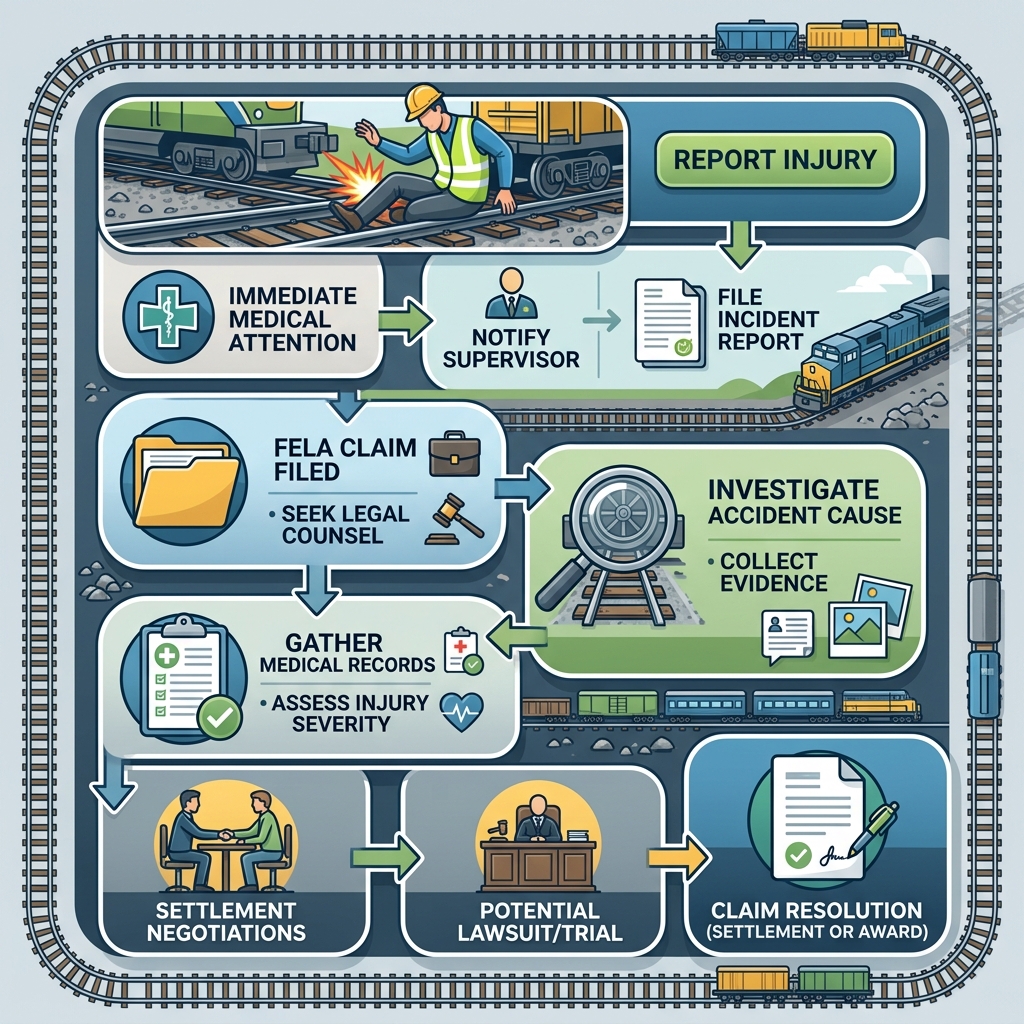
The Federal Employers' Liability Act (FELA) provides a path for injured railroad workers to seek compensation when employer negligence contributes to an on-the-job injury or occupational disease. Unlike no-fault workers' compensation systems, FELA requires proof of fault and proceeds through a civil claim or lawsuit process that unfolds in distinct stages. Understanding this chronology helps workers make informed decisions and avoid missteps that could weaken their case.
1. Immediate Response to a Railroad Injury
The sequence of a FELA claim begins at the accident scene. What a worker does in the minutes and days following an injury can shape the strength of the eventual claim and the available evidence.
Prioritizing Medical Care
Seeking prompt medical attention is essential for both health and legal reasons. Early evaluation creates a documented record of the injury, symptoms, and recommended treatment. This record often becomes a cornerstone of the FELA case.
- Emergency treatment: Go to the nearest emergency room or urgent care if injuries are serious.
- Independent medical judgment: FELA does not require treatment by a railroad-selected doctor; workers may choose their own physician.
- Clear reporting of symptoms: Providing a full history, including prior injuries, helps doctors differentiate new damage from pre-existing conditions.
Medical records generated at this stage later help establish causation, the extent of harm, and future care needs.
Notifying Supervisors and Creating an Incident Record
Once immediate safety and medical issues are addressed, the injury should be reported to a supervisor or appropriate company representative as soon as practicable. Many railroads require an internal incident or accident report when a worker is hurt.
- Prompt notice helps prevent disputes about when or how the injury occurred.
- Accident reports should be accurate and concise; exaggeration or speculation can undermine credibility later.
- Union involvement early in the process can help ensure forms are completed carefully.
2. Early Evidence Gathering and Legal Consultation
After initial medical care and employer notification, the focus shifts to preservation of evidence and evaluating legal options under FELA. Because FELA claims depend on proving employer negligence, capturing details soon after the incident is crucial.
Collecting Witness Information and Physical Evidence
The worker or their representatives should gather as much information as possible while memories are fresh and physical conditions remain unchanged.
- Witness details: Names, addresses, and phone numbers of crew members or other witnesses to the unsafe condition or incident.
- Photographs: Images of the location, equipment involved, and visible injuries before conditions change or heal.
- Personal records: Notes about pain levels, activity limitations, and any lost work days or wages.
These materials can corroborate testimony later and serve as objective indicators of what occurred.
Consulting a FELA-Experienced Attorney
Because FELA is a specialized federal statute with unique standards and procedures, many sources recommend consulting an attorney experienced in FELA as early as possible. Legal counsel can help avoid common pitfalls such as signing broad releases or giving detailed statements to railroad claim agents without understanding their implications.
Key reasons to seek legal advice early include:
- Analysis of negligence: Evaluating whether unsafe practices, inadequate training, defective equipment, or rule violations may support a claim.
- Preservation of rights: Ensuring compliance with limitation periods and protecting against tactics that may weaken the case.
- Coordination with union: Working alongside union representatives who often have experience with railroad injury claims and benefits.
3. Starting the FELA Claim and Investigation Phase
Once a worker decides to pursue compensation, the matter enters an investigative stage. Some claims resolve through negotiation before a lawsuit is formally filed, while others progress to court.
Internal and External Investigations
Multiple parties typically conduct investigations into the incident:
- Railroad investigation: The employer often interviews witnesses, reviews safety records, and inspects equipment.
- Claim agent involvement: Railroad claim agents may approach the worker for statements or offer early settlements, which should be reviewed with counsel before acceptance.
- Plaintiff's investigation: The worker's attorney conducts interviews, obtains photographs, reviews maintenance and training records, and may engage experts to analyze the scene.
The goal for the injured worker's side is to build a factual and legal foundation demonstrating that employer negligence played a role in causing the injury.
Negotiation and Pre-Lawsuit Resolution
During or after the investigation, the parties may discuss settlement. Many FELA claims resolve at this stage, without a lawsuit or trial, when the railroad and the worker agree on compensation for wage loss, medical costs, and non-economic harm.
Factors that influence early settlement negotiations include:
- Strength of the liability evidence.
- Severity and long-term impact of injuries.
- Potential future medical needs and disability.
- Dispute over whether pre-existing conditions contributed to the harm.
If negotiations stall or the offer remains inadequate, the next step is usually filing a lawsuit in federal or state court, as permitted under FELA.
4. Filing the FELA Lawsuit
When informal resolution is not possible or advisable, the worker's attorney initiates formal litigation by filing a complaint. This complaint begins the court-based phase of the FELA claim.
Understanding the Role of the Complaint
The complaint is a formal document submitted to the court that sets out the factual and legal basis for the claim. It typically includes:
- Identification of parties: The injured worker (plaintiff) and the railroad or employer (defendant).
- Statement of facts: Description of how the incident occurred, what hazards were present, and how the employer allegedly acted negligently.
- Legal theories: Allegations that the employer violated its duty to provide a reasonably safe workplace under FELA.
- Damages claimed: Broad categories such as wage loss, medical expenses, and pain and suffering, without necessarily specifying exact amounts early in the case.
Railroad’s Answer and Initial Court Deadlines
After the complaint is filed and served, the railroad must submit an answer within a defined period, often a matter of weeks. In the answer, the defendant:
- Admits or denies specific factual allegations.
- Raises defenses, such as arguing that the worker was primarily at fault or that conditions were reasonably safe.
- May assert counterclaims or involve other parties if it believes others share responsibility.
Once pleadings are complete, the case moves into discovery, the evidence-exchange phase.
5. Discovery: Exchanging Evidence and Testimony
Discovery is the process by which each side obtains information from the other to prepare for trial or informed settlement. FELA cases, like other civil lawsuits, use tools such as document requests, interrogatories, and depositions.
Key Discovery Tools in FELA Claims
| Discovery Tool | Purpose |
|---|---|
| Document Requests | Obtain safety records, maintenance logs, training materials, medical records, and internal reports. |
| Interrogatories | Written questions to clarify facts about procedures, equipment, or company policies. |
| Depositions | Sworn oral testimony of witnesses, supervisors, safety personnel, and medical experts recorded for use at trial. |
| Requests for Admissions | Ask the other party to admit specific facts, which can simplify trial issues. |
During this phase, both sides refine their understanding of the case's strengths and weaknesses. Discovery often drives renewed settlement discussions, sometimes supported by mediation.
Pre-Trial Motions and Settlement Efforts
As discovery concludes, parties may file motions asking the court to decide certain issues before trial, such as whether the case should be dismissed or whether specific evidence should be excluded. Courts may also encourage or require alternative dispute resolution, such as mediation, to explore settlement.
Mediation and settlement conferences can be useful because:
- A neutral mediator helps narrow disputes and identify realistic settlement ranges.
- They allow parties to retain control over the outcome instead of leaving it entirely to a jury.
- Resolving the claim avoids the time, cost, and uncertainty of trial and appeal.
6. Trial: Presenting the FELA Case in Court
If settlement efforts fail, the FELA case proceeds to trial. Trials may be heard by a jury or, less commonly, by a judge alone. The worker carries the burden of proving both negligence and causation under FELA.
Typical Phases of a FELA Trial
Although procedures vary by court, a FELA trial generally follows a familiar structure:
- Opening statements: Each side outlines its theory of the case and the evidence the jury will hear.
- Presentation of evidence: Witnesses testify, documents are introduced, and experts explain technical or medical issues.
- Cross-examination: The opposing party questions witnesses to test their credibility and challenge their accounts.
- Closing arguments: Each side summarizes the evidence and argues how the law should be applied to the facts.
After closing arguments, the judge instructs the jury on the applicable law, including FELA standards for employer negligence and comparative fault, and the jury deliberates to reach a verdict.
Judgment and Post-Trial Options
If the jury finds in favor of the worker, the court enters a judgment specifying the amount of damages owed. The railroad may have a limited period to challenge the verdict or appeal, while the worker can consider whether to pursue an appeal if the award seems inadequate or if legal errors affected the outcome.
When a settlement is reached instead of a verdict, both sides usually agree to resolve their disputes without the ability to appeal, bringing final closure to the claim.
7. Time Limits and Long-Term Considerations
FELA claims are subject to a statute of limitations, meaning lawsuits must be filed within a specified period or the claimant may lose the right to recover entirely.
Statute of Limitations Under FELA
In most FELA cases, a lawsuit must be filed within three years from the date the cause of action accrues. For sudden injuries, this is usually the date of the accident. For occupational diseases or latent injuries, the three-year period may start when the worker knew or reasonably should have known that the condition was related to railroad employment.
Missing this deadline can bar recovery even when negligence is clear, making early legal consultation critical.
Types of Compensation Commonly Sought
FELA permits recovery of a broad range of damages, reflecting both economic loss and human impact.
- Past and future wage loss, including overtime and fringe benefits.
- Medical expenses, both already incurred and anticipated.
- Pain and suffering, for physical discomfort and emotional distress.
- Loss of earning capacity if injuries limit future employment options.
- Disfigurement or disability-related harms, including shame or humiliation tied to visible injuries.
In cases involving fatal injuries, dependents may seek economic losses linked to the worker's death.
8. Practical Tips for Navigating the FELA Claim Process
Although each claim is unique, some practical measures can help railroad workers protect their interests throughout the chronology of a FELA claim.
Practical Do's
- Report injuries promptly and keep copies of any written reports.
- Seek independent medical care and follow treatment recommendations as closely as possible.
- Consult a FELA-qualified attorney early, especially before signing documents or giving detailed statements to claim agents.
- Keep detailed records of lost wages, out-of-pocket costs, and daily symptoms.
- Stay involved in the claim process, ask questions, and understand each stage as it unfolds.
Common Pitfalls to Avoid
- Delaying legal advice until just before the statute of limitations expires.
- Assuming that early settlement offers reflect full long-term costs.
- Relying solely on railroad-selected doctors without seeking independent opinions.
- Sharing posts or photographs on social media that conflict with reported limitations.
9. FAQs: FELA Claim Chronology
How is a FELA claim different from regular workers' compensation?
Workers' compensation typically provides no-fault benefits through an administrative system, while FELA requires the worker to prove that railroad negligence contributed to the harm and proceeds in civil court. FELA allows broader categories of damages, including full wage loss and pain and suffering, but places a heavier burden of proof on the injured worker.
Do I have to wait until I fully recover before filing a FELA lawsuit?
No. The lawsuit must be filed within the applicable limitation period, even if medical recovery is ongoing. Future damages such as ongoing medical care and long-term wage loss can be evaluated with the help of medical and economic experts.
Can my case settle after the lawsuit is filed but before trial?
Yes. Many FELA cases settle during discovery or in pre-trial conferences or mediation. The lawsuit simply provides structure and deadlines for the parties but does not prevent negotiated resolution at any time before verdict.
What happens if the jury finds that I was partly at fault?
Under FELA, comparative negligence applies. If the jury determines that both the railroad and the worker shared responsibility, damages may be reduced in proportion to the worker's share of fault, but the claim is not automatically barred.
How long does a typical FELA claim take from injury to resolution?
Timeframes vary widely. Some claims settle within months after investigation and negotiation, while complex cases involving serious injuries, disputed liability, or appeals can last several years. The pace depends on court schedules, discovery disputes, and the willingness of both sides to compromise.
References
- The 5 Steps of a Railroad Injury FELA Claim — FindLaw. 2024-02-20. https://www.findlaw.com/injury/workers-compensation/chronology-of-a-fela-claim.html
- Understanding the FELA Claims Process — Levinson Axelrod. 2023-08-15. https://www.njlawyers.com/blog/understanding-the-fela-claims-process
- Understanding the FELA Claims Process: A Comprehensive Guide — Hoey & Farina. 2023-05-10. https://www.hoeyfarina.com/articles/understanding-the-fela-claims-process-a-comprehensive-guide/
- What happens when I make a FELA claim — Gaar Law Firm. 2022-11-01. https://railroadattorneys.co/what-happens-when-i-make-a-fela-claim/
- Louisiana FELA Railroad Claim Attorney — Sarphie Law. 2024-01-05. https://sarphielaw.com/fela-claims-lawyer/
- FELA Claims — Roven Camp PLLC. 2022-09-10. https://rovencamp.com/fela-union-resources/fela-claims/
- What is FELA? Federal Employers' Liability Act for railroad workers — Yaeger & Weiner. 2021-06-20. https://www.felaattorney.com/faqs
Similar Articles








Read full bio of Sneha Tete




